U.S. will control Venezuelan oil sales "indefinitely," energy secretary says

Add Axios as your preferred source to
see more of our stories on Google.
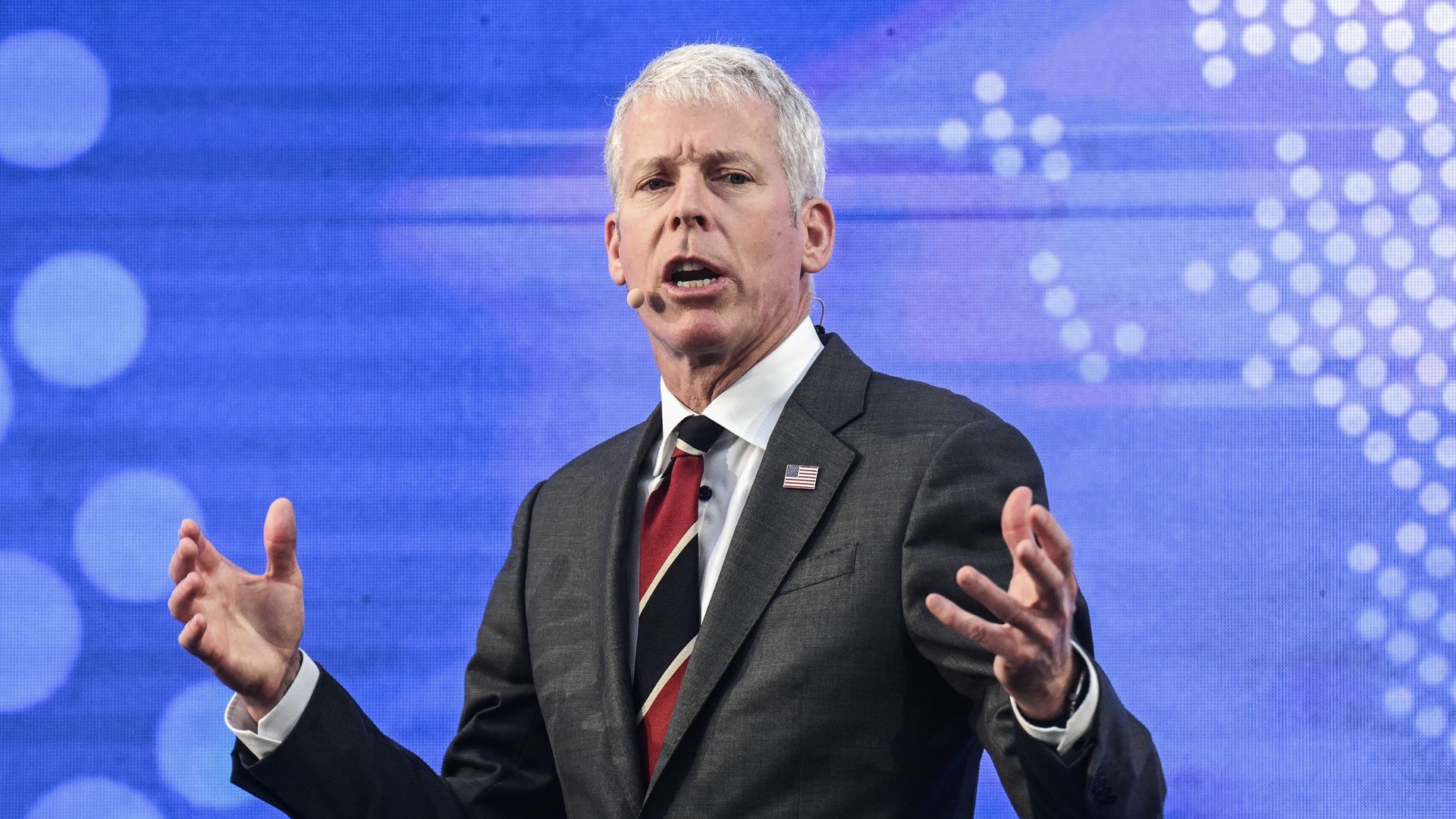
Energy Secretary Chris Wright speaks in November. Photo: Angelos Tzortinis/AFP via Getty Images
The U.S. plans to directly control Venezuelan oil sales and revenue via U.S.-controlled accounts, but those moves will benefit the country's people as well, Energy Secretary Chris Wright said Wednesday.
Why it matters: His comments are among the Trump administration's most expansive descriptions of its approach to Venezuela's oil sector since the toppling of President Nicolás Maduro.
Driving the news: Wright, speaking at a Goldman Sachs energy conference in Miami, said the U.S. goal is greater supply for U.S. refiners and the global markets.
- Sales will be "done by the U.S. government and deposited into accounts controlled by the U.S. government," he said.
- "Then from there, those funds can flow back into Venezuela to benefit the Venezuelan people, but we need to have that leverage and that control of those oil sales to drive the changes that simply must happen in Venezuela," he said.
The intrigue: Wright's comments track with President Trump's social media post saying U.S. would receive as many as 50 million barrels of sanctioned oil from Venezuela, worth about $2.5 billion, and that Venezuela would share in the profits from the sale.
- But Wright's remarks also look beyond the current U.S. attempt to blockade sanctioned Venezuelan barrels as the Trump administration looks to entice American companies to help rebuild the country's broken down oilfields.
- "We're going to market the crude coming out of Venezuela, first this backed up, stored oil, and then indefinitely, going forward, we will sell the production that comes out of Venezuela into the marketplace," Wright said.
- CNBC reported that the sanctioned barrels would have gone to China but will be re-routed to the U.S.
State of play: Wright said a near-term goal is to stabilize and start growing production, citing the U.S. ability to supply diluents to improve processing for the country's heavy crude, and enable imports of parts, equipment and services.
- "And of course, in the long run, create the conditions that the major American companies that were there before, maybe that weren't there before, but want to be there, will go in. The resources are immense," he said.
By the numbers: Venezuela's production is currently around 800,000 barrels per day, far from the 3.5 million barrels per day or more in the late 1990s.
- But years of underinvestment and mismanagement in the nationalized sector, departure of companies including Exxon and ConocoPhillips in the 2000s, and more recent sanctions have taken their toll.
- Wright sees potential for boost production by several hundred thousand barrels per day in the "short- to medium-term."
- But he acknowledged that returning to historical levels will require tens of billions of dollars and "significant time."
What we're watching: Asked if the administration is contemplating a mechanism to compensate U.S. oil companies for investing there, Wright replied, "Absolutely."
Reality check: The U.S. industry's appetite for a major entry into Venezuela is very unclear amid modest prices and opportunities elsewhere.
- At the very least, companies would need clarity on the governance regime and security outlook.
- Chevron, with limited production, is currently the only U.S. producer operating there under a special U.S. license.
- But Wright said he has opened talks with U.S. companies. "We're in active dialogue between our administration, Venezuelans, and the oil and gas companies that were there before," he said.
One company that has publicly expressed interest in Venezuela is Continental Resources, a firm led by Harold Hamm, a longtime informal energy adviser to Trump.
- Hamm told the Financial Times earlier this week that "with improved regulatory and governmental stability we would definitely consider future investment."
What's next: President Trump is slated to meet with industry execs at the White House on Friday.
