Three CEOs who see opportunities in nuclear waste

Add Axios as your preferred source to
see more of our stories on Google.
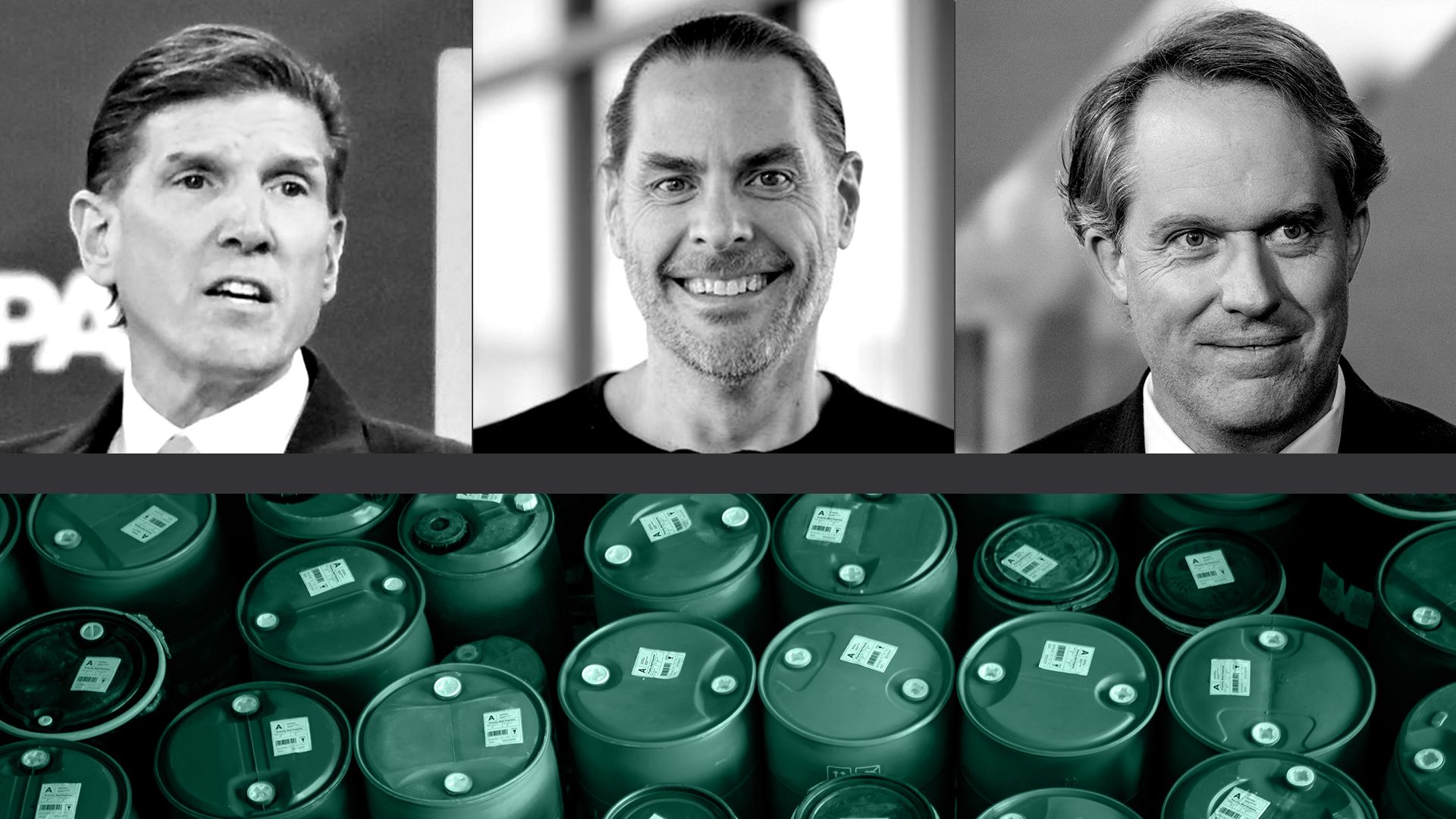
Curio's McGinnis, SHINE's Piefer and Oklo's DeWitte. Photo illustration: Axios Visuals. Photos: Courtesy of SHINE, Alex Wroblewski/AFP, Victor J. Blue/Bloomberg via Getty Images
Three startup CEOs are challenging the notion that nuclear waste is just something to bury.
Why it matters: Oklo's Jacob DeWitte, Curio's Ed McGinnis and SHINE Technologies' Greg Piefer are gaining attention from and influence with the Trump administration as well as other companies.
- All are betting on the idea that the dangerously radioactive byproducts of nuclear power plants can be recycled into usable fuel.
- The concept — used in other countries, but not in the U.S. in decades — has gotten a big push from the administration.
Driving the news: Oklo recently announced a $1.68 billion recycling facility in Tennessee, while Curio has collaborated with DOE's national laboratories on lab-scale demonstrations and SHINE signed an agreement with Orano to develop pilot programs.
- Some nuclear experts are deeply skeptical about potentially high costs as well as whether terrorists could easily acquire to-be-recycled material.
- But a bill that would streamline the process for approving recycling plants easily won bipartisan approval this month from a Senate committee.
Here's a look at the three would-be waste wizards.
Jacob DeWitte
Why he matters: DeWitte's company is a Sam Altman-backed venture. He attended the signing of President Trump's nuclear executive orders in May.
- Oklo is working on an initial commercial facility at Idaho National Laboratory to recycle used fuel into material for reactors like Oklo's Aurora "fast" reactor.
Zoom in: These reactors use neutrons with high kinetic energy to sustain a nuclear fission chain reaction instead of the slower thermal neutrons used in conventional reactors.
- John Kotek, the Nuclear Energy Institute's senior vice president of policy development and public affairs, is among those impressed with Oklo's approach. "We know that technology works," he told Axios.
- DeWitte said he hopes the Tennessee site can begin producing metal fuel for Aurora by the early 2030s, if not sooner.
What he's saying: Oklo's approach "is more cost-effective and extraordinarily proliferation-resistant," he told Axios.
- "And now we're entering this world where we're kind of seeing all this activity around building a lot of reactors and a lot of nuclear plants, and we need fuel for them. For a lot of reasons, we're just in a really great spot to see that kind of come to fruition."
Ed McGinnis
Why he matters: McGinnis has held several nuclear-related jobs in past presidential administrations, including his work as principal deputy assistant secretary for nuclear energy under Trump from 2017 to 2019.
- Energy Secretary Chris Wright visited Curio earlier this year to learn about its technology.
Zoom in: Curio's method differs from traditional reprocessing, which uses nitric acid and extracts pure streams of weapons-usable plutonium.
- It says its process can shrink high-level waste volumes to about 4% of their original amount.
- "It's a generational improvement over the reprocessing recycling technology that's used in France, Russia, Japan ... It's environmentally responsible, has built-in security by design and is economically robust," McGinnis told Axios.
- Some experts think investing in fuel recycling could be cheaper than producing high-assay, low-enriched uranium (HALEU) — a reactor fuel that only Russia and China make at commercial scale — from scratch.
McGinnis said the company plans to conduct an additional "scale-up" process with the national labs before seeking to put the technology on the market within a few years.
- Curio recently announced a partnership with Infinity Power to advance usage of high-energy isotopes and completed an all-stock acquisition of TriVis, a nuclear waste management and reactor construction company.
- He said competition from other companies doesn't faze him because each is using different approaches: "It's apples and oranges and pears. There are so many different ways to recycle."
Greg Piefer
Why he matters: Piefer's company focuses on fusion, the power of the stars.
- Though fusion is still early in development, the Energy Department recently announced a fusion roadmap. It's also drawn the attention of a think tank led by former top Google executive Eric Schmidt.
Zoom in: Piefer has a four-part strategy to commercialize technologies on the way to generating fusion energy, one of which is waste recycling. Another is making medical isotopes to treat cancer and other diseases.
- In SHINE's technique, neutrons — a side product of the fusion process — are beamed at long-lived isotopes in waste to break them into shorter-lived isotopes.
- It then hopes to sell the uranium and plutonium it recovers to partners that can turn it into reactor fuel rods. Piefer's goal is to operate a pilot plant in the 2030s.
What he's saying: "The reason I'm so confident is the facility that we built for medicine is licensed by the exact same part of the NRC as a recycling facility would be," he told Axios.
- "Sometimes I even refer to the isotope plant as almost like a pilot plant for what we want to do with waste."
