Axios Future of Energy
October 19, 2026


😮 A lot happened since our last edition. We look ahead after a flurry of Russia-related news, then move on to...
- Tesla's future, energy deals, climate politics, and a new power record, all in 1,203 words, 4.5 minutes
🙏 Thanks to Mackenzie Weinger and Chris Speckhard for editing, and to our brilliant Axios visuals team.
🎸 Bog Seger & the Silver Bullet Band's album "Night Moves" turns 50 this week and provides today's intro tune...
1 big thing: The fallout from Trump's Russia energy moves

Energy is looming ever larger in the Russia-Ukraine conflict, U.S. policy toward Moscow, and the midterm elections coming up fast. Let's break down a busy couple of days and what's ahead.
Why it matters: Trump's push to lower energy prices ahead of the midterms could provide Russia an economic lifeline and is exposing divisions within his own party.
- Oil, gas and petroleum product exports help finance Russia's war on Ukraine.
Catch up quick: Late Friday, Trump waived new sanctions against Russia and tariffs on top buyers of Russian energy that would have taken effect under the bipartisan Graham Act he signed last month.
- That came just days after the administration waived certain sanctions as part of a deal aimed at enabling higher exports of Russian diesel after high prices have become a political millstone for Republicans.
Here's what's on our radar:
🥕 A new rationale. Energy Secretary Chris Wright, in CNN and ABC appearances yesterday, called the diesel deal a "carrot" to get Russia to ease its assault on Ukraine.
- It's an "incentive to Russia, that if they can reduce the conflict with Ukraine, they can get an energy ceasefire or reduce the conflict such that they have diesel to export, we'll allow it to flow to world markets," Wright told ABC's "This Week."
- Ukrainian drone strikes have lowered Russia's refining capacity. Trump, in a Truth Social post yesterday, also cast his recent decisions as a way to get a peace deal with Russia.
⏰ A new clock. Secretary of State Marco Rubio told reporters Saturday that Trump wants to take 60 days to review implementing the Graham Act in order to gauge its impact on the global and U.S. economies.
📉 A deteriorating relationship. Ukrainian President Volodymyr Zelensky has sharply and publicly criticized both the diesel deal and Trump's decision to waive, for now, the Graham Act penalties.
- Trump's post, meanwhile, bashed Zelensky for hitting Russian refineries, "knowing that these attacks are seriously hurting the world diesel markets, including those in the United States."
⚔️ Republican rifts. Many GOP lawmakers and candidates, to varying degrees, have joined Democrats in criticizing Trump's Friday night sanctions waivers and the diesel deal days earlier.
- Sen. Darline Graham (R-S.C.) told the AP that she disagrees with Trump's decision not to implement, for now, the bipartisan law named after her late brother, Sen. Lindsey Graham (R-S.C.).
- She's running for a full term after being appointed to replace her brother. Former Rep. Mike Rogers — the GOP candidate in Michigan's tight Senate race — also expressed concern with the decision but avoided directly criticizing Trump on CNN yesterday.
- Other Republicans were far harsher, including retiring Sen. Thom Tillis (R-N.C.), who called Friday night's move "beyond irresponsible."
🦆 Lame duck rumblings. "A growing chorus of House Republicans is warning President Trump that they're ready to block additional Pentagon funding unless the administration gets tougher on Russia," The Hill reports.
What we're watching: As the midterms hit their final frenzied weeks, Republicans have shown an increasing willingness to put distance between themselves and Trump.
2. 👋 Tesla waves goodbye to the car business


Elon Musk's spectacular unveiling of a flying, rocket-powered Tesla Roadster Thursday night could be seen as a boisterous farewell to Tesla, the car company.
Why it matters: The Roadster is a dazzling celebration of automotive engineering, but Musk increasingly envisions a future in which humans don't drive at all — and Tesla is more an AI and robotics company than an automaker.
The big picture: With speculation mounting about a possible Tesla-SpaceX merger, the Roadster offers a tantalizing glimpse of how the two companies' technologies might intersect.
- Tesla's first Roadster, introduced nearly 20 years ago, helped launch the electric vehicle revolution by proving that EVs could be fast, sexy and fun.
- The new Roadster takes that idea to an almost absurd extreme, using SpaceX rocket technology and powerful suction fans to perform gravity-defying stunts.
- And while Tesla can still push the boundaries of automotive engineering, its mainstream vehicle lineup is aging, sales have struggled and Musk is increasingly focused on robotaxis, Optimus robots and artificial intelligence.
Between the lines: The Roadster is an extravagant tribute to the very thing Tesla is moving beyond: the thrill of driving.
- Musk told Thursday's audience the two-seater would be "the only manually driven car that Tesla makes" in the long term.
- For all its technological wizardry, the Roadster isn't likely to generate much revenue for Tesla.
The bottom line: The original Roadster announced Tesla's arrival as a car company. The new one might be its most extravagant exit.
3. 🤝 Catch up quick on tech finance



💵 Blackstone, the asset management giant, today announced that it raised $8.7 billion for its Blackstone Energy Transition Partners V fund.
- Why it matters: It's 50% larger than its predecessor fund, and comes amid a "generational opportunity" for investors amid growing power demand, the firm said.
🍨 Scoop: Form Energy, a long-duration battery developer, is pushing its public listing to next year as it struggles to find investor traction, Axios Pro has learned.
- Why it matters: The once-buzzy climate startup joins a long list of companies that have delayed going public. Go deeper
⚛️ Scoop: The Nuclear Company, which aims to build conventional large reactors, has decided against a 2026 IPO as other nuclear stocks take a beating, Axios Pro has learned. Go deeper
🔋 Adden Energy, a Harvard battery spinout, is raising $26.6 million as it looks to commercialize its solid-state batteries, per an SEC filing. Go deeper
☀️ Aligned Climate Capital secured $387m for community solar projects led by Apollo's Apterra Infrastructure Capital, PV Tech reports.
Want a steady diet of finance scoops and smart analysis? Talk to our sales team about Axios Pro Deals.
4. 💬 Quote of the day: How climate shows up to voters
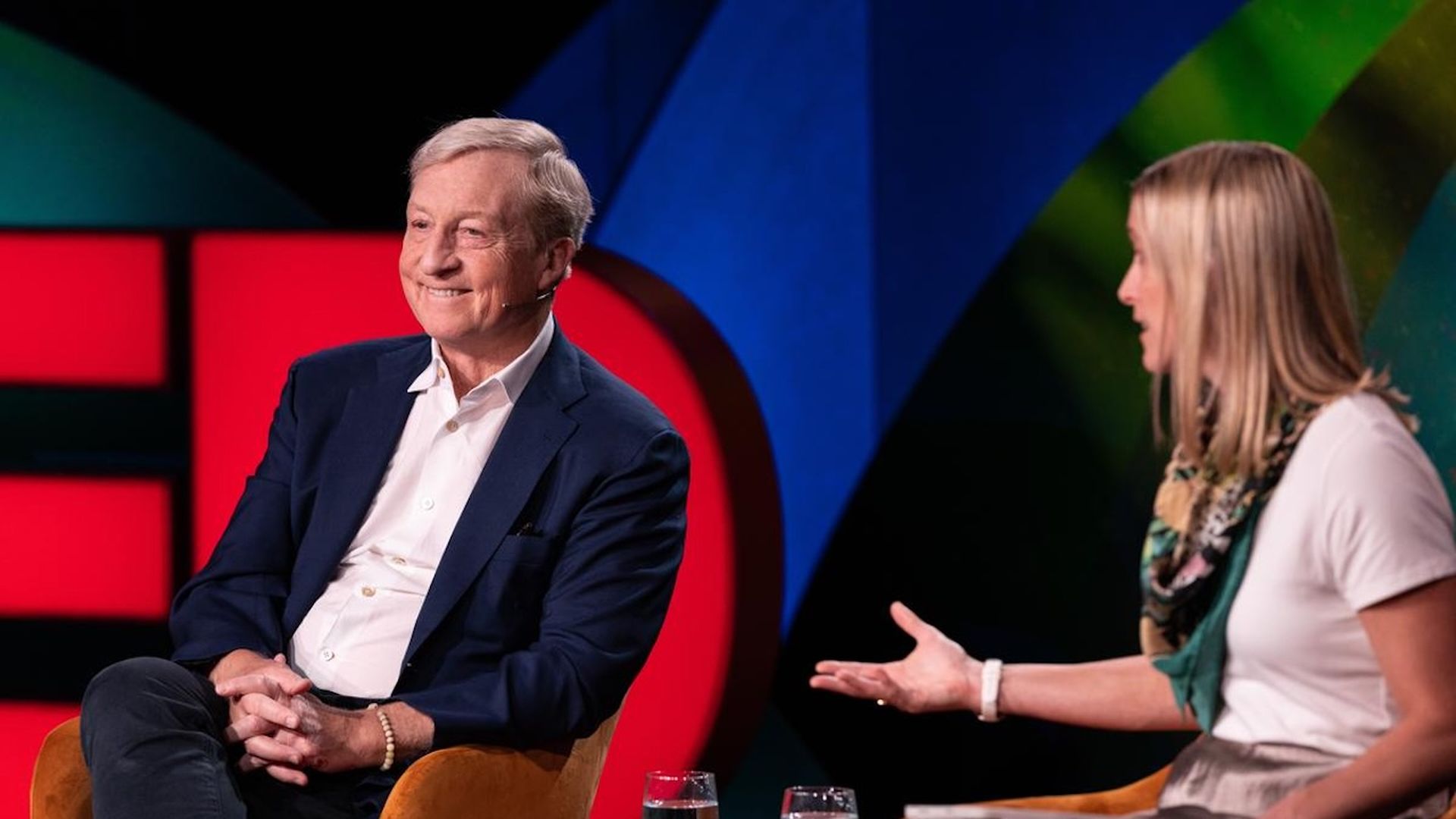
Tom Steyer, a billionaire climate investor and activist, said in an interview with Axios' Amy Harder that climate change and concepts like carbon dioxide aren't landing with voters.
"All these kinds of intellectual and scientific points that are reasonably far off are not things that make them vote or not vote. Here's what they do know: they know their electricity cost. ... They know their gasoline costs. They know how much it costs to insure their houses against fire and flood." — Tom Steyer
Inside the room: Amy interviewed Steyer, who unsuccessfully ran for California governor this cycle, at an event in Berkeley, Calif., last week hosted by TED Countdown and the organization New Constellation.
5. 🧮 Stat du jour: 89 gigawatts
That's the combined U.S. solar, wind and battery storage capacity slated to be added in 2026 — a record, per the research firm BloombergNEF's latest outlook.
What's next: It projects a fresh record next year "as developers race to complete tax-credit-eligible projects," and then a multi-year decline before things pick back up early next decade.
What we're watching: How the big Senate permitting bill, if it becomes law, shakes up long-term forecasts.
Go deeper: Renewables boom faces a Trump-era cliff
📫 Did a friend send you this newsletter? Welcome, please sign up.
Sign up for Axios Future of Energy