Elon Musk's flying Tesla is gloriously absurd

Add Axios as your preferred source to
see more of our stories on Google.
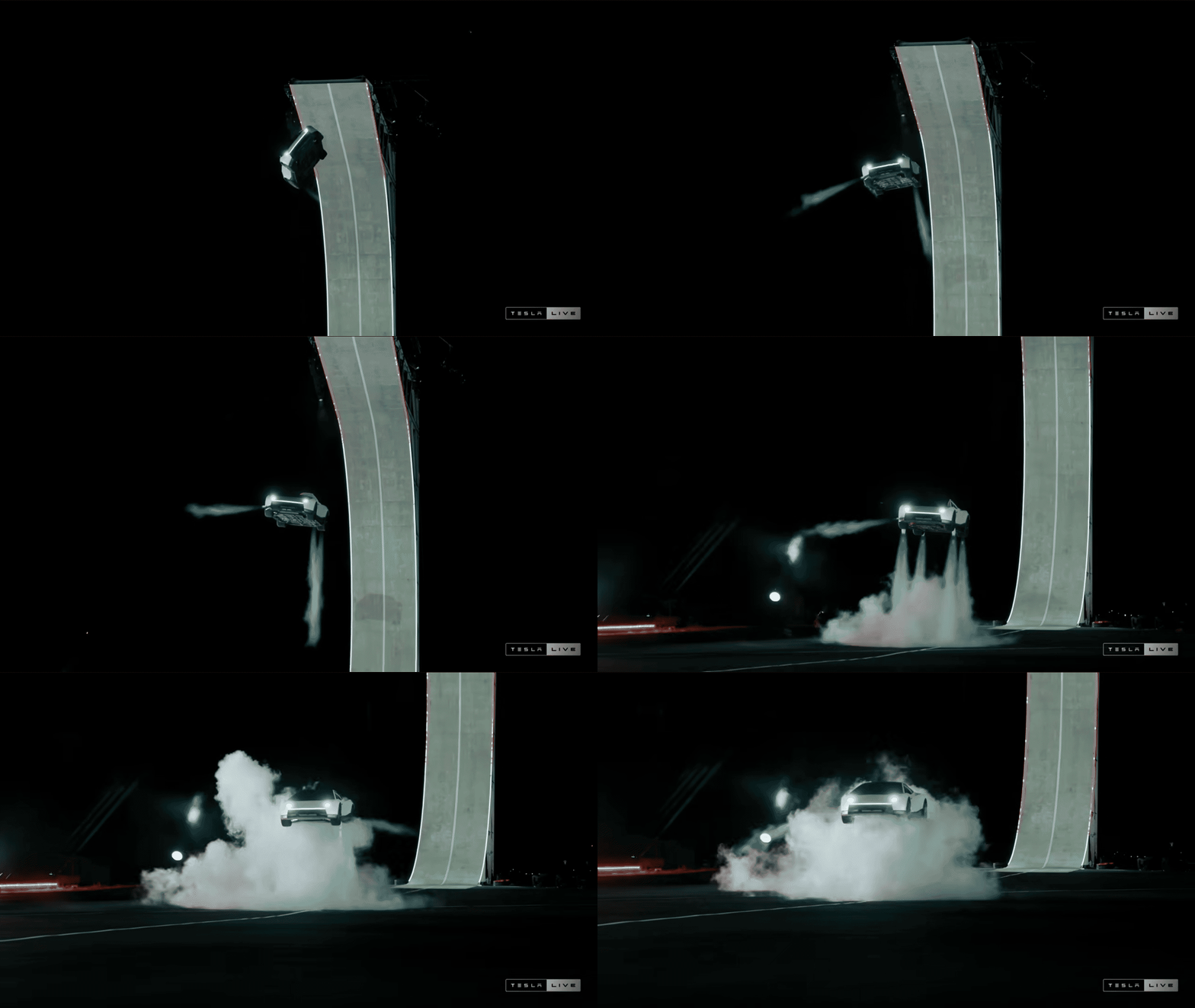
Tesla demonstrates the Rocket model of its Tesla Roadster at an event Thursday night. Images: @Tesla via X
Elon Musk finally unveiled his long-promised next-generation Tesla Roadster, and it's every bit as outrageous as you'd expect from a man who launches rockets into space.
- The car flies, does backflips and even drives upside down.
Why it matters: Musk's latest creation — a collaboration between Tesla and SpaceX engineers — pushes the boundaries of automotive technology, even if it's hard to imagine what practical purpose a flying sports car might serve.
Driving the news: At a theatrical unveiling Thursday, Musk showed off a two-seat electric supercar equipped with rocket thrusters and a powerful suction system.
- The Roadster uses high-pressure compressed air, rather than rocket fuel, for added thrust and to propel itself into the air and perform aerial gymnastics.
- A system of underbody fans sucks the car toward the pavement, creating extraordinary grip for acceleration and cornering.
- Tesla claims the car can accelerate from zero to 60 mph in just 0.8 seconds — faster than any production car — and will exceed 230 mph, although Musk said the goal is to achieve "half the speed of sound."
"This car could suck the chrome off a trailer hitch," Musk joked about its powerful fans.
- He also acknowledged that the Roadster is "not necessarily a safety optimized car."
- And before the demonstrations began, he warned: "Success is not guaranteed ... But if it doesn't work, we're at a safe distance."
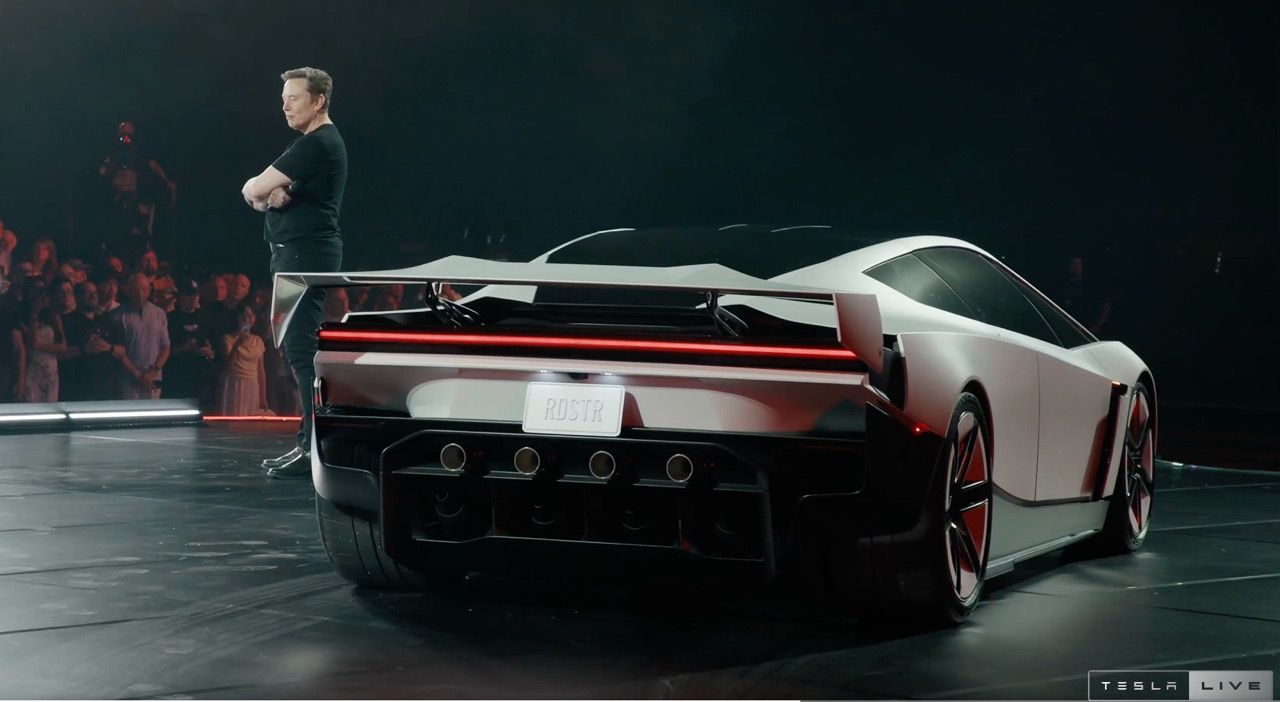
Between the lines: The Roadster is a reminder of what makes Musk such a polarizing figure: his willingness to pursue ideas that other engineers — or corporate lawyers — might dismiss as insane.
- Tesla and SpaceX have already transformed the auto and aerospace industries by challenging conventional engineering assumptions.
- The Roadster takes that boundary-pushing philosophy to an almost comical extreme.
- But the underlying technologies, particularly its active aerodynamics and extraordinary traction system, could have applications beyond a so-called flying car.
My thought bubble: There's an irony here. Musk envisions a future where humans won't need to drive, yet he's building what he says will be Tesla's last manually driven car.
- While Tesla's robotaxis promise to make transportation safer and more mundane, the Roadster is designed to make driving thrilling — and perhaps a little terrifying.
- It's a throwback to the era when cars were objects of desire, not just appliances that move people around.
Reality check: Tesla lists three models of the Roadster, and the flying version it acknowledges is not approved for public roads.
- It hasn't disclosed a price, driving range or how long the Rocket version can stay airborne.
- And Musk has a long history of promising revolutionary products years before they arrive.
What we're watching: Musk says the Roadster will enter production in 2028. There are still so many unanswered questions, not the least being whether a flying car — legal or not — is even practical.
- But for one crazy evening, he made the future look like a science-fiction movie.
