Axios Future of Energy
November 02, 2026


🥞 Welcome back! We're talking about the weather, in this case a weather pattern with big implications for the power sector. Then we move on to...
- Two pieces of OpenAI energy news, permitting bill analysis and more, all in 1,335 words, 5 minutes.
🙏 Thanks to Mackenzie Weinger and Chris Speckhard for editing, and to our brilliant Axios visuals team
🎸 This week marks 45 years since the Cars dropped the album "Shake It Up," which provides today's perfect intro tune...
1 big thing: America's changing power grid faces a powerful El Niño

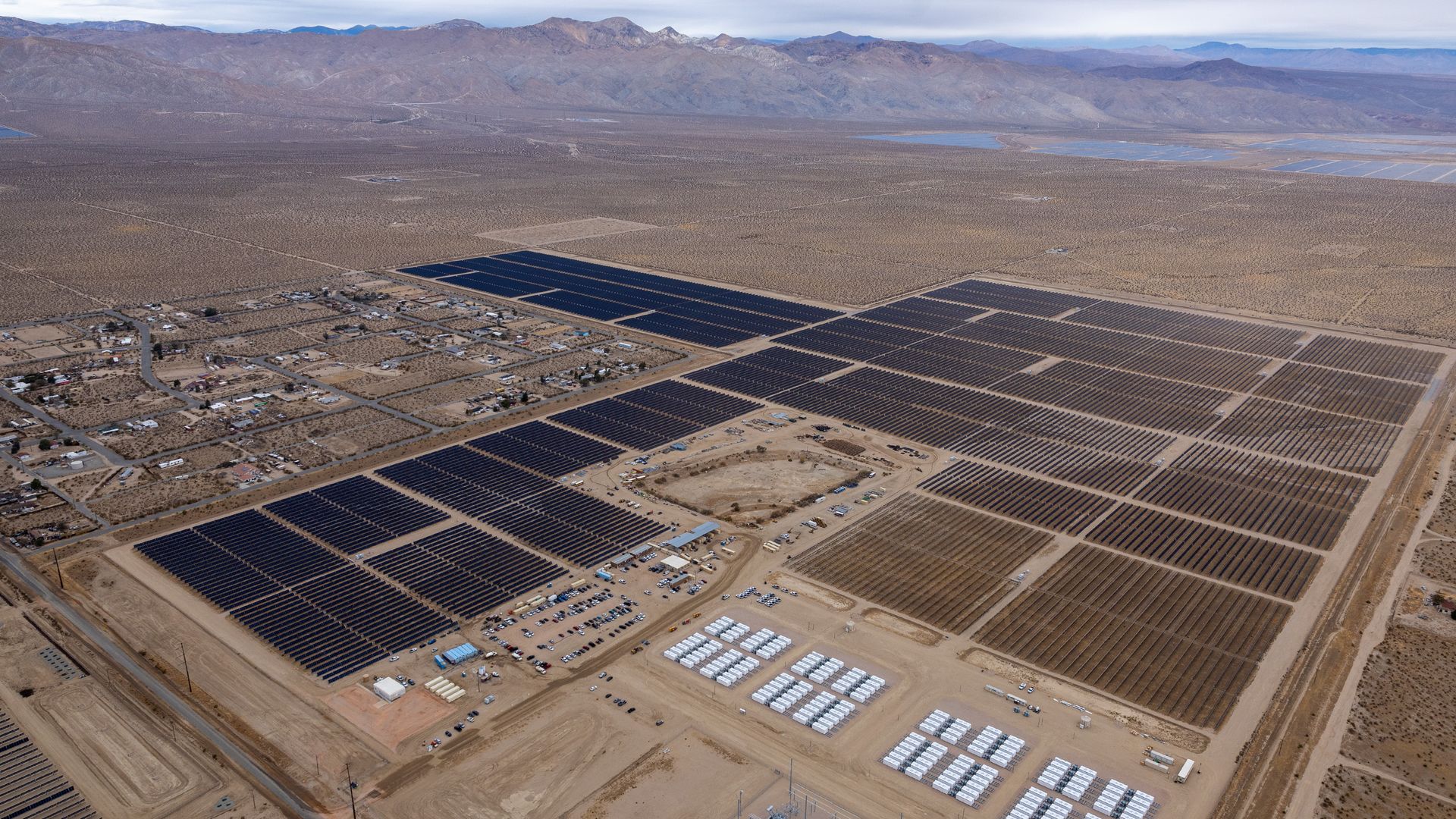
A powerful El Niño could bring major shifts in electricity supply and demand across the U.S. this winter, posing new challenges for utilities.
Why it matters: The U.S. power grid has far more solar, wind and battery storage than during the last major El Niño, and the ongoing event could reveal whether that changing energy mix has made the grid more resilient or left it vulnerable in new ways.
Driving the news: A very strong El Niño is strengthening in the tropical Pacific and is expected to continue into spring 2027, the National Oceanic and Atmospheric Administration says.
- NOAA's latest outlook favors wetter-than-normal conditions across California, the Southwest and much of the southern U.S. this winter, while the northern Rockies and parts of the Great Lakes lean drier and much of the northern U.S. leans warmer.
The intrigue: El Niño doesn't affect every electricity resource the same way.
- A March study found that previous super El Niños were associated with reductions in potential solar power output of nearly 5% in parts of California over 12 months — and more than 10% in the state's north during winter.
- Vincent Tidwell, chief scientist at Pacific Northwest National Laboratory, says a wetter California winter could boost hydropower, while reduced precipitation or snowpack in the Pacific Northwest could cut generation there.
- Erik Smith, a climate scientist at the Electric Power Research Institute, tells Axios the Southeast is another region to watch for reduced solar generation as El Niño favors cloudier conditions.
California now has more than 21 gigawatts of battery capacity, giving the grid another tool to manage fluctuations in electricity supply — one it barely possessed during the last very strong El Niño.
- The Columbia and Snake river basins accounted for roughly 62% of Western U.S. hydropower generation between 2001 and 2020, according to a Pacific Northwest National Laboratory analysis.
- Tidwell tells Axios that the Western grid is accustomed to shifting electricity between regions when hydropower conditions differ, helping compensate for shortages.
- Federal water managers, states and utilities use seasonal forecasts to plan for potential hydropower availability at Hoover and Glen Canyon dams on the Colorado River, Tidwell says.
Zoom in: Tidwell expects natural gas to play a larger backup role if El Niño reduces Pacific Northwest hydropower and California solar generation this winter.
- Other resources, including wind, geothermal and nuclear power, provide additional options, though he says El Niño's effects on wind generation remain poorly understood.
The big picture: A very strong El Niño could actually ease some pressure on the electricity system, Smith says.
- Warmer-than-normal conditions across the northern U.S. could reduce winter heating demand, potentially offsetting some of the pressure from changing electricity supplies elsewhere.
Yes, but: Even a very strong El Niño doesn't guarantee specific weather impacts.
- A severe cold outbreak could still stress the grid despite a warmer-than-average winter, while a few major storms could radically alter regional rainfall and snowpack, Smith says.
2. 🗞️ OpenAI pledges data center power cuts

Breaking: OpenAI is vowing to reduce electricity use at U.S. data center campuses it directly develops when extreme weather or other emergencies strain the power grid.
Why it matters: OpenAI is moving to build its own data centers just as public and political backlash over its electricity demands threatens the industry's expansion plans.
Driving the news: The "Grid Protectors Program" envisions going national with existing commitments at the planned data center campus in Effingham County, Georgia.
- That's where OpenAI has pledged to cut electricity demand by up to a gigawatt when the grid needs relief, equivalent to the power use of roughly 700,000 homes.
State of play: "[O]ur ambition is to make this kind of flexibility a core part of how we build and operate future campuses," OpenAI will state in a blog post later today.
- "That means ... working with utilities to agree on how much demand can be reduced, how quickly and for how long," it states.
- The specific arrangements will vary by campus, with details announced as they're finalized.
3. 🛢️ Bonus OpenAI note: A new oil deal
ADNOC, the United Arab Emirates' state oil giant, today announced a new partnership with OpenAI to improve its oilfield planning and operations.
Why it matters: ADNOC, describing one of the applications, said it will be the world's first energy company to use the OpenAI Frontier platform to "value every barrel while it is still in the ground."
Catch up quick: OpenAI Frontier, unveiled this year, helps companies build, integrate, manage and deploy fleets of AI agents. Today's partnership also includes UAE-based AI firm G42. Reuters has more.
State of play: The announcement coincided with OpenAI CEO Sam Altman participating in the huge ADIPEC energy conference in Abu Dhabi.
Zoom out: "OpenAI has signed deals across energy, investment and government sectors in the United Arab Emirates as the AI lab works to secure funding from investors in the region as part of a $20 billion round," CNBC reports.
4. 🔌 Who pays for the grid's growing tab
Americans' electricity bills could be affected for years to come by the decisions being made now about who pays for the AI data center boom
- 💰 Why it matters: Policymakers increasingly want tech companies — not residential customers — to foot more of the bill, we report in Axios' deep dive into the first major election of the AI era.
The big picture: Data centers pay for the electricity they use and generally cover the cost of connecting to the grid. But the cost of building new power plants and broader grid upgrades can be passed on to households.
🧮 Who ultimately pays depends on where a data center is built, how its utility charges customers and whether new protections take effect.
- More than half of states have taken or considered steps to protect residential customers, including special electricity rates and requirements that data centers cover more infrastructure costs.
👀 What to watch: Congress is considering bipartisan legislation to require large data centers to pay more of those costs — even if projects are canceled.
5. 🏃 Catch up quick on energy finance



🍨 Scoop: DG Matrix, an advanced electrical transformer maker, plans to raise about $250 million in Series B funding early next year to expand production, Axios Pro has learned. Go deeper
🎸 Carbon removal startup Terradot has closed a $34 million senior secured term loan from infrastructure investor HASI, Axios Pro was first to report. It's the largest disclosed debt financing for enhanced rock weathering. Go deeper
☀️ Solar tech company Nextpower's newly acquired battery business is booming, fueled partly by a major hyperscaler deal, the company revealed last week. Go deeper
🔍 Anthropic still hasn't disclosed any substantive process to monitor or manage rising emissions, even as it revealed plans for dedicated data centers powered by on-site gas in its IPO filing. Go deeper
🛠️ Re:Build, an advanced manufacturer with clean energy business lines, raised $2.1 billion led by General Catalyst and JPMorgan Strategic Investment. Full announcement
For a steady diet of scoops and smart analysis, talk to our sales team about Axios Pro Deals
6. 🧮 Number of the day: $35 billion
That's how much more data centers could pay in electricity transmission charges over the next decade under the bipartisan permitting bill being considered in Congress, according to a new analysis from consulting firm Grid Strategies.
Why it matters: The estimate puts a price tag on a major shift in energy policy that would require tech companies to shoulder more of the costs of the AI power boom, potentially reducing electricity bills for everyone else.
Zoom out: The report estimates data centers could pay a total of $55 billion in transmission charges over the next decade under the bill, with potentially much higher costs if states adopt additional provisions.
📫 Did a friend send you this newsletter? Welcome, please sign up.
Sign up for Axios Future of Energy