
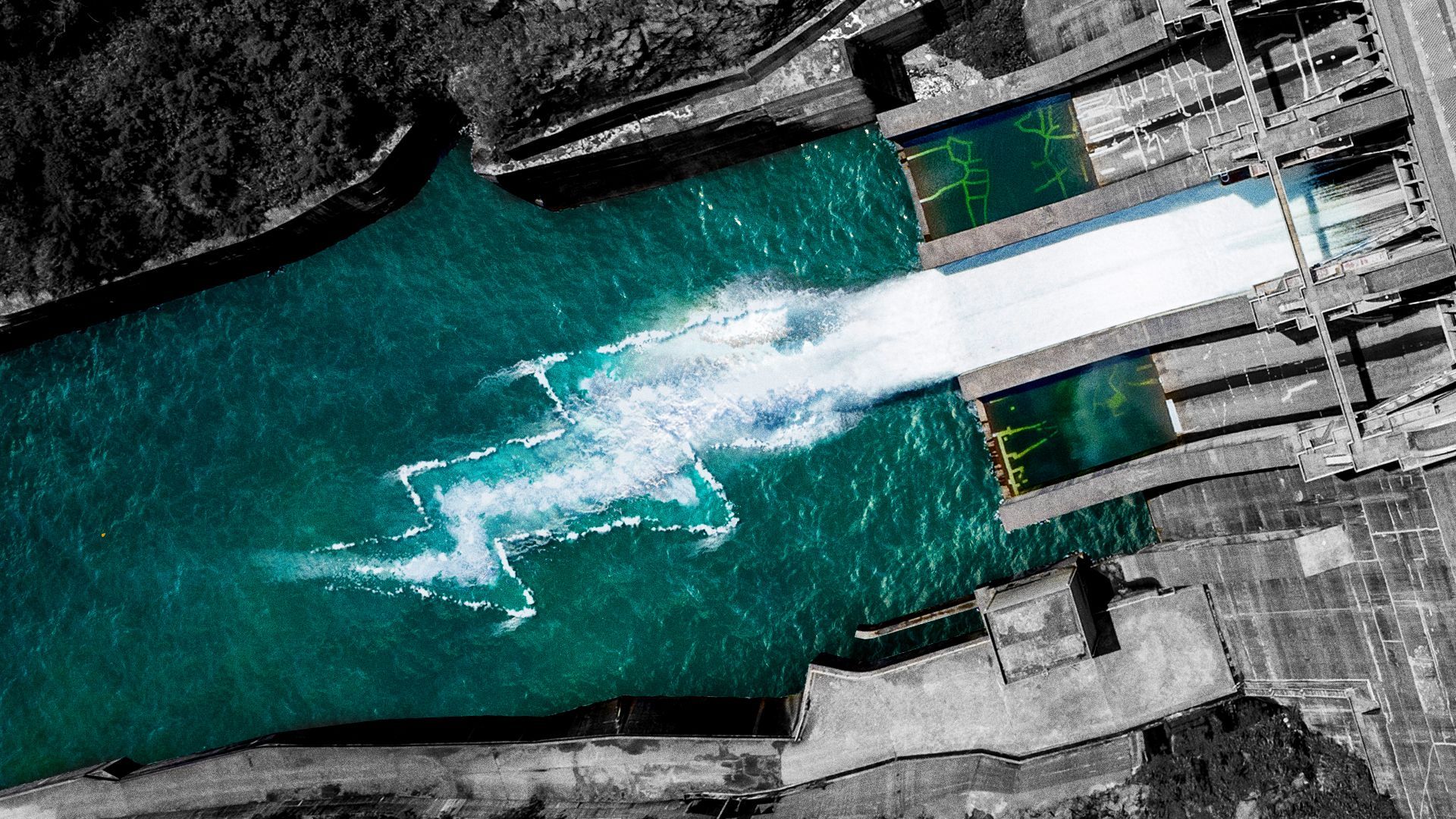
Illustration: Maura Losch, Sarah Grillo / Axios
A little-noticed voice vote in the House is a sign that the Hill may be changing its tune about a round-the-clock power source.
Why it matters: Monday's unanimous support for a bill that would identify permitting hurdles for relicensing hydroelectric dams could build momentum for broader changes as permitting talks heat up.
- It's one of the first energy bills to clear the House this session — and the only bipartisan one of the 13-bill package that the Energy and Commerce Committee sent to the floor last month.
Driving the news: The legislation from Kim Schrier, a Washington state Democrat, and Russ Fulcher, an Idaho Republican, would require FERC to report annually on the status of the relicensing process for each dam seeking a renewed license.
- "FERC has not demonstrated its ability to license and relicense facilities in a timely manner to meet the growing demands of the region and support this clean energy," Fulcher said in a statement.
- "I look at this bill as the first step," Schrier told Axios. "Before you make policy, you look at where the hiccups are. And so this bill is shining a light — where are the hiccups?"
- "Congress has seemed paralyzed in a lot of ways, and there's so much polarization about some things like drilling and wind and solar," Schrier added.
- But hydro is "abundant [and] it's not emitting. The dams are there, and this is about cutting red tape and streamlining, and that's really easy for everybody to get behind," she said.
Yes, but: Hydropower has often failed to get the attention heaped on other technologies that promise to provide round-the-clock power —nuclear, hydrogen, electric battery storage.
- Hydropower supporters have been pressing for an investment tax credit that would help dam operators upgrade aging facilities as a large chunk of the existing fleet goes through relicensing in the coming years.
- Sens. Lisa Murkowski and Maria Cantwell reintroduced bipartisan legislation to do just that. But they weren't able to get it in the reconciliation bill.
Between the lines: Still, hydro backers can point to recent wins.
- While the hydro industry didn't get its tax credit, it was spared from the harshest IRA cuts that targeted wind and solar.
- "The kinetic movement of flowing water" — aka hydropower — met President Trump's definition of "energy" in his executive order declaring a national energy emergency, which otherwise excluded renewables like wind, solar and batteries.
- Energy Secretary Chris Wright told Cantwell last month that the DOE would support repowering and increasing the yield from hydroelectric dams.
Hyperscalers are also driving renewed investment in one of the oldest and largest forms of clean energy.
- Google plans to buy up to 3 GW of energy from hydro projects owned by investing giant Brookfield in what they're calling "the world's largest framework agreement for the purchase of hydroelectricity," Axios reported Tuesday.
Context: FERC relicensing activity — which takes about eight years on average — is set to more than double in the coming decade, the DOE has reported.
- "I don't think Congress understands how at risk a hydropower fleet is," Malcolm Woolf, CEO of the National Hydropower Association, told Axios.
- "I'm afraid that that is going to become a wave in the next decade, as 40% of the non-federal fleet is up for relicensing," he said.
What we're watching: Whether the first step begets larger leaps.
- Bills requiring agencies to file reports are often Congress' way of kicking the can down the road. But as permitting talks heat up, hydropower is at the table.
