Axios Future of Energy

March 04, 2026

👋 Amy here. I'm hosting a keynote at the Dallas Fed's "Powering AI" gathering (register here).
👀 Today we're looking at ...
- How natural gas is like a moat
- The state of oil markets
- Critical minerals, venture capital and more, all in 1,462 words, 5.5 minutes.
🚨Just in: Axios' AI+DC Takeover Week— a three-day event culminating in our AI+DC Summit on March 25. Request an invite here.
🤠 Today's intro tune is from Ella Langley, whose hit "Choosin' Texas" was the focus of this week's NYT article about Texas-themed songs.
1 big thing: U.S. natural gas prices hold steady amid Middle East unrest
America's natural gas bounty is acting like a moat, largely shielding the U.S. from price spikes while much of the world reels from escalating unrest in the Middle East.
Why it matters: Natural gas hasn't, historically, drawn the same headlines as the more volatile oil markets. But it's increasingly central to the economy — including powering the AI boom.
Yes, but: The moat isn't impenetrable. And if substantially more American natural gas gets exported, it could raise heating and electricity bills.
The big picture: Fueled by fracking, the U.S. has been the world's largest natural gas producer since 2011. Since 2022, it's also been the largest exporter of liquefied natural gas (LNG), the fastest-growing segment of global gas trade.
- That dominance provides a cushion when overseas supply is disrupted (check out the chart below).
What they're saying: "The U.S. covers all of its domestic demand with its own production but then produces more to export," said Alex Munton, director of global gas and LNG for research and consulting firm Rapidan Energy.
- "So when things happen internationally, that doesn't create problems for consumers in the U.S."
Driving the news: As we know by now, Qatar, the world's second-largest exporter of LNG, said earlier this week it is halting production amid the escalating conflict between the U.S. and Iran.
- That move pulls roughly 20% of global LNG exports off the market.
By the numbers: The U.S. market share in the global LNG market is expected to increase from roughly 25% in 2025 to around 33% by the end of the decade, the International Energy Agency said in a late January report.
Domestic natural gas prices are forecast to rise this year due to growing LNG exports, the U.S. Energy Information Administration, the federal government's energy statistics agency, said in a late January report before the Middle East escalation.
Zoom out: It's classic supply and demand. As more gas is shipped abroad, tighter domestic supply can raise the cost of heating, which affects the majority of U.S. households.
Follow the money: Higher exports would benefit exporters. Stocks of major U.S.-based LNG exporters, including Cheniere Energy and Venture Global, jumped after the U.S.-Israel missile strikes and Iran's retaliation.
What we're watching: Beyond the immediate events in the Middle East, tension is brewing inside America's natural-gas moat.
- Experts are debating to what degree there is enough gas to satisfy both surging exports and rising power demand from data centers in the coming couple of years.
The bottom line: "That is probably one of the biggest areas of uncertainties," said Anne-Sophie Corbeau, a natural-gas expert at Columbia University's Center on Global Energy Policy.
2. 🧁 Bonus: America's natural gas buffer
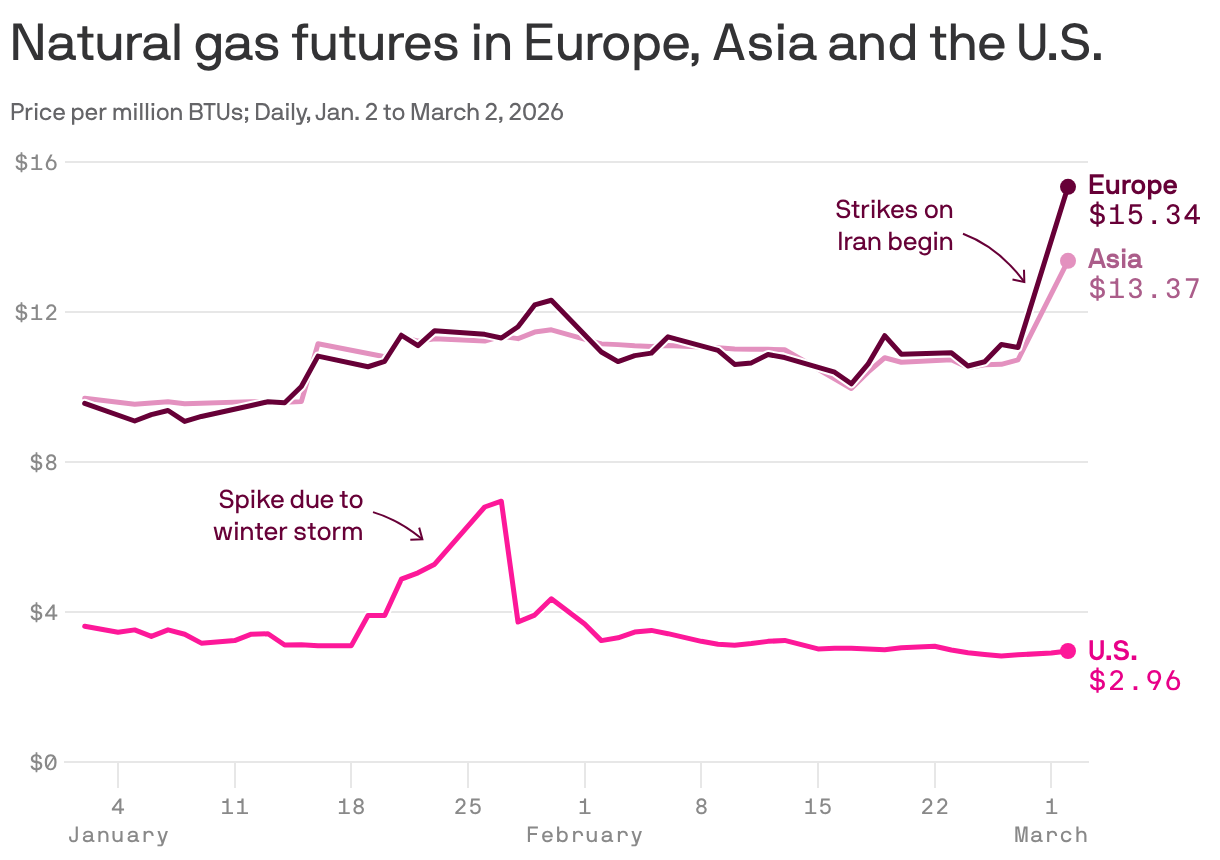
Natural gas prices immediately spiked in Europe and Asia following strikes on Iran, but the impact in the United States has been far more muted — so far, anyway.
Why it matters: This is a direct result of the fact the U.S. is the world's largest producer of natural gas and largest exporter of liquefied natural gas (LNG).
How it works: Oil is a global commodity; prices tend to move in sync worldwide. That's why American consumers — along with others — are already seeing at least a short-term spike in gasoline prices.
- But natural gas is still mostly regional.
- Prices in Europe and Asia are increasingly linked as both rely more on LNG and compete for it, including shipments from the U.S. But America's vast domestic supply insulates its market.
Context: In the U.S., natural gas prices are driven more by regional dynamics — especially weather. That's why winter storms sent prices soaring briefly in late January.
The bottom line: In other words: Disruptions inside the moat matter more than those outside of it.

3. 🛢️ Oil markets might not be spooked enough
Sure, prices have soared since attacks on Iran and counterstrikes began — but it's also possible the market isn't freaking out enough.
Why it matters: Consumers and companies worldwide will feel the effects of the conflict that's pushing up petroleum and natural gas prices.
- But oil hasn't yet approached the $100-per-barrel — or higher — level that numerous market-watchers say is possible in the unpredictable, expanding regional battle.
The intrigue: Veteran analyst Bob McNally sees a mismatch between risk and oil prices, and believes the market remains too complacent despite the recent rise.
- The president of Rapidan Energy Group points to years of geopolitical crises that didn't bring large-scale supply disruptions.
- There's a "boy who cried wolf effect," McNally said.
4. 🗞️ Trump tanker plan fallout and more petro-notes
👀 Let's catch up on President Trump announcing the U.S. will "immediately" offer "political risk insurance and guarantees" for ships in the Gulf region, and that the Navy will escort tankers through the Strait of Hormuz if needed.
- The latest: The U.S. Development Finance Corp. said it's ready to "mobilize its Political Risk Insurance and Guaranty products" and invited inquiries. And French President Emmanuel Macron announced he's sending military assets to the region and looking to build a coalition to "pool resources" to secure maritime traffic.
- Why it matters: The White House is trying to ease oil price spikes that are starting to boost U.S. gasoline prices. Oil prices retreated yesterday as word of the plans began to emerge. Full story.
- What they're saying: "Our experts don't think Trump's vessel escort idea will work as vessels will be heavily exposed to Iranian missiles. And even if they do manage to escort the vessels the cost will be too high," Amena Bakr of the energy data and intelligence firm Kpler said on X.
⛽ The average U.S. regular gasoline price is now up 20 cents this week to $3.20 per gallon, per AAA tracking this morning.
- Go deeper: Axios' Nathan Bomey broke down the surge — and its wider impact — yesterday when prices were around $3.11.
🥾 Exxon will probably have "boots on the ground" in Venezuela within a few weeks to assess the state of play, senior VP Jack Williams told a Morgan Stanley conference yesterday.
- Why it matters: The oil giant — which previously had Venezuelan assets expropriated — has the balance sheet to invest there. But it has been skeptical about the viability.
- Yes, but: The government, under U.S. pressure, has recently loosened restrictions, though Williams said more is needed on multiple fronts, including security. "If we can get those terms in place, we would be interested in going back," he said.
- Catch up quick: CEO Darren Woods had previously floated the idea of sending a technical team to Venezuela for assessments.
5. ⛏️ House OKs bill to align agencies' critical-minerals lists

The House yesterday passed a bill aiming to fix concerns over the federal government's labeling of critical minerals and metals.
Why it matters: It's a rare sign of bipartisan cooperation on energy.
Driving the news: The bill — approved by voice vote — would align the separate Energy and Interior department lists of metals and minerals considered critical.
- Under federal law, critical minerals are those essential to U.S. economic or national security and that have supply chains vulnerable to disruption.
- During the Biden administration, the Energy Department's critical minerals list included copper, but Interior's U.S. Geological Survey did not. The survey added copper last year.
State of play: The legislation has the backing of numerous industry groups, including the Zero Emission Transportation Association, National Electric Manufacturers Association, Business Council for Sustainable Energy and National Mining Association.
What we're watching: The Senate, where Energy and Natural Resources Chairman Mike Lee (R-Utah) has introduced a similar bill that won committee approval.
6. 🚘 What's next after the EV sales cliff


This chart really shows the steep drop-off in U.S. EV sales as consumers rushed to use federal tax credits before they phased out under the GOP budget law.
What we're watching: The market's new footing.
- "The roll out of new BEV product over the course of 2026 should provide a floor for the downside, but little movement is expected for the sector in the first half," S&P Global Mobility's new report states.
7. 🧮 Number of the day: $17.6 billion for climate tech startups

That's how much venture capital flowed to U.S. climate tech startups in 2025, up from $14.3 billion in 2024, per a new J.P.Morgan report first shared with Axios Pro.
Why it matters: The data confirms recent bullish climate financing reports and bucks recent bearish ones.
Unlock the whole story and talk to our sales team about Axios Pro Deals.
🙏 Thanks to Chuck McCutcheon and Chris Speckhard for edits to today's newsletter, along with the brilliant Axios Visuals team.
📬 Did a friend send you this newsletter? Welcome, please sign up.
Sign up for Axios Future of Energy