American gas bounty shielding consumers from war spikes, for now

Add Axios as your preferred source to
see more of our stories on Google.

Illustration: Allie Carl/Axios
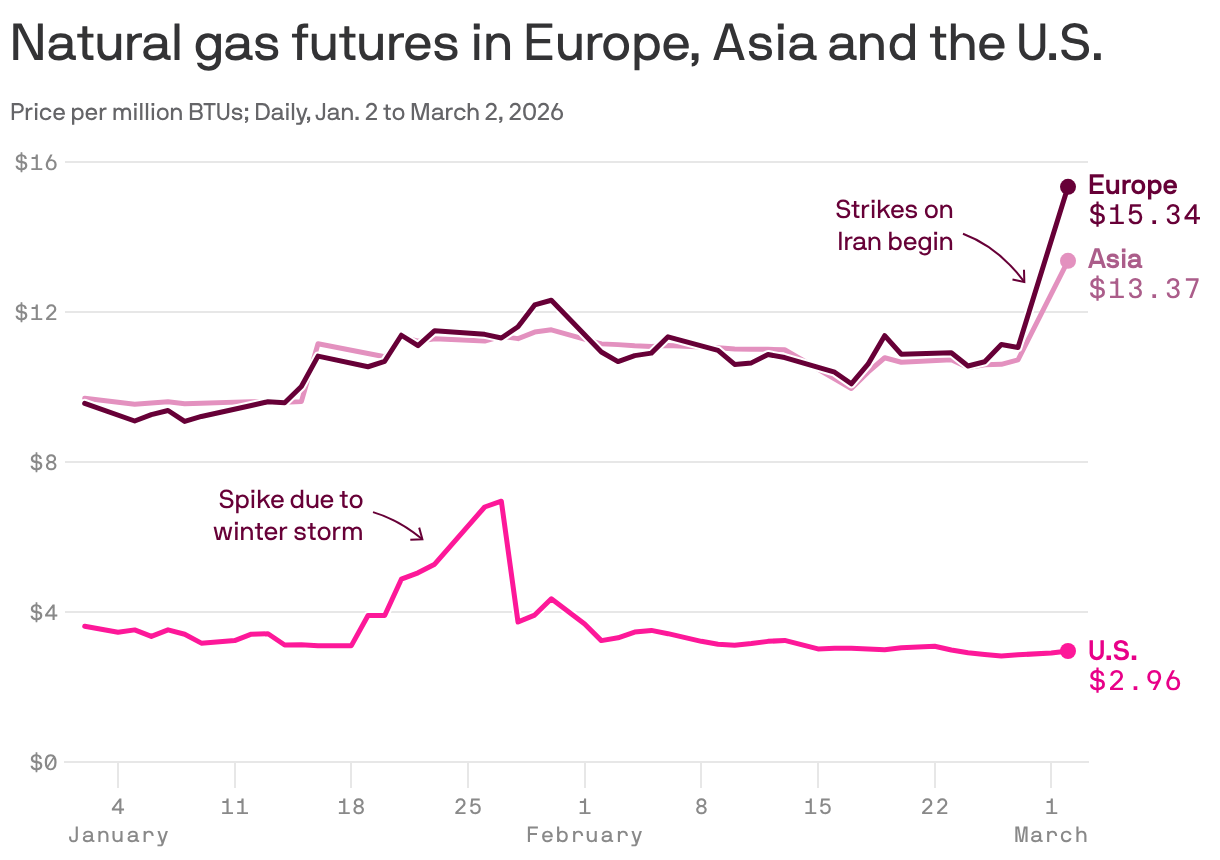
America's natural gas bounty is acting like a moat, largely shielding the U.S. from price spikes while much of the world reels from escalating unrest in the Middle East.
Why it matters: Natural gas hasn't, historically, drawn the same headlines as the more volatile oil markets. But it's increasingly central to the economy — including powering the AI boom.
Yes, but: The moat isn't impenetrable. And if substantially more American natural gas gets exported, it could raise heating and electricity bills.
The big picture: Fueled by fracking, the U.S. has been the world's largest natural gas producer since 2011. Since 2022, it's also been the largest exporter of liquefied natural gas (LNG), the fastest-growing segment of the global gas trade.
- That dominance provides a cushion when overseas supply is disrupted.
What they're saying: "The U.S. covers all of its domestic demand with its own production but then produces more to export," said Alex Munton, director of global gas and LNG for research and consulting firm Rapidan Energy.
- "So when things happen internationally, that doesn't create problems for consumers in the U.S."
Driving the news: Qatar, the world's second-largest exporter of LNG, said earlier this week it is halting production amid the escalating conflict between the U.S. and Iran.
- The move follows U.S. strikes ordered by President Trump and Iran's retaliatory attacks.
- Qatar's move pulls roughly 20% of global LNG exports off the market.
The result: Natural gas prices immediately spiked in Europe and Asia, but the impact in the U.S. has been far more muted — so far, anyway.
How it works: Oil is a global commodity; prices tend to move in sync worldwide. That's why American consumers — along with others — are already seeing at least a short-term spike in gasoline prices.
- But natural gas is still mostly regional.
- Prices in Europe and Asia are increasingly linked as both rely more on LNG and compete for it, including shipments from the U.S. But America's vast domestic supply insulates its market.
Context: In the U.S., natural gas prices are driven more by regional dynamics — especially weather. That's why winter storms sent prices soaring briefly in late January.
- In other words: Disruptions inside the moat matter more than those outside of it.
By the numbers: The U.S. market share in the global LNG market is expected to increase from roughly 25% in 2025 to around 33% by the end of the decade, the International Energy Agency said in a late January report.
Zoom out: America's dominance in natural gas didn't happen overnight. It's the product of decades of drilling — backed by bipartisan policies that (mostly) supported domestic production.
Domestic natural gas prices are forecast to rise this year due to growing LNG exports, the U.S. Energy Information Administration, the federal government's energy statistics agency, said in a late January report before the Middle East escalation.
- "If we see an increased appetite for U.S. LNG exports following the events in Iran, that will likely drive up U.S. natural gas prices due to the increased demand — potentially beyond what was already anticipated," Jack Buckley, vice president at advisory firm Capstone, said in an email to Axios.
Zoom in: It's classic supply and demand. As more gas is shipped abroad, tighter domestic supply can raise the cost of heating, which affects the majority of U.S. households.
- At the end of the Biden administration, the Energy Department said in a report that under a high-export scenario, Henry Hub natural gas prices (the primary domestic benchmark) could increase 31% in 2022 dollars by 2050.
- That would mean up to a $122.54 annual average increase for natural gas plus electricity expenditures across all households, the report said.
Follow the money: Higher exports would benefit exporters. Stocks of major U.S.-based LNG exporters, including Cheniere Energy and Venture Global, jumped after the U.S.-Israel missile strikes and Iran's retaliation.
- "This crisis could act as a catalyst to even more investment in US LNG," Munton said. "It could give the export market a shot in the arm big time."
What we're watching: Beyond the immediate events in the Middle East, tension is brewing inside America's natural-gas moat.
- Experts are debating to what degree there is enough gas to satisfy both surging exports and rising power demand from data centers in the coming couple of years.
The bottom line: "That is probably one of the biggest areas of uncertainties," said Anne-Sophie Corbeau, a natural-gas expert at Columbia University's Center on Global Energy Policy.
Sign up here for Axios' Future of Energy newsletter.
