Axios Future of Energy

December 19, 2025

š£ļø This morning we're mapping the road ahead for Trump's fusion merger, data centers, permitting and more, all in 1,444 words, 5.5 minutes.
š Thanks to Chuck McCutcheon and Chris Speckhard for edits to today's newsletter, along with the brilliant Axios Visuals team.
šø Funk aliens Parliament dropped "Mothership Connection" 50 years ago this week, and it blasts us into the news with today's intro tune...
1 big thing: How Trump's fusion company could navigate the road ahead

Let's explore what's next for the year's surprise odd couple: Trump Media's merger with TAE Technologies, a company trying to commercialize fusion.
Why it matters: The deal injects new cash into TAE as fusion ā long more science fiction than energy reality ā moves closer to commercial scale.
- The merger ā if it goes through ā with President Trump's publicly traded media group will offer the first test of public markets' appetite for the tech.
- And it's a massive pivot for Trump Media, which saw a big share price bounce yesterday but remains down 56% this year.
šļø Driving the news: Some nuggets that emerged since we covered the news in yesterday's newsletter...
- ā° TAE hopes to start producing power by 2031 from a 50-megawatt reactor it plans to start building next year with new financing from the merger.
- šŖ Donald Trump, Jr. will be on the merged company's board.
š„ Friction point: The deal "raises significant concerns about conflicts of interest and avenues for potential corruption," said Democratic Rep. Don Beyer, a fusion booster who co-founded the bipartisan House fusion energy caucus.
- His statement notes public funding for fusion R&D, and says Trump has used federal power and taxpayer money to advance his family interests.
š Catch up quick: The deal will provide TAE, whose prior backers include Google, up to $200 million in cash at signing.
- Another $100M is available upon formally notifying the SEC, the companies said.
The intrigue: The company plans to be solely energy-focused, which means Truth Social and other Trump Media assets could be sold or separated, a source familiar with the deal tells Axios.
- TAE CEO Michl Binderbauer didn't confirm or deny this in an interview with Axios.
š What we're watching: Asked if TAE is in talks with hyperscalers about power offtake deals, Binderbauer cited TAE's ties to Google and said it more broadly "knows the space very well," but added: "I'm not ready to announce a deal there at this point."
- The company has previously raised $1.3 billion in private capital from investors including Google, Chevron, Sumitomo and NEA.
- Binderbauer also said TAE is generating revenue through its power management and life sciences spinoffs. He didn't rule out seeking federal funding as the company looks to build additional plants.
What's next: The companies need approval from shareholders and regulators to merge, which they expect to do in mid-2026.
- How TAE trades over the next months and years will signal whether the public markets have the patience for fusion at its pre-commercial stage, with its complicated technologies and long timelines.
Dan Primack and Alex Fitzpatrick contributed.
Disclosure: In 2023, TMTG sued 20 media organizations, including Axios, for defamation. That suit in Florida is ongoing.
2. š¬ What they're saying about FERC's big data center move

FERC members are united in demanding that the largest U.S. grid operator better enable co-location of data centers and power sources ā but much of the heavy lifting remains.
Why it matters: The regulators' unanimous, bipartisan directive to PJM Interconnection shows how officials are trying to thread the needle of meeting tech giants' AI power needs while limiting price spikes for consumers.
Catch up quick: FERC said PJM should provide new options for big data centers and new and existing power generators to link directly, but also draw from grids to varying degrees.
- It's the latest wrinkle in the movement for BYOB for electricity.
The intrigue: Shares of several independent large power producers active in PJM ā like Vistra, Constellation, and NRG Energy ā rose after the order.
- But utilities are wary. The Edison Electric Institute ā a trade group for investor-owned utilities ā issued a noncommittal statement.
- EEI said broadly that it wants to work with federal and state officials on data centers, protecting people from new costs, and strengthening grids.
What they're saying: "[T]he order will benefit nuclear- and gas-heavy independent power producers in PJM ... by allowing them to contract directly with data centers, bypassing utility load interconnection queues with new, non-firm service options," advisory firm Capstone said in a note.
- But it sees "mild headwinds" for utilities, "given that the order endorses the option for generators to self-fund network upgrades."
Reality check: TD Cowen analysts point out that FERC didn't provide granular details on the new types of transmission arrangements it wants for co-located facilities.
- They expect a "contentious" process ahead with PJM, so Cowen is "cautious" about calling it a "done deal" for co-location in PJM, it said in a note.
What we're watching: The details that emerge from PJM ā and how they might spill into other grids.
- And remember that DOE is pressing FERC to write broad new rules governing data center grid connections.
The bottom line: "How PJM decides to structure their co-location arrangements will have effects beyond the nation's largest power market," RBC Capital Markets said in a note.
- "[I]t provides guidance for addressing similar jurisdictional, load growth, resource adequacy, and cost allocation issues in other regulatory markets."
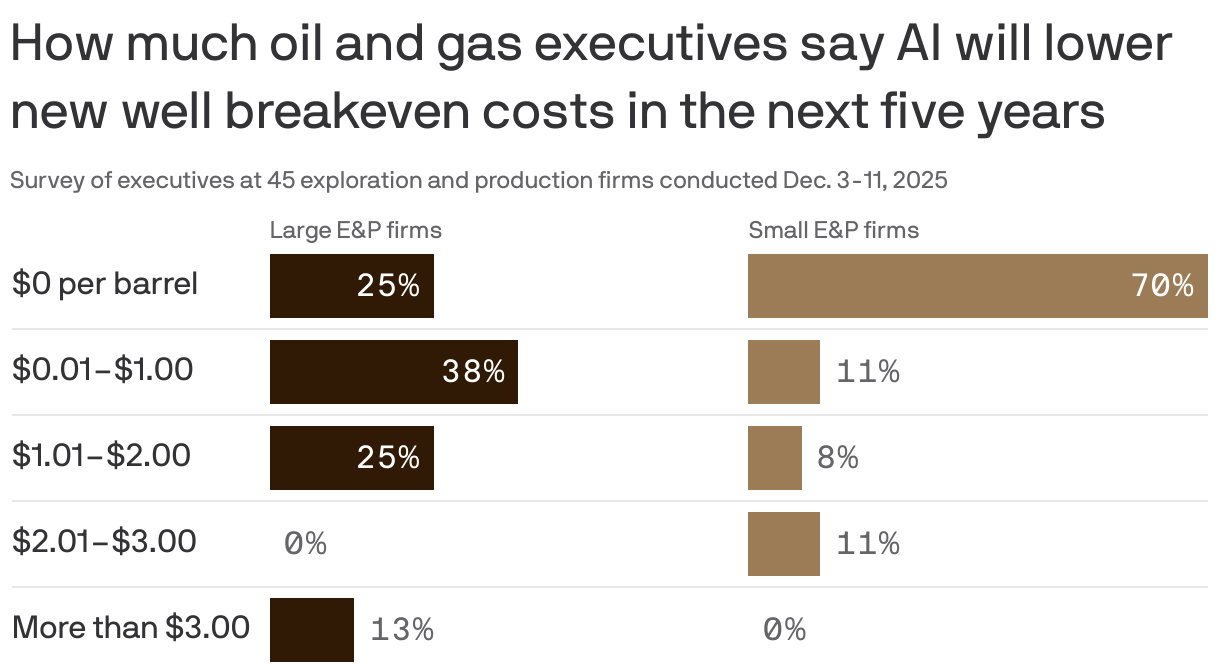
3. š¢ļø Charted: AI and the U.S. oil patch

Oil execs in the largest U.S. producing region see AI improving the economics of new wells, but the effect is often modest, per the latest Dallas Fed survey.
Why it matters: AI may help boost oil output, even as it has applications in low-carbon tech like improving battery chemistries.
State of play: The latest pulse-taking of execs in the Dallas Fed region finds that bigger firms expect more upside from AI.
- Small players are less hopeful (see above).
The big picture: The wider survey shows a mixed mood, with companies expressing a range of views on the price trajectory in 2026 and beyond.
- The Dallas Fed region includes the prolific Permian Basin, though some companies based there have national and even global operations.
The bottom line: "While oil prices have not been low enough this quarter to force a substantial cutback in activity, they were not high enough to support any growth either," Michael Plante, a Dallas Fed assistant VP, in a statement.
4. š Hot reads: Offshore wind, coal, carbon pricing

The man behind the fall of offshore wind (Canary Media)
Amy says: A long read worth reading until the end. I learned a lot about the offshore wind fight and a glimpse into an influential person's mind. Also, 39 to 6 gigawatts ā yikes.
This former Trump strategist wants a US carbon price (Sustainable Views)
Chuck says: I'd quibble with the headline, which overstates Alex Flint's connection to Trumpworld. But this is a handy summation of his thinking about the need for carbon pricing, as politically far-off as it is right now.
DOE orders WA coal plant to continue operating despite state ban (Seattle Times)
Amy says: I remember pitching a story about this plant years ago. I wonder if its power will get used, or if it'll somehow sit idle due to the complexity of power grids.
Clean, Limitless Energy Exists. China Is Going Big in the Race to Harness It. (NYT)
Amy says: Naming a project BEST seems like the Chinese are taking a cue from Trump. Also, the satellite images are stark.
5. š¬ The narrow, rocky road ahead for permitting legislation

The push for permitting legislation doesn't get any easier from here despite House passage of a bill to speed project approvals.
Why it matters: Streamlining the process for green-lighting energy and infrastructure projects is of paramount importance for many business groups.
Catch up quick: The House yesterday passed the SPEED Act, sponsored by House Natural Resources Chairman Bruce Westerman (R-Ark.) and Rep. Jared Golden (D-Maine), on a 221-196 vote. Eleven Democrats backed it.
- The bill would make what supporters call long-needed changes to the National Environmental Policy Act.
- It would impose new deadlines, exempt some project types from new review, and narrow the environmental effects agencies must study.
Reality check: The final legislation ā if there is any ā won't look like the SPEED Act.
- The House bill "is at best an input for permitting reform ā the real bill is still percolating in the Senate," Rapidan Energy Group said in a note.
The bottom line: Some Senate Democrats who oppose the SPEED Act said they remain optimistic they can craft something that can win the 60 votes needed to pass most bills.
- But the political opening is extremely narrow.
6. š Quote of the day: Auto pendulum edition
"These massive swings in policy from administration to administration are paralyzing to the [auto] industry."ā AlixPartners' David Steinert on changing EV policies
That's from Axios' Joann Muller's great look at Ford's new strategy and big write-down on EV and battery investments.
š¬ Did a friend send you this newsletter? Welcome, please sign up.
Sign up for Axios Future of Energy