Ford shows the consequences of whiplash politics

Add Axios as your preferred source to
see more of our stories on Google.
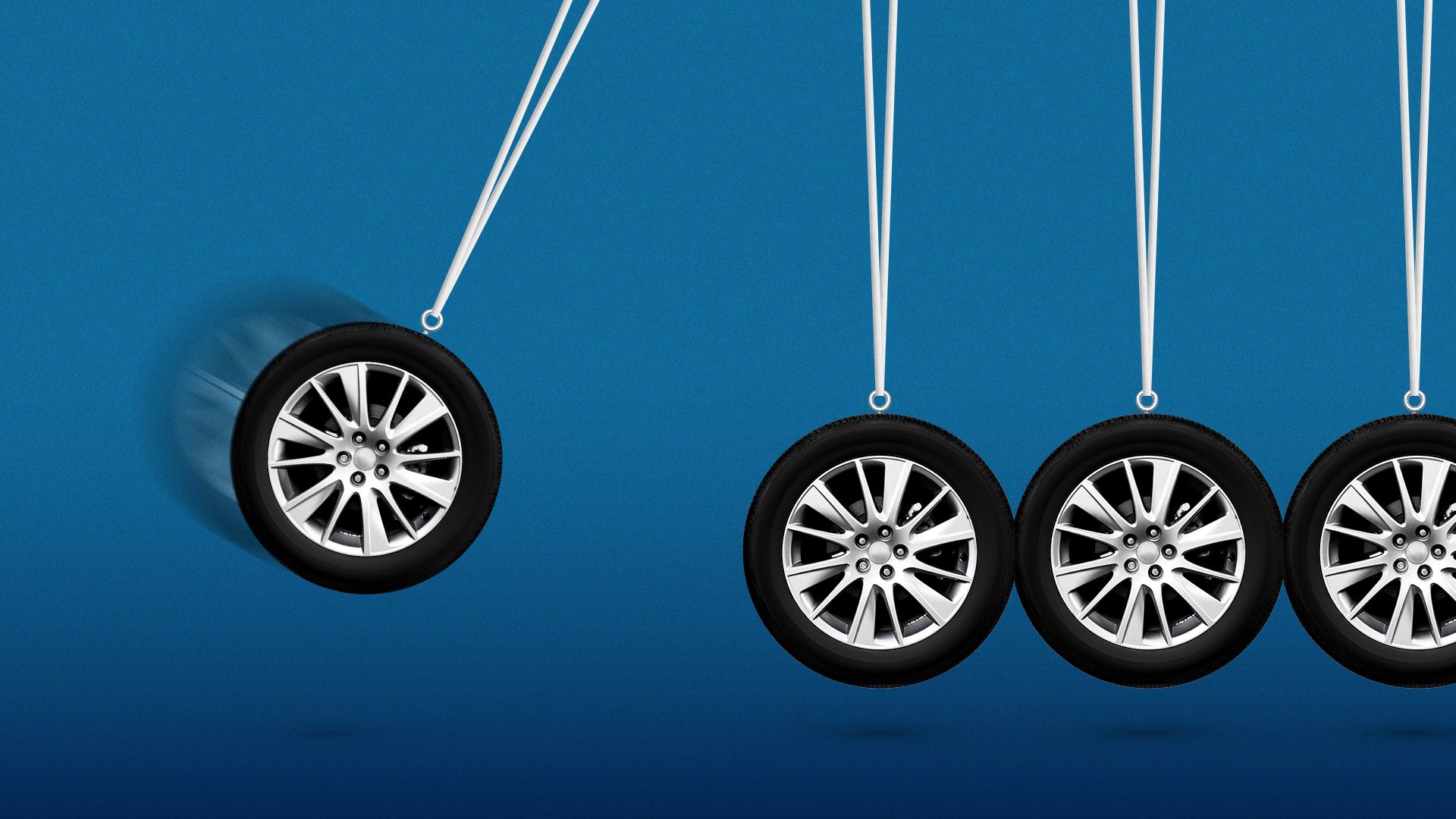
Illustration: Allie Carl/Axios
Seesawing government policy can wreak havoc on companies.
- Exhibit A: Ford Motor Co., which has written off tens of billions in stranded investments over the past 15 years.
Why it matters: Big shifts in political power tend to lead to extreme regulatory swings, too, as policymakers try to steer consumer markets in one direction or another.
- For capital-intensive industries, that can result in billions of dollars wasted, and crucial time lost, while global rivals like China keep advancing.
The big picture: "These massive swings in policy from administration to administration are paralyzing to the industry," David Steinert, a partner in the automotive and industrial practice at AlixPartners, tells Axios.
Driving the news: Ford's stunning $19.5 billion write-down of planned electric vehicle and battery investments this week is the latest example of what happens when big bets chase ever-changing policy directives.
Flashback: Just four years ago, Ford announced an $11.4 billion plan to build a new EV and battery manufacturing campus in Tennessee and two more battery plants in Kentucky.
- The project was supported by huge government loans and manufacturing incentives, plus tax credits for EV buyers — policies the Biden administration and industry experts thought would shove the new car market toward 50% EVs in a decade or two.
Yes, but: The new Trump administration quickly gutted those policies and gave automakers a green light to produce more gas-powered vehicles without penalty.
- Now Ford is retrenching on EVs and will spend billions more to switch factories to produce gas and hybrid trucks and vans, which it believes consumers will prefer.
What they're saying: "We view Ford's move as an acknowledgement that its EV strategy is not working," amid weak demand and regulatory rollbacks, wrote BNP Paribas Research auto analyst James Picariello.
- But by targeting a 50% mix of electrified powertrains by 2030, he said, "[w]e believe Ford is still protecting itself against a future pro-environmentalist U.S. administration change."
Zoom out: Lots of industries, ranging from energy and pharmaceuticals to health care and construction, are being buffeted by a similar whiplash.
- Back-and-forth policy shifts in trade, immigration, deregulation and taxes are making it hard for companies to stick to a long-term plan.
Ford says its strategy pivot, while expensive, was driven by many factors — not just regulatory changes — including low EV demand, high battery costs and even customer complaints about the limitations of an electric pickup truck.
- "Ford is following the customer," Andrew Frick, who is president of both the traditional and EV divisions, told reporters.
- "We are looking at the market as it is today, not just as everyone predicted it to be five years ago," he said.
Reality check: Management decisions matter, too.
- Ford, GM and other automakers eagerly scooped up all those government incentives while jumping on the EV bandwagon.
- Many ignored signs that consumers weren't ready to make the switch — the lack of available charging, for example, and high sticker prices.
- Clear proof that policies were propping up EV sales came at the end of September, when consumer tax credits expired and EV sales collapsed.
Friction point: For now, Trump's seismic policy actions seem like a net win for automakers because they're free to produce more high-margin, gas-powered trucks and SUVs, despite higher costs from tariffs.
- If Democrats take control of Congress in the 2026 midterm elections, or recapture the White House in 2028, the policy pendulum would likely swing back again.
What to watch: In the meantime, more big EV investments like Ford's are going to wind up as stranded costs, predicts AlixPartners' Steinert.
- GM already took a $1.6 billion charge after cutting EV production and said more write-offs may be coming.
The bottom line: The EV reckoning is a reminder that automakers should be listening more to consumers and less to policymakers.
