Axios Future of Energy

December 18, 2025


🤯 What a moment! Trump's media company is investing in fusion. BP's CEO is out. Permitting is on the House floor. Dogs and cats living together.
- We break it down after a look at a critical, under-the-radar energy topic, all in 1,504 words, 5.5 minutes.
🙏 Thanks to Chuck McCutcheon and Chris Speckhard for edits to today's newsletter, along with the brilliant Axios Visuals team.
🎸 Happy birthday to Rolling Stones guitarist Keith Richards, whose playing, writing and voice animate today's intro tune...
1 big thing: The growing push for clean cooking in Africa — and the U.S. role
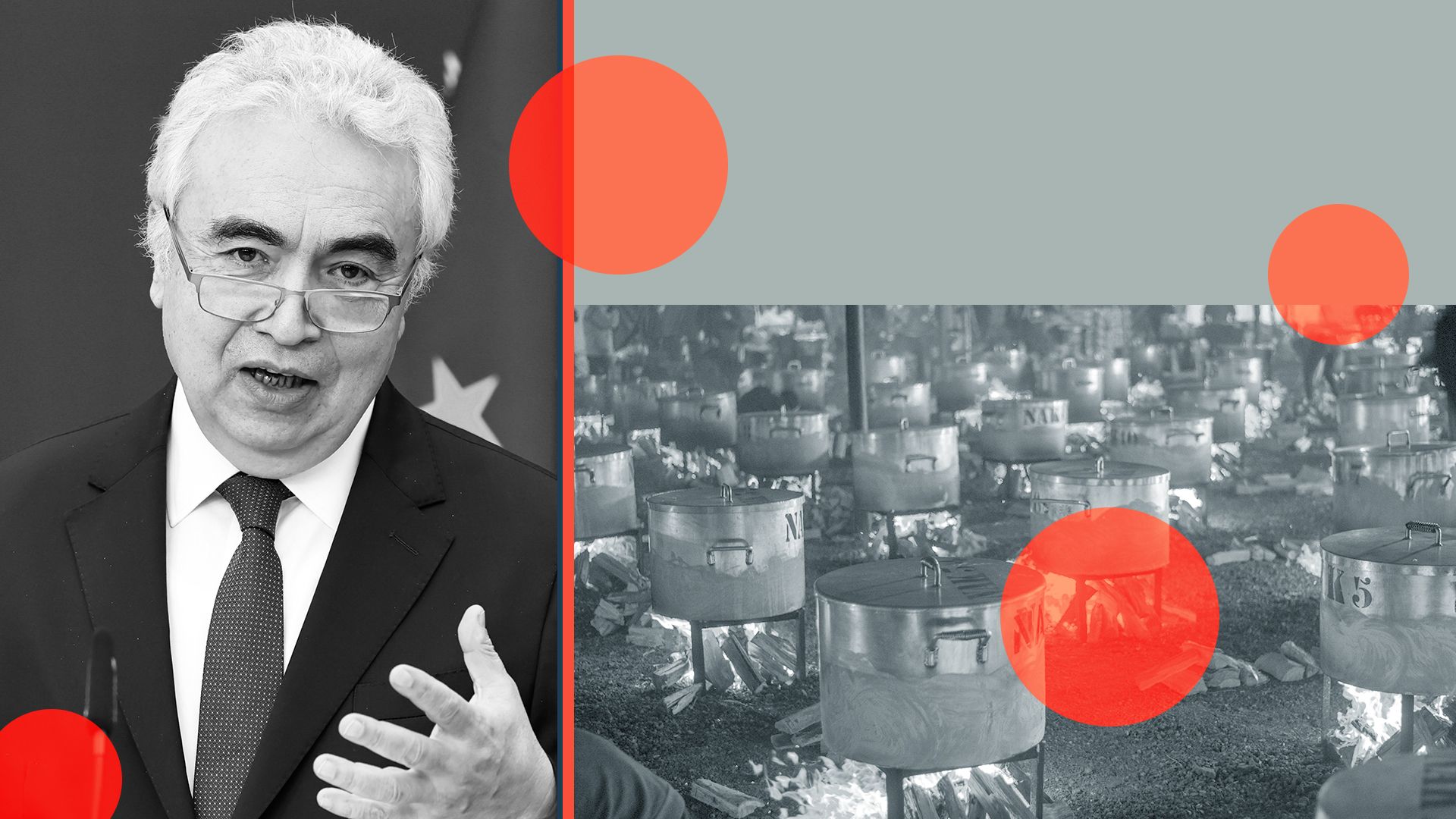
International Energy Agency head Fatih Birol wants to move Africa's need for clean cooking fuels and tech higher on the global agenda — and sees the U.S. as a fruitful partner.
Why it matters: Widespread use of fuels like wood, charcoal and dung — and open fires or inadequate stoves — is a massive health and economic problem.
- An IEA report this year estimated that cooking with highly polluting fuels contributes to over 800,000 premature deaths annually in Africa alone.
State of play: A first-time summit IEA convened in France with the African Development Bank and other partners last year brought $2.2 billion in public and private sector pledges — and $470 million has already been disbursed.
- Now IEA is looking to secure more commitments at a recently announced second summit next year in Kenya.
U.S. Energy Secretary Chris Wright will co-chair along with Kenyan President William Ruto, Norwegian PM Jonas Gahr Støre, and Birol.
- "We want to see even stronger financial commitments," Birol said in an interview. And he's hoping for more equity finance alongside the debt funding.
🇺🇸 What we're watching: Birol sees the U.S. presidency of the G20 next year as fertile ground on what Wright has also called an "urgent challenge."
- He plans to approach U.S. officials about its role on the agenda.
The intrigue: Trump officials and some Republicans have criticized IEA, arguing it has placed too much focus on climate advocacy.
- But Birol said IEA works on many topics with the Trump administration, and clean cooking is an area where views "converge perfectly."
- "We have a similar way of thinking when it comes to the issue of clean cooking and ... alignment on what could be the main solutions to address this problem," he said.
Yes, but: The Trump administration is scaling back foreign aid, which could complicate the push for more resources on the U.S. side.
The big picture: Birol is looking at multiple forums to bolster action on what he calls one of his "obsessions," as well as more summits after the Kenyan meeting next year.
- "I want to make it a regular item in the agenda of the IEA, but also in the international energy agenda," he said.
- The agency has created road maps and analysis to help bolster use of cleaner alternatives — notably liquid petroleum gas, but also advanced biomass cookstoves, electrification, and more.
What's next: One near-term place to look is the World Economic Forum.
- Birol chairs its energy advisory board and said he'll ensure clean cooking will be on the agenda in Davos next month, and the February session of IEA ministers.
2. 🍲 Visualizing the clean cooking challenge
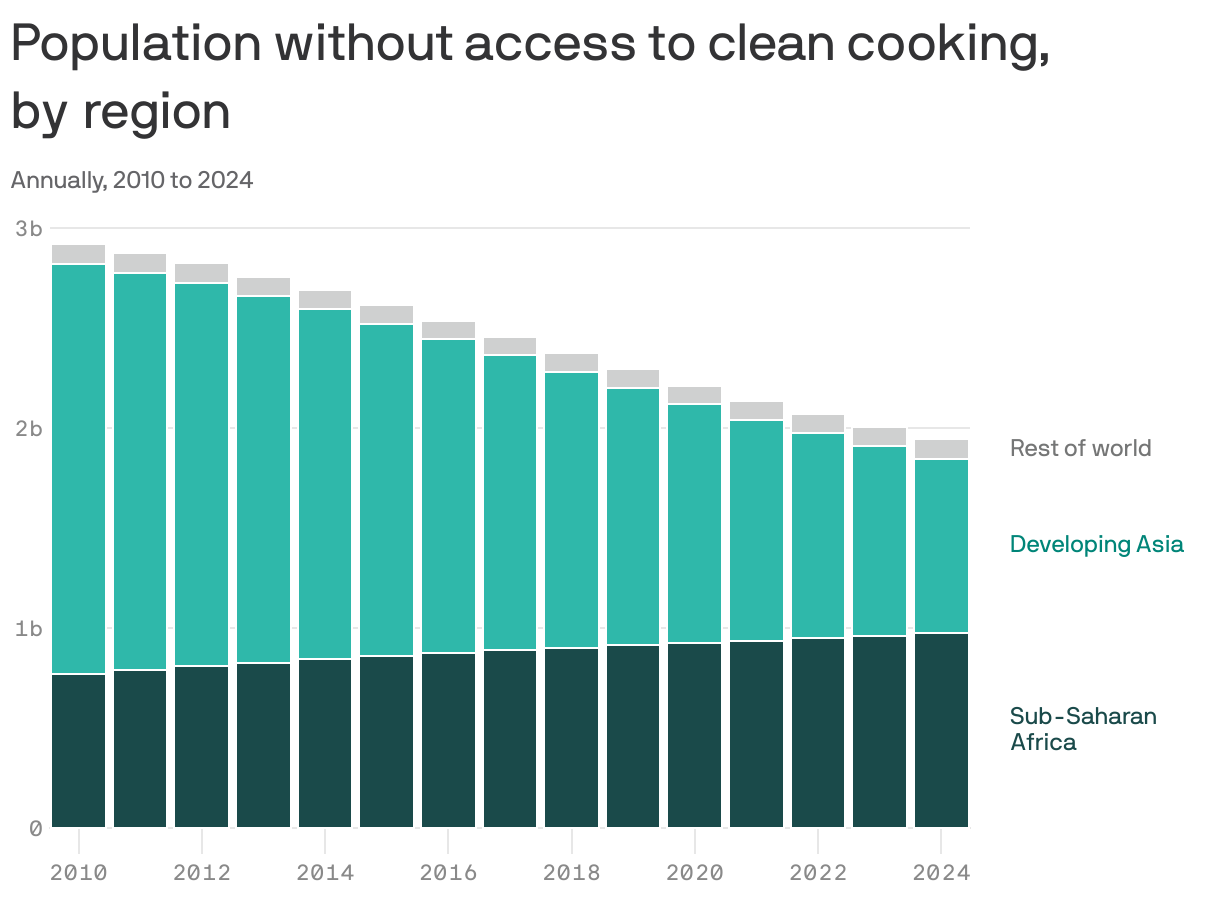
The number of people who lack safer cooking fuels has grown in sub-Saharan Africa while falling on a global basis.
- IEA has estimates that clean cooking access for every African household would take less than 0.1% of annual global energy investment over 15 years.
3. ⚛️ Trump's shock nuclear fusion deal

Trump Media & Technology Group is merging with nuclear fusion power startup TAE Technologies in an all-stock deal valued at $6 billion.
Why it matters: The unusual combo expands the president's business interests into this heavily regulated nuclear power business.
- It will provide new resources to the fusion player, and signals Trumpworld's enthusiasm about a potentially big power source, which faces big scientific and cost hurdles to become viable.
- It also shows how AI's voracious power needs are drawing investment into both existing and, in this case, frontier energy technologies.
Zoom in: The Trump administration has been extremely bullish on fusion, which advocates say is starting to move from the scientific into the construction phase.
- The Energy Department in October announced a fusion road map to provide a strategy for the technology.
4. ➡️ What's next after BP's CEO shakeup

Let's take the early pulse after last night's surprise news that BP CEO Murray Auchincloss is out, and that Woodside Energy boss Meg O'Neill is en route as his replacement.
Why it matters: BP's 2020 pivot to green energy, and its pivot back toward its core oil and gas business, is a cautionary tale about how Big Oil is positioning itself.
The big picture: O'Neill, who arrives in April, will be BP's first female CEO and its first brought in from outside the company ranks.
- The shakeup comes after BP's performance has frequently lagged its Big Oil rivals for years.
- O'Neill cut her teeth at Exxon before moving to Woodside, an Australian multinational giant investing heavily in LNG.
What they're saying: Via the FT's deep dive this morning: Saul Kavonic, senior energy analyst at MST Financial, said O'Neill was a "low-ego leader" who would "steady the BP ship, address cultural issues and return BP to making money rather than headlines."
- The change comes as key shareholders have been pressing BP to streamline itself further and lean into its oil and gas lines.
Yes, but: The shareholder advocacy group Follow This, which pushes for oil giants to embrace climate-friendly tech, criticized the move.
- "BP needs leadership that recognises the risks and opportunities created by the shift to clean energy," founder Mark van Baal said in a statement.
The bottom line: O'Neill's "hands-on track record in engineering and operations" signals a back-to-basics move, said Bernstein analyst Neil Beveridge, via Bloomberg.
5. 👀 A permitting showdown guide and more policy notes
🗳️ A possible House vote today will help show whether the narrow political window for bipartisan legislation to speed up permitting has slammed shut.
- State of play: The SPEED Act is before lawmakers after a fresh change to appease GOP hardliners opposed to offshore wind. It protects Trump officials' court actions to block previously approved projects.
- What we're watching: How many Democratic votes the revised bill, which most Dems already oppose, can garner. That limited support could be even weaker after a major renewables trade group yanked its support yesterday.
- What they're saying: Democratic co-sponsor Jared Golden (D-Maine) tells Politico's Josh Siegel — a must-follow on this — that Senate Dems could make further changes to protect clean energy.
- The intrigue: There are intra-party tensions on the right, too. Many GOP-aligned K Street industry groups are fine with a bill that would generally support fossil fuels and renewables, but Republican hardliners' buy-in is softer.
- The bottom line: There's a good chance of passage, but the revisions only make the uphill climb toward a final Capitol Hill deal even steeper.
🕵️ DOE's inspector general will audit Trump officials' rescission of roughly $7.6 billion in clean energy project grants for mostly blue states, a letter shows. Go deeper.
⚖️ Via Bloomberg, "Environmental groups and state green banks convinced the full DC Circuit Wednesday to vacate and reconsider an earlier ruling that allowed the EPA to rescind billions of dollars in grants."
6. 💵 Power auction stokes data center demand fears


The country's largest grid operator hit the cap for power capacity prices in Northeastern states — a sign that electricity demand from data centers is coming in faster than the power needed to juice them.
Why it matters: Lawmakers from both parties have been clamoring for PJM Interconnection to avoid hitting their constituents with higher electric bills.
- The results of PJM's recent capacity auction announced yesterday show that a price cap set by a negotiated settlement helped rein in costs.
- But that cap is set to expire before the next auction in June 2026, fueling concerns about future cost spikes.
Driving the news: Households and businesses in PJM will pay a record $16.4 billion to ensure there's adequate supply to meet soaring power demand, the grid operator said.
- "This auction leaves no doubt that data centers' demand for electricity continues to far outstrip new supply, and the solution will require concerted action involving PJM, its stakeholders, state and federal partners, and the data center industry itself," Stu Bresler, PJM's executive VP – market services and strategy, said in a statement.
Catch up fast: Capacity markets aim to ensure the long-term ability of electricity supply to meet demand by creating price signals indicating where and how much capacity is needed in future years.
- Buyers in those markets are utilities that seek electricity for customers.
What's next: Renewable energy advocates and environmental groups say PJM must move much faster to lower barriers for wind, solar and batteries to connect to the grid.
- "PJM should be doing everything in their power to lower prices for their millions of customers, and planning for enough clean energy to meet the demands of data centers," Sierra Club Senior Adviser Jessi Eidbo said in a statement.
7. ⚛️ Number of the day: $300 million
That's how much Radiant, a microreactor startup, raised in Series D funding, valuing it at over $1.8 billion.
- Why it matters: Investors are flocking to next-gen nuclear as electricity demand soars, Axios Pro Deals Katie Fehrenbacher reports.
📬 Did a friend send you this newsletter? Welcome, please sign up.
Sign up for Axios Future of Energy