Axios Future of Defense
June 03, 2026

Good morning from New York City's Flatiron district. (NoMad is not real.)
- Excited to see some of y'all at the AI+NY expert-voices lunch today.
🏘️ Situational awareness: President Trump tapped Bill Pulte, the Federal Housing Finance Agency director, to be the acting director of national intelligence. A full rundown from my colleague Avery Lotz here.
Spotted: Taiwan's space awareness, AUKUS action and a sonobuoy bonanza from General Atomics.
Today's newsletter is 1,921 words, a 7-minute read.
1 big thing: A "voracious" appetite

The defense-tech sector is a whole lot more than just drones — and it's diversifying by the day.
The big picture: The Silicon Valley Defense Group's latest inventory of prominent private-capital-backed companies and their contracts, known as the NatSec100, bears this out.
- The top quartile, bracketed by Anduril Industries and Blue Origin, includes makers of autonomous boats and hypersonic missiles as well as a serial factory specialist, plus a quantum computer.
- Keep scrolling and you'll see nuclear batteries, secure communications, ground autonomy, augmented reality for pilots and lunar rovers.
- More than a third of the list appears for the first time. Meantime, a dozen previous listees, including Hawkeye 360 and Kodiak Robotics, have gone public.
What they're saying: "When we started this — and this is a bit of an exaggeration — there was a little bit more of a challenge to come up with 100 companies. Now, the challenge is to fit the top 100 companies," Mike Keating, the executive director of SVDG, told me.
- "We have companies that aren't in the top 100 that have deployed technologies as part of Epic Fury. They're in the field in Ukraine," he added.
- "The reality is the private-capital appetite is voracious. It's not going down."
Follow the money: In-Q-Tel, which recently reworked its investment strategy, backed 33 companies in this year's rankings.
- Alumni Ventures backed 25. Washington Harbour Partners, 16. Andreessen Horowitz, 15. Lockheed Martin Ventures, 14. BlackRock, 11.
- "Last year alone we invested over three-quarters of a billion dollars in the defense-industrial base," Mina Faltas, the founder of Washington Harbour Partners, told me. (He specifically cited space, nuclear energy and AI.)
- "Our view is that private capital and the public sector, that PE and VC, that primes and system integrators, that startups and neo-primes should work together as a community."
Yes, but: These contractors still aren't winning major chunks of Defense Department spending. As the Defense Tech and Acquisition blog noted: "Our topline takeaway is that the NatSec100 companies still only received a pittance (0.5%) of DoW contract obligations last year."
What we're watching: Whether a $1.5 trillion defense budget, as promised by President Trump and Defense Secretary Pete Hegseth, trickles down to the smaller startups.
The intrigue: JPMorgan sponsored this year's NatSec100.
- The financial institution in late 2025 launched a $1.5 trillion defense investment initiative. Months later, it expanded to Europe.
The bottom line: Merritt Ogle, the SVDG chief operating officer, told me the number of companies eligible to make the list had roughly quadrupled over the last four years, from around 300 to 1,200.
- "There is a much larger mix here at play."
More from Axios:
The booms and bombs of defense-tech investing
2. Exclusive: Lockheed locks on
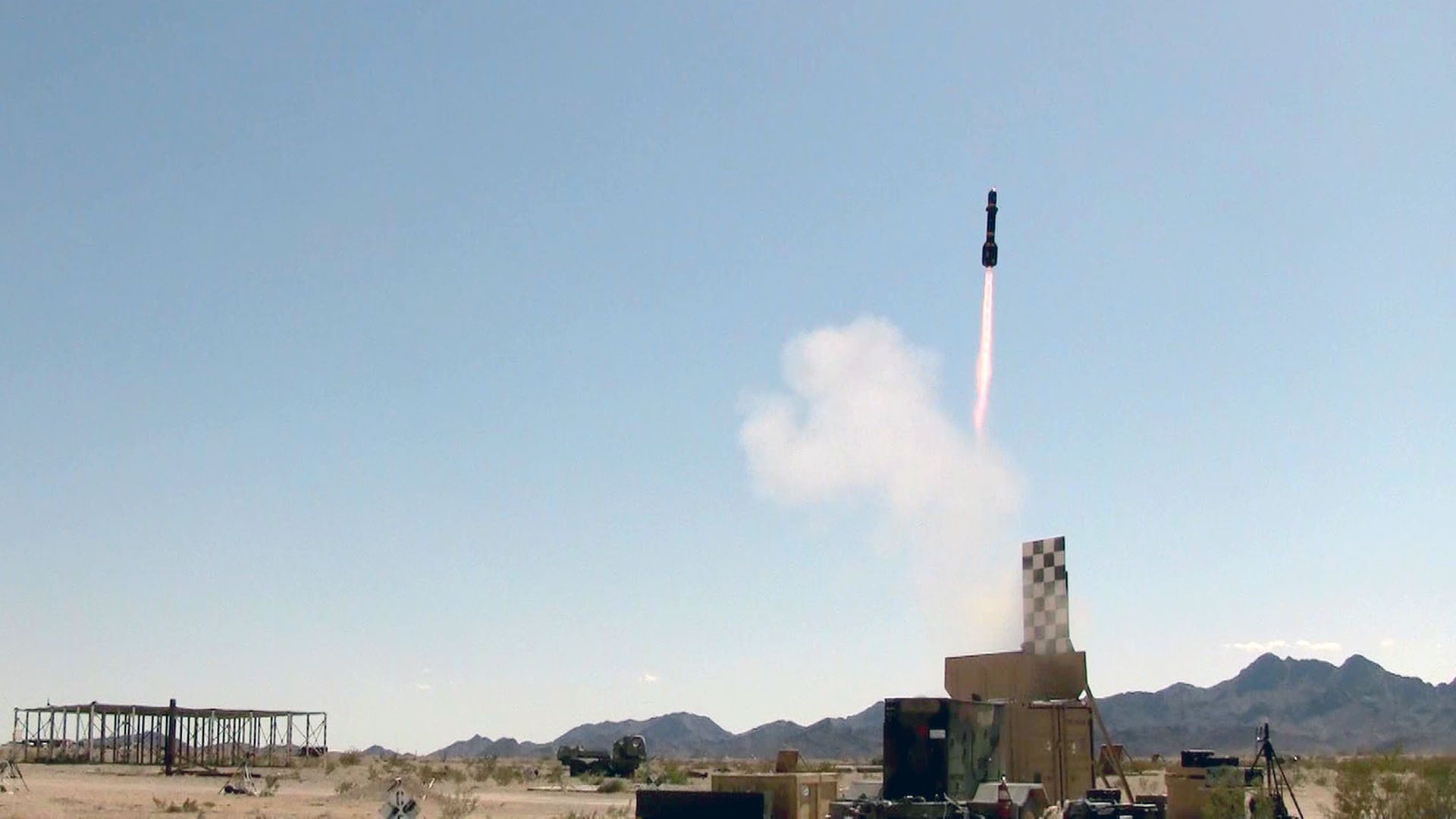
Lockheed Martin for the first time intercepted a Shahed-style attack drone using a Joint-Air-to-Ground Missile fired from a Grizzly containerized launcher, company officials told me.
- Its AI-fueled Sanctum counter-drone system was used as the battle manager. Fortem Technologies R40 radars were used to detect and track the target.
Why it matters: The U.S. military is scrambling for cheap, effective overhead defenses, and lately has shown a liking for weapons that can be packed into boxes and wheeled out where and when they're most needed.
- Lockheed assembled all these pieces and hit fire at Yuma Proving Ground, Arizona, in less than 45 days.
What they're saying: "When we show these things, we have the ability to produce them, develop them, get them out there at scale," Dan Tenney, senior vice president of global business development and strategy, told me.
- "We certainly think we're moving at speed, and we're changing our own practices."
- Lockheed is the world's largest defense contractor by revenue.
Zoom in: Grizzly, developed in six months, is suited for both land and sea, according to the company. Each JAGM costs a few hundred thousand dollars.
- "Containerization is really important," Tenney said. Firstly, "it's mobile." Secondly, "it can hide in plain sight."
- "The missiles themselves aren't exposed."
Follow the money: Lockheed invested $25 million in Fortem this year and also tapped the company to help protect critical infrastructure.
- Its kit has been used in Ukraine for years. U.S. allies in Europe and the Middle East recently ordered a dozen of its counter-drone systems.
The bottom line: "In this case, because you can fire one proven missile, you bring down the cost-per-kill drastically," Tenney said, "and you save your Patriots for larger, more-robust threats."
Go deeper: U.S. Army-led task force seeks counter-drone coordination
3. Taiwan keeps tabs
HSINCHU, TAIWAN — Taiwan's space agency wants to improve abilities to monitor Chinese maneuvers in space out of concern that acts of aggression could go undetected.
Why it matters: Space and satellites are essential to everyday life: financial markets, navigation, weather predictions, communication. They're also critical to military operations, enabling long-range strikes and surveillance.
- But if a Chinese satellite is doing some spooky things on our satellite, it's really hard for us to" actually observe it in time, a Taiwanese official told reporters during a tour of its facilities and assembly line.
What they're saying: "If it's in the air or if it's in the ocean, you can actually see that," the official said.
- "If it happens in space, it's really hard to collect evidence," the official said, noting that TASA hopes to build out that capability "in the near future."
State of play: The agency is responsible for multiple Earth-imaging projects, including Formosat-5 and -8. Synthetic aperture radar, which can penetrate bad weather and smoke, is planned for Formosat-9.
Threat level: China has over the years conducted several satellite close-approaches. That reflects "a likely on-orbit antisatellite capability," according to the 2025 China Military Power Report.
- Beijing also destroyed one of its own satellites in 2007, scattering space debris.
The bottom line: Space is dual-use. You don't know if "the civil space is purely civil space. You don't know the military use is purely military use," the official said. "Sometimes it's really hard to distinguish those two."
Go deeper: Global powers brace for space warfare
Editor's note: This trip, attended by more than a dozen members of the media, was organized and partially funded by the Taiwanese government.
4. AU(UV)KUS
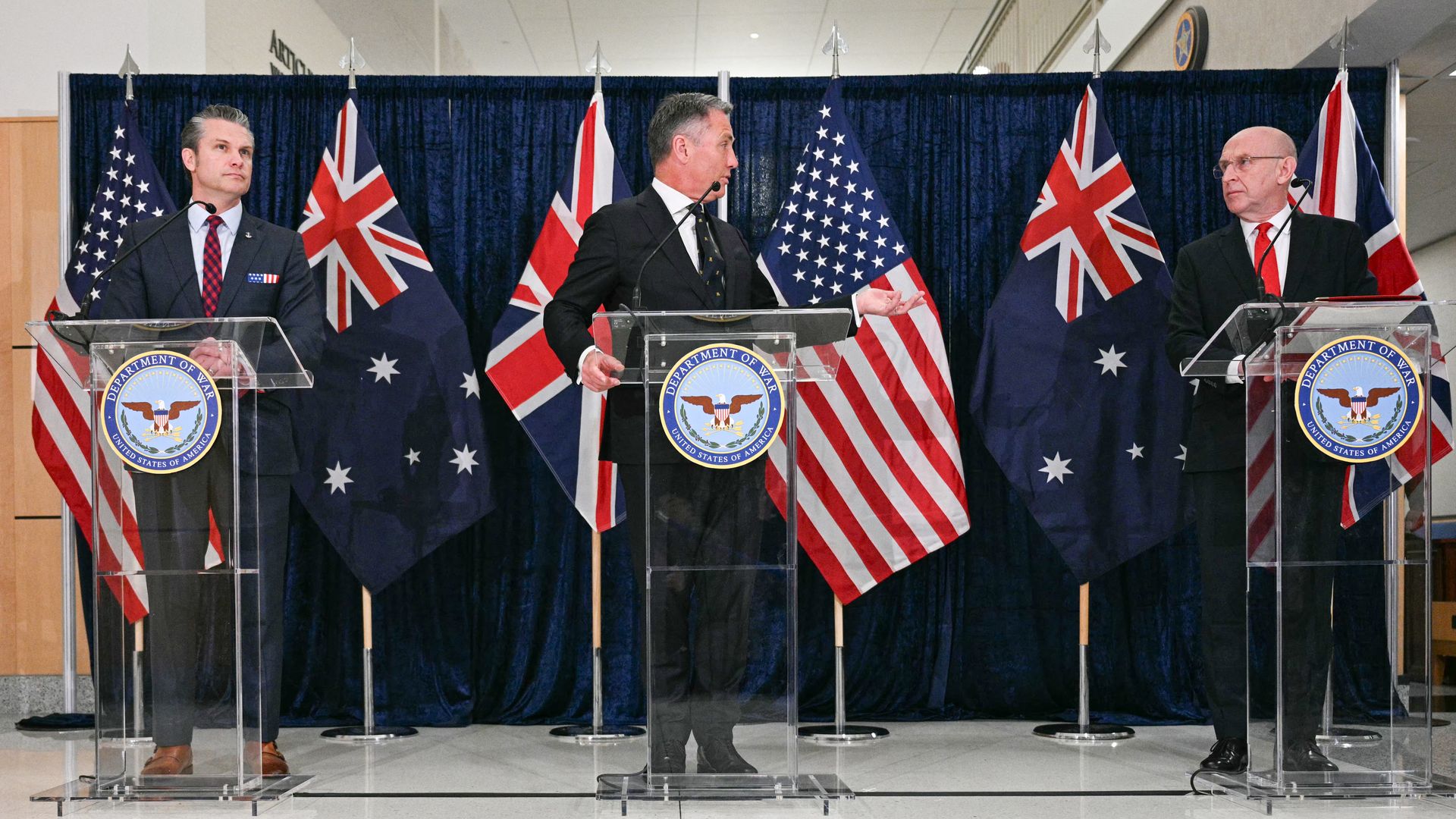
The U.S., U.K. and Australia will together develop interchangeable sensors and weapons for their uncrewed underwater vessels.
Why it matters: It's the first "signature" undertaking for AUKUS Pillar II, the autonomy, cyber, electronic warfare and quantum side of the trilateral pact so often associated with submarines.
Driving the news: The announcement coincided with the Shangri-La Dialogue in Singapore.
- Payload delivery is expected to begin next year.
Zoom in: The governments hinted at the capabilities that are in development in a joint statement, saying the project will "significantly enhance" their ability to protect seabed infrastructure, like cables and pipelines; conduct surveillance; strike targets; ferry supplies; and hunt other ships and subs.
What they're saying: "Indo-Pacific security and Euro‑Atlantic security are indivisible. What happens here matters to Brits at home, it matters to Americans, it matters to Aussies, too," U.K. Defense Minister John Healey said.
- London has committed approximately £150 million, or $202 million, he added.
The big picture: Uncrewed vessels, either on or below the waves, are considered key contributors to navies of the future. They can monitor far-flung corners of the world, relay communications, soak incoming fire and more.
The bottom line: "For too long with AUKUS, we talked too much and delivered too little," Healey said. "Make no mistake, this is a big step forward."
Go deeper: Ditching AUKUS will "cause grave damage" in Indo-Pacific, says McCaul
5. ICYMI: Missile management


The war in Iran has exacerbated a shortage of missile-defense weaponry that is likely to plague the U.S. and its partners — from Ukraine to Taiwan — for years to come.
Why it matters: The conflict is draining weapons stockpiles far faster than American factories can replace them, leaving the Pentagon and its allies scrambling to ramp up production and find cheaper alternatives.
- Ukrainian President Volodymyr Zelensky wrote to President Trump this week urgently requesting interceptors to knock down expected Russian missile barrages.
- But Iran has taken top priority, and a new analysis suggests it will take years to replace munitions expended in that war.
Breaking it down: A report from the Center for Strategic and International Studies finds that the U.S. used so many interceptors from missile defense systems like Patriot and THAAD in the Middle East that stockpiles won't be replenished until 2029.
- That's assuming the war does not resume, and even takes into consideration President Trump's massive $1.5 trillion defense budget proposal.
- The math is stark. The U.S. took delivery of just 172 Patriot interceptors in fiscal year 2026 and has used more than 1,000 in the Iran war, according to CSIS. Production targets in the coming years are much higher.
6. Quick hits

💳 Mach Industries raised $300 million. The startup is now valued at $1.8 billion. Other recent raises include Observable Space's Series A ($90 million), Picogrid's Series A ($45 million) and Shifters' seed ($10.2 million).
- Why it matters: As Mr. Krabs famously put it: Money, money, money.
- 💭 My thought bubble: Questions? Reread the first bit of this newsletter.
💀 Roughly 500,000 Russian troops have been killed in Ukraine since the start of the invasion, according to the head of Britain's electronic surveillance agency.
- Why it matters: Russian leader Vladimir Putin "is going backwards on the battlefield," GCHQ director Anne Keast-Butler said. "We're also disrupting Russia's attempts to smuggle Western tech."
- 💭 My thought bubble: Now add to that those injured. Staggering numbers.
☄️ The U.S. Space Force awarded SpaceX a $4.16 billion contract to speed up the service's Space-Based Airborne Moving Target Indicator program and deploy a constellation of satellites by 2028.
- Why it matters: "We are beginning development and integration efforts immediately to meet the program's rapid deployment milestones and address emerging national security requirements," Col. Ryan Frazier said in a statement.
- 💭 My thought bubble: My colleague Dan Primack chatted with Founders Fund about SpaceX and its early days investment. Check out that conversation, here.
🇨🇦 Canada entered negotiations with Saab to buy its GlobalEye airborne early warning and control aircraft, which is based on the Bombardier Global 6500.
- Why it matters: "GlobalEye is a highly modern and capable system that now has earned the trust of a fourth country, in addition to Sweden, France and the UAE," Swedish Prime Minister Ulf Kristersson said on X.
- 💭 My thought bubble: Separately, keep an eye on the Lightning II-Gripen debate.
7. Check this out
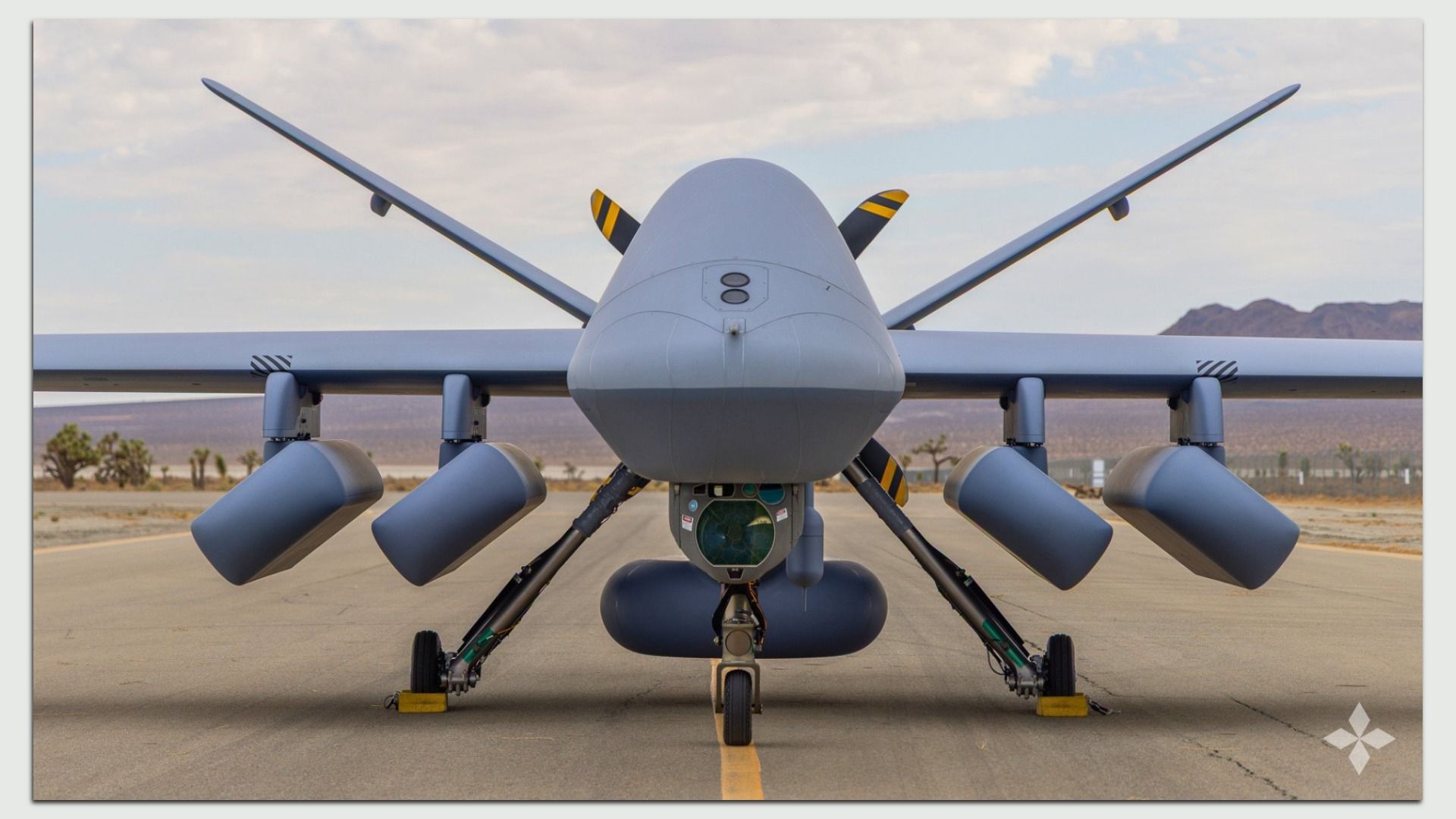
How many sonobuoys could a big drone chuck if a big drone could chuck sonobuoys?
The big picture: General Atomics Aeronautical Systems shared this photo on X the other day. It features an MQ-9B SeaGuardian loaded with sonobuoy dispensers.
- Each pod can "carry and dispense up to 10 A-size sonobuoys or up to 20 G-size sonobuoys," according to the company, which teased expanded testing in January.
My thought bubble: The Aviationist has lots more detail, here.
Go deeper: Saildrone is building a 170-foot unmanned sub-hunter
Shoutout to Dave Lawler for editing and Matt Piper for copy editing.
👋🏼 Thanks, as always, for reading and sharing. Tell your friends to subscribe here.
Sign up for Axios Future of Defense