Axios Future of Defense

July 09, 2025

Hello, again. Hope you had your fill of hot dogs over the long weekend. Reminder: Ketchup is for children!
- Headed to Reindustrialize in Detroit next week? Me too. Give me a shout!
🇺🇳 Situational awareness: Former national security adviser Mike Waltz will appear before senators next week for his confirmation hearing to be ambassador to the UN.
- My thought bubble: Waltz has laid low since his firing. My colleague Hans Nichols has the scoop, here.
Down the pike: An ESS verdict, Dutch F-35s and a gaggle of retired generals backing the E-7 Wedgetail.
Today's newsletter is 1,395 words, a 5.5-minute read.
1 big thing: U.S.-Ukraine power play
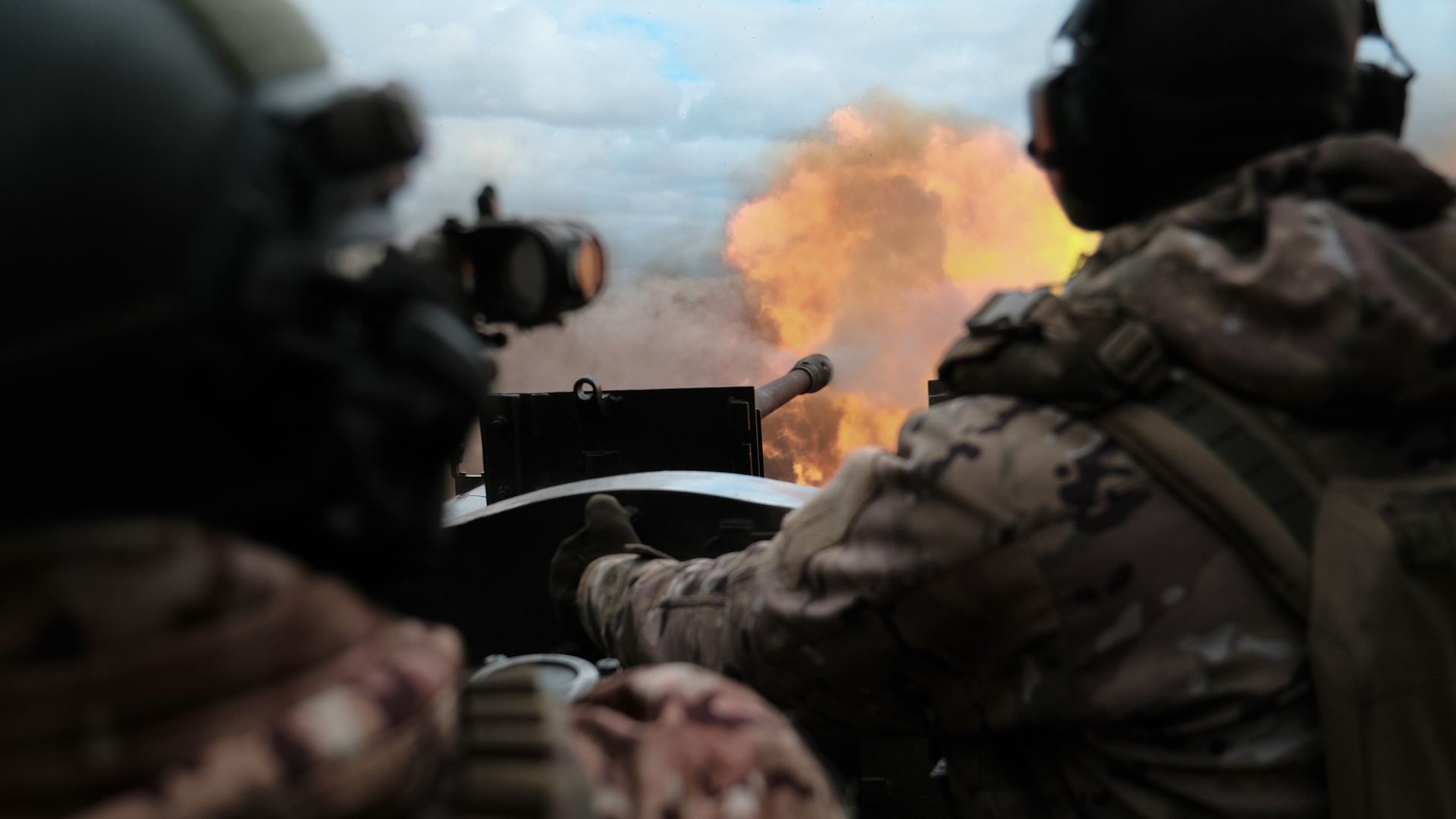
Recent U.S. messaging regarding Ukraine has been a cluster.
The big picture: Jumbled narratives and dismissive answers raise questions about what an "America First" foreign policy looks like, and who really holds the levers of power in Washington.
Driving the news: President Trump on Monday reversed a hold on weapons shipments to Ukraine. He told his counterpart, President Volodymyr Zelensky, in the intervening days he hadn't actually ordered the freeze, according to the Wall Street Journal.
- The suspension came after Trump asked Defense Secretary Pete Hegseth to take stock of Patriot air defenses and other key U.S. supplies, an adviser told Axios.
- It was Hegseth and Undersecretary of Defense for Policy Elbridge Colby who pushed for the pause, NBC News and Politico reported.
Zoom in: It's a breakout moment for Colby, who has argued for "strategic prioritization," aka elevating the Indo-Pacific and Taiwan's defense at the expense of other regions.
- In his March confirmation hearing, Colby warned senators the U.S. lacks a "multi-war military."
- He was also hesitant to name Russia as Ukraine's invader, citing a delicate diplomatic situation.
The intrigue: Trump has been reluctant to both blame Russia and equip Ukraine, telling aides that if he sends weapons to Kyiv it could become "my war," my colleagues Marc Caputo and Barak Ravid reported.
- But Trump has grown increasingly frustrated with Russian leader Vladimir Putin, and German Chancellor Friedrich Merz has personally advocated for Ukraine's overhead defense.
- "We get a lot of bullshit thrown at us by Putin, if you want to know the truth," Trump said at a Cabinet meeting this week. "He's very nice all the time, but it turns out to be meaningless."
Zoom out: The Pentagon on July 2 blamed the arms holdup on a broader review of American support to militaries worldwide.
- "For a long time — four years under the Biden administration — we were giving away weapons and munitions without really thinking about how many we have," spokesperson Sean Parnell told reporters. (Former national security adviser Jake Sullivan rejected that thinking in an essay published in the New York Times.)
- Some Ukrainian needs overlap with those of U.S. troops abroad, including in the Middle East, where the largest Patriot engagement ever occurred last month at Al Udeid Air Base in Qatar.
What we're watching: It remains unclear which other countries fall under the administration's review, and where the line is drawn.
- The State Department, for example, authorized a potential $510 million sale to Israel at the end of June.
- Washington's also been working to beef up Taiwan.
The bottom line: "It is absolutely vital that security assistance continues to flow to force Putin to the negotiating table," Sen. Jeanne Shaheen (D-N.H.), the ranking member of the Foreign Relations Committee, said in a statement.
- "Unfortunately, last week's decision sent exactly the wrong message."
Go deeper: Changes to U.S. weapons sales mustn't be "haphazard," says Rep. Dean
2. Countering today's IEDs

The U.S. Defense Department is assembling a counter-drone task force capable of coordinating actions taken by the often stovepiped military services.
Why it matters: The group has Hegseth's blessing.
Driving the news: Army Vice Chief of Staff Gen. James Mingus revealed the task force, still in its infancy, at a Center for Strategic and International Studies think tank event July 2.
- "We need an organization that is joint, interagency, has ... a colorless pot of money and the authorities to go from requirements all the way through acquisition in a rapid way, to be able to keep pace with that," he said.
The intrigue: Mingus likened the drone-counter-drone threat to that of improvised explosive devices so often encountered during the global war on terror.
- "We cannot move fast enough in this space," he said.
- An explosive drone strike in early 2024 killed three U.S. troops at Tower 22 in Jordan.
Zoom in: The Army is expected to lead the task force.
- Few other details are available.
- Questions sent to the service — concerning the task force's name, expected size and metrics of success — were not immediately answered.
Zoom out: The drone threat has existed for years. The Nagorno-Karabakh conflict opened Pandora's box while the Russia-Ukraine war injected its consequences into social media algorithms.
Flashback: Under the Biden administration, the Pentagon launched the Replicator initiative, which sought to quickly find, buy and deploy thousands of drones and countermeasures.
- Critics said it was too little too late.
Go deeper: Dominating drone defense
3. Boeing nabs ESS

The U.S. Space Force tapped Boeing to build at least two satellites to be used for nuclear weapons coordination.
Why it matters: The company bested Northrop Grumman for the nearly $3 billion Evolved Strategic Satellite Communications (ESS) contract.
State of play: The ESS satellites will succeed the service's Advanced Extremely High Frequency constellation, a key part of command-and-control networks that ensure the U.S. can use its nukes if and when the time comes.
- Boeing is expected to deliver the first spacecraft by 2031.
- The verdict has been years in the making, with preliminary work dating back to 2020.
What they're saying: "The U.S. needs a strategic national security architecture that works without fail, with the highest level of protection and capability," Kay Sears, the vice president and general manager of Boeing's space, intelligence and weapons division, said in a statement.
- "We designed an innovative system to provide guaranteed communication to address an evolving threat environment in space."
- The company's announcement touted a "highly protected" waveform as well as classified technologies developed alongside the Defense Department.
Between the lines: Its bid was built on prior experience with Wideband Global SATCOM-11 and -12 spacecraft as well as the O3b mPOWER system.
Zoom out: The combined 2025-34 nuke plans of the Defense and Energy departments add up to $946 billion, the Congressional Budget Office said in April.
- Nuclear acquisition programs represent almost 12% of the Pentagon's planned buying costs over the next decade.
Go deeper: A "more powerful" Space Force requires upgraded arsenal, says Kendall
4. Quick hits
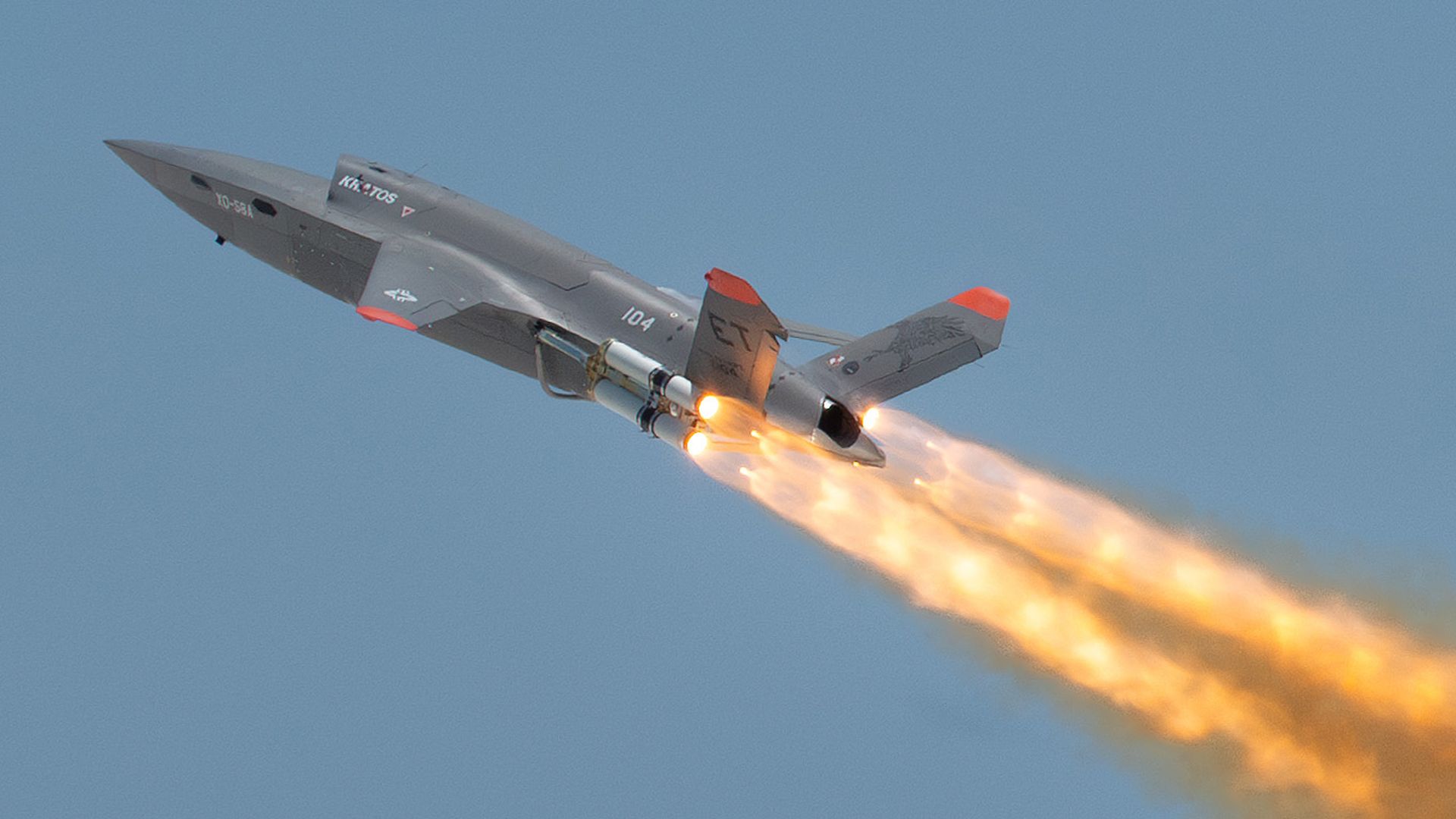
🦾 Pilots in F-16C and F-15E jets each controlled two XQ-58A Valkyrie drones during an air-combat training scenario in Florida, the U.S. Air Force Research Laboratory said.
- Why it matters: This is another step toward the human-machine fighting force of the future.
- 💭 My thought bubble: It's hard to relay in photos and text, but the Valkyrie is big. Staged at defense conferences, it looks like a breaching whale.
↔️ HavocAI and Lockheed Martin Ventures are collaborating on a 100-foot medium unmanned surface vessel (mUSV), expected to break cover by the end of this year. The former already produces 14-, 38- and 42-foot drone boats.
- Why it matters: "The mUSV is a game-changer for maritime defense, offering enhanced range, payload capacity, and mission versatility," Chris Moran, the vice president and general manager of Lockheed's investing arm, said in a statement.
- 💭 My thought bubble: The USV game is white hot — but also loaded with hazards. Justin Katz at Breaking Defense breaks it down nicely, here.
🇳🇱 Dutch F-35s will patrol NATO airspace from September to December, protecting materiel bound for Ukraine, according to the country's defense ministry.
- Why it matters: "In this way, we literally keep the Russian threat at bay," Ruben Brekelmans, the defense minister, said in a statement.
- 💭 My thought bubble: Timely, given everything I wrote about at the top of this newsletter.
⛴️ BlueForge Alliance and Palantir Technologies have partnered in hopes of improving U.S. shipbuilding and sustainment.
- Why it matters: Their Warp Speed for Warships initiative is funded by the U.S. Navy's Maritime Industrial Base program.
- 💭 My thought bubble: Shipbuilding needs all the help it can get.
5. Check this out

More than a dozen retired U.S. Air Force generals, pictured above, are urging Congress to revive the E-7 Wedgetail project and buy more F-35As.
- You can read their letter, shared by the Air and Space Forces Association, here.
The big picture: "China has committed itself to being able to achieve, in two short years, the successful amphibious assault of Taiwan — an island with a peaceful, self-governing people," they said.
- "If conflict does come, there will be no more decisive question than who controls the skies over the Pacific."
Friction point: The Air Force said it's nixing the E-7, an early-warning and control aircraft, in favor of space-based solutions.
- But "the scientific and engineering hurdles to accomplish this goal are daunting and the timeline to success is unclear," the retired generals said.
Go deeper: Trump administration shelves Navy's F/A-XX, citing industry strain
Shoutout to Dave Lawler for editing and Matt Piper for copy editing.
👋🏼 Thanks, as always, for reading and sharing. Tell your friends to subscribe here.
Sign up for Axios Future of Defense