Axios Future of Defense
March 04, 2026

Busy, busy. Let's get right into it.
- This month, I'm moderating a nuke panel at the Govini Defense Software and Data Summit and a drone panel at the National Security Innovation Base Summit. See y'all there?
🇨🇳 Situational awareness: The U.S. spent at least $3.4 trillion on confronting and countering China between 2012 and 2024, according to a Costs of War report published yesterday.
Up and coming: Blackbeard advancements, Lightning Surge electronic warfare and chatting with Vantor's Susanne Hake.
Today's newsletter is 2,038 words, a 7.5-minute read.
1 big thing: The ongoing fight
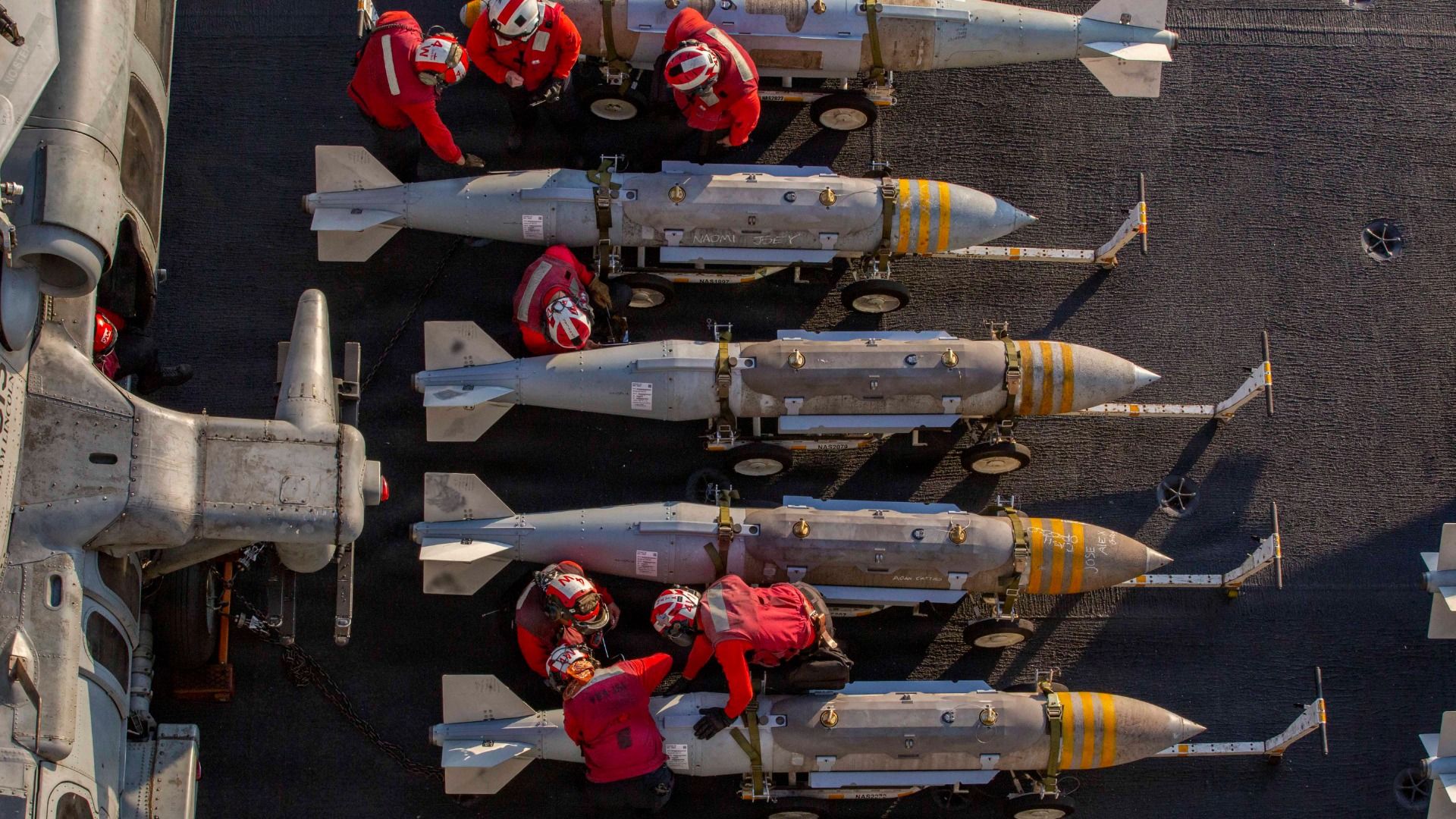
The U.S., Israel and Iran have been at war for days. The fighting has thus far:
- Produced several combat firsts, including in drone, missile and fighter performances;
- Supercharged debate about war powers and congressional oversight, or lack thereof;
- And killed many, including six American troops.
The big picture: The conflict is slowly expanding, as Iran lashes out at neighbors and tankers, Hezbollah lobs missiles from Lebanon and European governments mull their respective roles going forward.
Here are just some of the key stats, observations, remarks and achievements driving the Operation Epic Fury conversation:
🏢 U.S. troops were killed when Iran attacked a tactical operations center, according to Defense Secretary Pete Hegseth. (CNN previously reported it was a suspected drone strike.)
- Hegseth also did not publicly rule out putting boots on the ground. Both President Trump and Joint Chiefs Chairman Gen. Dan Caine warned of additional casualties.
🪽 The U.S. for the first time used LUCAS attack drones, which are modeled after Iran's deadly delta-winged Shahed.
- Each costs about $35,000. They were launched by Task Force Scorpion Strike, a group that was publicly revealed in December.
🚀 The U.S. also fired the new Precision Strike Missile, or PrSM, from a High Mobility Artillery Rocket System.
- The weaponry was visible in footage shared by Central Command, as analysts noted.
📈 The U.S. has thus far used "tens of thousands" of pieces of ordnance in its campaign, according to Caine.
- Tomahawk Land Attack Missiles were part of the opening salvo, as Cyber and Space commands worked their magic behind the scenes.
⚫ At least one photo of a Tomahawk launch shows the munition in an unusual glossy-black paint scheme.
- It could be a measure to reduce detectability — aka increase stealth. The War Zone drew comparisons to the Long-Range Anti-Ship Missile.
🌊 Trump said American forces sank nine Iranian warships and are working to finish off the rest of its navy. CENTCOM called specific attention to a foundering corvette in the Gulf of Oman.
- "Abandon ship," the command posted on X.
➡️ The U.K. is sending its HMS Dragon warship and Wildcat helicopters, armed with drone-busting Martlet missiles, into the Eastern Mediterranean. British officials also said their intelligence community is "making a serious contribution" and that the U.S. can use the Diego Garcia and RAF Fairford bases.
- But British Prime Minister Keir Starmer has said the country "will not join offensive action," despite Iran's "scorched earth strategy."
✈️ Israel said it achieved air superiority over Tehran, employing approximately 200 fighter jets and attack helicopters.
- The aircraft took out ballistic missile launchers, air-defense systems, command-and-control nodes and more than 50 drones, according to Israel Defense Forces tallies.
❌ Qatar said it downed two Iranian Su-24 aircraft and intercepted seven ballistic missiles.
- The country also denied a Bloomberg report that it was running low on Patriot interceptors.
What we're watching: How long the conflict persists. American officials have suggested weeks, at least.
- "Make no mistake, the Islamic Republic is still fighting," Behnam Ben Taleblu, an expert at the Foundation for Defense of Democracies, told me.
- "It may be leaderless, but not rudderless."
More from Axios:
U.S. Capitol security "heightened" due to Iran conflict
Trump delivers Iran messaging through exclusive interview spree
2. Castelion takes flight
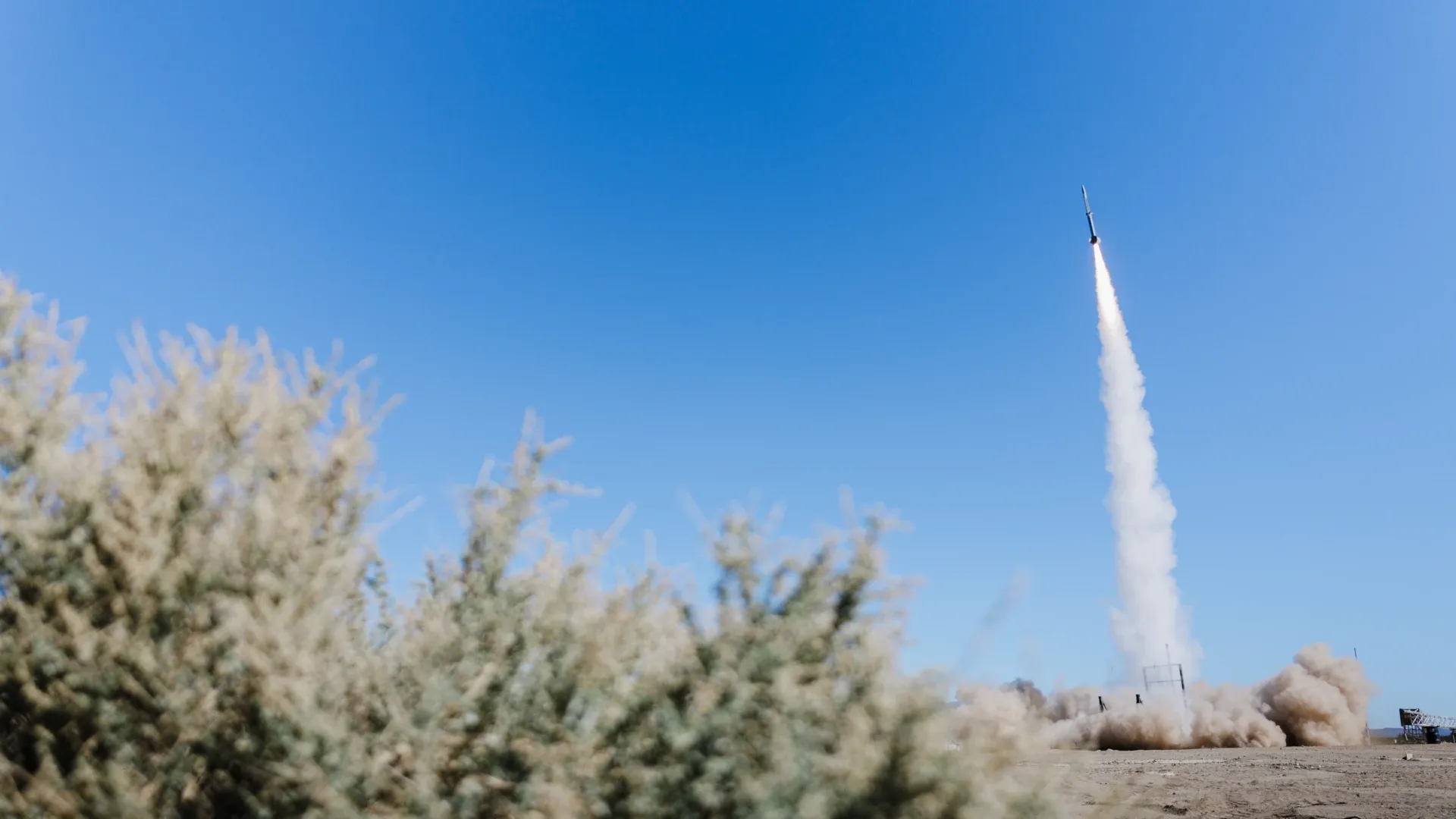
Castelion's air-launched variant of the Blackbeard hypersonic missile will fly aboard an F/A-18 in the near future, I have learned.
The big picture: The company, founded in 2022 and now valued in the billions of dollars, in late February scored nearly $50 million to continue development of the weapon, Pentagon contract records show.
- It's also working with the Army to integrate onto the High Mobility Artillery Rocket System.
Zoom in: Castelion has sites in Texas supporting the effort, as well as its headquarters in Torrance, California.
Context: Emil Michael, the Pentagon's chief technology officer, last year named hypersonic weaponry as a "critical technology area."
- Experts have warned the U.S. arsenal trails those of China and Russia.
Flashback: Castelion recently broke ground on Project Ranger, a 1,000-acre plant in Rio Rancho, outside of Albuquerque.
- "Project Ranger is all about scaling out an enormous production capacity," Bryon Hargis, a co-founder, told me at the time.
Go deeper: Castelion wants Blackbeard missiles made at New Mexico factory in 2026
3. Exclusive: Banks hits up Hegseth

Sen. Jim Banks (R-Ind.) wants the Pentagon's nascent Artificial Intelligence Futures Steering Committee to identify China's top AI influencers, examine the country's security practices and investigate what sabotage of frontier models might look like, according to a letter I obtained exclusively.
Why it matters: AI is supercharging the Washington-Beijing face-off.
- And military employment of the technology is driving one of the largest news stories of the year.
Driving the news: Banks laid out his recommendations and questions for the committee in a two-page letter to Defense Secretary Pete Hegseth sent yesterday.
- In it, the senator describes AI as "likely to be the defining technology of the 21st century" and notes China is "clearly aware" of its applications.
- "Many experts predict that AI may soon match or surpass human performance across various tasks, including AI research and development itself."
Catch up quick: The fiscal 2026 National Defense Authorization Act directed the Defense Department to form a senior panel to tackle questions about AI and potential breakout moments.
Zoom out: The U.S. military has for years used and experimented with AI, autonomy and automation.
- The Pentagon's fiscal 2026 budget blueprint allocated $13.4 billion for autonomous systems, including $9.4 billion for aerial drones and $210 million for ground vehicles.
- It logged more than 685 AI-related projects in 2022. At the time, the Army had the most. The Marine Corps had the least.
The bottom line: "Last year, DeepSeek caught much of our national security community by surprise," Banks wrote.
- "As AI competition intensifies, we need to take appropriate actions to avoid strategic surprises."
Go deeper: China seeks "alternative world order," U.S. commission warns
4. Anthropic asks

U.S. defense contractors are examining their relationships with Anthropic and its products days after President Trump said he would blacklist the company.
Why it matters: Such declarations are exceedingly rare.
- The very public Pentagon-Anthropic feud also risks spooking the defense-tech market as it gains wider public acceptance.
Driving the news: I asked 14 big-name defense contractors about their dealings with Anthropic as well as whether and how they use Claude.
- Northrop Grumman said it has "very limited use of Claude" but would not continue the "pilot effort." The AI space, it said, is "rapidly changing."
- Leidos said it employs a "range of commercial AI tools" and has licensed Claude for "limited use." The company is "prepared to adjust" its "technology stack as required" to match government policy.
- HII said it does not have a relationship with Anthropic.
- Both RTX and L3Harris Technologies declined to comment.
- Others, including Anduril Industries, BAE Systems and GE Aerospace, did not respond by my deadline.
Flashback: The Defense Department last week probed Boeing and Lockheed Martin's exposure to Anthropic. At the time, a source familiar told Axios the department would reach out to "all the traditional primes."
- Boeing is the seventh-largest defense contractor in the world ranked by defense revenue. Lockheed is first.
Go deeper: U.S. must "absorb a lot of risk" in AI race, says Palantir's Karp
5. Quick hits
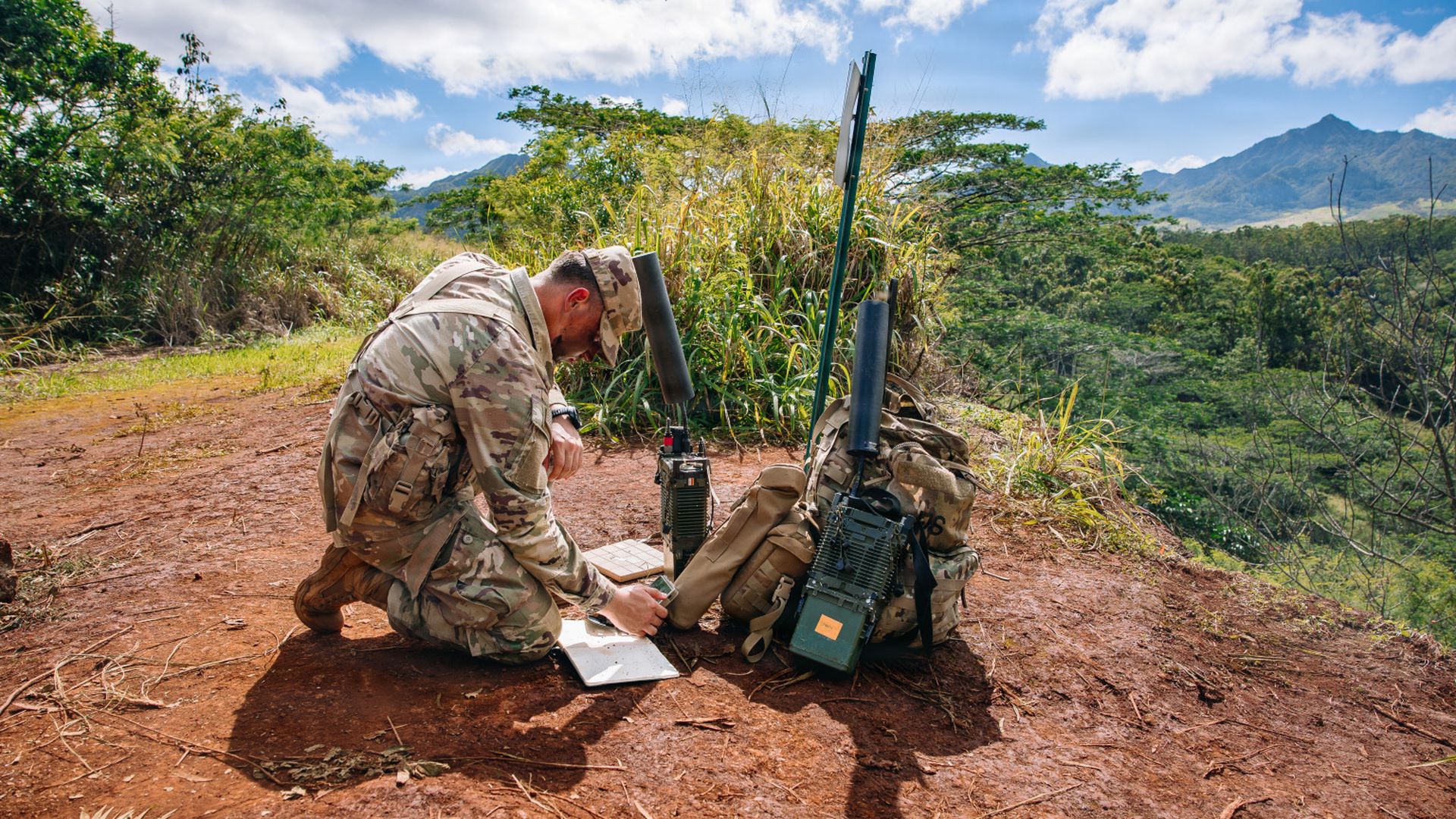
⚡ Soldiers with the 25th Infantry Division automated their electronic warfare workflows during the recent Lightning Surge II exercise.
- Why it matters: "We can, with great clarity and increased speed, determine if that's really an adversary signal or if that's a friendly signal," Lt. Col. Adam Brinkman told reporters.
- 💭 My thought bubble: If Ukraine has taught people anything, it's that speed matters, delays kill and jamming is effective.
⏩ Hermeus flew its Quarterhorse Mk 2.1. The aircraft is the size of an F-16 and powered by a Pratt & Whitney F100 engine.
- Why it matters: "We're building and flying aircraft on timelines that match the urgency of the world we're in," chief executive AJ Piplica said in a statement. (It's the company's second first-flight in less than a year.)
- 💭 My thought bubble: Aviation Week has a solid rundown, here.
🖥️ Phasecraft joined the Defense Advanced Research Projects Agency's Quantum Benchmarking Initiative. Its work falls under a nearly $35 million contract with the University of Maryland.
- Why it matters: The news follows the company's $34 million Series B.
- 💭 My thought bubble: Who are the smartest quantum reporters or writers you follow? Reply to this newsletter and let me know.
💵 Smack Technologies raised a combined $32 million. Its seed round was led by Point72 Ventures. Its Series A was led by Geodesic Capital and Costanoa Ventures.
- Why it matters: The company, led by veterans, already has U.S. Defense Department contracts, including for the Joint Fires Network.
- 💭 My thought bubble: The press release mentions "WWIII" four times.
6. Axios interview: Susanne Hake

This week's conversation is with Susanne Hake, the general manager of Vantor's U.S. government business.
- We met up in Arlington.
Why she matters: Hake has years of experience in the defense, intelligence and business communities. Before joining Vantor — then Maxar — she was at Palantir Technologies.
- Vantor on Feb. 25 announced an additional U.S. Army One World Terrain contract worth as much as $217 million.
Q: When you hear "future of defense," what comes to mind?
A: It's not just about collecting more data, which is something we've been doing for a long time. It's about connecting data and then pushing that connection into prediction.
- You can still go to any watch floor or mission operation center, and you see your analysts with four screens and 10 different legacy systems, and they're still manually stitching together information. There's still that gap.
- How do we think about going from situational awareness to true anticipation?
Q: What's the biggest challenge the defense industry faces at the moment?
A: I know you hear this from everyone, but I do think it's the acquisition system. It's just not built for where we are, in terms of modern technology.
- When AI is improving every hour, and software is coming out every few days and procurement cycles are still taking years, it's just really challenging to get new capabilities out in the field.
- I am optimistic about the progress we're making and some of the new policies coming out.
- But the changes aren't going to be made unless both the contractors commit to making changes and the government commits to making changes.
Q: What's a national security trend we aren't paying enough attention to?
A: Space. It's our bread and butter here.
- I think most people don't realize how much of their daily lives on Earth are connected to what's going on in space.
Q: What's your secret to a successful overnight flight?
A: Well, I don't think there's such a thing as a successful overnight flight. Maybe I start by asking you to rewrite the question.
- For me, I'm super-impacted by jet lag. Any time I travel internationally, I've been using the Timeshifter app. A couple of days in advance, it sets a schedule for you.
Q: What's a piece of gear or tech you can't go without?
A: At first I was going to say my phone, but that's so obvious. I would say my Oura ring, though.
- My goal is to improve my sleep and reduce my stress levels.
7. Check this out
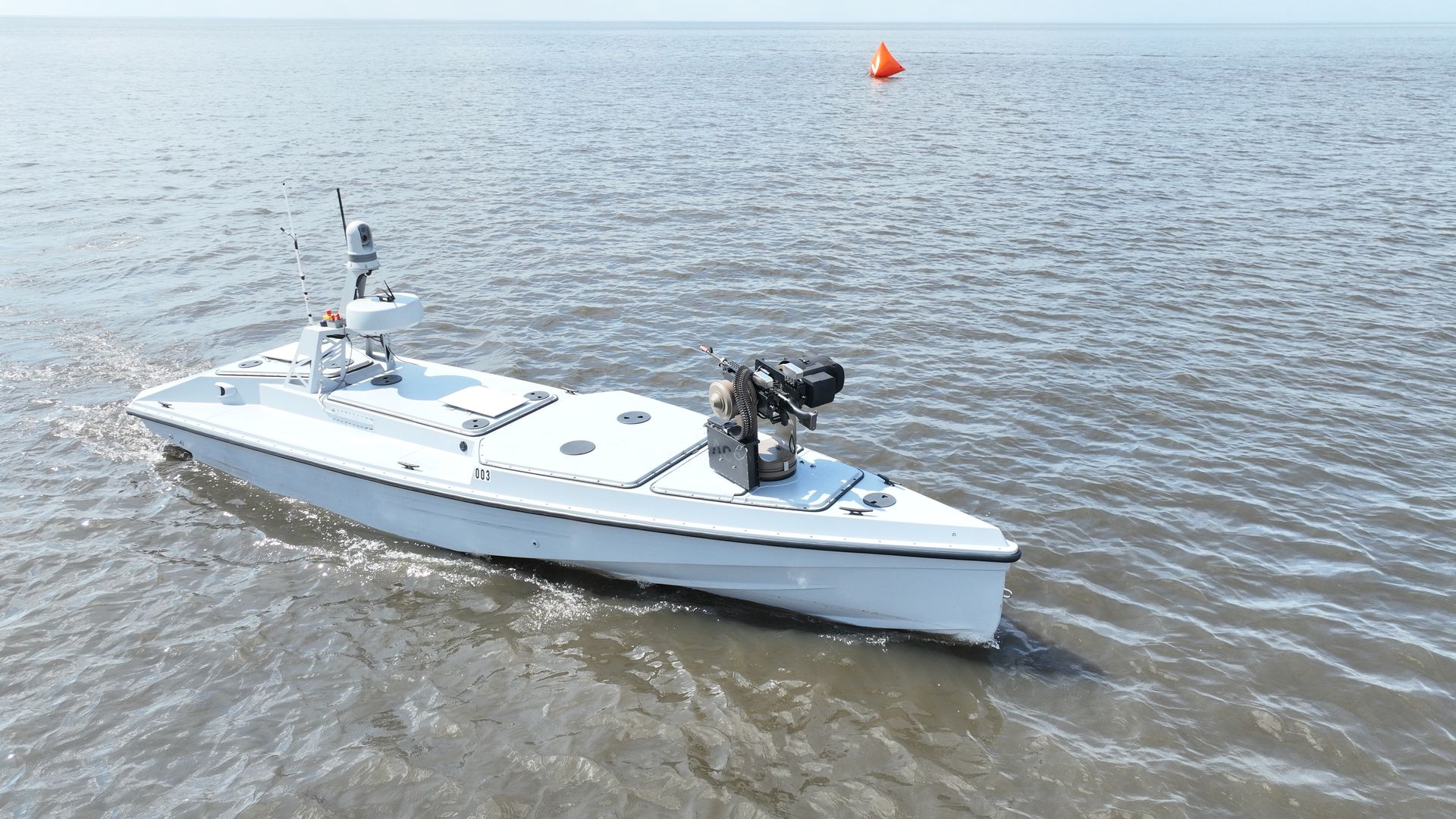
The latest defense-tech collaboration? A counter-drone drone-boat.
The big picture: Allen Control Systems is equipping Blue Ops, a maritime division of Red Cat, with its autonomous turrets.
- ACS is also joining the Red Cat Futures Initiative.
What they're saying: "The rapid proliferation of small unmanned systems has reshaped the modern battlefield and requires equally advanced countermeasures," Red Cat's Jason Gunter said in a statement.
Go deeper: Louisiana becoming a drone boat hot spot
Shoutout to Jeffrey Cane for editing and Matt Piper for copy editing.
👋🏼 Thanks, as always, for reading and sharing. Tell your friends to subscribe here.
Sign up for Axios Future of Defense