Axios Future of Defense
July 23, 2025

Welcome to Wednesday. Rain coats no longer cut it for the Washington commute. I'm now packing water wings.
- We're hosting an invite-only Golden Dome event in Huntsville, Alabama, on Aug. 5. Stay tuned for details!
👋 Situational awareness: A patched-up British F-35B departed an Indian airport Tuesday after being stranded there for more than a month. Its prolonged stay generated headlines and memes, including a fake auction.
- My thought bubble: The New York Times wins the headline contest on this one. "Bye, Bro."
On hand: Anduril-Archer moves, Booz Allen's $300 million commitment and German robo-wingmen.
Today's newsletter is 1,565 words, a 6-minute read.
1 big thing: Exclusive ... Sullivan and stockpiles
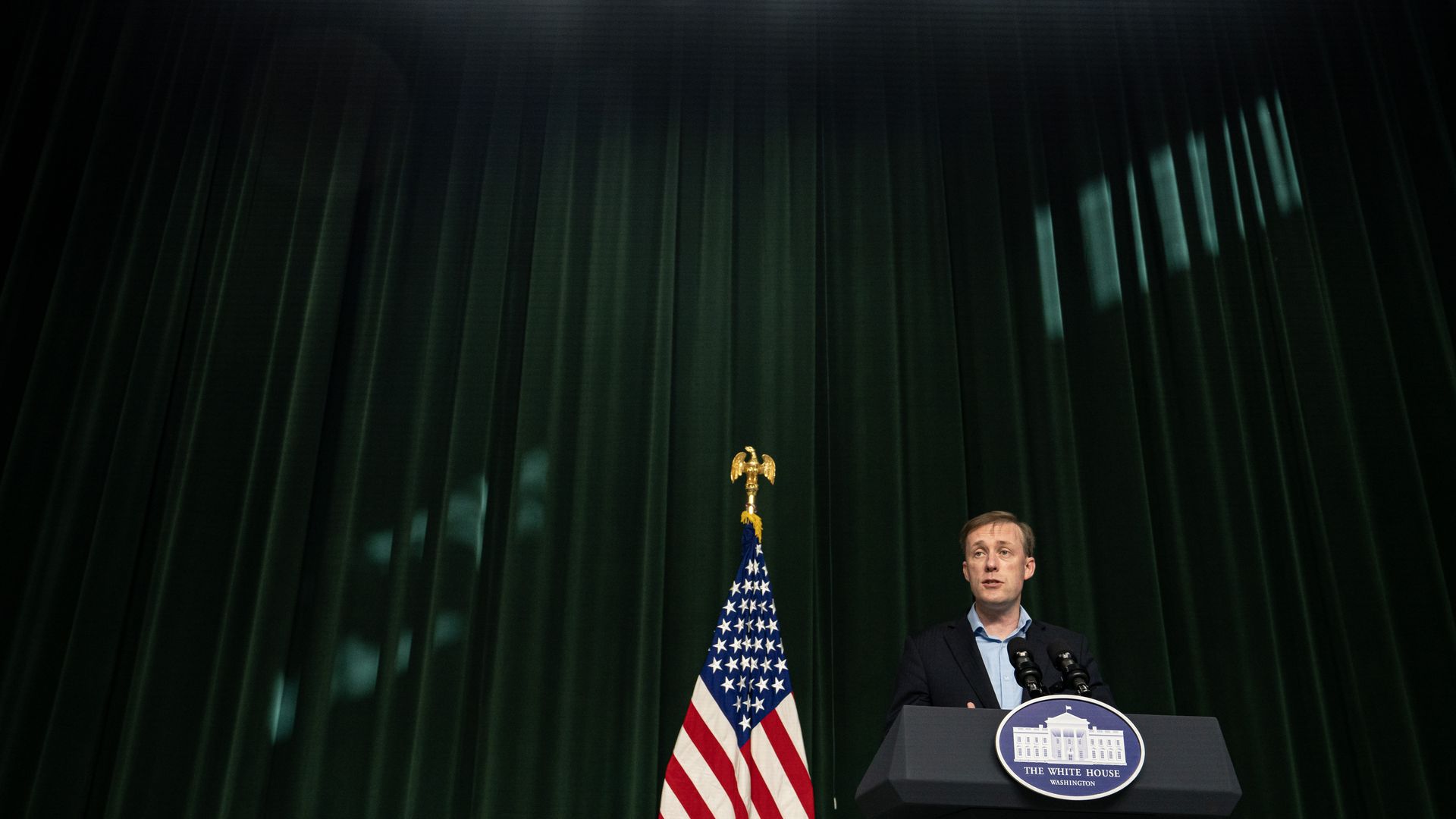
Years of industrial complacency, including not putting "enough energy or emphasis on munitions," has painted the U.S. into a corner, former national security adviser Jake Sullivan told me.
- Solving the problem, he said, requires a "generational project" spanning business interests and political affiliations.
Why it matters: Today's defense news cycle is dominated by questions of American manufacturing might. The conversation is set against a backdrop of competition with Russia and China (and their growing symbiosis).
- The sudden shipbuilding obsession, including President Trump's own preoccupation, is a symptom of this.
Driving the news: Sullivan and I spoke on the sidelines of the Reindustrialize conference in downtown Detroit, a city experiencing its own metropolitan rebirth.
- There's a pressing need, he said, "for the national security community — not just the economic policy community — in the United States to be focused on reconstituting our industrial base in critical sectors that are going to define the future."
- The status quo "was decades in the making," he added. "When I came in, I found just how weakened a state our defense-industrial base was in."
State of play: Reams of studies, white papers, op-eds and surveys detail the fragility of the defense-industrial base (DIB).
- Govini's National Security Scorecard, published this summer, warned that China's "relentless three-decade military modernization — with an estimated $236 billion expenditure in 2024 — and Russia's industrial surge capacity — quintupling artillery shell production since 2022 — starkly contrast with the U.S. DIB."
- The Ronald Reagan Institute's National Security Innovation Base Report Card, shared in March, cautioned that the U.S. "struggles to manufacture and field new national security tech" at speeds and scales that matter.
- And the Commission on the National Defense Strategy concluded last July that the Pentagon's "business practices, byzantine research and development and procurement systems, reliance on decades-old military hardware, and culture of risk avoidance" reflect a bygone era.
Yes, but: There's hope the ship can be righted. It will take time — meaning multiple administrations and, potentially, conflicts.
- Sullivan in our conversation encouraged the Trump administration to pursue multiyear contracting for munitions.
- Such deals give defense contractors "the certainty to make the capital expenditures to build the factories, to supply the munitions, rather than make this a year-by-year thing."
- Multiyear munitions buys were also favored by the House China Committee.
What they're saying: "The more you challenge the industrial base, you build the muscle, and it's like a flywheel," Darin DiTommaso, a GE Aerospace vice president, told me at the conference.
- "You actually enhance the capability of the supply base by putting more challenge on them, as opposed to starting and stopping programs, because that's when you lose people, and you lose skill sets," he said.
- "It's really hard to restart a production line once you've stopped it."
By the numbers: The U.S. Air Force in 2024 inked a $3.2 billion multiyear contract with Lockheed Martin for Long Range Anti-Ship and Joint Air-to-Surface Standoff missiles. That same year, the Navy secured a bulk deal with HII for four amphibious warships, expected to save the service $1 billion.
The bottom line: "A country without robust manufacturing is hardly a country at all," Jamieson Greer, the U.S. trade representative, said in a Reindustrialize speech.
- "America, like any country, is not just a country of consumers that want cheap stuff. It's a country of producers."
Go deeper: "You could never have enough": Militaries scramble for air defense interceptors
2. Exclusive: Hill and Valley who's who
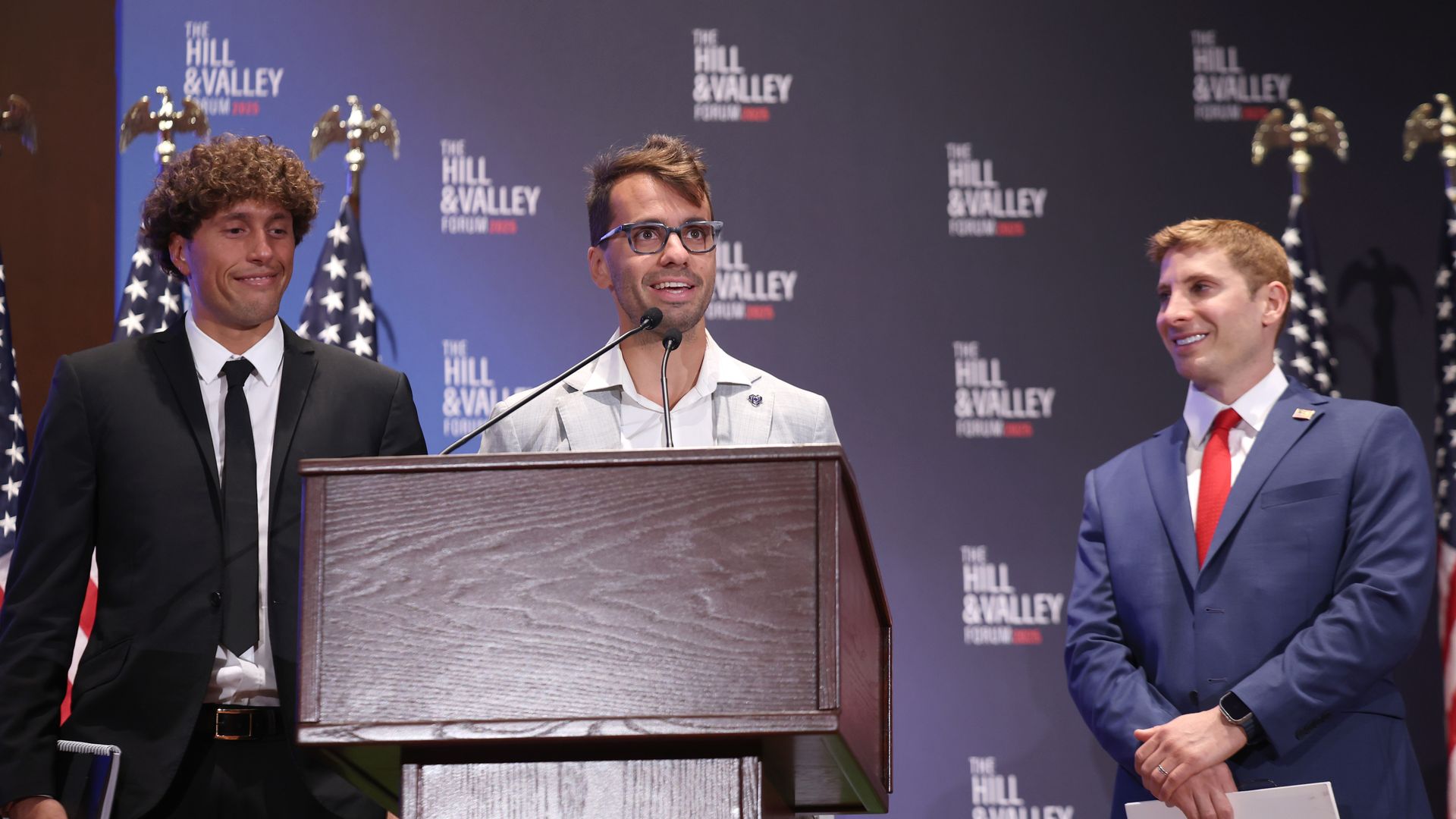
The Hill and Valley Forum sprang from an idea years ago for a 40-person get-together: four tables of 10 people discussing shared interests. Today, it's cohosting an artificial intelligence summit in downtown Washington anchored by President Trump.
Why it matters: The group wields increasing influence at the intersection of policy, venture capital and American industry, including weapons production, at a time when powerful communities on the East and West coasts are getting cozy.
Driving the news: I spoke with Hill and Valley co-founders Jacob Helberg, Christian Garrett and Delian Asparouhov ahead of the "Winning the AI Race" event.
- The consensus? The opportunity to blunt China and ensure U.S. advantage is attractive to almost all political persuasions and business sectors.
The latest: Helberg, who was earlier this year nominated to be a top State Department economic policy and trade official, described Hill and Valley as "the Rosetta Stone," capable of translating the wants and needs of previously standoffish tribes.
- "Washington saw Silicon Valley as a collection of companies that acted as quasi-sovereigns, detached from national security priorities or detached from the national interest," he said. "Vast swaths of Silicon Valley at the time saw Washington as a nuisance and a roadblock to building transformative technologies."
- "While China had civil-military fusion, America had civil-military confusion."
Context: This afternoon's AI conference comes weeks after the Hill and Valley Forum confab at the Capitol, which drew some of the flashiest names in tech and politics.
- Speakers included Palantir CEO Alex Karp and Nvidia CEO Jensen Huang as well as Sen. Jack Reed (D-R.I.) and House Speaker Mike Johnson (R-La.).
What they're saying: "This is a unifying event, from a geographical perspective, among the U.S. and our allies. It is also a unifying event within Silicon Valley," said Garrett, who is also a partner at 137 Ventures.
- "People who usually compete with each other come together around this, and that obviously spreads to the D.C. dynamic."
- The 137 Ventures portfolio includes Anduril Industries, Hadrian, Ramp and SpaceX. Hadrian last week announced a $260 million raise and its factories-as-a-service model.
What we're watching: The ripple effects of the White House's AI action plan, expected to drop this week, on the Pentagon.
The bottom line: "This wasn't necessarily, from the get-go, meant to be this huge statement or intended to turn into this massive thing," said Asparouhov, also the co-founder of Varda Space Industries.
- "There were just a lot more companies that were being started up, and a lot more people that were turning their eye toward the national security community as somebody they really wanted to serve," he added.
- "I feel like we helped embolden that trend."
Go deeper: Tech's dance with the Pentagon speeds up
3. Archer-Anduril advancements

Archer Aviation and Anduril Industries are "deep in the work, building stuff," for their hybrid-power vertical takeoff and landing aircraft, the former's CEO, Adam Goldstein, told me.
Why it matters: Very little has been shared about the project, which was initially described as targeting a potential Pentagon program.
What they're saying: "I think the U.S. and its allies have an increasing demand for autonomous and attritable assets, especially big flying things," Goldstein said in an interview on the sidelines of the Reindustrialize conference in Detroit.
- "The need is very near-term for this stuff. The question is: How much of it can you build?"
Catch up quick: The companies announced their exclusive partnership in December. At the time, Goldstein told Axios: "You can imagine things that helicopters do are the things that we're building toward."
Flashback: Archer most recently raised $850 million. It disclosed the funding ahead of the Paris Air Show, where it displayed its Midnight aircraft.
- Archer last summer delivered a Midnight aircraft to the U.S. Air Force for evaluation under the Agility Prime program.
Go deeper: Archer to provide electric air taxi service during 2028 L.A. Olympics
4. Quick hits
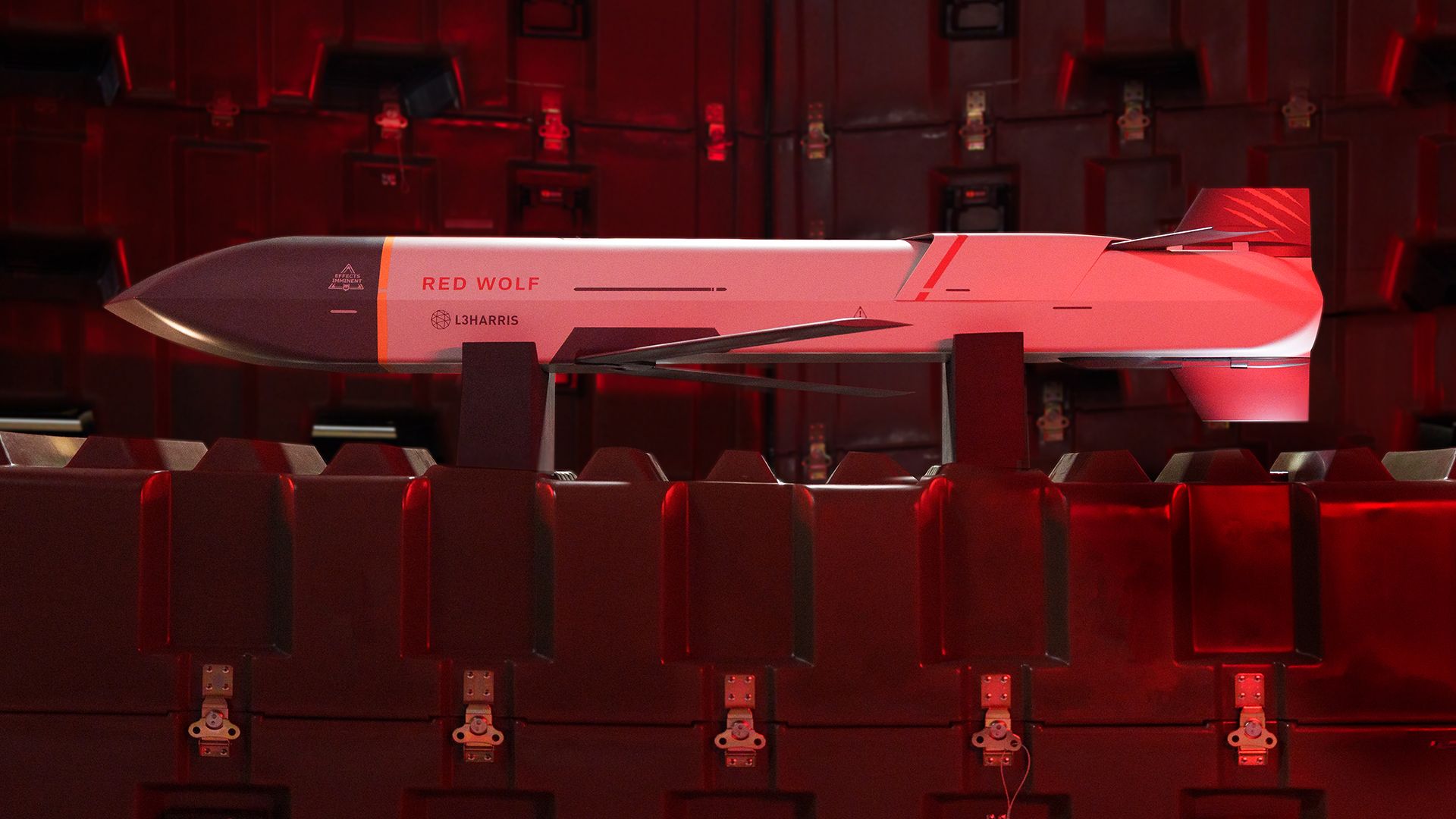
🐺 L3Harris Technologies rolled out a pair of launched effects, Red Wolf and Green Wolf. The former is designed for explosive precision strikes; the latter, jamming and sensing.
- Why it matters: The company has already completed 40-plus flights with what it's calling the "wolf pack."
- 💭 My thought bubble: The lines between launched effect, missile and drone continue to blur.
🏧 Booz Allen Hamilton is tripling its venture capital commitment — $300 million, up from $100 million — and plans to spend it on AI, cyber, autonomy, quantum and space companies.
- Why it matters: "We are in a race for global tech supremacy, and America's innovation ecosystem is our most important source of strategic advantage," Matt Calderone, Booz Allen's chief financial officer, said in a statement.
- 💭 My thought bubble: Booz Allen Ventures backs companies you know (especially if you read this newsletter): Hidden Level, Second Front and Shift5, among others.
💥 The U.S. Army used a Typhon launcher to hit an at-sea target with a Standard Missile-6 during the Talisman Sabre 25 exercise in Australia.
- Why it matters: It's a first-of-its-kind firing west of the International Date Line.
- 💭 My thought bubble: There's always an information warfare angle. This is no exception.
🇩🇪 Airbus and Kratos are working together on drone wingmen, which they hope to have "combat ready" for the German air force by 2029. They will be based on the XQ-58A Valkyrie.
- Why it matters: "This partnership will help to accelerate Europe's ability to defend itself while fostering NATO's transatlantic ties," Mike Schoellhorn, CEO of Airbus Defense and Space, said in a statement.
- 💭 My thought bubble: The War Zone has a ton more detail, here.
5. Check this out

This is a defense-tech Rorschach test.
- Who does this robot most closely resemble?
The big picture: Anduril Industries founder Palmer Luckey on July 17 conducted a live interview in Detroit, from California, using Phantom, a robot made by San Francisco-based Foundation Future Industries.
Inside the room: The mullet was a last-minute addition, people familiar with the costuming process told me.
What they're saying: "I'm a big believer in tele-operated robotics versus, let's say, exo-suits," which were better suited for Cold War and global war on terror eras, Luckey said.
Shoutout to Dave Lawler for editing and Matt Piper for copy editing.
👋🏼 Thanks, as always, for reading and sharing. Tell your friends to subscribe here.
Sign up for Axios Future of Defense