Axios Future of Defense

April 23, 2025

Good morning, y'all, and welcome back.
- Headed to Modern Day Marine in Washington? Me too. Give me a shout!
🛡️ Situational awareness: The U.S. Army's future tank, the M1E3, is "absolutely modular," Vice Chief of Staff Gen. James Mingus said at an event Tuesday. While the "base vehicle" will stick around for 50 years, he continued, "everything inside the cockpit" needs to be rapidly replaceable.
- My thought bubble: Tanks do have a place on the battlefields of the future. The Ukraine experience isn't one-size-fits-all.
Below: Domino's deal, Carnegie's cash and Hegseth's headaches.
Today's newsletter is 1,672 words, a 6.5-minute read.
1 big thing: The case for deep-tech big bets

Innovation is a weapon. But in a defense world pockmarked by delays, it typically doesn't come fast or cheap.
Why it matters: The largest leaps ahead are accomplished by butting heads with the hardest problems.
- And, oftentimes, whoever corners a market as it emerges sets its rules.
The latest: I spoke with a half-dozen business executives, financiers, former defense officials and more who made the national-security case for patient capital and argued the government should play riskier hands on technologies that may not come to immediate fruition but, given enough time, can change the game.
- "The next decade of geopolitical competition is going to get boiled down to frontier technology," Adam Hammer, CEO of Roadrunner Venture Studios, told me. "Which technologies dominate and where they are built will decide some of the most important questions facing humanity."
- Roadrunner springboards deep-tech endeavors. It works closely with scientists and scholars at national labs and universities.
- "Today it's like, 'Hey, we discovered something in the lab. It's at a benchtop.' Great. It needs a team. It needs a business model. It needs to be productized. It needs marketing. It needs all of these things to make it scale," Hammer said. "But we as a country have not figured out that early valley of death."
Zoom in: Areas of opportunity include advanced materials and manufacturing; energy production and storage; compute; quantum; and agritech.
- Some of these sectors are incredibly capital-intensive.
- "You're unlikely to have a lot of commercial investors fund something super, super early, where they don't know if the basic science has been figured out," Jason Lapadula, a former Pentagon official and Marine infantry officer now at LeoLabs, told me.
Zoom out: Michael Kratsios, President Trump's chief science and tech policy adviser, in a speech at the Endless Frontiers summit last week said there is "nothing predestined about technological progress and scientific discovery."
- "For a future stamped with the American character, the federal government must become an early adopter and avid promoter of American technology," he added.
- "Our industrial might, unleashed at home, and our technical achievements from AI to aerospace, successfully commercialized, can also be powerful instruments of diplomacy abroad and key components of our international alliances."
State of play: Some promising avenues already exist. Sources pointed to the Office of Strategic Capital, Defense Innovation Unit and Defense Advanced Research Projects Agency, as well as the Accelerate the Procurement and Fielding of Innovative Technologies program.
- "The only question is how do we structure this," Anshu Roy, the founder of Rhombus, said in an interview. "It's not a matter of if."
Threat level: China's goals for 2035 include boosting economic and science-and-technology strength, "new-type industrialization" and having "national defense and armed forces modernization basically achieved," according to a translated version of its 14th five-year plan.
- Also mentioned in the document are space and polar exploration — two fronts of security competition.
The bottom line: "If the U.S. wants to win the next era of aerospace, we need to fund the hard problems very early. That means prioritizing technologies still in the R&D-to-product transition, not just scaling what's already proven," Venus Aerospace CEO Sassie Duggleby told me.
- "Let me be specific: If China fields hypersonic systems that can circle the globe in under two hours while American companies are still chasing SBIR Phase II grants, we've lost the game."
2. Exclusive: In the digital depths

Domino Data Lab will spearhead artificial intelligence efforts for the U.S. Navy's Project AMMO following a $16.5 million deal.
The big picture: The award — made through the APFIT program, designed to accelerate procurement of innovative technologies — comes amid growing pressure inside and outside the Pentagon to smartly adopt software.
- Defense Secretary Pete Hegseth in March issued a memo titled "Directing Modern Software Acquisition to Maximize Lethality."
- And the Atlantic Council that same month published a report on "software-defined warfare," arguing the U.S. is still moored to an acquisition system "ill-suited to the rapid tempo of modern technological innovation."
The latest: The money allows Domino and its partners to continue their work, which involves developing, deploying and retraining models for unmanned underwater vehicles.
- Early work on Project AMMO was tied to mine countermeasures. That scope is expanding as part of the APFIT arrangement.
What they're saying: "Domino is the glue," Joel Meyer, the company's president of public sector, told me.
- "Without Domino, the user would end up having to leverage multiple different tools, different logins, different ways to access data, different ways to spin up."
Zoom out: Domino is working with Latent AI, Fiddler AI, Weights & Biases and Arize AI.
- "This is an opportunity for military organizations to take advantage of what's been going on in the commercial industry for a long time," Doug Small, an adviser to Latent and former head of Project Overmatch, told me.
What we're watching: If and how success here, with the Navy, translates to wins among the other services.
3. Exclusive: Carnegie consortium's cash

A consortium led by the Carnegie Corporation of New York is pledging millions of dollars to turbocharge nuclear weapons expertise, particularly concerning risk reduction and the bomb's intersection with space and artificial intelligence.
Why it matters: Political uncertainties in the U.S. are sparking proliferation concerns and prompting nuke discussions in France, Germany, Poland and South Korea.
- Meanwhile, China is expanding its own arsenal, the nuclear shadow looms over Ukraine, and negotiations about Iran's future creep along.
Driving the news: Louise Richardson, the Carnegie Corporation of New York president, announced the fund at a conference Tuesday.
How it works: The consortium is launching with $10.2 million to distribute over the next two years, with plans to raise more funds going forward.
- Backers include Carnegie, Longview Philanthropy, PAX sapiens and Founders Pledge. Others may chip in.
- The group will soon seek research proposals from think tanks, university centers, nongovernmental organizations, individual experts and more.
- Who gets what will be determined by the consortium members. Grants will likely be a minimum $500,000.
The announcement is meant to make clear "that nuclear threats are still here. They're still with us, and they're being complicated by things like emerging technologies," James McKeon, a program officer in the Carnegie international peace and security program, told me.
- "You could say it's a success every single day that a nuclear weapon is not used," he said. "But, of course, we want to be more specific than that."
- "For us, success in nuclear policy means long-term investment. It's a long-term challenge."
Context: The U.S. and Russia wield the largest nuclear stockpiles in the world, with thousands of warheads each. China trails with hundreds.
Yes, but: Arms control is not at the top of the list for presidents Vladimir Putin and Xi Jinping.
- The last major U.S.-Russia arms control treaty, New START, expires in less than a year. President Trump is unlikely to negotiate another major treaty that does not involve China.
- And Beijing last year waved off conversations, citing weapons sales to Taiwan, which it considers a renegade province.
The bottom line: "We need to reinvest in our capability to understand these trends and to bring together people with deep expertise in technology and politics and these regions and these regional players if we're going to make ourselves safer," Carl Robichaud, the director of Longview's nuclear weapons policy program, told me.
- "I think we might look back at this moment as a time that this field was revitalized," he added, "and that you had a new wave of philanthropic interest and a new wave of expertise coming into the field."
4. Up close with Japan's railgun
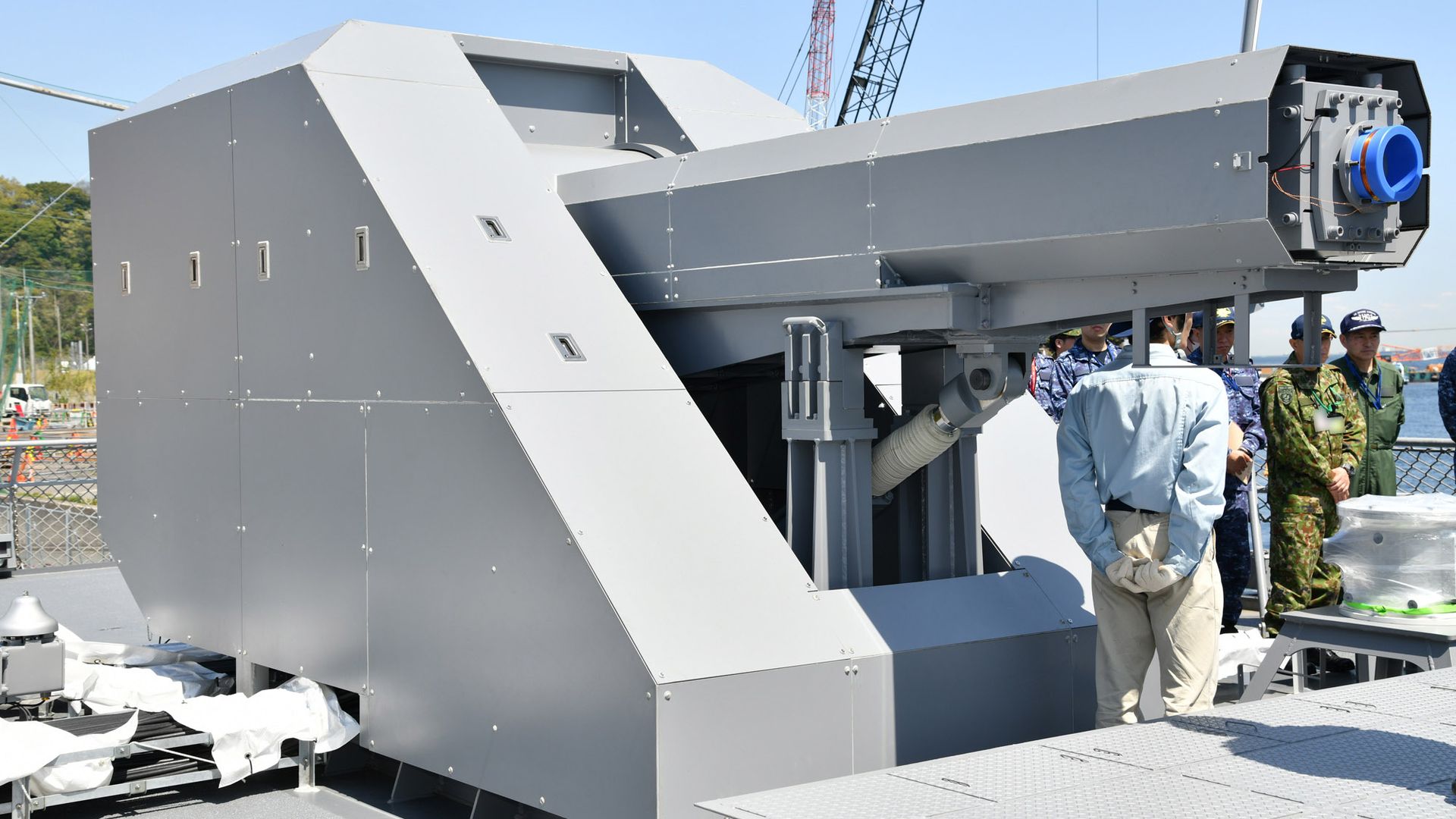
Japan recently gave the world its best look yet at an experimental railgun aboard the JS Asuka test ship.
Why it matters: It's a style of weapon the U.S. military expressed great interest in but ultimately shelved.
The latest: Photos emerged following a visit by Vice Adm. Omachi Katsushi, the commander of the Self-Defense Fleet.
- An accompanying statement described the railgun as still "under development."
Catch up quick: Japan's Acquisition, Technology and Logistics Agency in 2023 said it successfully test-fired a shipboard railgun.
- The country months later signed a railgun cooperation pact with France and Germany, according to Aviation Week.
Friction point: Railguns require significant power and cooling systems, and physical space on warships is a precious resource.
Go deeper: Shield AI delivering V-BAT drones to Japan's navy
5. Quick hits

🛰️ Astranis will build Taiwan's first-ever dedicated communications satellite. It is expected to launch by the end of the year and be fully operational in early 2026.
- Why it matters: China has threatened to seize the island and sever its ties to the outside world.
- 💭 My thought bubble: Ongoing sabotage of undersea cables underscores the value of resilient communications and PACE plans.
💸 Ukraine fueled its domestic drone industry with more than $2.5 billion in 2024-2025, according to numbers published by its defense ministry.
- Why it matters: Money talks, and Kyiv is screaming.
- 💭 My thought bubble: The variety of manufacturers and loadouts is to be envied. The ministry named 36 first-person view and 12 reconnaissance drone manufacturers, among other specialists.
🏗️ Putting U.S. Space Command headquarters in Alabama, not Colorado, would've saved the Pentagon $426 million, according to a heavily redacted watchdog report.
- Why it matters: President Trump is expected to relocate the command, with an announcement coming as soon as this month, according to Rep. Mike Rogers, an Alabama Republican.
- 💭 My thought bubble: Insert the Patrick Star "push it somewhere else" meme here.
6. Check this out

All eyes in Washington are glued to the Pentagon as Defense Secretary Pete Hegseth's future is debated.
The big picture: My newsroom colleagues have kept close tabs on this week's saga, plus its preface.
Here's what you may have missed ...
🥾 First House Republican calls for Pete Hegseth's ouster
⛔ White House denies reports that it plans to replace Hegseth
📲 Turmoil engulfs Pentagon as fresh Signal allegations hit Hegseth
🔍 Two top Pentagon officials put on leave amid leak investigation
👋 "Heads should roll": Congress erupts over stunning Trump admin leak
💥 How Trump's team could've planned the Houthi strikes without Signal
Shoutout to David Lawler for editing and Matt Piper for copy editing.
👋🏼 Thanks, as always, for reading and sharing. Tell your friends to subscribe, here.
Sign up for Axios Future of Defense