Axios Future of Defense
September 03, 2025

The long weekend is over, unfortunately. At least the weather in D.C. was nice.
- We're hosting a space security event next week in Navy Yard. Expect a full rundown in a future newsletter.
🧱 Situational awareness: The U.S. military killed 11 people in a strike on a drug-running vessel, according to President Trump. Secretary of State Marco Rubio said it departed from Venezuela.
- My thought bubble: My colleague Marc Caputo was way ahead of the news cycle on this. Give his latest a read!
What's cookin': F-47 optimism, the Space Command shuffle and a handshake heard 'round the world.
Today's newsletter is 1,881 words, a 7-minute read.
1 big thing: The contractor conundrum
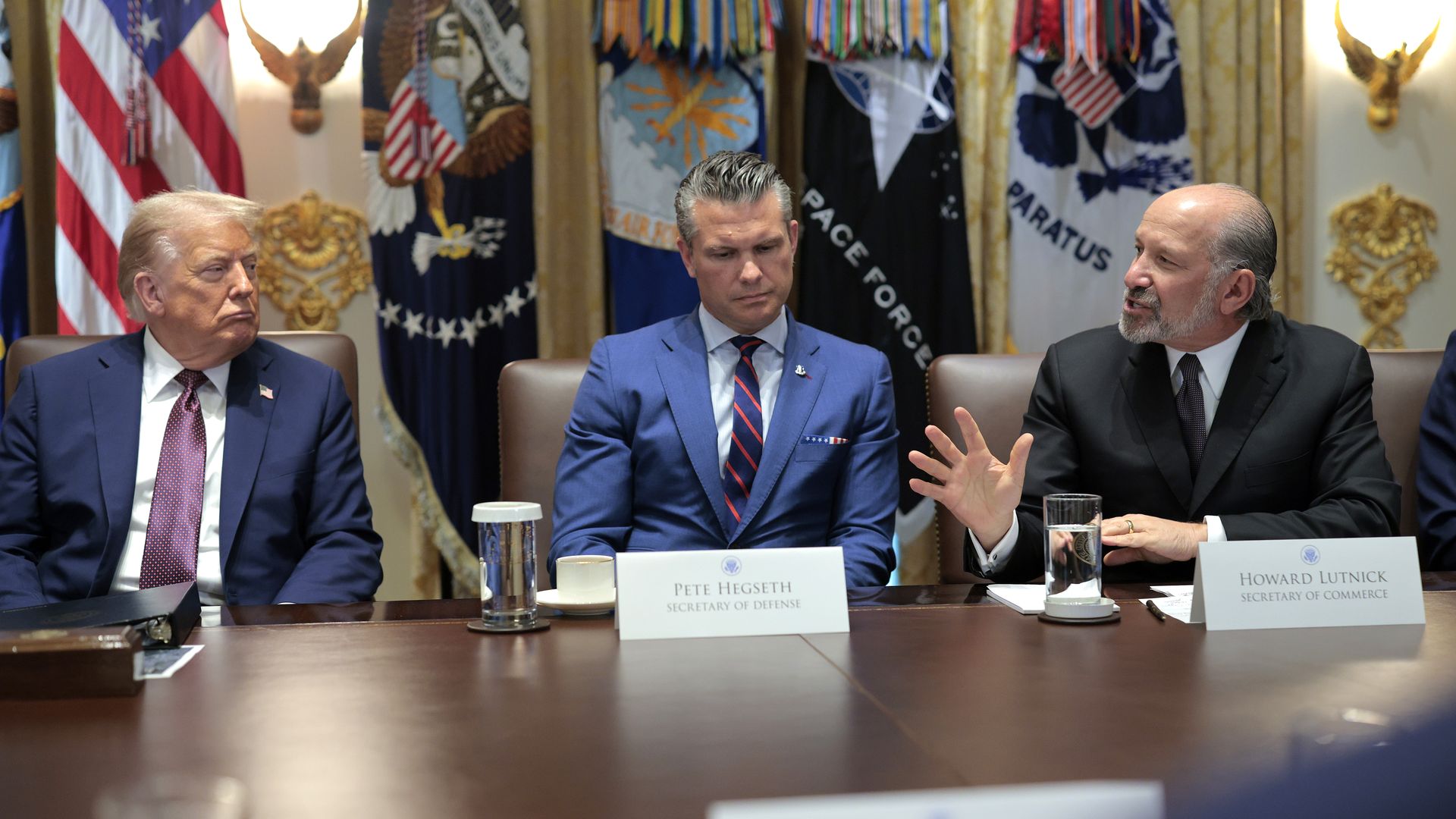
As the Trump administration considers taking stakes in big defense contractors, industry insiders are so far offering silence, sidesteps and safe answers.
Why it matters: Commerce Secretary Howard Lutnick's suggestion last month that the government may acquire pieces of weapons makers inspired political jabs from the left and right as well as dramatic comparisons to China's military-civil fusion.
- "There's a monstrous discussion about defense," Lutnick told CNBC, later describing Lockheed Martin, the world's largest defense contractor by revenue, as "basically an arm of the U.S. government."
- The administration is already intervening in the economy in unprecedented ways, particularly when it comes to semiconductors. Arms sales seem like a natural next step.
Friction point: The Cabinet commentary puts companies in a tough spot: Do they publicly break with the White House at a time when loyalty scorecards are a very real thing?
- And imagine this goes ahead. Competitors for multibillion-dollar contracts are now part-owned by the U.S. government.
Driving the news: I asked a wide variety of defense firms if they'd had contact with the administration about the partial nationalization idea, and if they would consider selling stakes if asked.
Here's what I heard back:
- L3Harris Technologies said it "supports President Trump as he fulfills his most critical responsibility as commander in chief" and that its "top priority" is "to evaluate new ways to partner with President Trump and the Department of Defense in that regard."
- Lockheed said it is "continuing our strong working relationship with President Trump and his administration to strengthen our national defense."
- Boeing, HII, Leidos and RTX declined to comment.
- Others, including Booz Allen Hamilton and CACI, didn't respond by deadline.
Zoom out: Two government power plays are fueling all this tea-leaf reading:
- Its $11.1 billion investment in Intel, for which it secured a 9.9% stake
- Its 15% fee on some of Nvidia's and AMD's chip sales to China
Yes, but: Defense is a beast unto itself — with timelines, acquisition structures and consequences unseen elsewhere.
The other side: Treasury Secretary Scott Bessent has downplayed Lutnick's speculation.
- "We'll see whether the defense companies are fulfilling their mission in terms of providing adequate and timely deliveries for the U.S. military," he said, "as opposed to maybe an overemphasis on the shareholders."
Go deeper: Trump's pay-me capitalism puts the squeeze on corporate America
2. Need for speed
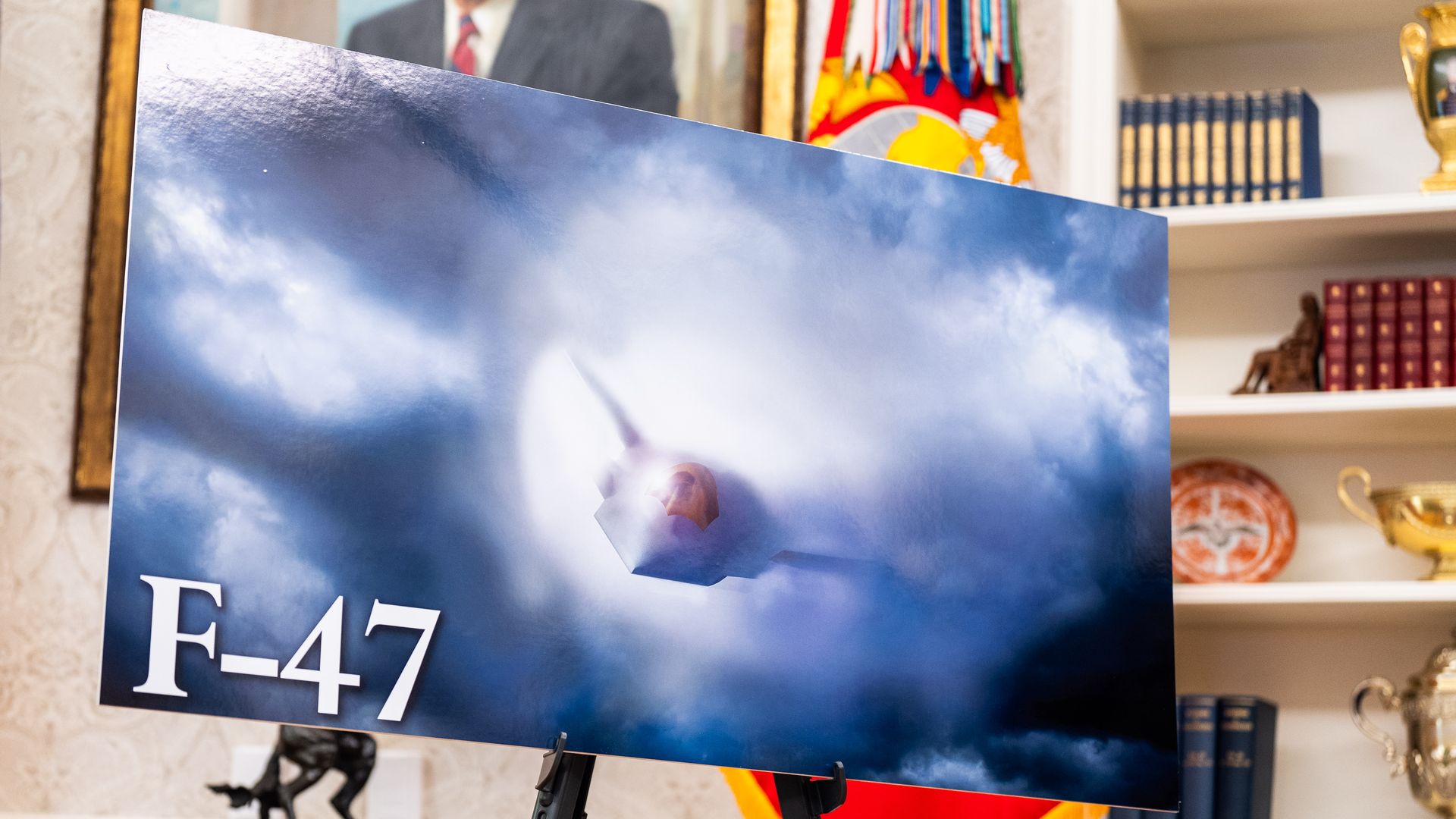
The U.S. Air Force's F-47 will be be airborne "faster than normal," as maker Boeing is "positioned to go quickly," the head of its clandestine Phantom Works division said.
Why it matters: Everyone is watching this futuristic fighter project and what the final product means for Western airpower.
Driving the news: I interviewed Colin Miller, vice president and general manager of Boeing Phantom Works, last week at the Emerging Technologies for Defense conference in Washington.
- The company's winning bid for F-47 was "born in Phantom Works," Miller said, and was "built on decades of technical development" and expertise.
- "Constant research and development enabled the underlying technologies that come together on that platform," he added.
- "I think you'll be surprised by how fast you see it flying."
State of play: Boeing bested Lockheed Martin in the Next Generation Air Dominance contest earlier this year. The contract is worth billions of dollars.
- The manned F-47 is expected to cost less than the F-22, which it supersedes. Initial plans were to buy more of the former than the latter.
- Experimental X-planes flew for hundreds of hours before a decision was made.
Friction point: The Air Force has said the F-47 will fly before the end of the second Trump administration, in 2028. Miller would not say if the timeline he teased was sooner than that.
Go deeper: What's influencing the Air Force's F-47 and Navy's F/A-XX
3. Exclusive: Aurelius' counter-drone quest

Laser-turret maker Aurelius Systems plans to hire more people, build out its production lines and continue participating in U.S. military tests on the heels of a $10 million seed round.
Why it matters: The company is gaining traction as drone-counter-drone discussions, as well as talks about the sustainability of overhead defenses, reach a fever pitch.
State of play: At almost 2 years old, Aurelius employs more than 10 people. While its research-and-development efforts are concentrated in San Francisco, the company has interest in metro Detroit, as well.
- Aurelius has from "the very, very beginning" been dedicated to laser weapons and their counter-drone application, chief executive Michael LaFramboise told me.
- "We go out and test for one- and two-stars at these military bases," he said. "They see a drone explode, and then they're like, 'Alright, I'm in.'"
Yes, but: Defense departments around the world have for years poured money into directed-energy weapons. Their adoption remains fleeting.
Zoom in: Aurelius' laser weapon is known as Archimedes — a nod to the ancient thinker said to have set ships ablaze during the Siege of Syracuse.
- Archimedes is compact and works in fixed and mobile setups, according to LaFramboise, who has a background in heavy manufacturing and directed energy.
- Renderings on the company's website show it mounted to a Ford pickup truck, creating a sci-fi technical; on the belly of a larger drone, similar to the General Atomics MQ-9 Reaper; and on the roofline of bunkers.
Zoom out: "We start out with the Archimedes," LaFramboise said. "From there, we go into more Golden Dome stuff."
Follow the money: The seed round was led by General Catalyst and Draper Associates.
- "This stuff is super hard to crack. It's super hard to sell, and it's a really competitive market," Paul Kwan, who leads the General Catalyst global resilience team, told me.
- Winners "have this combination of real technical capability, ability to sell, understanding of the warfighter and some personal craziness."
The bottom line: There's a ton of emphasis "on drones, the UAS themselves," Kwan said. Countermeasures and force protection, he added, need equal attention.
Go deeper: U.S. Army-led task force seeks counter-drone coordination
4. Exclusive: Vector's pockets

Defense startup Vector has raised $61 million since its founding a little more than one year ago, its chief executive, Andy Yakulis, first told me.
Why it matters: The 150-person company, based in Salt Lake City, bills itself as a provider of modern warfare as a service, a deadly riff on the more widely known "as a service" model.
- "We realized there was a gap in the market of anyone providing this fully integrated model: all of the tactical training, all of the technical training, bringing together all of the kit required to operate unmanned systems," Yakulis said.
- "A lot of companies out there do a really great job of just technically showing someone how to fly, for example, a first-person-view drone," he added. "But where we saw the gap was no one was actually applying tactics to that."
Flashback: Vector unveiled its Hammer quadcopter in July.
- It features fiber-optic spools as seen on jam-resistant drones in Eastern Europe.
Follow the money: The company has U.S. military customers but declined to specify exactly who. Financial backers include Harpoon Ventures, Point72 Ventures, Lightspeed Venture Partners and Shield Capital.
Friction point: Tectonic and Law360 this summer reported Vector was sued by Red Cat Holdings, another defense player.
- Yakulis has said the accusations "are without merit and, as such, Vector intends to vigorously defend itself in court."
- "We can take the heat — because that's what we are built for."
Go deeper: DOD's drone dilemma
5. Get packing, SPACECOM
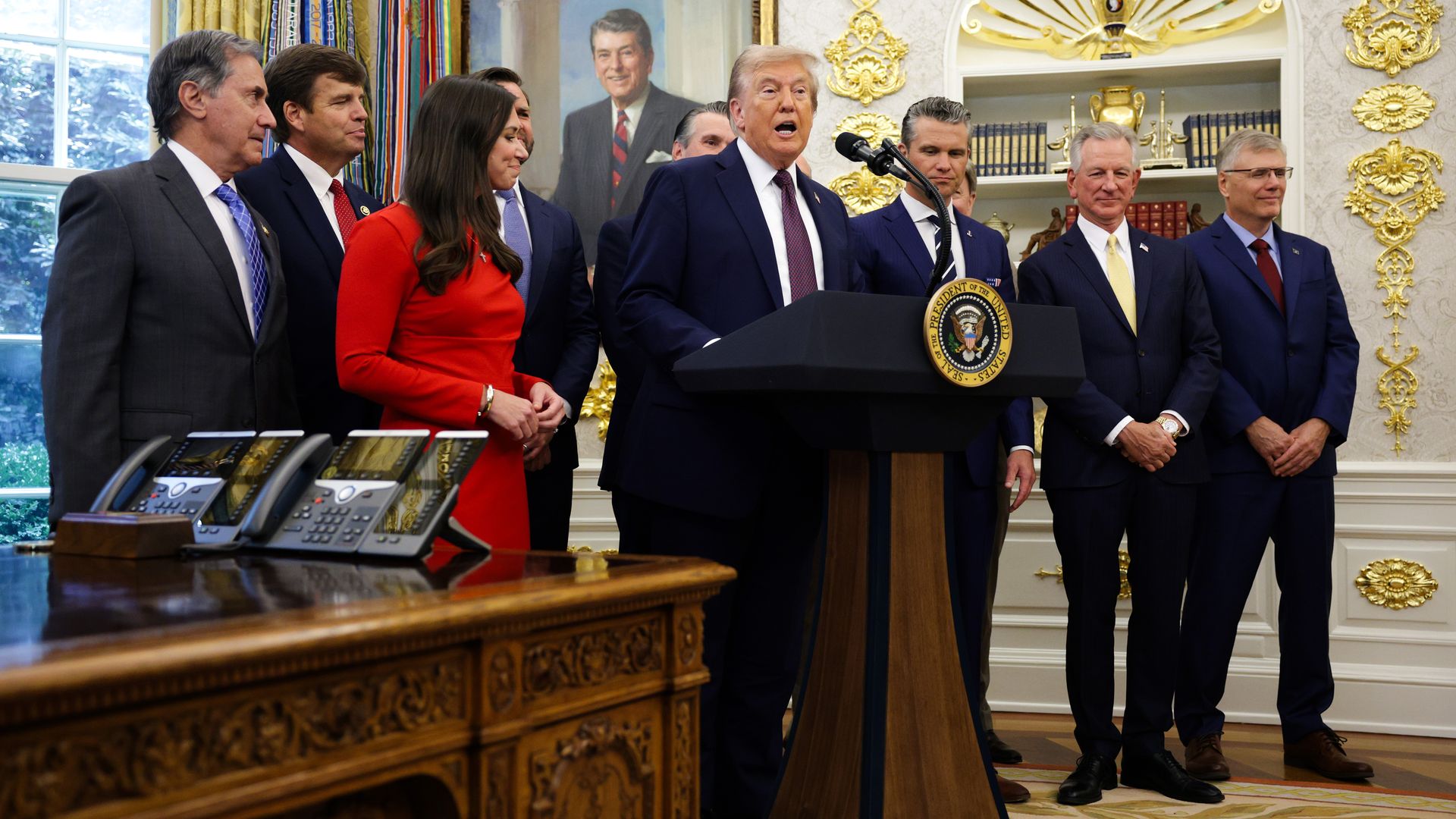
U.S. Space Command will move from Colorado to Alabama, according to President Trump.
Why it matters: The commander in chief's Tuesday announcement caps months of speculation — local and federal — as well as a turf war that stretched across administrations.
Driving the news: Trump discussed the decision during an Oval Office address. He was joined by Vice President JD Vance, Defense Secretary Pete Hegseth, Rep. Mike Rogers (R-Ala.) and others.
My thought bubble: The shift away from Peterson Space Force Base in Colorado Springs to Redstone Arsenal in Huntsville will motivate investment across the South, a typically military- and business-friendly region.
- It's also a boon to defense contractors that already have a presence in the Rocket City, including Boeing, L3Harris Technologies, Lockheed Martin and Northrop Grumman.
The intrigue: The announcement was spoiled ahead of time by livestreaming metadata, which described the event as a "U.S. Space Command HQ Announcement."
More from Axios:
Trump will move U.S. Space Command from Colorado Springs to Alabama
6. Quick hits
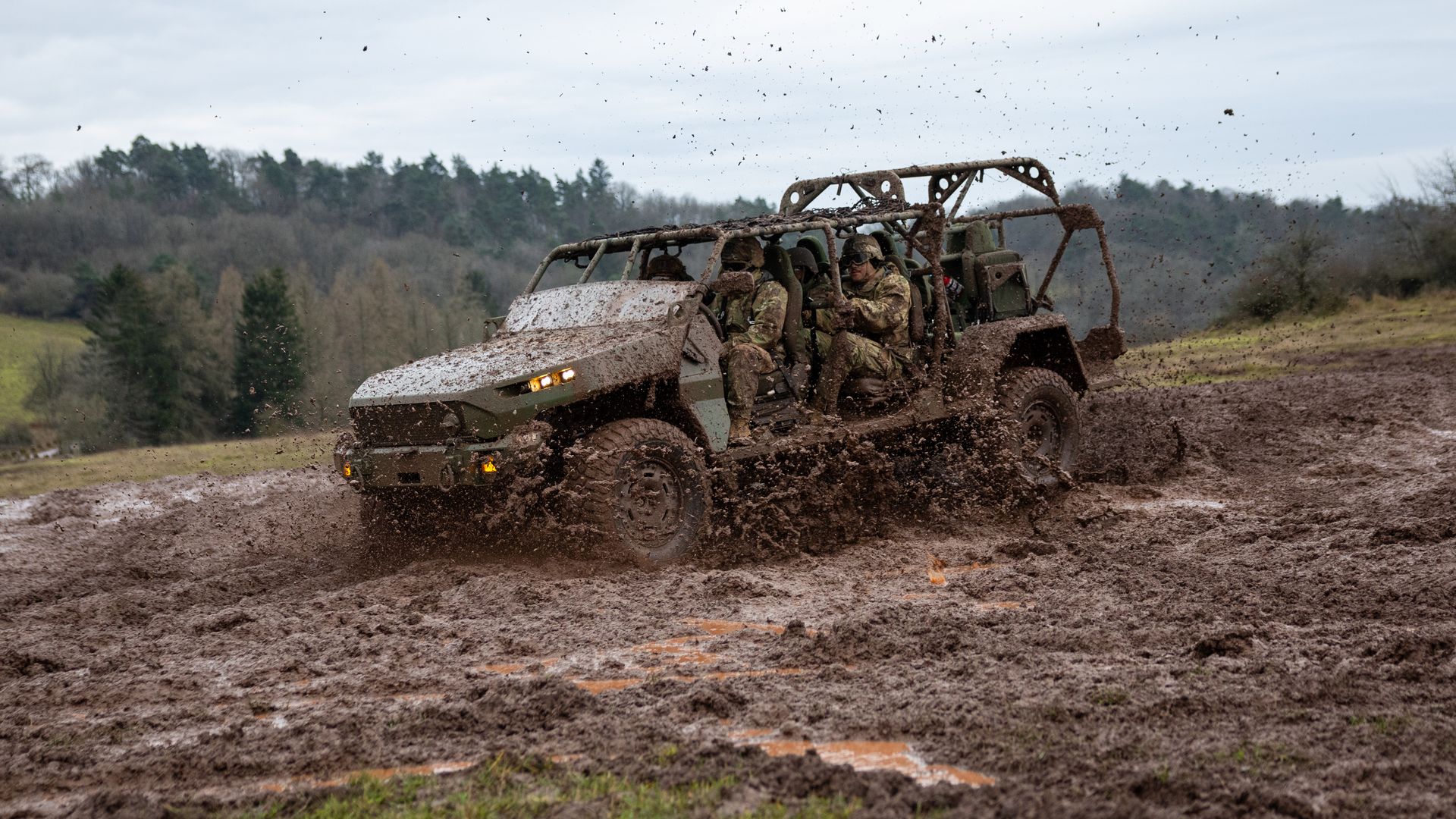
🚛 The U.S. Army awarded three deals totaling millions of dollars for unmanned systems autonomy. Forterra, Overland AI and Scout AI will integrate their commercial offerings into existing Infantry Squad Vehicles.
- Why it matters: "This is a major step, not just for Forterra, but for how autonomy will shape the future of the Army," a company spokesperson told me. "With AutoDrive integration, the ISVs will be ready for real-life situations on the battlefield."
- 💭 My thought bubble: Scout's the newest of the bunch. I broke news of their stealth exit, here.
🏧 Phasecraft, a quantum algorithms company, secured $34 million in Series B funding. The company has existing partnerships with Google and IBM.
- Why it matters: The company can now "double down on" research and development and expand its "industrial efforts," according to an announcement.
- 💭 My thought bubble: I'm getting more and more quantum pitches these days. The future? Or a fluke?
🪽 The General Atomics-made YFQ-42A drone wingman began flight testing at an undisclosed California facility.
- Why it matters: "In record time, [collaborative combat aircraft] went from concept to flight — proving we can deliver combat capability at speed when we clear barriers and align around the warfighter," Air Force Secretary Troy Meink said in a statement.
- 💭 My thought bubble: The Anduril Industries response on Twitter was classy.
🌍 All NATO countries will hit the minimum 2% spending mark this year, according to fresh data from the alliance. Poland, Lithuania and Latvia are well ahead.
- Why it matters: This is a major win, and likely buys countries some time before President Trump again cracks down.
- 💭 My thought bubble: There's a long road ahead to hit 5%. I wrote about that, here.
7. Check this out

Hey, Siri? Play "We're Going to Be Friends" by the White Stripes.
The big picture: The leaders of China, Russia and India — Xi Jinping, Vladimir Putin and Narendra Modi — linked this week in the northern Chinese city of Tianjin.
Threat level: Each man has beef with the U.S.
My thought bubble: Remember when Trump floated selling F-35s to India?
Go deeper: Modi joins hands with Xi and Putin in message to Trump
Shoutout to Dave Lawler for editing and Matt Piper for copy editing.
👋🏼 Thanks, as always, for reading and sharing. Tell your friends to subscribe here.
Sign up for Axios Future of Defense