Axios Crypto

September 27, 2023
Wednesday is about taking the shirt off your back and getting a loan off it. Plus, wen spot bitcoin ETF.
- Email: [email protected]
Today's newsletter is 1,112 words, a 4-minute read.
π₯Έ 1 big thing: Unregulated ramps
Illustration: Shoshana Gordon/Axios
In the uncomfortable dΓ©tente between crypto and regulators, the one broad point of agreement is that "on ramps and off ramps" must be very closely regulated to avoid money laundering and other illegal activity.
Why it matters: We're now in a world where fiat money, physical goods, and NFTs are becoming increasingly interchangeable. That's creating new on- and off-ramps that are still largely unregulated, Axios' Felix Salmon writes.
Driving the news: Earlier this month, the owner of a collection of T-shirts handed the collection over to a custodian and received an NFT in exchange β a clear on-ramp where real-world assets are turned into digital assets. He then borrowed $1.1 million by using the NFT as collateral.
- If the loan isn't repaid, the lender of the $1.1 million will become the new owner of the NFT.
- Whoever owns the NFT can either sell it or burn it. The act of burning it is designed to redeem the T-shirts, in an act that grants legal real-world title to them. At that point, the collection can be sold for cash.
Between the lines: The NFT can pass through any number of different hands before being burned, with no KYC (know your customer) checks whatsoever. The final owner of the NFT can therefore be anybody.
- The redemption process, as detailed in a whitepaper from 4K β the platform in charge of ensuring custody of the T-shirt collection β similarly involves no KYC checks. The NFT owner simply provides "the physical address where the asset must be sent" β and off it goes.
- Burning and redeeming the NFT is therefore a clear way to turn crypto into real-world assets without any kind of fraud checks or visibility to tax authorities.
Be smart: The on-ramp, similarly, does not require the possessor of the real-world asset to prove legal title to it, nor does it require that the owner go through a KYC check to prove that they aren't, for instance, on a U.S. Treasury sanction list.
The big picture: Anybody building a protocol to put physical assets on the blockchain has to grapple with the fact that they're creating on-ramps and off-ramps that regulators and criminals alike will be very interested in.
- Arcade, the lending platform that facilitated the deal, and 4K did not respond to requests for comment on this matter.
π° 2. Charted: Arbitrum leftovers


"Wen token" so the saying goes, Crystal writes.
Flashback: Arbitrum, one of the more popular blockchains built atop Ethereum, airdropped its much-anticipated governance token ARB to its users in March β opening a six-month-long claim window.
Driving the news: That window just closed, with 93.3% of addresses having claimed those tokens, according to a Dune dashboard by Blockworks Research.
- Roughly 69.4 million ARB remained unclaimed.
- So after a vote about what to do with the leftovers, the Arbitrum Foundation sent the remainder to the DAO by the same name.
What he's saying: "We knew we'll never get to 100%, because we knew there would be some wallets not claiming," Offchain Labs co-founder Steven Goldfeder tells Axios.
- Some of their employees wouldn't claim, per policy.
- Others may have simply forgotten.
- And 93% retention isn't bad anyway, Goldfeder added.
Quick take: Tokens worth roughly $56 million is pretty good for leftovers.
π 3. Celsius bankruptcy's end
Illustration: Shoshana Gordon/Axios
Creditors in the Celsius bankruptcy case voted overwhelmingly in favor of its proposed restructuring plan, according to a voting declaration filed Monday by restructuring agency Stretto.
Why it matters: The vote brings the firm closer to exiting the bankruptcy process and moves creditors closer to recovering most of their assets, writes Ryan Lawler, co-author of Axios Pro: Fintech Deals.
Driving the news: Most classes in the bankruptcy claim voted more than 98% in favor of the reorganization plan, which is expected to return between 67% and 85% of their holdings.
The intrigue: Creditors approved the plan despite objections from the U.S. Trustee, the DOJ-backed entity overseeing bankruptcy cases.
- The SEC has also filed a limited objection to the plan, questioning Coinbase's proposed involvement in distributing assets to Celsius' international customers.
Details: Under the plan, Celsius' assets would be sold to a consortium called Fahrenheit Holdings, which includes Arrington Capital and bitcoin miner US Bitcoin Corp.
- The consortium would distribute about $2 billion worth of bitcoin and ethereum back to creditors.
- In addition to a return of their assets, creditors will get equity in a newly formed entity, temporarily referred to as NewCo.
- NewCo is expected to take charge of and expand the debtors' bitcoin mining operations, engage in ethereum staking, and monetize some of the debtors' less liquid assets, according to a disclosure statement filed Aug. 17.
π Crystal's thought bubble: The drama isn't quite over β Michael Arrington, founder of Arrington Capital, gave up his board seat to Fahrenheit's Ravi Kaza, a court filing on Sunday showed.
- "I am not able to go into much detail on why I requested this change, but that information will come out in due time. This statement was heavily edited by attorneys," Arrington said on social media.
What's next: The plan still requires approval from the bankruptcy court, with a hearing scheduled for Oct. 2.
Catch up fast: Celsius filed for bankruptcy over a year ago, on July 13, 2022.
- The Fahrenheit consortium won a bid to acquire the Celsius assets in May.
- In July, former CEO Alex Mashinsky was indicted and charged with fraud related to the firm's collapse.
π΄ 4. Catch-up quick
Illustration: Shoshana Gordon/Axios
π Here's the stuff SBF's judge says he can't talk about. (Decrypt)
π·πΊ Binance to exit Russia with a sale of operations to CommEX. (Axios Pro: Fintech Deals)
π Curve founder Michael Egorov settled one of his largest DeFi debts, on Aave. (The Block)
π€ Meet the Frenchman who bought 100 Cryptopunks early on. (Decrypt)
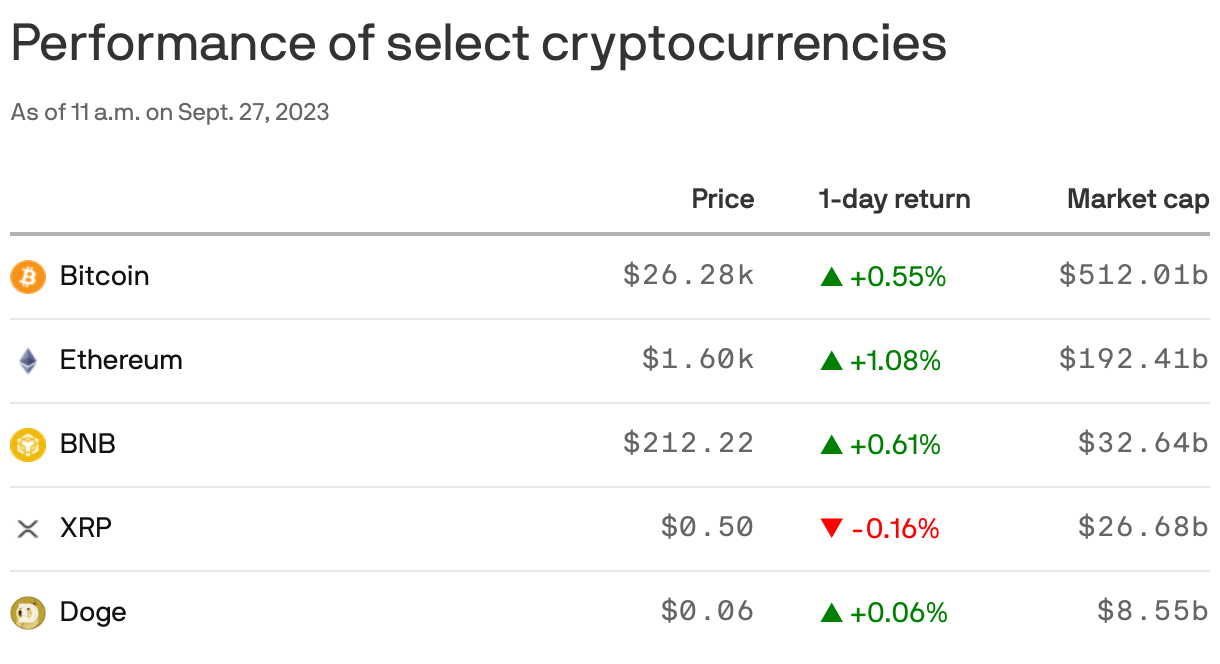
Top coins

5. π₯« Culture hash: Kick the can
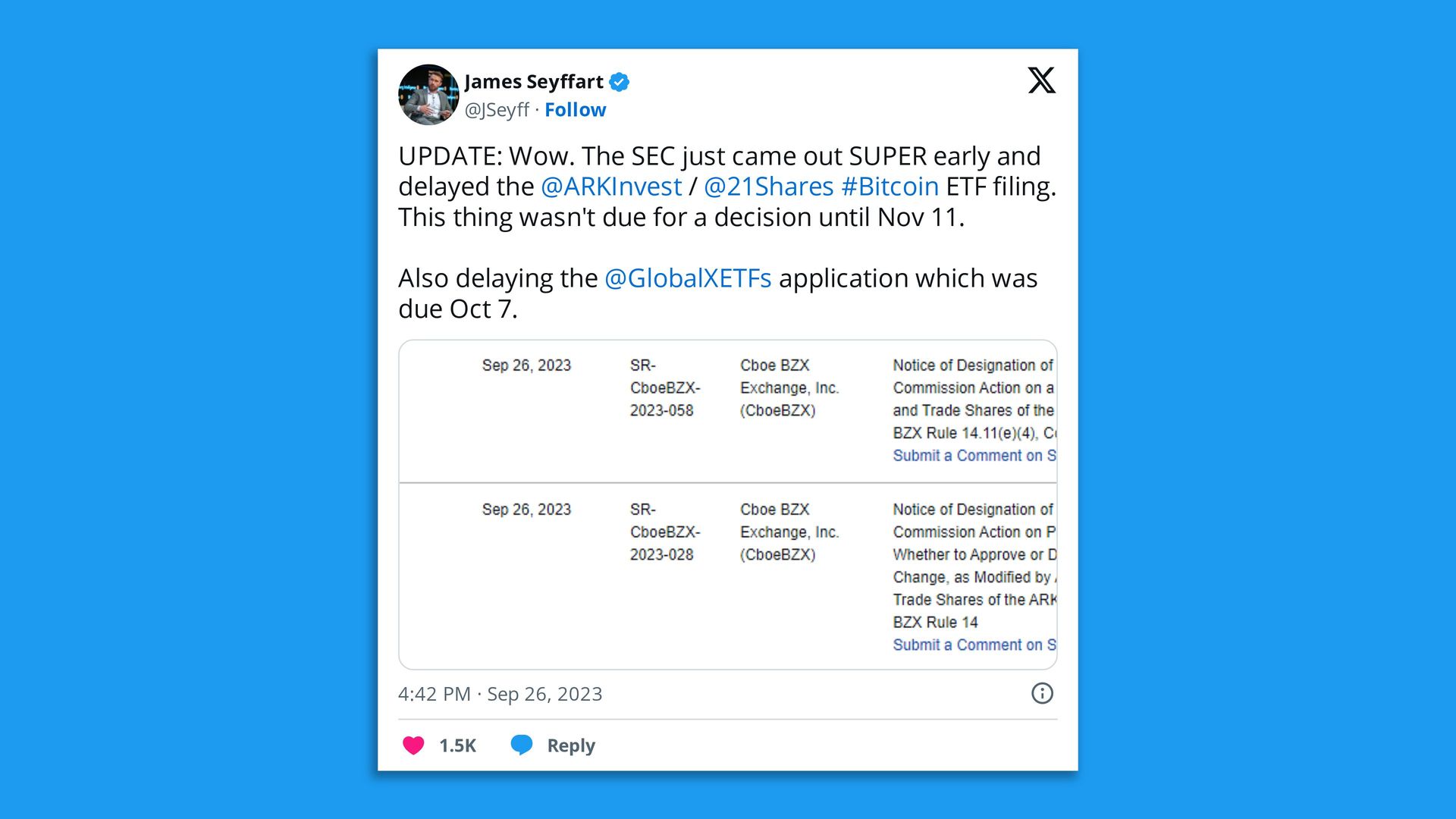
Screenshot: @JSeyff (social media)
The odds of a spot bitcoin ETF getting approved this year just got infinitesimal, Crystal writes.
Driving the news: The SEC has delayed a decision on the Ark Invest/21Shares application due in November β the one in the pole position to get approval before any other.
- The next deadline to watch for that one lands in January.
The other side: To be sure, BlackRock, Bitwise, VanEck, WisdomTree, Invesco/Galaxy, Fidelity and Valkyrie all have pending deadlines in mid-October. And maybe they get the nod before Ark.
- If those get delayed, the dates to watch are in January.
π Crystal's thought bubble: A spot bitcoin ETF landing this year was highly unlikely anyway.
What we're watching: The Grayscale lawsuit.
- Oct. 13 is the deadline for the SEC to ask for an en banc hearing β where all the judges of the D.C. appeals circuit would hear the case.
- Three judges already said that the regulatory agency's decision to deny Grayscale a spot bitcoin ETF was "arbitrary."
This newsletter was edited by Pete Gannon and copy edited by Chris Speckhard.
So how many of y'all are watching the Gary hearing? Maybe you caught the crypto policy advertising blitz. βB & C.
Sign up for Axios Crypto

Brady Dale covers crypto and blockchain impacts on markets and regulation.