Axios Crypto

September 07, 2023

In Britain, the cops would rather like to be able to scan all of everyone's messages everywhere. The blockchain has other ideas, but slightly more amicable ones this time.
- 🙋 Do you think law enforcement should be able to see everything you do online? [email protected]
Today's newsletter is 1,293 words, a 5-minute read.
🥷 1 big thing: Another try at privacy, with cops in mind

Illustration: Sarah Grillo/Axios
Consider this: To have a drink at a bar, the law doesn't say that you have to show the bartender your identification. All it says is that you can't have booze unless you're over 21.
- And yet we show our full IDs all the time, leaking all kinds of sensitive information, Brady writes.
- Why does someone need to see my address to verify my age?
Cryptography provides ways to prove something without revealing more information than is absolutely necessary.
Driving the news: Various scions of blockchains published a paper yesterday that proposes a new arrangement for preserving privacy in blockchain transactions while making criminal activity more difficult.
- If you read Tuesday's newsletter, we told you that we'd learned it was coming.
Why it matters: Crypto people have been scrambling to find a way to preserve privacy ever since Tornado Cash was sanctioned by D.C. a year ago.
- Big institutions, meanwhile, don't like to reveal their strategies. So they're also looking for on-chain privacy schemes that don't turn off regulators.
How it works: Privacy protocols conceal users' identities by pooling them, thus breaking the link between deposits and withdrawals.
- The idea in this paper is to describe a way within blockchains to prove that a withdrawal from a privacy-preserving scheme was linked to some broad set of legal transactions.
Zoom in: This way you could hide a donation to a controversial charity. Or you could hide the fact that you're a degenerate crypto gambler.
What they're saying: "If there is a perfect consensus on which funds are 'good' and which are 'bad,' the system will lead to a simple separating equilibrium," the authors write.
- Legitimate users would join a set that's proven to have legal origins. Say, for example, proof that funds originated from a service that required some kind of anti-money laundering verification (like any of the big U.S. exchanges).
- After withdrawing, a user could prove that the assets had a licit origin, without revealing who they are.
- Any withdrawal that could not prove it was tied to some law-enforcement friendly set would be suspect, perhaps rejected.
In the weeds: How all this stuff works gets into some very wild math we don't understand and could never quickly explain even if we did.
- That said, it has worked reliably in the wild to route around billions in assets on various blockchains already.
💭 Brady's thought bubble: Law enforcement is likely to resist such a scheme until they are made to accept it by higher authorities.
- Cops like to have all the information all the time.
🎱 2. What's this: The billiard ball example

Illustration: Shoshana Gordon/Axios
Here's the classic example of a zero-knowledge proof, Brady writes.
- It won't really explain how the fancy stuff works, but at least it gives you a hint of how it begins.
Example: Let's say you want to prove to someone that you have handed them two billiard balls of two different colors, but you don't want them to know which one is which (or even what the colors are). Here's how you could do it:
- Blindfold them.
- Now hand them two balls of different colors and ask them to hide the balls behind their back. Then instruct them to show them to you after either switching them or not switching them.
- You will say if they were switched or not.
- Do this, say, 20 times. Keep track of how often the other person says you were right or wrong.
- Take the balls away, hide them, and then take your friend's blindfold off.
If you were paying attention, you should know if the balls were switched every single time (you aren't blindfolded), so you should get the answer right 100% of the time. But as long as it's well over 50%, the blindfolded person should feel reasonably confident that he had two different colored balls in his hands.
- But that's still all he knows, just that they were different. That's it.
👤 3. Charted: The price of privacy


Here are the top four coins that are associated with zero-knowledge proofs, Brady writes.
- CoinGecko estimates the full market cap of all the coins connected to this space at around $7 billion.
🔀 4. A bid for another ETF, with a twist

Illustration: Aïda Amer/Axios
The pair of asset managers in the pole position for a spot bitcoin ETF now want to launch one for ether, the second-largest digital asset behind just bitcoin, Crystal writes.
Driving the news: Ark Invest and 21Shares filed to launch the ARK 21Shares Ethereum ETF on Wednesday, in a first test of the Securities and Exchange Commission's position on a spot ether investment fund.
Be smart: Ethers (ETH) are the coin of the realm on the Ethereum blockchain. All transactions cost ethers to make, so ethers become more valuable as using Ethereum becomes more popular.
The intrigue: There isn't even a spot bitcoin ETF approved for launch yet, but the early application suggests that perhaps a spot ether ETF isn't out of the realm of possibility.
What they're saying: Cathie Wood, CEO of ARK Invest, and Hany Rashwan, CEO of 21Shares tell Axios in an emailed statement:
- "As the regulatory environment changes, we are committed to innovating, developing and launching products providing efficient and regulated ways to access ether in the market."
Context: It helps that a U.S. court of appeals last week found that the SEC's denying Grayscale a spot bitcoin ETF was arbitrary — by that logic, now would be the perfect time to ask for spot bitcoin, but also for spot ether.
- There was already chatter that the SEC had eased on the idea of ether futures ETFs.
By the numbers: ETH prices, which were down with the rest of the market, reversed on the news and traded around $1,630 as of Wednesday afternoon.
Details: Bank of New York Mellon will serve as the trust administrator and transfer agent; Coinbase is the custodian, according to the filing.
Quick take: If you're already asking for the moon, why not also the stars.
🐇 5. Catch up quick

Illustration: Shoshana Gordon/Axios
⚖️ Ex-FTX executive Ryan Salame is expected to plead guilty today to criminal charges. (Bloomberg)
📣 Unstoppable Domains created an encrypted messaging platform that's interoperable with other messengers. (The Defiant)
🤠 Texas regulator ERCOT paid $31.7 million to Riot to curtail power use in August. (Decrypt)
🕳 August had the lowest trading volume in four years. (CoinDesk)
📖 6. Culture hash: Story time
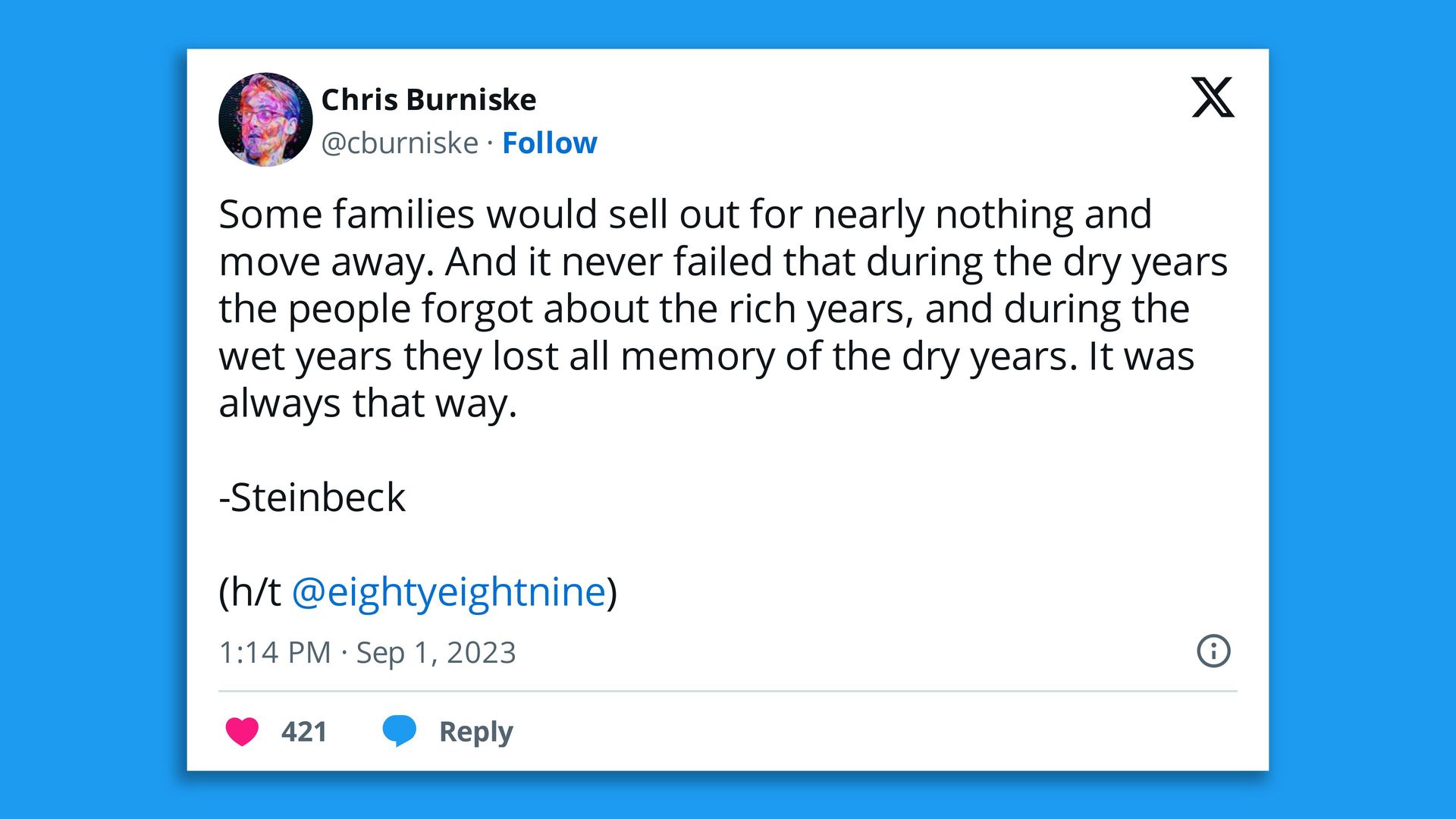
Quick! Which Steinbeck book do you think this is from?
- I thought it could have been maybe "The Grapes of Wrath" or "To a God Unknown," but no, it's the tale of those two divided brothers, the two coasts of the United States and two families, Brady writes.
It's the big one: "East of Eden."
Zoom out: The person who posted it is Chris Burniske, co-founder of the crypto fund Placeholder, formerly of Union Square Ventures.
- Do you really need me to spell out why a crypto guy is posting this quote?
Fun parallel: There's something else in "East of Eden" that I think is worth reminding readers about, however: A big theme in the book is innovation. It takes place at a time when much was changing.
- For example, there's a detailed description of how hard it was to get early automobiles started.
- Here it is re-enacted in the 1955 James Dean movie. Honestly, this is wild. How on Earth did anyone even want a car? Hey! Does that remind you of anything?
- Toward the end of the book, Adam Trask, sort of the main character, gets fixated on the idea of using cold to keep produce fresh longer.
🥬 So Trask tries to send a bunch of lettuce across the country in a train car loaded with ice.
- It's a disaster, and everyone thinks he's an idiot.
- Of course, as readers, we know he's onto something. He just hadn't solved all the engineering problems yet. 🤔
Quick take: These are just slivers from an overall great novel — one of the all-time best!
This newsletter was edited by Pete Gannon and copy edited by Chris Speckhard.
🧐 We did a roundup edition of this newsletter on privacy technologies in June. —C & B
Sign up for Axios Crypto

Brady Dale covers crypto and blockchain impacts on markets and regulation.