Axios Crypto

September 05, 2023

Happy post-Labor Day! Anyone wearing white? We won't tell.
🙊 Scroll down to Card 6 for a little scoop from the creator of Ethereum.
Today's newsletter is 1,189 words, a 5-minute read.
🍊 1 big thing: Hedging for bitcoin miners
Brian Rudick, from GSR's Bitcoin team. Photo illustration: Shoshana Gordon/Axios. Photo: GSR
Bitcoin may be volatile but the returns for miners don't have to be, Brady writes.
- That's the message from GSR, a trading and market-making firm. It wants to sell hedging products to bitcoin miners to make their revenues more predictable.
Why it matters: The $501 billion Bitcoin network would be considerably more resilient if its largest operators weren't in danger of going under every time there is a massive drawdown.
- See: Core Scientific.
Zoom out: GSR's effort isn't new, its Brian Rudick tells Axios. He said they've been pitching miners on these instruments for years with very little uptake.
- In the boom, miners had zero interest. Many believed bitcoin price was going to go much, much higher than it did.
- GSR just put out a report on hedging. Looking at the financial reports of publicly traded miners, the only statements they found on hedges noted that they weren't buying them.
Today, its pitch is better timed.
- In the contraction, many miners had much larger problems of staying viable. Now they seem to be more interested, Rudick says.
How it works: GSR is pitching swap and options products that would allow bitcoin miners to lock in prices for future production.
- That would make their business considerably more predictable. With swaps, miners sell future production now at a set price.
Be smart: The advantage of swaps is that their counterparty is likely to agree to some kind of steadily increasing price.
- The risk of the swaps is that the price rises considerably faster and they miss out on gains.
Options, on the other hand, allow a miner to buy an option to sell bitcoin at a certain price. If the price is higher, they don't have to exercise the option, but it also means they can still cover costs if price falls below the agreed price.
- The price of options is they cost a fee. That's a guaranteed new expense for miners, cutting into margins.
What they're saying: "These miners have a really hard time knowing what they are going to make in six months," Rudick says.
The impact: Rudick tells Axios that miners tend to get charged rates somewhere in the teens to finance expansion because their business is so volatile.
- He's trying to convince miners that hedging will help lending partners justify lower rates.
Zoom way out: GSR's report contends that the hedging model is well established in oil and gas exploration, and there's no reason it shouldn't be copied to bitcoin mining.
The big picture: Bitcoin miners win fresh bitcoin proportional to their contribution to the network. If they don't grow roughly as fast as the overall network, they start to fall behind.
- In other words, expansion is existential.
📉 2. Charted: Solana's still down


Big news for Solana this morning from Visa (see below), but it hasn't shown up much in its price yet, which is surprising, Brady writes.
- Solana's coin, SOL, is down over 90% from its peak in November 2021.
Catch up fast: Solana was also the favorite blockchain of Sam Bankman-Fried, the founder of FTX. He liked the fact that it was fast and cheap, promising the potential to really scale decentralized finance.
The latest: MakerDAO founder Rune Christensen is talking about moving the project to a new blockchain-based on Solana.
- Ethereum's founder sold off a half-million dollars worth of MakerDAO's MKR token in response.
💳 3. Visa extends its stablecoin pilot to Solana
Illustration: Shoshana Gordon/Axios
Visa is extending its experimentation with stablecoins via the Solana blockchain, Brady writes.
Why it matters: Blockchain boosters have long contended that they provide a better way to move money around the world, with faster settlement and lower costs than legacy payment rails, which have lots of intermediaries.
Details: Visa will work with Worldpay and Nuvel to extend its payment settlement capabilities on the Solana blockchain.
- The upshot: As far as we can tell from the announcements, there's no way users will have any idea how their payments are settled under this extended pilot, just like they don't know how payments get settled now.
- You might be using Solana over Visa and you might not.
What's happening: Since 2021, Crypto.com has used USDC to fulfill its settlement obligations on its Visa card in Australia and now intends to roll out this capability in other markets.
- According to a press release from Visa, the pilot reduced the time and complexity for many of these payments.
Meanwhile, Visa's looking to extend use of USDC to manage settlements to Worldpay and Nuvei, who can route them to merchants using their services.
- The release does not spell out the exact customer base they expect to serve with this offering, but it suggests it will largely be participants in the crypto economy: such as web3 games and NFT companies.
Context: Solana was designed to be an extremely fast and high-performance blockchain. It was the darling smart contract blockchain of the 2021 boom, rising much higher in market cap than any of its competitors.
- One hedge fund went so deeply into Solana that it massively sank its overall returns when the chain lost 90% of its value.
Nuvei and Worldpay are payments companies, managing all the guts and complexity of handling various currencies, issuers, processors and payment methods all over the world.
💭 Brady's thought bubble: Announcements like this get people with investments in whatever cryptocurrency is named very excited, but so far "Big Company Tries Some Blockchain" has not exited the pilot phase.
🛼 4. Catch up quick
💦 Liquid staking is doing well in the downturn, despite the general doldrums for the rest of the industry. (Bloomberg)
🤝 Liquid staking enabler Lido might have to close down on Solana. (Blockworks)
📊 Concerns about Huobi seem to be subsiding as volumes rise. (Blockworks)
🚪 Binance's head of product has left, extending the string of executive departures. (Decrypt)
🗣 5. Culture hash: Whattaya say, Jay?
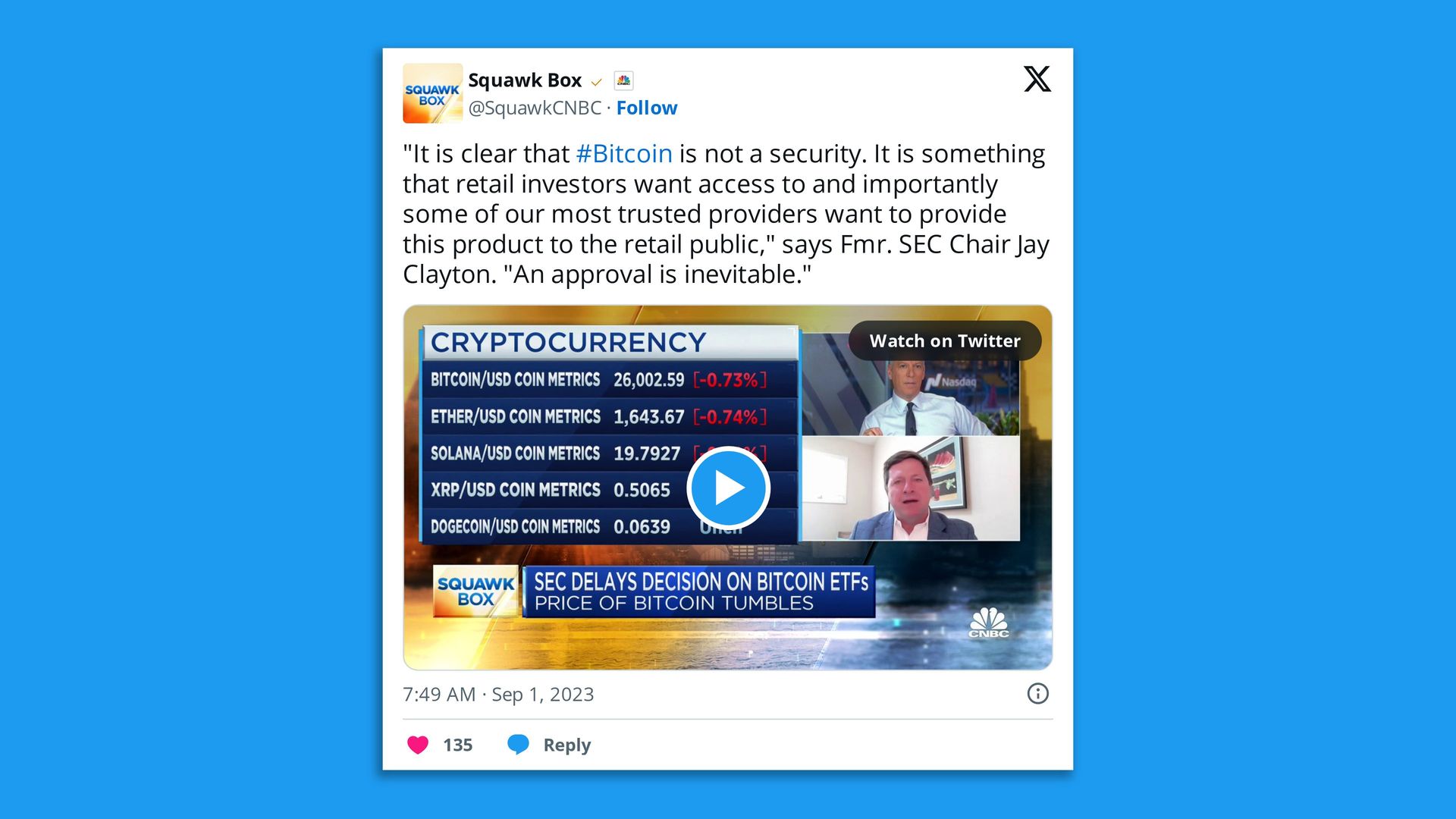
Screenshot: @SquawkCNBC (Twitter)
Former SEC chair Jay Clayton said a bitcoin ETF is inevitable on CNBC, Brady writes.
In the weeds: More intriguingly, he talks a little bit about how the world has changed. He says that when he was chair, they didn't approve a bitcoin ETF because they worried that the market was too prone to manipulation.
- He goes on to say that, now, large institutions have made it clear that they aren't nervous. There are too many eyes on the market now. It's not the concern that it was.
Of note: Clayton has taken roles at Apollo Global Management and Sullivan & Cromwell since leaving the agency. He also serves as an adviser to the crypto custodian Fireblocks.
Catch up fast: The SEC's rejection of a Grayscale ETF was recently sent back by the D.C. court.
- One option before the SEC now, however, is to simply reject the proposal for new reasons.
What they're saying: "We'll give them time. There's a 45-day time period," Clayton said, "In the relative scheme of things, 45 days is a short amount of time, and I do expect we'll have progress on this going forward."
⛓ 6. A new privacy system
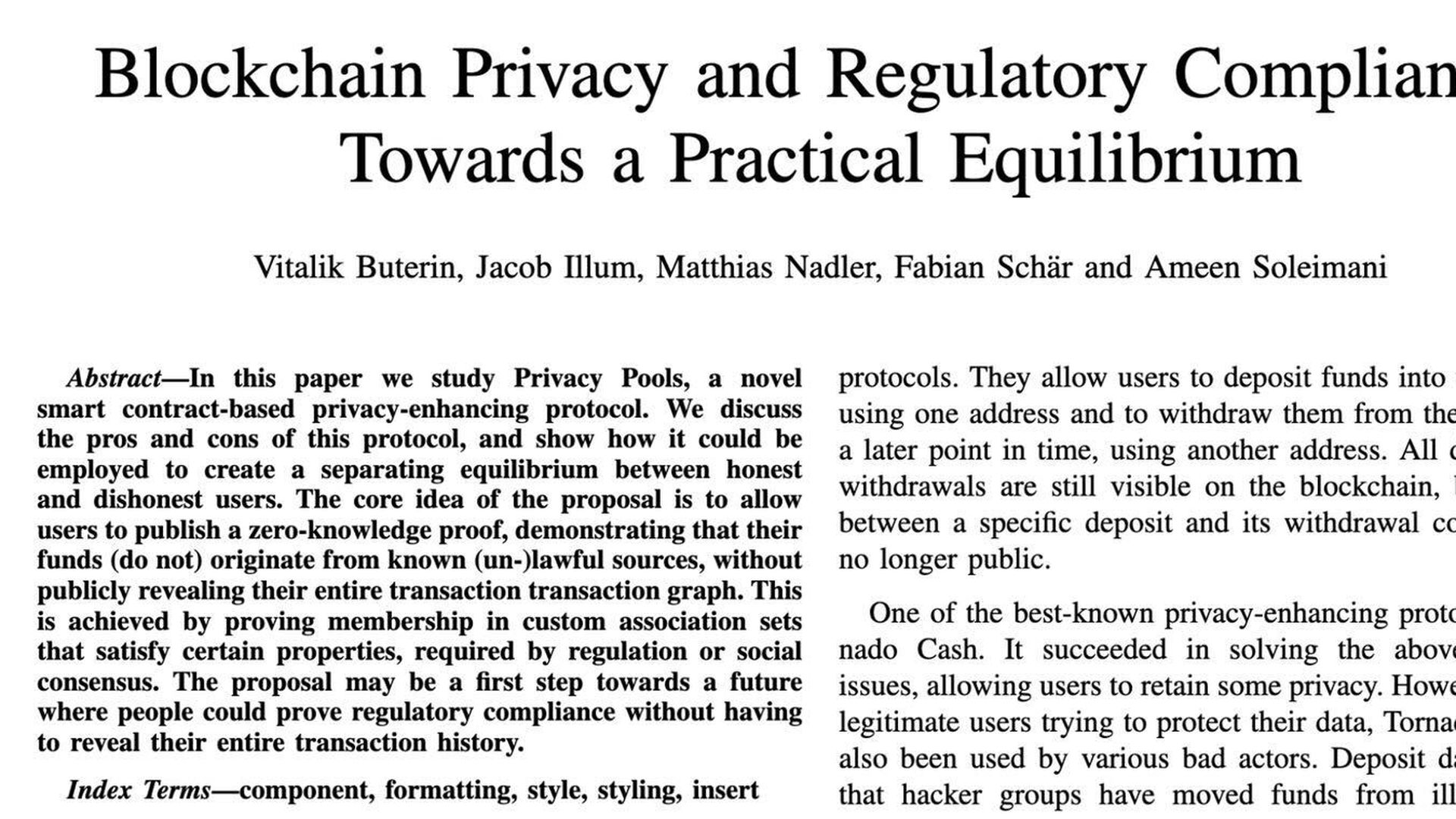
Screenshot: New whitepaper on blockchain privacy.
A new whitepaper is coming from the creator of Ethereum, the creator of SpankChain, Chainalysis' chief scientist and others.
- The idea, according to a leaked copy of the paper from a source familiar with the matter, appears to be to create a privacy system that regulators could live with that doesn't provide back doors, Brady writes.
Details: The summary indicates zero knowledge proofs would be used to prove that transactions didn't come from illicit sources, without revealing more.
This is all we have. Word is it will come tomorrow. We shall see!
This newsletter was edited by Pete Gannon and copy edited by Carolyn DiPaolo.
🐶 Lots of fairly sketchy sites out there report that a page in Walter Isaacson's upcoming book about Elon Musk reveals that he's been secretly covering the development on Dogecoin. —C & B
Sign up for Axios Crypto

Brady Dale covers crypto and blockchain impacts on markets and regulation.