Axios Crypto

June 09, 2023

TGIF! What a week. Today we're returning to more like our regular programming, with an explainer plus a couple pieces of news (a deal and a big upgrade).
🚨 Situational awareness: Justice has charged two Russian nationals as the Mt. Gox hackers — no arrests yet.
Are there any crypto events coming up that are must-attend? Tell us: [email protected].
Today's newsletter is 1,211 words, a 4½-minute read.
😎 1 big thing: Next generation privacy

Illustration: Natalie Peeples/Axios
Privacy technology based on what's known as zero-knowledge proofs (often referred to by the shorthand of "zk") has energized a new class of well-funded blockchain startups, Brady writes.
Why it matters: The fact that everything someone does on a blockchain leaves a permanent, public record has turned off a certain class of business that worries such openness could reveal their strategy. Still, zk-tech promises to let them cut out the middleman while keeping their secrets.
Zoom out: These new technologies represent a counterstrike against an internet that went from a nice place to find funny cat videos, to something not unlike the eye of Sauron.
- Yes, but: Sometimes it seems like Washington, D.C., really likes that Sauron functionality.
What they're saying: "It's pretty revolutionary tech," said Elena Nadolinski, founder of a compliance-friendly private cryptocurrency called Iron Fish, which launched in March.
- It's a branch of technology that uses very fancy math, such that someone can reveal only as much information as needed.
- Classic example: To drink in a bar, the bar only needs to know you are over 21, not your exact birthday. Cryptographers could build that using zero-knowledge proofs.
Flashback: Bitcoin and some subsequent tokens were built with privacy in mind, but zk-tech goes further. It has the capacity not just to offer private transactions, but private everything: social networks, financial arrangements, logistics tracking, etc.
- The Aleo blockchain, which aims to launch this year, looks to be a private version of Ethereum.
- Tristero will make markets for traders with deep pockets, aiming to prove that darkness makes large trades safer.
What they're saying: "If crypto is trying to be a borderless, bias-less system, I don't see how that can be achieved without privacy," Nadolinski said.
- "A lot of this technology is struggling to achieve mainstream velocity in our view because of a lack of privacy," Zac Williamson, the CEO of another next-generation privacy company, Aztec Network, told Axios.
- Williamson worked in enterprise technology for medium-sized enterprises, where it became obvious to him that privacy was the sticking point for those firms to use blockchain applications.
- Aztec aims to go fully live next year.
Every time a company can cut out a middleman, its margins improve. Blockchains are great at that, but Aztec wants to provide companies with such gains without revealing too much about the game they are playing.
What we're watching: How long it takes for zk-tech to go through its Fortune 500 copycat buzzword cycle.
Quick take: "One of the fundamental tensions with our current information age is the way we monetize the internet by treating users as resources," Williamson said. "It's very predatory."
Reality check: Governments of the world are cracking down on anything that makes money harder for authorities to follow. For example, Europe's new crypto rules explicitly put a damper on so-called "privacy coins."
- The next generation privacy blockchains are getting built with compliance in mind, but the niche's cypherpunk veneer could still make officials leery.
🌞 2. What's this? Optimism and its upgrade
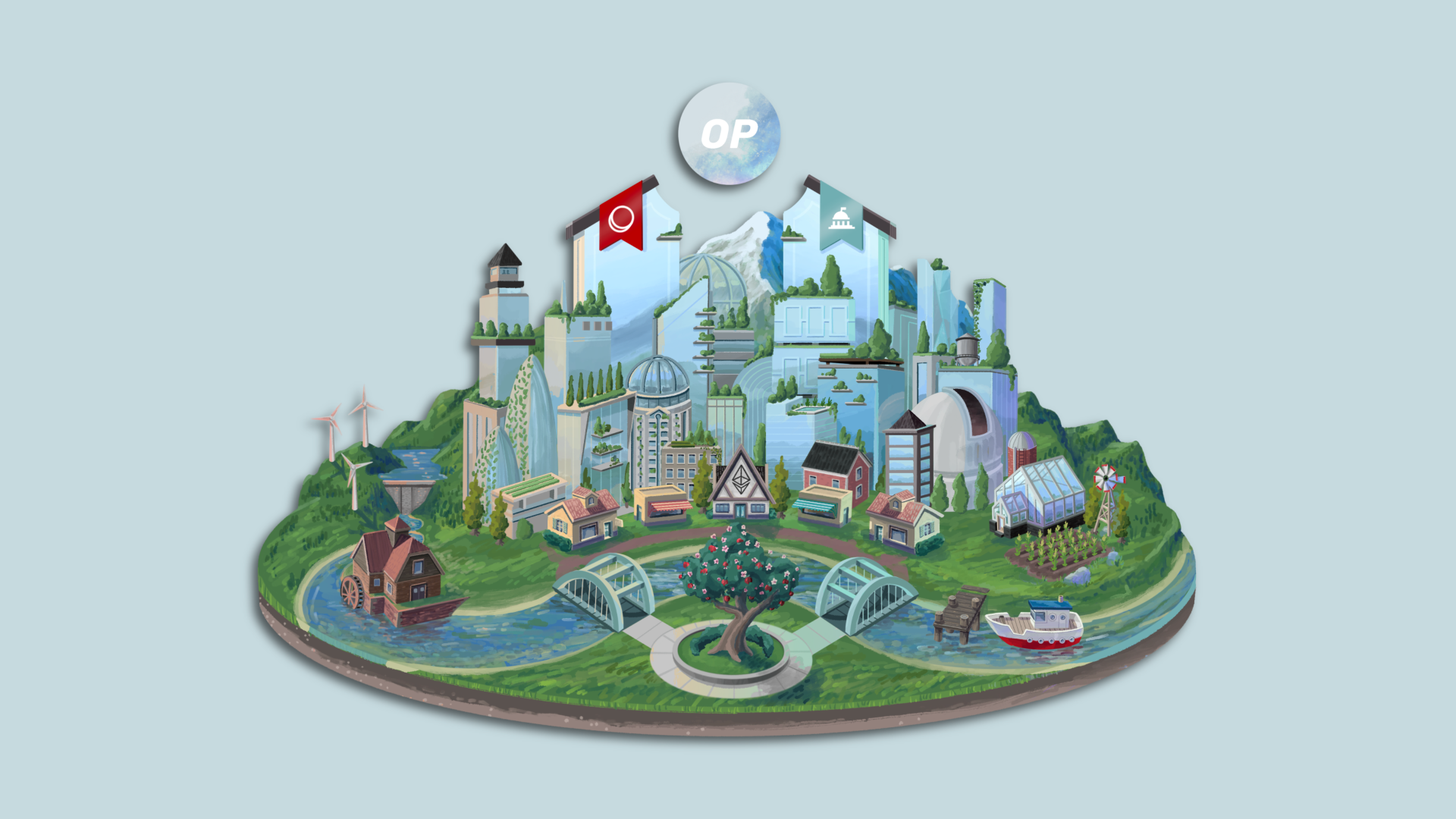
Image: Optimism City
Amid all the hullabaloo of SEC lawsuits against crypto world's marquee brands, a major software upgrade took place on a significant piece of crypto infrastructure, Brady writes.
Driving the news: Optimism, a Layer 2 blockchain that enables lots of fast transactions while leaning on Ethereum for security, completed its long-awaited Bedrock upgrade.
Be smart: Bedrock ups the compatibility between Optimism and Ethereum, the original smart contract blockchain.
- For users, Optimism should be even cheaper to use and faster than it has been (versus its parent Ethereum, which can be quite expensive at times, and slow by computing standards).
By the numbers: Optimism and Arbitrum are the two biggest Layer 2s now, with Arbitrum in the lead, with $5.7 billion committed to it, versus Optimism's $1.7 billion, according to L2Beat.
- Yes, but: Layer 2s built using the aforementioned zero-knowledge technology are eating market share every day.
- Zk-tech isn't just private, it can also be quite fast in certain contexts.
💰 3. BitGo looks likely to buy Prime Trust

Illustration: Natalie Peeples/Axios
An early deal has been struck between two crypto shops, Crystal writes.
Driving the news: Crypto custodian BitGo announced late last night that it signed a non-binding term sheet to buy Prime Core Technologies for an undisclosed amount.
- Prime Core is the parent company of Prime Trust, a financial infrastructure firm.
The intrigue: Crypto exchange Binance.US was said to be parking customers' cash at Prime Trust as it struggled to find new banking partners when the major service providers to the industry, Silvergate and Signature, failed.
Quick take: The deal between BitGo and Prime Core would appear to be a marriage of convenience—one that ties into the industry's recent woes, but also points back to another collapsed major: FTX.
Why it matters: In filings, Prime Trust was named as the source of some $14 million in donations to a super PAC called Protect Our Future. But it was later found to have only been acting as a middleman to route contributions for FTX executives including founder Sam Bankman-Fried, per Politico.
Flashback: Prime Trust's CEO Tom Pageler was fired in late November, and replaced with interim chief Jor Law.
Fun Fact: BitGo also has ties to FTX, selected by now chief John Ray III to hold assets amid the crypto exchange's bankruptcy proceeding.
What they're saying: "This is a landmark transaction, leading a greater shift in the digital asset landscape toward a more secure and sustainable future," Mike Belshe, co-founder and chief of BitGo said in a statement.
What we're watching: For term sheet details that would provide a clearer picture of the deal.
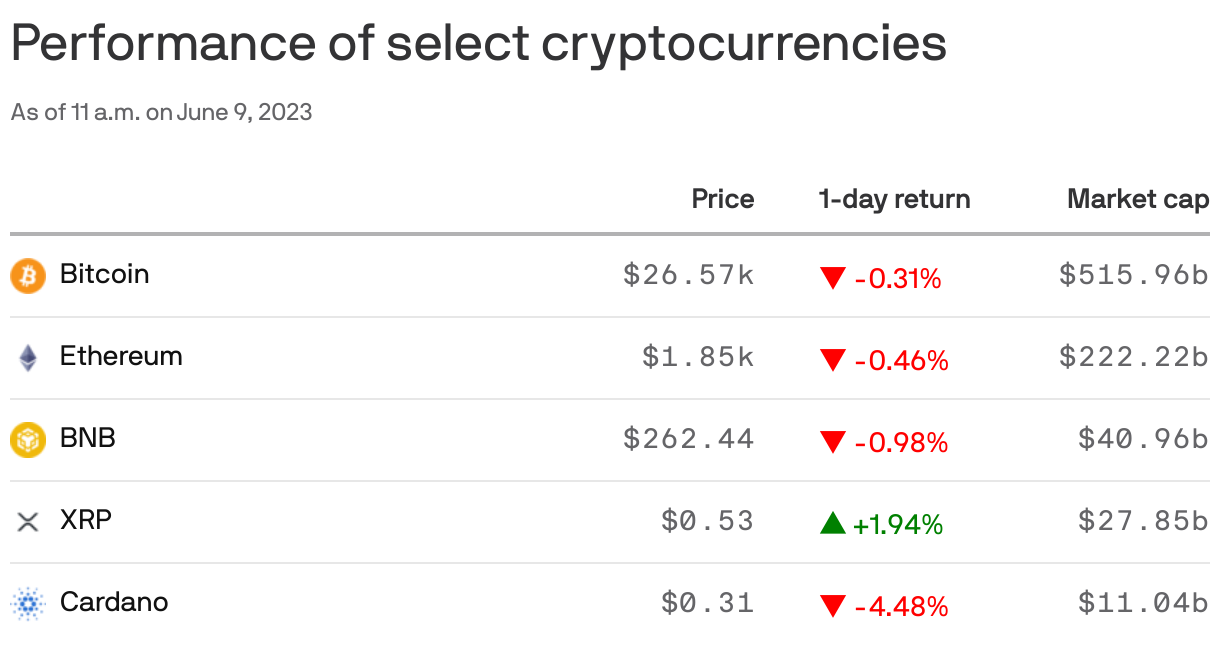
Top coins
🛹 4. Catch up quick

Illustration: Annelise Capossela/Axios
⛔️ Robinhood plans to pull its support for cardano (ADA), solana (SOL), and polygon (MATIC) – three tokens named in the SEC's legal offensive against Binance and Coinbase this week. (CoinDesk)
🇭🇰 Hong Kong Monetary Authority to start pilots on implementing a digital HKD. (CoinDesk)
😣 FTX argues that releasing its list of customers now under seal would "impair" its ability to sell its assets. (Cointelegraph)
🧩 5. Culture hash: Helpful metaphor
Screenshot: Unchained Podcast (YouTube)
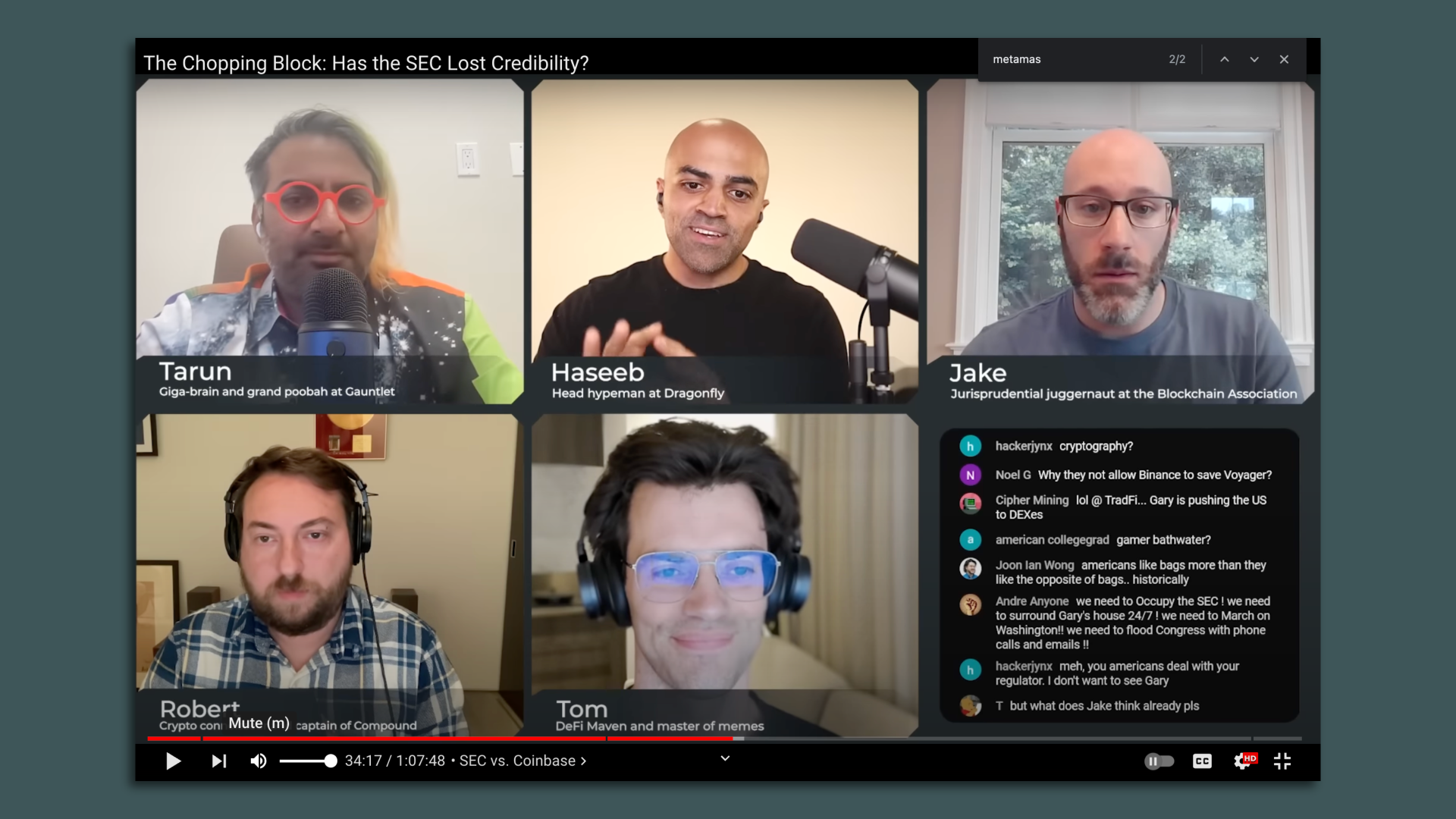
In this season of regulatory blitzkrieg, the most recent episode of "The Chopping Block," from the Unchained Podcast network, is illuminating.
- One moment jumped out at me, though.
Backing up: Jake Chervinsky, a guest on the show and an attorney for the Blockchain Association, explains how securities law has organized how trading works in the U.S.
- Exchanges are the meeting place for people who want to make deals.
- Brokers gather the deals individuals and companies want to do and bring them to exchanges and make them on clients' behalf.
- Clearing houses hold on to all the assets people are trading and keep track of who owns what when all the deals are done (also known as "settlement").
Be smart: That's when Haseeb Qureshi, managing partner at Dragonfly Capital, jumped in to analogize parts of the decentralized finance ecosystem to this arrangement, but in a way I've never heard before.
- Uniswap (a DEX) is like an exchange.
- Metamask (a wallet) is like a broker.
- Ethereum (a blockchain) itself is like the clearing house.
Of note: These aren't the only applications that fit each of these three roles, but they are the best-known in each category.
Go deeper: Listen to the episode for an explanation by co-hosts, Tarun Chitra and Robert Leshner, of why assets that enable self-custody can really never go all the way to zero, no matter how hard governments attack them.
This newsletter was edited by Javier E. David and copy edited by Carolyn DiPaolo.
🎻 This is fine. —C & B
Sign up for Axios Crypto

Brady Dale covers crypto and blockchain impacts on markets and regulation.