Axios Crypto

August 10, 2022

GM, Wednesday! Today we hear from crypto's main character, Coinbase Global, and dig into customer trading habits. Plus, an energy startup that wants to take methane emissions and turn them into coin.
- If you have had crypto addresses locked out of services (such as OpenSea) possibly due to past use of Tornado Cash, please: [email protected]. Also, you can find Brady and Crystal on Twitter.
This newsletter was edited by Pete Gannon and is 1,194 words, a 4.5-minute read.
💸 1 big thing: Crypto's main character
Illustration: Aïda Amer/Axios
Coinbase Global stepped into the spotlight for its earnings show-and-tell and delivered the stinker of a performance everyone expected, Crystal writes.
- The crypto exchange reported a $1.1 billion net loss (roughly half of which was due to crypto price drag) and revenue of $803 million, down 31% compared to the previous quarter.
- Its stock fell 11% and extended losses yesterday in post-market trading.
Why it matters: Coinbase is the industry's main character at the moment. (Count the number of write-ups the company has drawn lately.)
- As the largest market operator for crypto in the U.S., its business has become the venue for a public battle between it and securities regulators over what is not allowed in the industry.
Of note: If anyone was hoping for something illuminating on the Great Securities Debate, the call was a big disappointment.
- "In May, the SEC sent us a voluntary request for information, including about our listings and listing process. We do not yet know if this inquiry will become a formal investigation," CEO Brian Armstrong said in reference to the seven assets listed on Coinbase's platform that have been deemed securities.
State of play: Coinbase's business model relies heavily on regular people, with retail customers' transaction fees accounting for the lion's share of its revenue. Now those people are trading less.
- Monthly transacting users fell to 9 million, from 9.2 million in the previous quarter.
- Of its net revenue of $803 million, $655 million was in transaction revenue and the rest from subscriptions and services.
- Of that transaction revenue, its retail customers accounted for $616 million, down 36% from the first quarter.
- By contrast, institutional transaction revenue (from the likes of hedge funds, mutual funds and ETFs) was $39 million, down 17% over the same period.
Between the lines: Coinbase took a $42.5 million restructuring expense as a result of reducing its headcount by 18%.
Be smart: Impairment charges relating to crypto investments and venture investments were $446 million. That ate into profits due to an accounting quirk.
- Its crypto holdings in the aggregate are still worth considerably more than Coinbase paid for them.
What others are saying: "What is baked in [to the stock] — significant pessimism," BTIG analyst Mark Palmer said. He has a buy rating on shares, but his price target of $290 suggests the stock can climb 230% from yesterday's closing price of $87.68.
- "Coinbase’s institutional platform has largely been overlooked. That's a big part of our bullish thesis," he said.
- "BlackRock is a big step in the right direction," Chris Brendler, an analyst at DA Davidson tells Axios. "But we're not sure how big of a business that's going to be without details." Brendler has a buy rating on Coinbase and a 12-month price target of $90.
What's next: More of the same.
- Coinbase expects second-quarter trading trends to persist through the rest of the year.
🔇 2. Charted: Muted volumes
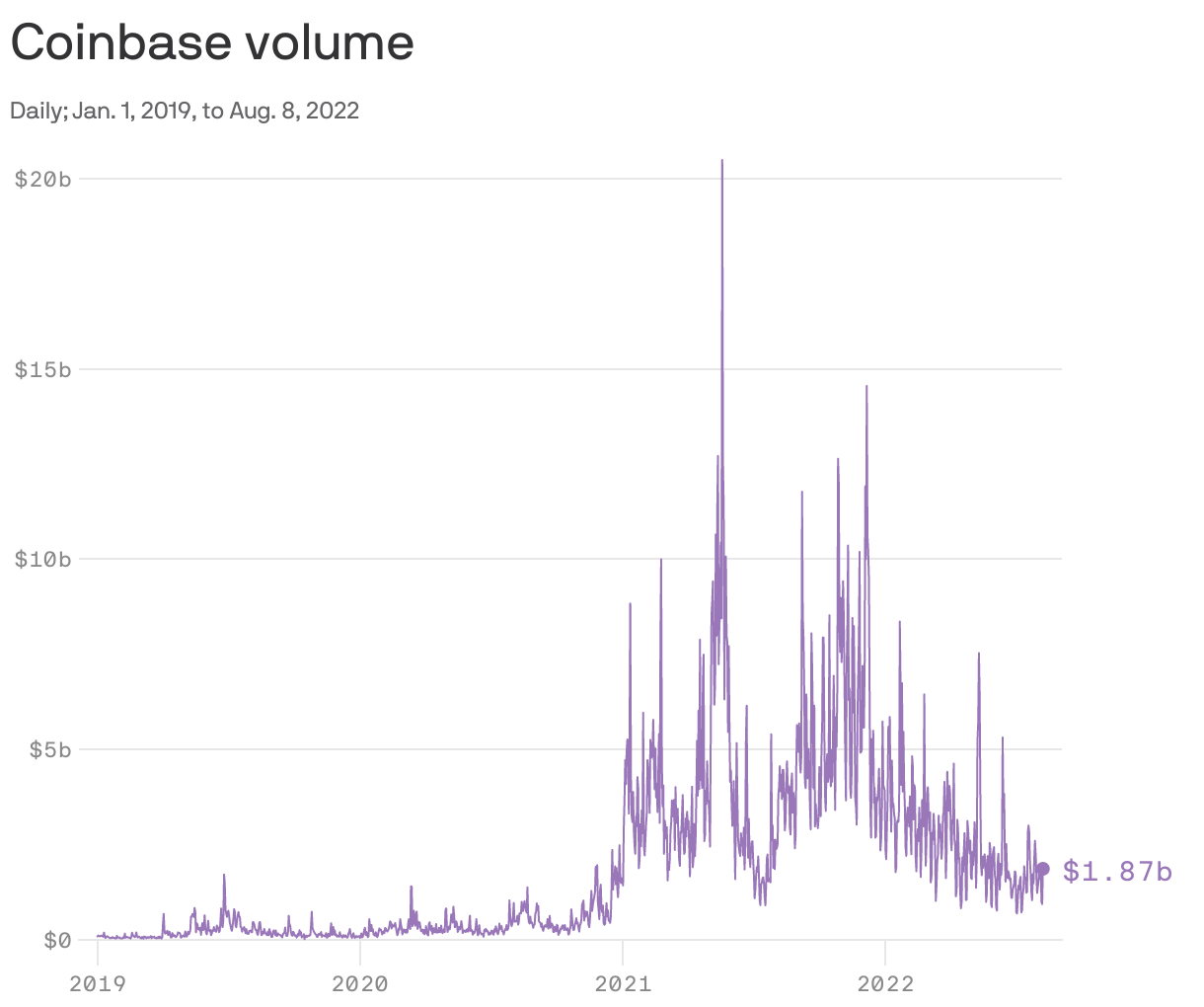
The decline in coin prices has dampened daily trading volume in the second quarter as folks who buy and sell digital assets sat on the sidelines, Crystal writes.
- For crypto exchanges like Coinbase Global that make money by collecting a small fee per transaction, lower volumes mean lower revenue.
Average daily trading volume hit roughly $1.9 billion recently according to data compiled by market intelligence provider Kaiko.
Be smart: What analysts focus on is what is called the take rate. That's total revenue divided by total trading volume to get at how much exchanges like Coinbase are making for every dollar transacted on its platform.
- The take rate is higher for retail than for its institutional customers.
⚡️3. Bitcoin deal energy
Illustration: Sarah Grillo/Axios
Vespene Energy's recent funding round shines a headlamp on a unique strategy of building a renewable resource to take the edge off of bitcoin mining Megan Hernbroth and Alan Neuhauser write in Axios Pro: Climate Deals.
Why it matters: If it takes off, Vespene will mine bitcoin using a greenhouse gas that was just going to be emitted anyway. So it's not driving new demand for fossil fuels, and burning it curtails some of the gas's contribution to global warming.
- The EPA estimates that municipal landfills represent 15% of methane emissions in the U.S.
Details: Vespene, a Berkeley-based energy-generation startup that wants to convert methane emissions to electricity for bitcoin mining, raised $4.3 million in an all-equity seed round.
- Crypto VC Polychain Capital led the round, which will finance Vespene's initial pilot location in central California. It will aim to produce 1.5 MW of electricity from captured and burned methane on-site from a municipal landfill.
What they're saying: "The continued adoption of Bitcoin will benefit from solutions that make the energy mix for mining more focused on clean energy,” said Polychain Capital CEO Olaf Carlson-Wee in a statement.
How it works: Vespene owns and operates microturbines on landfills in a process it says is a more efficient capture of methane emissions.
- It sequesters methane and burns it to power the microturbines, which in turn generate electricity.
- The electricity is used to power bitcoin mining operations. The profits generated from mining are then split between Vespene and the municipality that owns the landfill.
The intrigue: Crypto mining is very energy-intensive, making it a target of environmentalists.
- Vespene CEO Adam Wright says Vespene is more closely connected to energy markets than crypto, which helped when it came to fundraising.
- If all goes well, the company hopes the income earned from mining bitcoin will enable municipalities to use landfill methane to provide energy for other use cases, such as electric vehicle fleets.
Yes, but: Vespene is still burning methane on its way to producing electricity. Though it is using waste gas, there are still emissions associated with the technology.
- Methane becomes carbon dioxide and water when it burns.
🪂 4. Catch up quick
🌈 The front page for Curve, a popular decentralized exchange specializing in stablecoins, was compromised yesterday, but it has been resolved. (The Block)
🐘 Thailand's Central Bank would be given regulatory authority over cryptocurrency under new reforms. (Bloomberg)
🦾 CoinFlex seeks a restructuring in a Seychelles court as it waits for a counter-party to pay them back. (Bloomberg)
🧠 MakerDAO wouldn't be able to handle a crackdown by U.S. regulators, the founder of DeFi's largest project admits. (The Defiant)
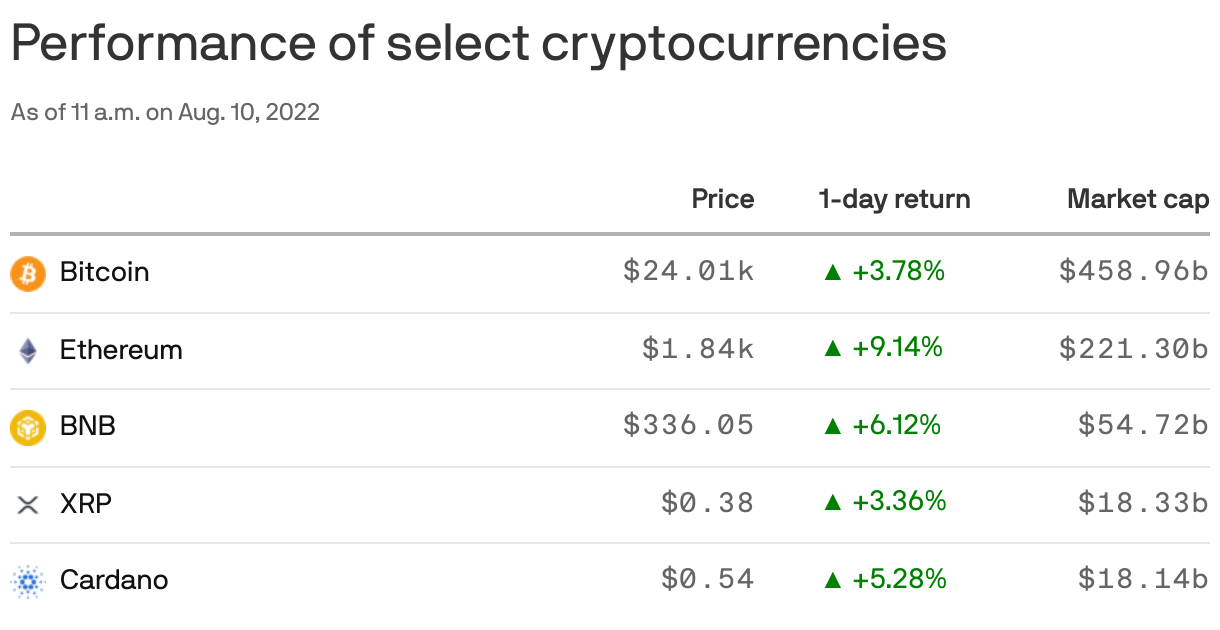
Top coins
🎙 5. Culture hash: Narrative wars
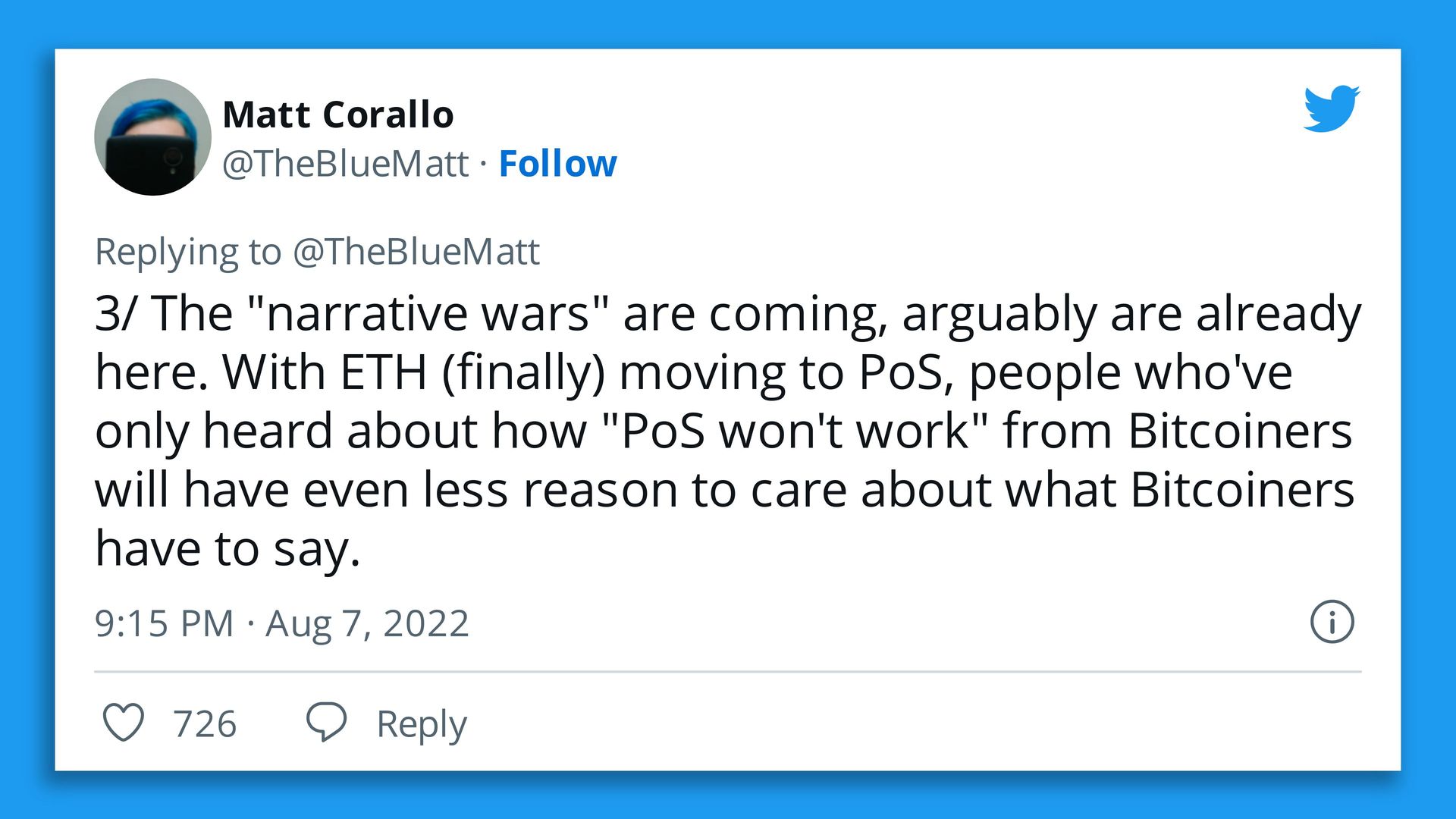
Screenshot: @TheBlueMatt (Twitter)
In a tweet thread that begins by saying "Bitcoin maxis are a dying breed," Matt Corallo makes an argument for why the us-vs.-them pose of most crypto communities does bitcoin no good.
- Flashback: Corallo has been a developer in the bitcoin world since forever, Brady writes.
Context: Crypto people talk about narrative all the time. It's something that's suffused the world of technology. It's not just what your thing does, but whether or not people get it.
- This is probably because the internet itself had a narrative, a story about making everyone a publisher and eliminating the gatekeepers so pervasive in the less networked world.
The intrigue: Outside crypto, all these coins and chains look like one thing. Inside, there's a fierce fight to be No. 1.
- Ethereum's truest believers look for the blockchain's forthcoming switch to a more environmentally friendly consensus model (PoS in the tweet means Proof-of-Stake) to give it a narrative edge with the public.
Summer is neat but the heat has been overwhelming this year. —C & B
Sign up for Axios Crypto

Brady Dale covers crypto and blockchain impacts on markets and regulation.