Axios Crypto

July 29, 2022
Hello, hello! Today we dig in to accounting's weirdness around crypto and the strange big smallness of a venture fund.
- Email us at [email protected]. We especially like to hear from normal folks messing around with crypto or even just curious.
This newsletter was edited by Pete Gannon and is 1,180 words, a 4.5-minute read.
😿 1 big thing: Why bitcoin only goes down

Illustration: Allie Carl/Axios
Accounting for bitcoin is weird, Brady writes.
Why it matters: Fifteen publicly traded companies have more than 1,000 bitcoin on their balance sheets (over $20 million worth), according to Bitcoin Treasuries.
- During the 2021 boom times, lots of public companies got into bitcoin. Some of them said it was a hedge against inflation. Others probably just hoped they could record an easy win one quarter.
- Under U.S. Generally Accepted Accounting Principles (US GAAP), as currently interpreted, the price of bitcoin can only go down, at least for most public companies.
In the weeds: There isn't actually a US GAAP rule on bitcoin and cryptocurrencies, though — not yet. The practice is based on an interpretation of existing rules.
Details: "There was a view that you had to take a conservative stance, hence you had to view it as an intangible asset," Markus Veith, who leads the digital asset practice at Grant Thornton, one of the country's largest tax advisory and accounting firms, tells Axios in an interview.
- Intangible assets are things like software, intellectual property or patents.
- Such assets can be valuable, but they are hard to price because they seldom trade. Superman is intellectual property, and he is undoubtedly valuable, but he doesn't go on the market very much (in fact, never).
- So the practice is to account for them at the price a company paid for them. It doesn't matter if the price is higher today.
The intrigue: Bitcoin is intangible, but it trades 24/7.
- "Plain and simple, as a public company you have to measure the impairment. The cost goes down, it doesn't go up," Veith explains.
Of note: Public companies can only realize a gain from their cryptocurrency holdings by selling (though there's an exception for investment firms).
Zooming out: This means companies like Tesla or Block (Square) are realizing losses on the bitcoin they bought in the good times.
What we're watching: The directive for public companies to treat cryptocurrency as an intangible asset comes from the U.S. Securities and Exchange Commission, which is relying on the standard-setting body, the Financial Accounting Standards Board (FASB).
- FASB has a project underway to update how it treats digital assets.
- "If the FASB comes out with guidance that says you can mark to market, then the SEC will say yes," Veith said. "Their word is gold."
The bottom line: So if holding bitcoin can only put losses on the books for a public company in the U.S., why would any of them buy bitcoin before US GAAP changes?
- "There's an old saying: Don't let bad accounting get in the way of a good investment decision," Veith said.
⛹️♀️ 2. Charted: The fight to be No. 3


Cryptocurrency might change the world, but, until then, it's a horse race, Brady writes.
- Mainly, coins are fighting to be third.
This chart looks backward from the top 10 cryptocurrencies by market cap today and where they stood in the CoinMarketCap rankings every summer going back to 2017.
- Bitcoin has always led this chart. Ethereum is solid, but if you go back a little further it traded places with XRP a few times.
- There's been a lot of battle for all the other spots.
Stablecoins jump out. Note the rapid ascents of tether, USD coin and binance USD.
Also, note the white space to the left. Empty rankings on the chart are where once buzzy but now mostly forgotten cryptocurrencies sat when they still looked interesting.
- Names like nem, dash, iota and eos may cause casual crypto observers to have a moment of "oh yeahhhh" as they read them here. That white space once belonged to such coins, now found way down in the rankings.
What we're watching: DOGE, crypto's comeback coin, keeps on hanging on in the rankings. Much wow!
😲 3. $450 million is small now
Illustration: Annelise Capossela/Axios
We've entered an era in crypto where $450 million is not that much money for a crypto fund 🤯.
- Driving the news: Variant, a crypto fund founded in 2020 with a vision to invest in the user-owned internet, raised a fresh $450 million for two new funds, it announced yesterday, Brady writes.
Why it matters: Axios research has found at least nine funds dedicated to crypto with more than a billion dollars in assets under management (AUM). Today, mere hundreds of millions of dollars is seen as the right size for funds writing small checks.
What they're saying: "We're viewed by others as the marquee seed fund in web3," Spencer Noon, a co-founder who takes the lead on decentralized finance (DeFi) investments at Variant, tells Axios.
- Noon described this as an intentionally smaller fundraise, which is a sign of the times.
- The big funds, he said, "have been forced to have a spray-and-pray approach, where ours is a lot more boutique."
Quick take: For comparison, in 2018, a then one-year-old fund also founded by young, thesis-driven investors, Multicoin Capital, raised $250 million. That was pretty big in those days.
- At the time, there was an estimated $3.5 billion to $5 billion across all known crypto funds, Reuters reported.
In the weeds: The backers for Variant's new funds are largely the same as they've had in past fundraising rounds. Its prior funds raised $22.5 million and $110 million, according to Fortune.
- "We're oversubscribed in this fund and oversubscribed in the last fund, with a really consistent LP base," Jesse Walden, the Andreessen-Horowitz and Spotify alum who initially sketched out Variant's vision as investing in the "ownership economy."
- "The headlines are bad but there are still institutions who still believe in the potential of this space to deliver great returns and realize the mission," Walden said. "We really didn't encounter much friction at all in this fundraise process."
- While those institutions won't allow him to disclose them, he said it included some large domestic foundations that support things like university and hospital systems and also pension funds.
Details: The two new funds are a $150 million seed fund (to keep chasing new projects) and a $300 million opportunity fund, to invest more in projects that are gaining traction.
The bottom line: "User-owned networks grow bigger and faster than their traditional centralized counterparts, with more favorable economic terms for users," co-founder Li Jin wrote in the announcement of the new funds.
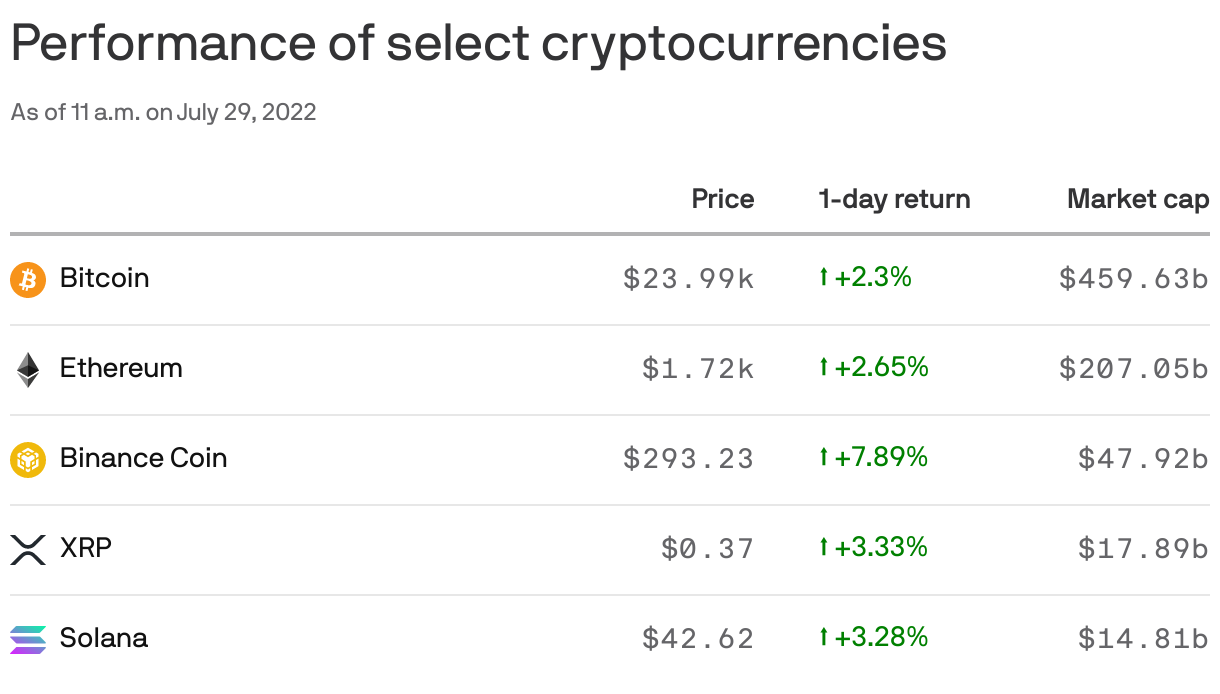
Top coins

🛸 4. Catch up quick
😡 FDIC cracks down on "misleading" claims from Voyager Digital. (Axios)
✋ Voyager Digital former executive files an objection with a competing restructuring plan. (Axios)
🌊 Another Ethereum testnet is set to merge, a boring but important stop on the path to Ethereum 2.0, which has been driving part of the ETH rally. (The Block)
📹 YouTuber catches a big move of Sky Mavis funds just before it disclosed the giant hack on its Ronin sidechain. (Bloomberg)
📺 5. Culture hash: Wait, what?
What I love about this video is that it just makes everything even less clear, but in a great way, Brady writes.
It is more journalism-as-art than it is a real explainer.
- If you step back from it, all these outtakes from a hundred conversations help illustrate the many strains of thought that are coming together through bitcoin.
Yes, but: This oldish BBC video explaining bitcoin actually does make sense in a straightforward way, if that's more your thing.
Reporter Jeff John Roberts is back in his old seat at Fortune and — dang — if he didn't let Gary Gensler have it in his first appearance on "The Ledger" newsletter that he co-launched in 2018. —C & B
Sign up for Axios Crypto

Brady Dale covers crypto and blockchain impacts on markets and regulation.