Axios Crypto

January 13, 2023
TGIF! We've got a story about what to watch out for out there. Plus, more lawsuits.
- No newsletter Monday for Martin Luther King Jr. Day! Don't be a stranger though: [email protected].
Today's newsletter is 1,356 words, a 5-minute read.
๐ 1 big thing: A pig-butchering attempt
Illustration: Annelise Capossela/Axios
An online scammer managed to get a little bit of money out of one of our readers, so we wanted to share the story so others know what to look out for, Brady writes.
Why it matters: Scammers are creative, and they are always looking for new ways to squeeze money out of us. They prey on our weaknesses: greed, loneliness and faith in humanity.
Driving the news: After we asked readers about cases in which they had been scammed online, one reader came forward with a case of what's known lately as "pig butchering."
- Pig butchering is a labor-intensive scam where the attacker butters up a victim over time before putting pressure on them to make a big purchase.
The story: "In mid-October, I was 'accidentally' contacted via text by a stranger who was supposedly trying to reach someone else. The conversation quickly turned to crypto," a reader told us.
- His interlocutor called herself "Linlin." She sent him screenshots of trades she had pulled off and promised she could make him rich in a few months.
- They had one short phone call to verify she was real.
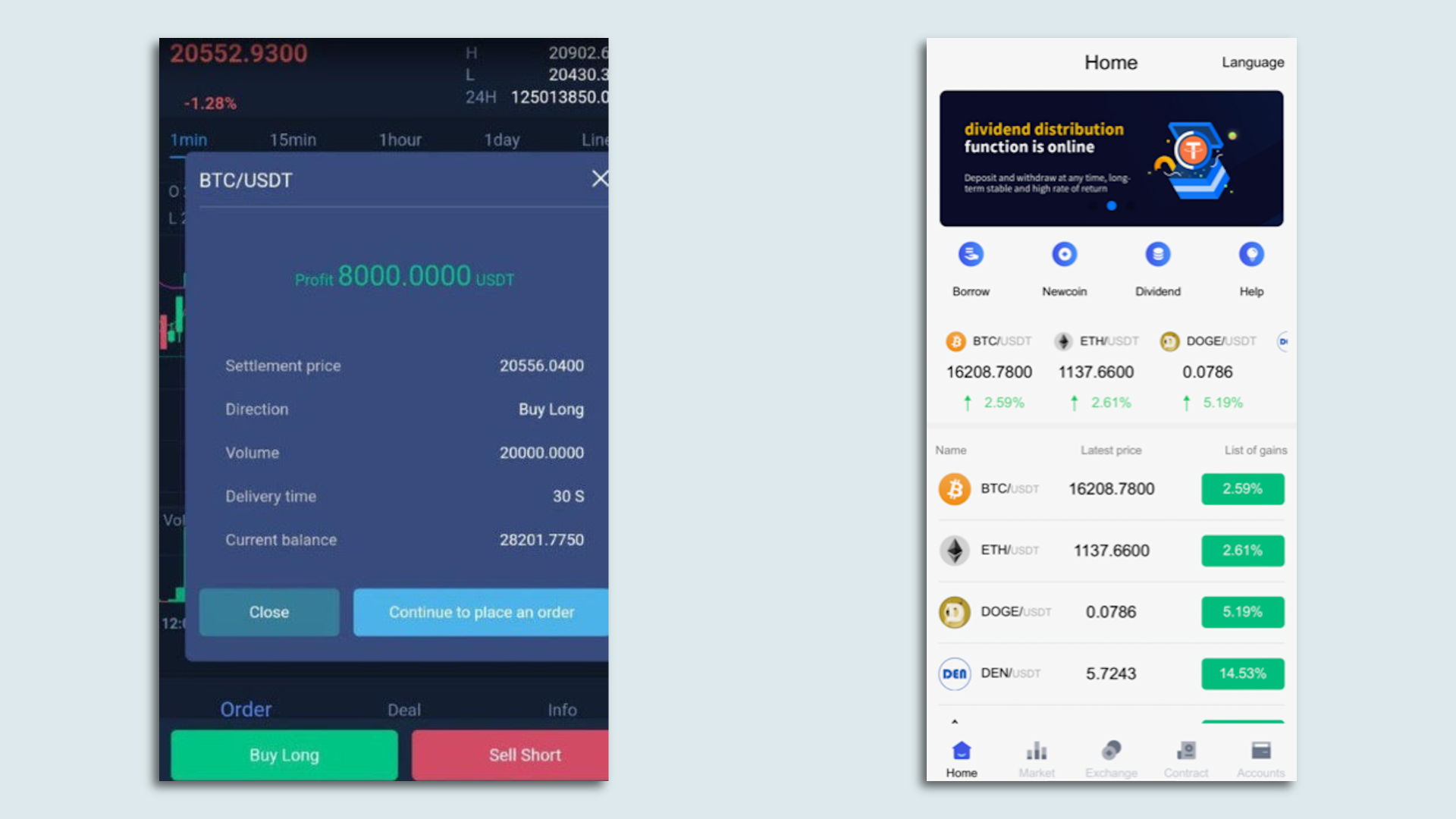
When it was time to invest, he needed to download both the Crypto.com app and the Cobeim app. Cobeim also has a website (intentionally not linking) where it says it's the "world's most innovative crypto exchange center;" however, it is not listed on CoinMarketCap's exchange page.
- Linlin directed our reader to buy $110 in tether (the stablecoin) on Crypto.com and then send it to Cobeim. On Cobeim, he converted it to bitcoin.
- A couple times per week, she directed him to make small buys in little bursts. She was telling him to buy put options on bitcoin in 30- and 60-second intervals (basically, bets on price).
- Before long, his $100 turned into $13,000 on Cobeim.
- Then his "tutor" began pushing him to borrow $50,000 to grow his money faster.
That's when he demurred. "By late November, this individual told me that I was 'too cautious' and she no longer wished to tutor me," he wrote. "That day, my account at Cobeim was compromised and I could no longer log in because my password did not 'exist.'"
- Reality check: There's no way to turn $100 into $13,000 that fast trading bitcoin (futures or otherwise). It's now clear to our reader that he had never "made" anything, and withdrawals were never going to be possible. It was all fiction created on the app.
By the numbers: He was only out $110. It could be much worse.
- In Santa Clara County, California, complaints about pig butchering have average losses of $300,000, according to the Wall Street Journal.
Be smart: When a stranger starts talking to you about money, tell someone else about it before getting involved.
๐ญ Our thought bubble: When checking out any new investing platform, do a search for it to see what others say. Then add the word "scam" to your search.
- Check our scam guide if you need a reality check.
The bottom line: "Throughout the process, she kept moving the goalposts," our reader told us.
- Everyone on the internet has ulterior motives, and strangers are never friends.
๐ 2. A thousand words: The orange... ball?
Screenshot: @TheNBACentral (Twitter)
The name of the building where the Miami Heat play at home is now officially "The Arena," Brady writes โ with a capital "A."
Catch up fast: The bankruptcy court agreed to an arrangement that lets what remains of FTX out of its 19-year $135 million naming rights deal. The agreement also stipulates that the city and the team quit using the name "FTX."
- Some major FTX branding on the building probably won't be removed until the season ends, however.
By the numbers: The Heat are in the middle of the pack in the Eastern Conference at the halfway point in the season, but they just set a single-game record for made free throws that's stood since 1982.
๐ฅ 3. The SEC sues Gemini and Genesis at once
Photo Illustration: Aรฏda Amer/Axios. Photo: Melissa Lyttle/Bloomberg via Getty Images
The Securities and Exchange Commission yesterday dropped a bomb on the ongoing Silbert/Winklevoss feud, Crystal writes.
- The regulator charged crypto lender Genesis Global Capital, a subsidiary of Silbert's Digital Currency Group (DGC), and Cameron and Tyler Winklevoss-founded crypto exchange Gemini with selling unregistered securities.
Why it matters: Regulatory heat on the crypto industry just rose, a lot.
What's happening: The SEC pointed to the contract โ called the Master Digital Asset Loan Agreement (MDLA) โ struck between Genesis and Gemini, partners in the latter's yield-bearing Earn product.
Between the lines: The SEC is not saying any digital assets are securities here, rather they are pointing to the contract itself.
- They're saying the MDLAs โ specifically the "Gemini Earn agreements" โ were the securities.
- "The Genesis Earn Agreements, as offered and sold through the Gemini Earn program, were securities that Genesis and Gemini offered and sold to the investing public," according to the SEC complaint.
Zoom in: Their failure to register the Earn agreements with the SEC, the agency says, meant that they sidestepped the need to disclose a "full panoply of information required by the federal securities laws," that would have been relevant to customers' investment decisions.
The crux: Gemini and Genesis allegedly raised billions of dollars from retail investors, promising those customers a return on their assets in exchange for a signed contract, the SEC said.
- It mentioned "significant harm" done to U.S. retail investors when Earn withdrawals were halted, pointing to the $900 million owed to 340,000 people.
Flashback: The complaint reads similarly to the one levied against BlockFi in February 2022. The crypto lender settled with the SEC, paid a $50 million penalty and another $50 million in state fines.
- Chairman Gary Gensler then called it the "first case of its kind."
How it works: When Genesis and Gemini struck a partnership for Gemini's Earn program between February 2021 and November 2022, they effectively struck a three-way investment transaction, the complaint notes.
- Gemini customers tendered crypto assets to Genesis, and Genesis promised to pay them interest on those assets.
- Gemini acted as an agent, taking a fee before distributing the interest payments, the SEC says.
The intrigue: Regulators appear poised to stop the companies from operating.
- "While the Gemini Earn program has been terminated, both Genesis and Gemini continue to do business in the crypto asset industry," the SEC says.
- "Defendants remain positioned to violate the registration provisions if they are not enjoined from doing so."
Neither Genesis nor Gemini responded to Axios' queries.
The bottom line: Chair Gensler took to Twitter saying: "Crypto intermediaries need to comply with our securities laws. This protects investors. It promotes trust in the markets."
- "It's the law."
๐ญ Our thought bubble: How existential for the crypto industry, with life or death written in contracts of their own making.
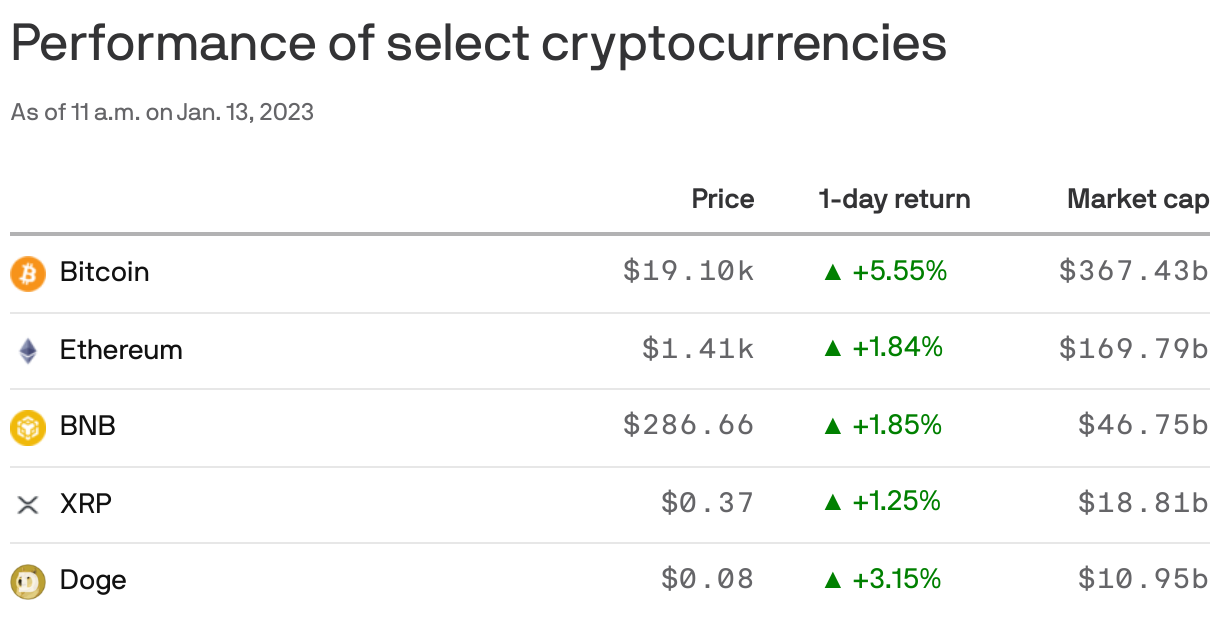
Top coins

๐น 4. Catch up quick
โก๏ธ Wyre, despite signs that it would shut down, announced it raised some kind of funding such that withdrawals have reopened. (Wyre)
๐ฃ Sequoia Capital partner says his firm was "misled" by FTX. (Axios)
๐ After a raid by police, crypto lender Nexo saw $158 million in withdrawals, or about 2% of its assets. (The Block)
๐ซ New FTX lost $72,000 on Aave because of missteps it made consolidating the funds. (The Block)
๐ธ 5. Culture hash: Bitcoin's Miss Universe
Alejandra Guajardo, Miss El Salvador 2023, Screenshot: @stacyherbert (Twitter)
Miss El Salvador 2023, actor and model Alejandra Guajardo, stunned in the prelims at the Miss Universe pageant wearing what looked like a Casascius-inspired 'fit, Crystal writes.
- She's also wearing the country's bygone currencies including cacao and the Salvadoran colรณn.
Be smart: Casascian Coins or "Cacs" are physically minted units of bitcoin with private keys written on a piece of paper, embedded within. Mike Caldwell is the fellow behind it.
Flashback: FinCen in 2013 put the kibosh on the whole thing, saying that Caldwell's business would qualify as a money transmitter, which requires licensing.
Yes, but: The shells of these coins, sans the private key, are still in circulation; one we saw was listed with a $17,499 sticker price on eBay.
- h2o_customs, the seller, tells Axios that the coin has been peeled.
- He says he only sells redeemed Cacs coins on the site to stay in compliance with eBay policy, but he's a collector and says he has intact coins.
๐ญ Our thought bubble: So much for the regulatory pageantry.
This newsletter was edited by Pete Gannon and copy edited by Carolyn DiPaolo.
Brady, for sure, got some of these pig-butchering messages during the pandemic. Did any of you? โC & B
Sign up for Axios Crypto

Brady Dale covers crypto and blockchain impacts on markets and regulation.