Axios Communicators

April 11, 2024

☀️ Happy Thursday, folks!
- 🧠 Join me for an exclusive Communicators Pro event on April 15, where I will chat with Axios co-founder and CEO Jim VandeHei about the media landscape and what it means for communicators. Sign up.
Today's newsletter is 1,560 words, a 6-minute read.
1 big thing: Reaching Gen Z

To reach younger audiences, brands and public figures are going direct through visual communications — like short-form video — and engaging with subject matter experts or trusted influencers across social, digital and audio platforms.
Why it matters: Young people aren't consuming news in a traditional way, which is flipping the public relations field on its head.
By the numbers: Three-fourths of Gen Z, millennials and Gen X use social media to find news, compared to only 44% of baby boomers, according to a recent Harris Poll study.
- The most popular platforms for news gathering among Gen Z include Instagram (71%), YouTube (69%), TikTok (65%) and Facebook (51%).
- Only 44% of Gen Z report consuming news on X and 22% on LinkedIn.
Younger audiences are also more likely to follow specific journalists than they are news organizations, according to dozens of Gen Z news consumers Axios spoke with.
- "Modern journalists are creators too," Jordan Alperin, associate creative strategist at Day One Agency, told Axios. "They have a presence on social media and have branded themselves as experts that we can relate to and trust, which is why we will follow them beyond just the stories they write."
Zoom in: Publications are investing in alternative ways to report news — like audio recordings, podcasts, explainer videos and glossy visuals — and are requesting digital assets from PR professionals to accompany the news stories.
- "We do a lot of newsroom creation to help the editors tell their stories, because frankly, many of the newsrooms today don't have the time or resources," Day One Agency co-founder and CEO Josh Rosenberg says. "So for us, in order to tell the best stories, we create the best visual assets and pass them along."
What they're saying: Emily Blair Marcus, the 26-year old CEO and founder of PR firm Emily Blair Media (EBM), is best known for helping young creators and influencers extend their 15 minutes of fame through long-tail communication strategies.
- "Owned and social platforms still remain super important for building a following, but you need traditional media to keep the momentum and give you credibility in certain circles," she told Axios.
- "And while mainstream recognition will always be really exciting, many of our clients now recognize and understand the power of more niche media opportunities. At the end of the day, young audiences won't see most of the coverage unless it's included in a TikTok or listed in your Instagram bio."
Yes, but: Partnering with creators, influencers or celebrities can be a risk for brands and these partnership decisions cannot be made in a vacuum.
- "Brand safety is something that's on all of our minds, so we work really closely with corporate affairs, communications and legal," Rosenberg says. "The social media landscape moves fast and in order to keep up and protect the brand, you've got to get everyone on the same page."
What to watch: The comment sections across social media need monitoring.
- Young social media consumers are inherently skeptical of what they are seeing online and treat the comment sections like their source of truth or footnotes.
- In response, brands are increasingly showing up in the comments to engage with users, set the record straight or steer them toward their own page or content.
2. Youths say goodbye to Google
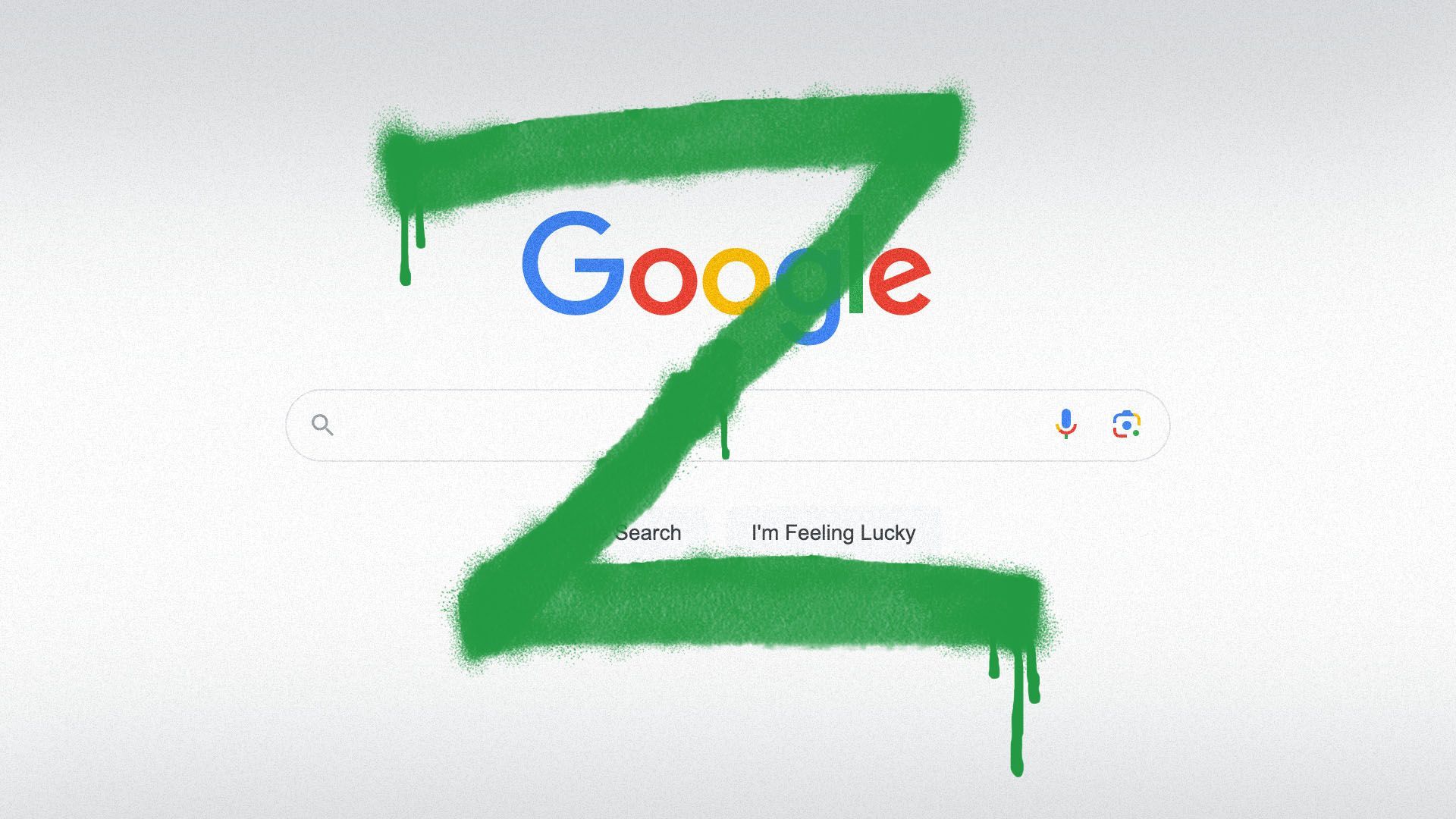
Gen Z is turning toward social media as a search engine, seeking quick, relatable answers amid dissatisfaction with Google's results, writes Axios' April Rubin.
Why it matters: Young internet users' behavior marks a clear departure from that of millennials, many of whom take pride in their "Google-fu."
- It's also a headache for Google, a nearly $2 trillion company that's still heavily reliant on ad revenue tied to search results.
Driving the news: 46% of those aged 18-24 start their information quests by searching on Google, per data shared exclusively with Axios from YPulse, a youth research firm.
- That's compared to 58% of those aged 25-39.
- 21% of 18- to 24-year-olds start with TikTok, while 5% start on YouTube.
The big picture: Social media platforms have "shifted so much from being a place to connect with friends and family to an information superhighway," MaryLeigh Bliss, chief content officer for YPulse, tells Axios.
- Some users prefer to search on social media to get more authentic answers, especially as Google and others increasingly promote sponsored results.
State of play: Users have been increasingly dissatisfied with Google's search results, says Danny Goodwin, managing editor of digital marketing and tech site Search Engine Land.
- Low-quality results are well optimized to show up high on Google search result pages, per a study published this year by researchers in Germany, focused on product searches.
- Plus, an increase in AI-generated content could exacerbate those issues, the researchers warned.
Between the lines: Some users prefer to search on social media to get more authentic answers, especially as Google and others increasingly promote sponsored results.
- "You're getting more information in smaller bites from more, different sources," says Fred Cook, director of USC's Annenberg Center for Public Relations.
- Gen Zers are also true digital natives, having grown up in the social media era with no memory of Google's early days.
What they're saying: "People have many choices when it comes to accessing information," a Google spokesperson said.
- "We're focused on continuing to make Search a place where you can find high-quality, reliable information as well as a variety of first-hand perspectives."
3. LinkedIn-fluencers rise

LinkedIn hopes that a new TikTok-style video feature will entice more brand builders and younger creators.
Why it matters: The rise of short-form video would inevitably change the way executives engage and thought-lead across the professional platform.
The big picture: There's more emphasis on building a personal brand — and for working professionals, LinkedIn is seen as a safest place to do it.
- Plus, the ability to connect with deeply engaged audiences has created more opportunities for executives to build their chops as thought leaders and visibly engage with employees, consumers and other industry leaders.
- "A lot of the CEOs are out there now evangelizing the brand," says Roberto Munoz, CEO and founder of Munoz Communications and author of "LinkedIn PowerUp Playbook."
- "We're also seeing CEOs step in as the face of the organization, commenting on everything from a new product launch to welcoming new team members [and] what's happening in Israel and Gaza."
Zoom in: Company pages also see a lot of action on the platform, per LinkedIn data shared with Axios.
- Over 67 million companies and organizations have pages, and 40% of LinkedIn visitors engage with a page organically every week.
Corporate communications teams are also buying ads across the platform to specifically target employees with corporate brand messaging.
- "LinkedIn is our most effective employee communications tool," one chief communications officer of a consumer package goods brand told Axios. "We know from the analytics that our employees find information and want to amplify and be advocates for our company on LinkedIn."
What they're saying: "In general, we've seen an increase in executives and other business leaders leaning more into LinkedIn as a platform to talk directly to the world," says a LinkedIn spokesperson.
- "And they're being more transparent than ever on their take on business trends, sensitive company news and their own advice on leading."
Go deeper ... LinkedIn moves in on TikTok's turf with video option
4. Communicator Spotlight: Allison Braley of Bain Capital Ventures

As Bain Capital Ventures' first marketing partner, Allison Braley splits her time between promoting the firm and its portfolio companies.
- Why it matters: Braley has used her personal brand to bring more awareness to both.
🗣 What she's saying: "Smart entrepreneurs look at someone who is able to build a presence for themselves and feel a higher degree of confidence that they'll be able to do it for them too," Braley told Axios.
- "When I started out 15-20 years ago, having a personality and sharing it was not a positive [but] now, we've finally allowed communications professionals to be filled with real opinions ... and I think more comms people will end up trending in that direction over the coming years."
📍How she got here: Braley got her start in agency world, supporting public relations for consumer tech clients.
- She has since held in-house communications roles for Conde Nast, ZocDoc, Zoosk and The Information. Prior to joining Bain Capital Ventures in 2022, Braley led communications and marketing for venture capital firm Playground Global.
- Zoom in: "Earlier in my career, I was very much a comms person and even more of a media relations person. Obviously, the role of communications has evolved considerably and as part of my process of evolving, I ended up taking on more brand and content work, which included community building and working with influencers and led to me taking on a marketing title."
- Yes, but: "My specialty is brand communications and social content. It's not growth marketing, and so I need a strong growth vice president under me to to be successful."
📱What she's watching: The next big social media platform.
- "There's obviously been a lot of turmoil in the social media space, so I'm keeping my eye out in 2024 for new entrants that could make a big difference in growing our audience — which is made of up of founders and entrepreneurs."
🧠 Best advice: Don't come with problems, come with solutions.
- "That advice changed the trajectory of my career," she added.
5. 💰1 fun thing
Costco's gold bars are going viral and have generated between $100 million to $200 million in sales per month.
- Why it matters: The superstore known for its passionate fan base, $1.50 hot dog combo and cheap apparel has leaned into a quirky marketing move that appears to be working.
✅ That's all for now! Thanks to editors Nicholas Johnston and Kathie Bozanich.
📧 And don't miss out on more content, events and insights. Join Axios Communicators Pro.
Sign up for Axios Communicators