Axios Communicators

January 23, 2025

❄️ Hi! Sorry I'm a little late. I'm writing this from the back of a car headed to Zurich after just wrapping up our final conversation in Davos, Switzerland. More below ...
🚨 Situational awareness: President Trump virtually addressed the World Economic Forum at Davos today, taking digs at former President Biden and calling for a "revolution of common sense."
Today's newsletter is 1,874 words, a 7-minute read.
1 big thing: Ready to work with Trump
CEOs are committed to working with President Trump's new administration and are seeing very little internal pushback was the vibe I picked up over four days in the Alps with executives across industries.
Why it matters: This is a dramatic shift from the employee activism seen during the tail end of the first Trump administration.
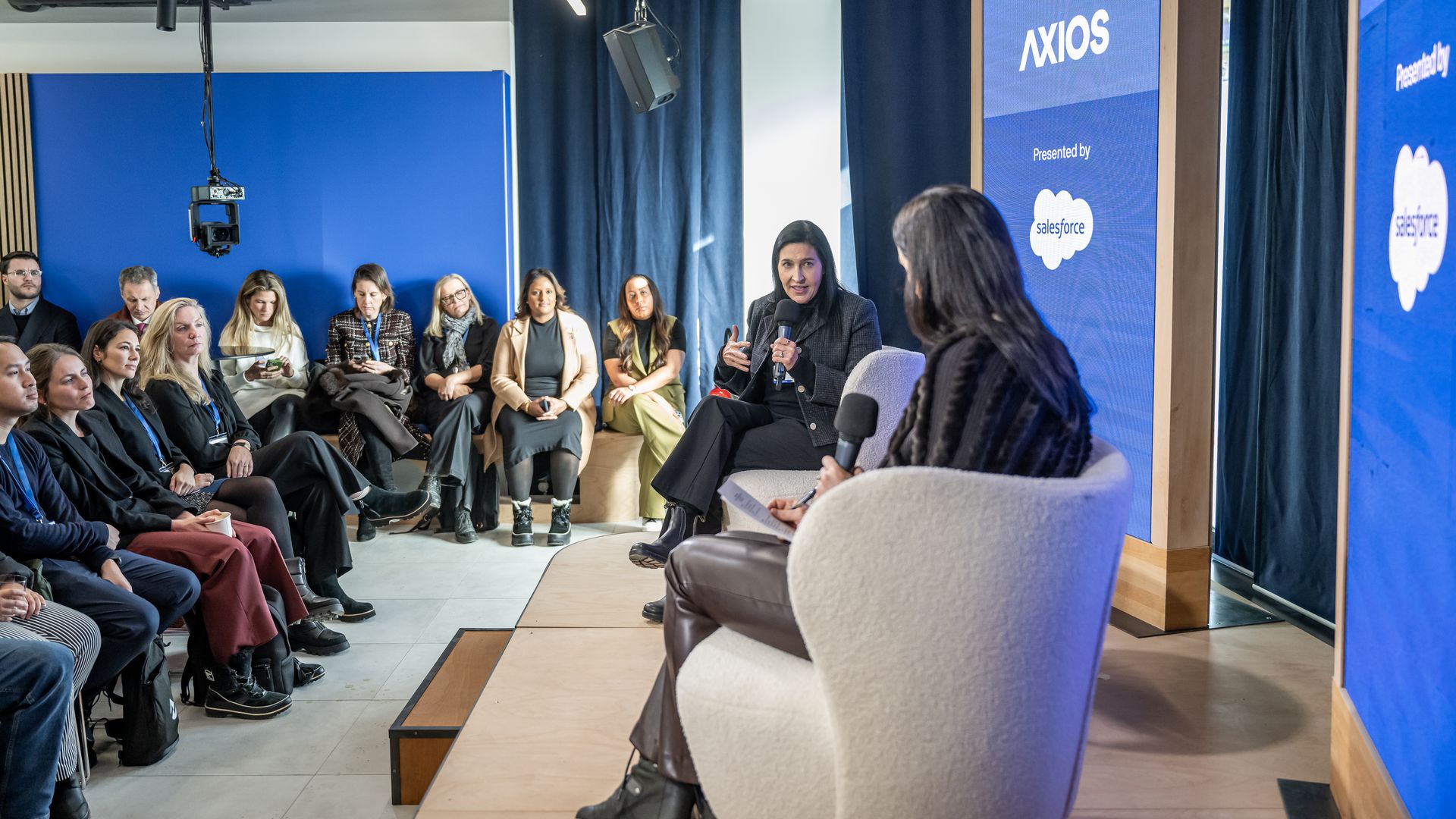
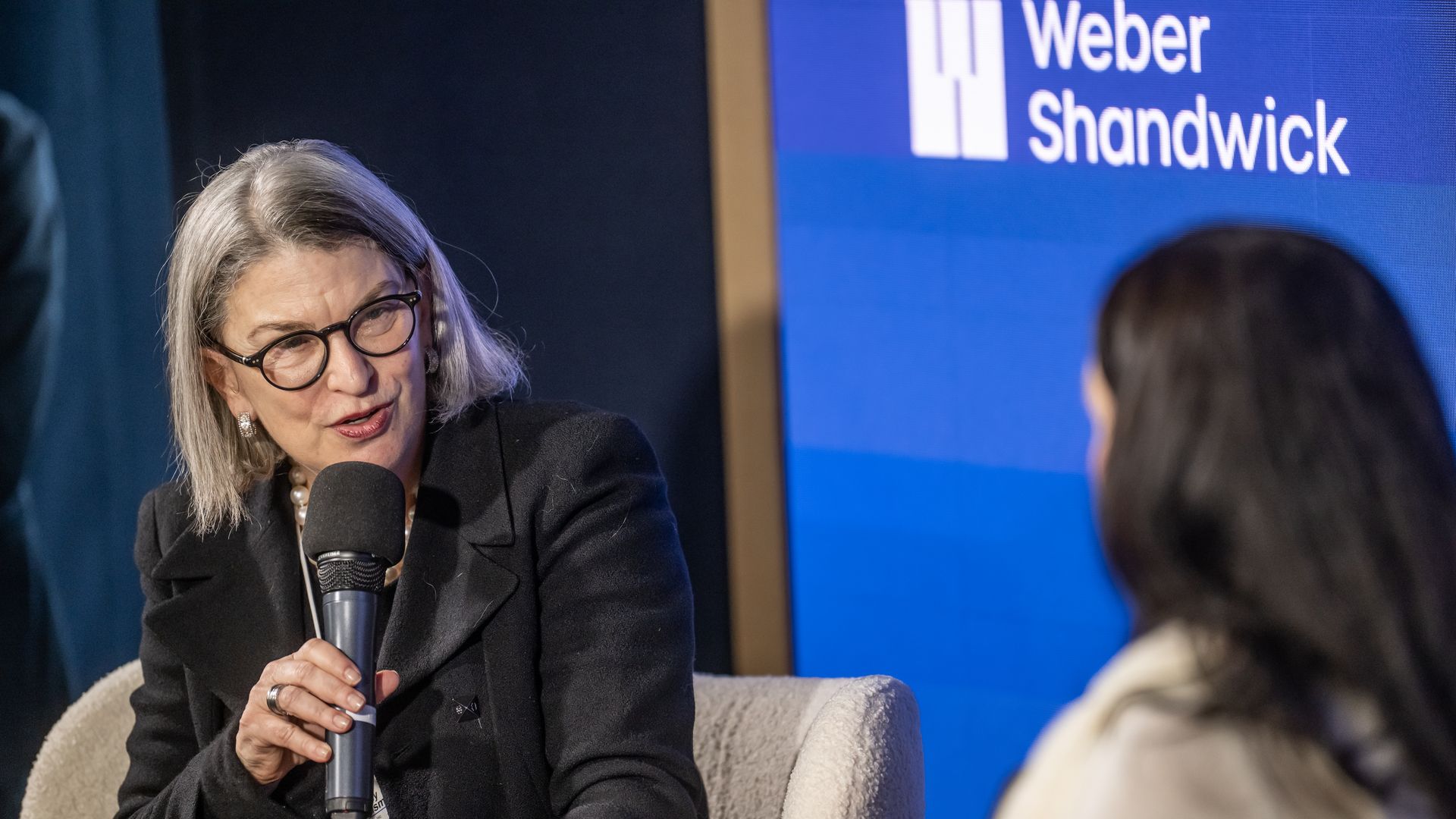
Driving the news: At an Axios conversation in Davos today, Pfizer chief corporate affairs officer Sally Susman and DoorDash chief corporate affairs officer Elizabeth Jarvis-Shean highlighted the necessity of working with Trump.
What they're saying: "This is not a time to disengage," said Susman. "This is a massive change in America, and there are other major changes also happening in other countries around the world. We have a choice: Do we want to take a pessimistic, dark view and think that it's all going to be horrible? Do we want to be optimists and say, in change is opportunity?"
- "It's my job, and probably many others in the room with similar positions, to get in there and make your case in support of your [company's] policies. … Despite the flurry of executive orders, I still think there's a lot to be discussed and debated."
- Jarvis-Shean echoed this sentiment saying, "it is our obligation, it's our responsibility to have engagement with the Trump administration in the same way that we would engage with the Biden administration, and in all of the other 30 markets where we operate."
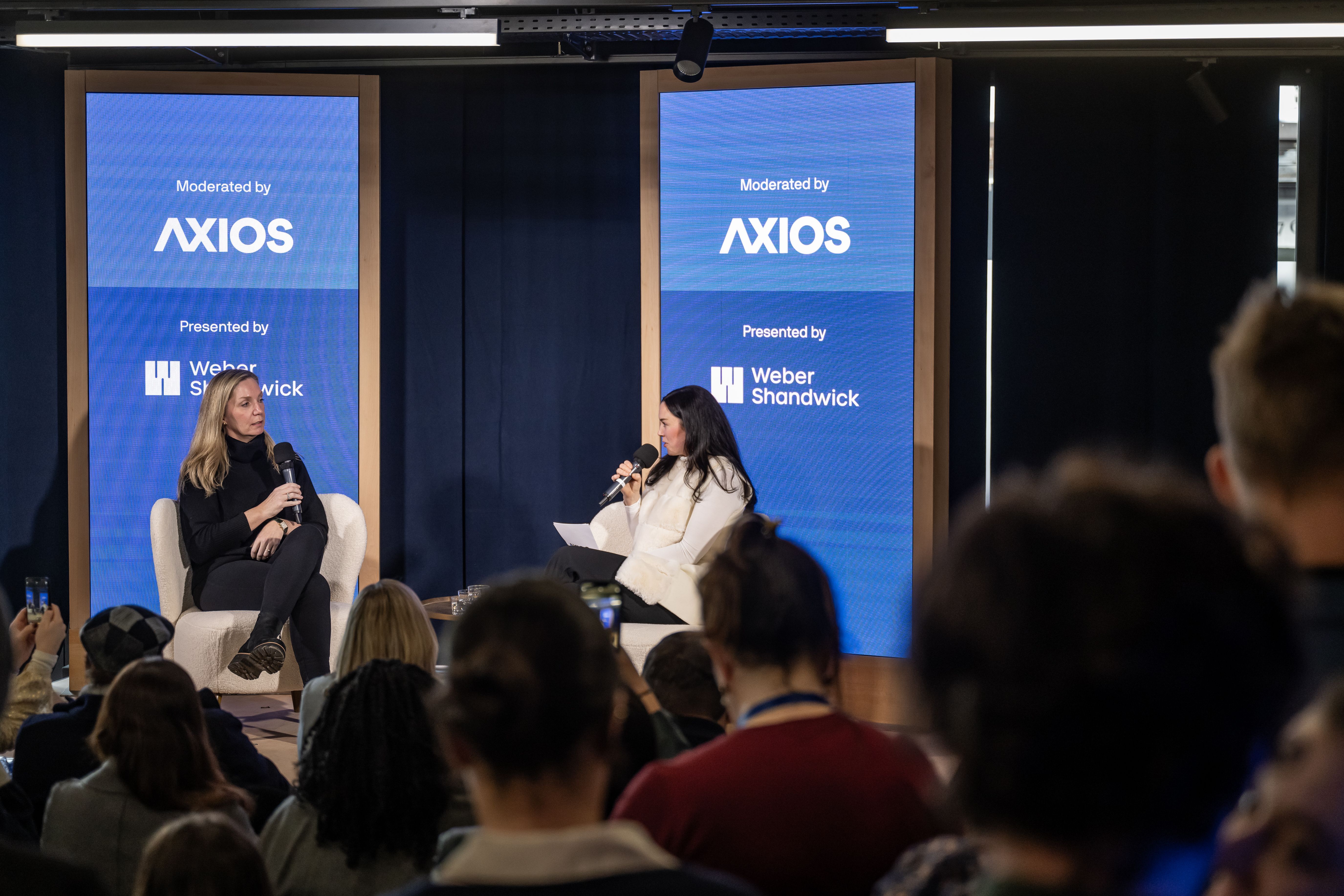
The big picture: Tech titans made a big show during Trump's inauguration and some have gone on to enforce Trump-aligned policies — like the rollback of diversity, equity and inclusion — within their workforces.
Yes, but: While not all companies expect to change their policies to fit Trump's agenda, they are interested in finding areas of alignment.
Between the lines: Susman and Jarvis-Shean emphasized employees remain a key stakeholder group and priority for CEOs, and communication teams are being proactive around social or political issues.
- "We talk about it at all-hands, and we send it out in messages, and we've been very, very clear with proactive" communication, said Jarvis-Shean.
- "Don't wait until the election results happen to tell people that you're engaging with governments. Tell them ahead of time, because everybody's thinking about it and they're going to be asking questions."
What to watch: Many are anticipating how the flurry of executive orders might affect businesses and how Trump policies could impact the geopolitical landscape.
- "The fields of communications, government relations and corporate affairs are going to be very, very busy," Susman said. "Most of the CEOs I've talked to seem to feel like they need almost a global diplomacy department to understand this very complex and rapidly changing world."
Go deeper ... watch the interviews.
2. AI comms conundrums
Three in four Americans view AI negatively, a recent Gallup-Telescope survey found, even as U.S. businesses go all in.
Why it matters: This creates a unique challenge for communicators.
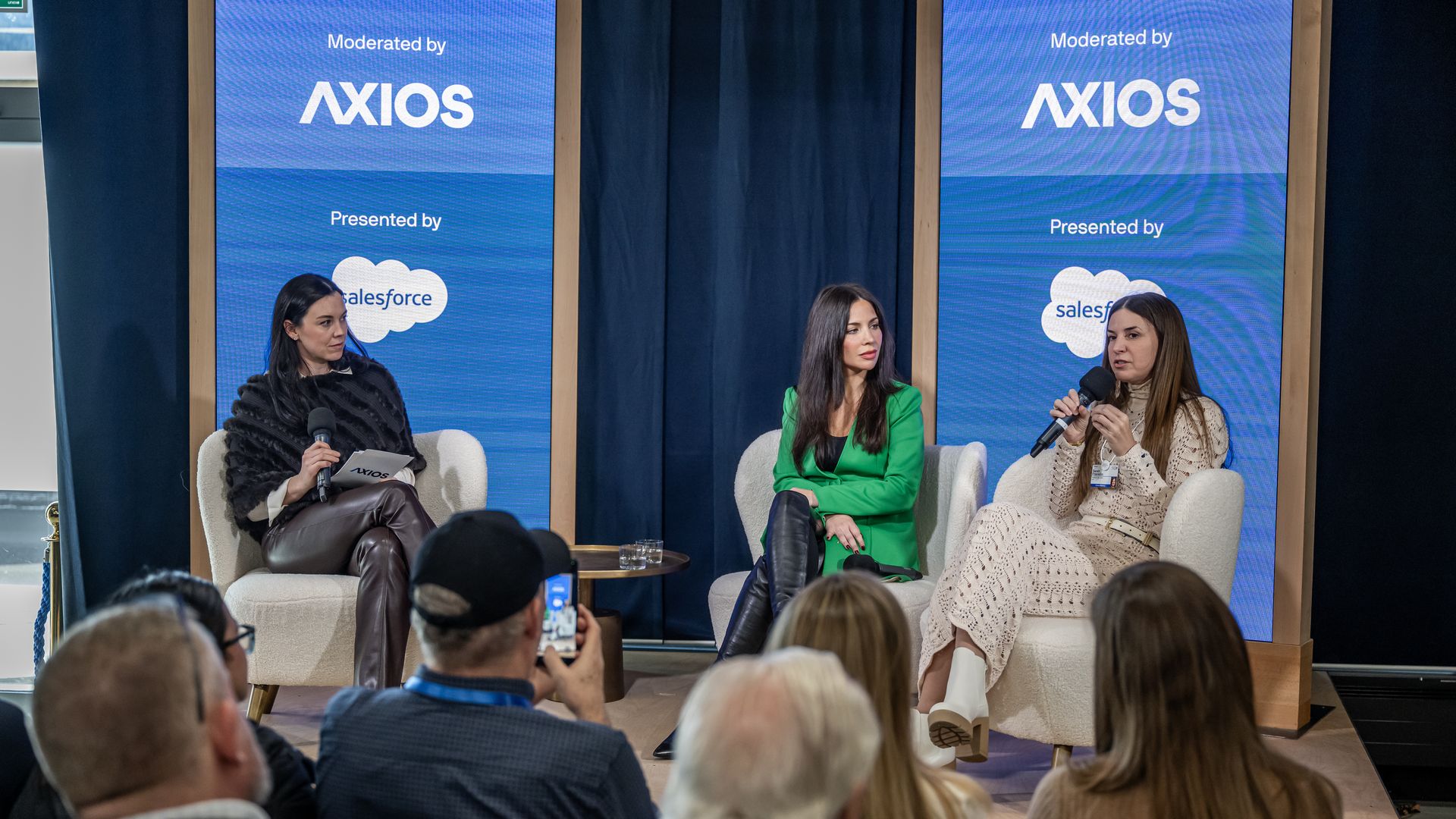
Driving the news: Communicators gathered at the Qualcomm House in Davos to discuss how to position artificial intelligence so that it builds confidence and trust.
- A new report from Page and The Harris Poll found that adults across the globe are most confident that companies can make an impact on tech innovation.
What they're saying: "What we see right now is that AI is a transformative technology, which is very exciting and very powerful," said Sarah Franklin, CEO of people management platform Lattice. "But there's a lot of questions, many questions that we don't have answers to."
Zoom in: It's particularly challenging to communicate how agentic AI could affect the workforce and change people's roles and responsibilities.
- "If you rewind one year backward, we weren't talking about a digital labor force, and now we are," said Franklin. "The question is, how close are we to agentic AI and how will that be to work together with [AI] agents? I think it'll be much more normalized."
Between the lines: Communicators anticipate pushback and questions from employees about these new tools. This makes early messaging and terminology — digital worker versus digital labor versus agentic workforce — particularly important.
- "It's a new concept, and it needs more explanation than a pithy headline," Franklin said. " ... We need to take time and be very clear in our explanations so that the details don't get lost."
Flashback: Companies came under fire in recent years for their positioning of issues like environmental, social and governance (ESG) and diversity and inclusion. How AI is messaged will be just as important.
- "Words matter. Timing matters," Lattice chief communications officer Cheryl Sanclemente said, adding what's "going to be an ongoing struggle for communicators is how do we bridge and tell stories around AI that still keeps people at the forefront."
Yes, but: It's also important to bring the pertinent communities along in the AI journey, says Bea Perez, global chief communications, sustainability and strategic partnerships officer at The Coca-Cola Company.
- Coca-Cola, which has been experimenting with AI since 2023, received backlash after airing its first fully AI-generated advertisement over the holidays.
- "One of the key learnings ... is making sure [the creative community] has a seat at the table and they're helping us," Perez said. "The second piece to it is making sure we're talking to our employees directly about how we're using it and how we're not using it."
What to watch: It will be interesting to hear how business leaders communicate the upside of AI to shareholders, compared to employees.
Go deeper ... Watch the interviews.
3. 👂🏻What I heard ...
Here are some other things I heard in Davos:
- 🔮 Every company is trying to position itself as innovative and on the cutting edge, especially as it relates to AI.
- "Relevance creates confidence in business," one chief communications officer said.
- 📱PR teams are retooling their budgets and outreach strategies to reach the audiences that matter most.
- "We look at influencers as beat reporters," said one chief corporate affairs officer.
- 💗 Communication teams are prioritizing human-centric storytelling to help build trust.
- "It's easy to hate corporations. It's harder to hate people," one comms leader pointed out.
- 🔎 When it comes to impact initiatives, corporate affairs leaders are narrowing their focus and "prioritizing fewer things, more deeply," as one chief corporate affairs officer put it.
- 🤖 Communicators are treating AI like an audience, as more people flock to large language models like ChatGPT or Gemini for information.
- ⏳Comms leaders are still "digesting" President Trump's laundry list of executive orders and how it might impact stakeholders.
- "We are monitoring everything, but we won't adjust our policies or communicate until the law is clear," one corporate affairs officer told me.
- ⚖️ Communicators must act as diplomats within the company.
- "Increasingly, our job is balancing business with stakeholder expectations," said one global head of comms.
- 🧠 Bonus observation: There was little to no programming tackling the issues of DEI and ESG. It seemed as though the topic of mental health took over that talk track.
4. Trust in CEOs erodes, new report finds
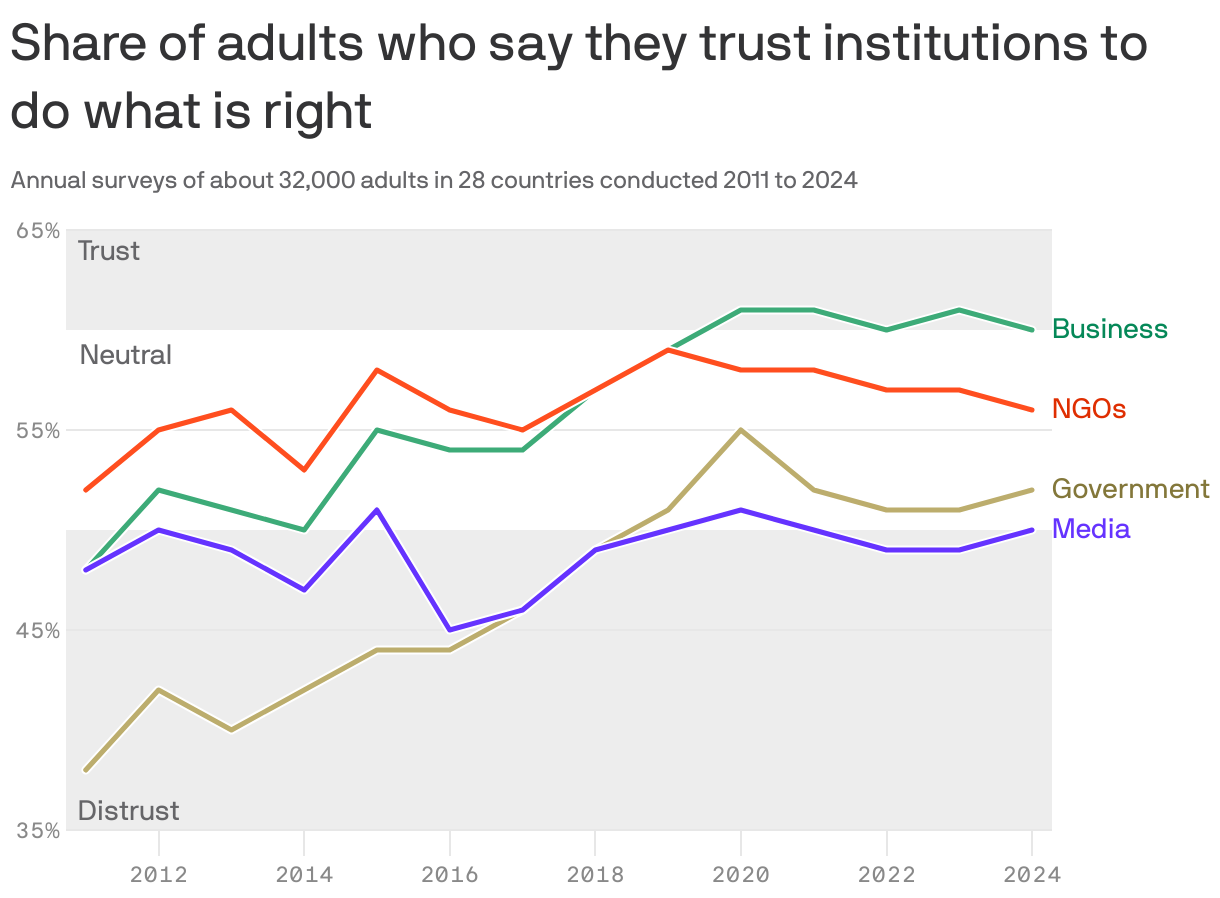
Seven in 10 adults surveyed worldwide believe government officials, business leaders and journalists deliberately mislead them by saying things they know are false or gross exaggerations, according to the 2025 Edelman Trust Barometer, released Sunday.
Why it matters: This is causing an erosion of trust among those that were once considered the most trustworthy.
By the numbers: Edelman surveyed more than 32,000 adults across 28 countries and found that a lack of faith in business leaders has increased 21% since 2021, while lack of faith in government leaders and media grew 19%.
- Roughly 6 in 10 report holding grievances against government entities, business leaders and the rich, citing bias and the belief that government and business serve only the few.
Zoom in: Those with a high level of grievances are significantly less likely to trust CEOs (30%), compared to those with a low level of grievances (64%).
Yes, but: Even given the decline in trust, roughly 8 in 10 believe business leaders are justified in addressing societal issues if their business can make an impact.
- Of note, those with a high level of grievances believe businesses can do more to address issues like climate change, misinformation and discrimination.
5. Trump's word choices


President Trump in his inaugural address on Monday portrayed the classic communications adage that it's not what you say but how you say it.
Why it matters: The speech gives insight into what to expect from Trump 2.0, and while his tone was warmer than in 2017, many of the underlying policy priorities remain the same.
The intrigue: We ran the transcripts of both speeches through ChatGPT and asked how the tone differed for each.
- According to the AI-powered analysis, Trump's optimistic tone shifted from "bold and assertive" to "hopeful but tempered." Meanwhile, his criticisms of opponents went from "direct" to "more restrained and framed as systemic issues."
- Trump's rhetorical style also shifted from "grandiose and dramatic" in 2017 to "inspirational and patriotic."
By the numbers: The words "I," "our" and "you" remained the most used words in the speech and were used at a rate of two times higher than in 2017.
- Frequently used words that didn't receive significant mention in his previous address include "thank," "govern," "unite," "Panama," "justice," "change" and "together."
Of note: Trump's 2025 address was roughly double the length of his 2017 address, which was the shortest in modern history.
Yes, but: According to an analysis by AI-powered speech coaching platform Yoodli, Trump struggled with conciseness in this year's address, saying 36% more than was needed to get his point across.
Zoom in: Yoodli also pointed out the speech's disjointed structure and lack of follow-through.
- "For instance, [Trump] mentioned "America first" several times, yet did not always tie it back to specific actions consistently," the AI speech coach said.
What to watch: Trump did take decisive action after being sworn in, by signing a slew executive orders that ranged from return to office mandates, to withdrawing from the Paris Climate Agreement and restoring TikTok.
6. Trump admin orders federal health agencies to halt communications

President Trump on Tuesday ordered key federal health agencies to pause all external communications, multiple outlets reported and Axios confirmed.
Why it matters: The health agencies' website updates, advisories, and scientific reports provide the public with critical information on a variety of medical issues, including food recalls, infectious diseases and new drug approvals.
Between the lines: The temporary pause is meant to allow the new administration's team to get settled but will not impact communications related to health emergencies, a source familiar with the matter told Axios.
- While a pause in external communications at the start of a new administration isn't unprecedented, an unnamed source familiar with the directive told CNN that the scope of the order seemed unusual.
Flashback: The first Trump administration in 2017 sent a similar directive pausing external communications to several federal agencies overseeing environmental and scientific policy.
7. 🤿 1 quote to-go
"I know this is a crazy analogy, but I feel like [scuba diving] is similar to the story of AI. There are some dangerous things down there. But if you don't go deep and if you don't try it, you're never going to see the beauty."— Bea Perez, global chief communications, sustainability and strategic partnerships officer at The Coca-Cola Company, to the audience in Davos.
☑️ Thanks for reading each week! And thanks to editors Nicholas Johnston and Kathie Bozanich.
Was this forwarded to you? Subscribe here.
Sign up for Axios Communicators