Axios Communicators

February 06, 2025

🔆 Welcome back!
- 📇 Reminder: Monthly Moves hits inboxes tomorrow. Share your job news here.
📅 Save the date: Axios returns with our fourth annual What's Next Summit in Washington, D.C., on Tuesday, March 25. Interested in attending? More info here.
Today's newsletter is 1,665 words, a 6.5-minute read.
1 big thing: How American Airlines communicated through tragedy
The communication team at American Airlines had to activate a crisis plan it hoped it would never have to use after last week's midair collision of a passenger jet and Army helicopter that claimed 67 lives.
Why it matters: Responding to a tragedy of this magnitude requires clarity, discipline and speed.
- The American Airlines team had a communications plan ready, followed it and managed to avoid major political distractions.
Catch up quick: The passenger flight from Wichita, Kansas, was on approach to Reagan National Airport outside Washington, D.C., when it collided with the helicopter about 9pm ET on Jan. 29. Both plunged into the Potomac River in the deadliest aviation disaster in the U.S. since November 2001.
- Within an hour of the crash, the airline released written communication that focused on what they knew and provided a helpline and directions for those who believed they had family members onboard.
- The airline also established its newsroom page as the key source for updates related to the crash and activated its CARE Team, a group of specialists who are trained to offer support for those affected.
Context: By 11pm the night of the crash, American Airlines CEO Robert Isom released a video statement offering deep sympathies and saying the company's priority moving forward was the investigation and those impacted by the crash.
- From there, Isom acknowledged there were still unanswered questions but shared what information he could.
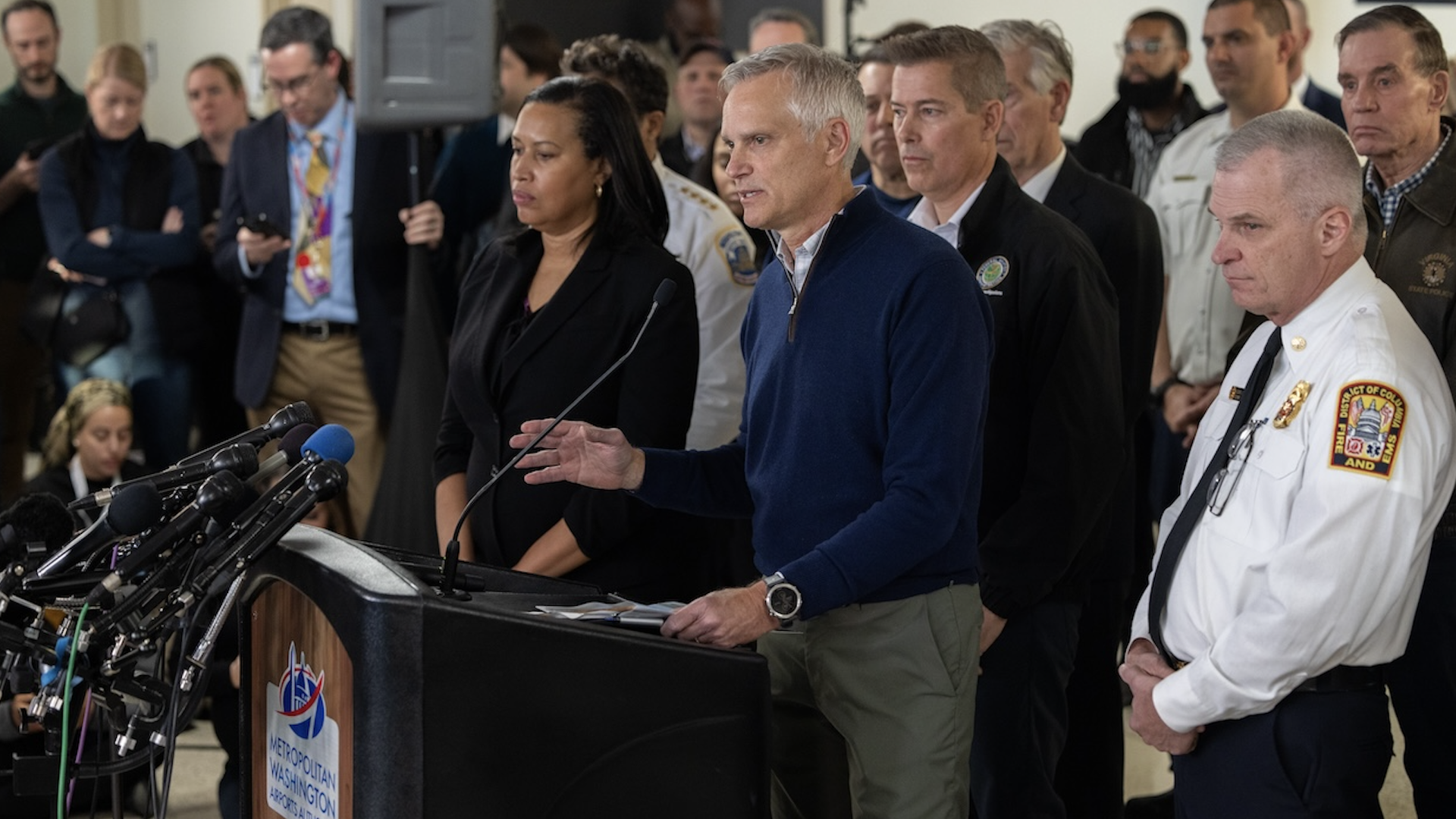
- The following morning, Isom appeared alongside local officials and first responders for a press conference, and he released another video that afternoon, wearing the same outfit he was wearing in his response just hours after the crash.
- Since then, the airline has been cooperating with the investigation, letting the National Transportation Safety Board take the lead while prioritizing internal communications.
- American Airlines declined to be interviewed for this story.
Between the lines: American Airlines did not respond to the political narrative being pushed by President Trump and others on his team, who suggested the Biden administration's diversity, equity and inclusion hiring practices were to blame for the crash.
- Of note, Trump's strategy of pointing to DEI and the Biden administration did not resonate with Americans, according to Morning Consult data shared with Axios.
- Only 24% of U.S. adults said DEI was responsible for the crash and 22% said the Biden administration was to blame. More U.S. adults (26%) said the Trump administration was responsible.
What they're saying: While your first communication is never going to be your last in a crisis of this scale, it does set the tone — and the tone American Airlines established was transparent and empathetic, says Carreen Winters, president of corporate strategy and reputation at MikeWorldWide.
- "Airlines are the godfathers of modern crisis communications in the way that they've established their protocols and the rigor that they have around continually thinking about new scenarios, practicing and testing their response team," Winters said.
- "Everybody's a crisis communicator and is trained and has that muscle. This is not a muscle that needs to be used often, but it is one that needs to be used with excellence and with speed."
Zoom out: News communications have drastically changed in the more than two decades since a U.S. airline experienced a crash of this magnitude.
- Now, speed is of the essence, and the standard of companies issuing a response in the first hour has been replaced by the need to respond within the first minutes.
- Plus, owned channels have become a more powerful tool for distilling information in the midst of a crisis.
- "It used to be that you had to find a broadcast outlet and put your CEO on the hot seat in order to get any kind of video out into the market," Winters said. "The fact that they can be their own news channel, if you will, and utilize video as well as they have, is one really big communication strategy that's evolved."
2. Chart: Aviation reputation

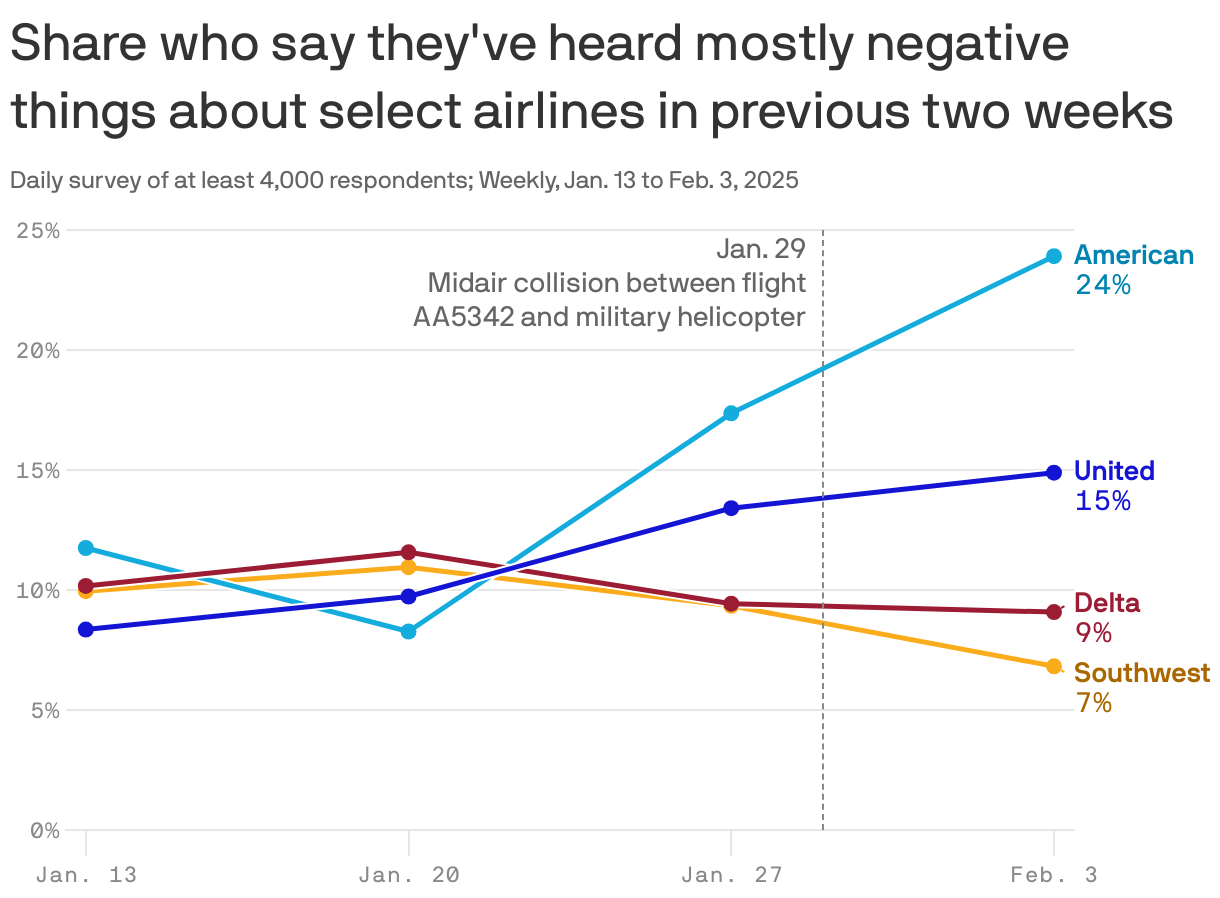
Before the crash, only 8% of U.S. adults reported seeing, reading or hearing something negative about American Airlines, according to Morning Consult's daily brand tracking.
- Since the collision, 25% say they have heard negative buzz. However, American Airlines' reputation metrics around brand favorability, trust and purchasing consideration have not moved.
Zoom in: The stable reputation metrics could signal the airline's response has been appropriate and well-received by key stakeholders and the general population.
Zoom out: While most Americans who heard about the collision knew it was an American Airlines carrier that was involved, 8% thought it was United Airlines and 5% thought it was Delta Air Lines.
- Some of that confusion translated to negative buzz, per Morning Consult.
The big picture: 66% of U.S. adults are concerned about flying in the future, with one-third of those saying they are "very concerned."
- Plus, recent operational failures — like the door blowout on a Boeing plane, Crowdstrike's outage that led to more than 5,000 Delta flight cancellations and the 2022 Southwest Airlines outage — have not helped the aviation industry instill trust.
What's next: Calming nerves after this tragedy will be a task for all U.S.-based airlines.
3. LinkedIn rolls out video features
LinkedIn has rolled out vertical video capabilities in an effort to make the platform more creator-friendly.
Why it matters: It is the latest attempt to go after the TikTok niche, as yet another social platform embraces video content.
The big picture: Working professionals are feeling more pressure to build personal brands, and many senior business leaders are flocking to the platform to share quarterly earnings, explainer videos and even their running routines.
Driving the news: The new video capabilities include in-feed design updates, enhanced video search and more video analytics like average watch time.
- LinkedIn users are watching videos on the platform at a rate 36% higher than last year and videos see 1.4 times more engagement than traditional posts, according to data shared with Axios.
What they're saying: "LinkedIn has evolved beyond networking and job hunting — it's now a content platform that rewards brands and people who create great content," says Roberto Munoz, CEO and founder of Munoz Communications and author of "LinkedIn PowerUp Playbook."
- "With so much AI-generated material flooding everyone's feeds, video has the potential to cut through and build trust by putting a face behind a brand, service or product."
Yes, but: LinkedIn-fluencers might not reach the same large following as those on TikTok.
Between the lines: LinkedIn says its algorithm is designed for relevancy, not "virality," which means the follower relationship is likely to be deeper, more trusted and often anchored in professional development or industry knowledge and trends.
- For example, roughly 8 in 10 investors say they research a company or executive's LinkedIn presence before making recommendations, per a recent Brunswick Group report.
- Plus, the platform has doubled down on news while other platforms like Facebook and X have deprioritized it.
What to watch: More PR professionals — who are typically responsible for managing the social media strategy of executives and corporate brands — are focusing on the platform.
💭 Eleanor's thought bubble: There's a level of cringe here that will be hard to break through, but that doesn't mean I won't give it a try.
4. Majority skeptical of corporate statements, new report


Nine in 10 Americans question the sincerity of a corporate message, regardless of where they see it, according to a new study from SmartNews, a news aggregator app.
Why it matters: Trust in business continues to decline, and communicating with clarity and consistency across a complex matrix of channels has never been more challenging.
By the numbers: SmartNews surveyed more than 1,000 U.S. adults from Jan. 16-19 and found that Americans are most likely to learn about company news or see official statements through traditional news coverage.
- Regardless of how they stumbled upon the company news, 31% say they usually question its sincerity and 15% always question it, per the survey.
Between the lines: One key reason for the skepticism is the jargon-laced statements, which a plurality of respondents say are overly scripted and appear inauthentic.
- Specific phrases cited included "This lawsuit has no merit," "[Company name] is a game-changer for the industry" and "We're the leading provider in [industry]."
- Phrases that show acknowledgment and action are viewed as the most impactful — like, "We are committed to resolving this issue," "We recognize the importance of this issue" and "This is a learning opportunity for us."
- Audiences are most leery of companies that issue a "no comment," per the survey.
Yes, but: Seven in 10 respondents say they learned about negative company issues because a company issued a statement, with 43% stating they would not have known if the company had not spoken out.
- Of note, close to 3 in 10 say that hearing about it from the company first made them more sympathetic to the company's position.
Zoom in: When issuing a response to tough issues or crises, audiences are more keen to hear from the company's CEO.
- Roughly half say the CEO is the most trustworthy spokesperson for crises involving security, while 56% say CFOs are most trusted to discuss financial issues.
What they're saying: "Audiences are keenly aware of corporate doublespeak," says SmartNews managing director Jason Alderman.
- "But, by prioritizing clear, direct communication, companies can rebuild trust and ensure their words hold genuine meaning."
5. 📺 1 Super Bowl thing


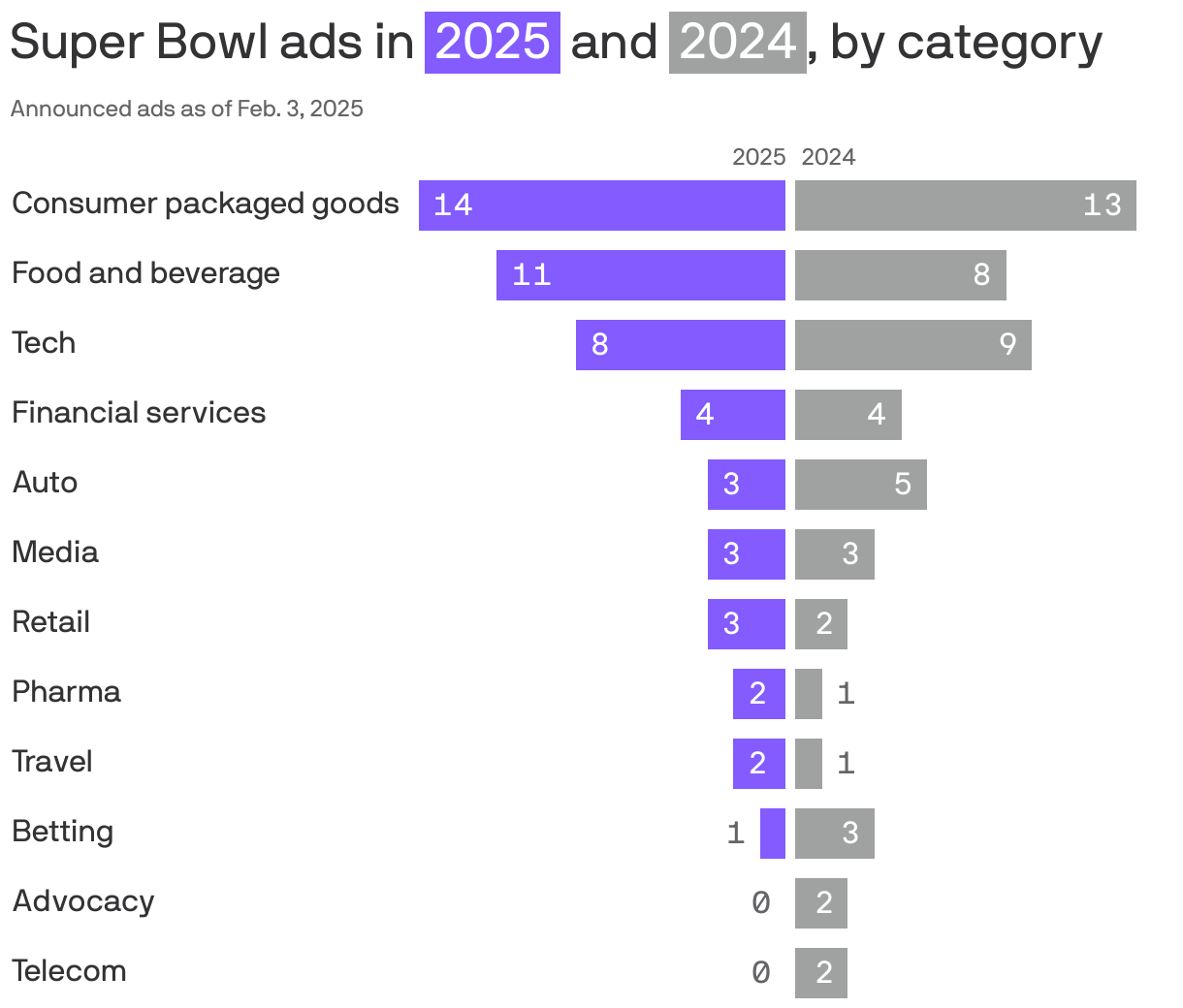
A slew of advertisers are bringing a healthier and more female-focused message to this year's big game, with spots highlighting everything from breast cancer awareness to obesity and body positivity.
- Why it matters: The trend is a shift from the last few years when the Super Bowl was flooded with ads that typically target young men and their vices, like sports betting and crypto investing.
Zoom in: Novartis will mark its Super Bowl debut with a 60-second, star-studded commercial spotlighting breast cancer awareness.
- Hims & Hers, Dove, WeatherTech and several nonalcoholic drinks will also appear during the big game, including Killer Cola and Cherry Obituary from water company Liquid Death and probiotic soda from Poppi.
Thanks for reading! And thanks to editors Nicholas Johnston and Kathie Bozanich.
🔍 Want to go deeper? Join Axios Communicators Pro.
Sign up for Axios Communicators