Axios Communicators

October 02, 2025

Hello and welcome to the second half of the week!
- 🗂️ Reminder: Monthly Moves hits inboxes tomorrow. Submit your job moves here.
- 💥Axios Live and Noticias Telemundo are headed to Los Angeles for our fourth annual Visionarios event on Wednesday, Oct. 8, featuring 2026 California gubernatorial candidate and former HHS Secretary Xavier Becerra, LA Galaxy's Christian Ramirez and more. RSVP here.
Today's newsletter, edited by Christine Wang and copy edited by Kathie Bozanich, is 1,965 words, 7.5 minutes.
1 big thing: The latest governance issue

It has never been easier to gather information about a company through disclosures, regulatory filings, statements, commitments, internal communications and brand campaigns.
- But what happens when there's even the smallest discrepancy in what a company is saying and what it's doing?
Why it matters: Narrative inconsistencies are not just PR glitches, they are the next big governance risk.
State of play: Regulators, investors and courts are beginning to treat narrative contradictions — statements that are true on their own but irreconcilable across disclosures — as actionable governance failures, says Craig Carroll, founder of the Observatory on Corporate Reputation.
- For example, Boeing's 737 MAX crisis highlighted the disconnect between internal communications and engineer warnings with public assurances and protocols.
- On a less severe scale, Bud Light's marketing misalignment caused consumer confusion, long-lasting boycotts and a sinking stock price.
- It could also show up across markets, with ESG marketing in Europe that isn't reflected in SEC filings.
The big picture: PwC surveyed over 600 public company directors and found that 21% believe there is a lack of the necessary expertise for today's board roles.
- Board appointments still largely focus on traditional expertise across finance, operations and industry knowledge.
- Only 32% of executives believe their boards have the right expertise.
Between the lines: Corporate boards face potential fiduciary exposure if they ignore narrative gaps, and CCOs who can manage contradictions become indispensable to the board.
Yes, but: As companies grow, evolve and adapt to the current environment, their commitments or scope of work change, which leads to contradictions in the corporate narrative.
- Most recently, this has taken the form of DEI or ESG walkbacks.
- It is up to the communications team to identify and reconcile these changes in language and strategy.
What's next: AI integration is bound to lead to several narrative discrepancies across businesses, such as gaps between public ESG commitments and operational realities.
The bottom line: If you don't govern the story, the story will govern you.
- "CCOs are uniquely positioned to detect, to compile and reconcile contradictions before they blow up, turning liabilities into governance signals," Carroll says.
2. Going direct builds trust, new survey finds


Audiences are more likely to trust people over platforms, according to a new survey by Foretell and Echelon Insights.
Why it matters: As news and information diets become more fragmented, audiences expect communications and outreach to be more personalized.
By the numbers: A survey of 1,084 likely U.S. voters found that direct connection — not communicating through a spokesperson or third-party source — creates more trust and credibility.
- In a crisis, the most trusted sources of information are a company's CEO (22%), followed by senior management (20%) and frontline employees (18%).
- Just 8% want to hear from a spokesperson following a crisis, and only 6% want to hear from a brand's social media account.
- Roughly half of those under 50 prefer to hear from business leaders and brands through social media posts, and less than 30% of all those surveyed want to hear from them through mainstream media, per the report.
Zoom in: Liberal and moderate voters and those earning more than $125,000 a year are much more likely to trust traditional news sites, per the survey.
- Meanwhile, independent journalists are gaining ground with voters between the ages of 18 and 34.
What they're saying: "It's a pretty clear signal that you have to be really intentional about who your audience is, where they are, and who they trust to hear from," says Nicole Flotteron, co-founder of Foretell.
- "It really starts with mapping out the audiences that your company or brand needs to reach in order to be successful. And if it's rural young people, your strategy for reaching them is going to be very different [from] if you were trying to reach wealthy boomers."
Between the lines: Silos within companies make it difficult to reach audiences and thus a challenge for companies to communicate effectively, Foretell co-founder Erin Pelton says.
- "Brand marketing, communications, investor relations and government relations all need to be working in concert," she adds.
What to watch: The effects of artificial intelligence on personalization and trusted content will continue to unfold.
- Audiences are generally skeptical of AI-driven news, says Patrick Ruffini, founding partner at Echelon Insights.
- Currently, urban voters are most likely to trust news summaries generated by AI.
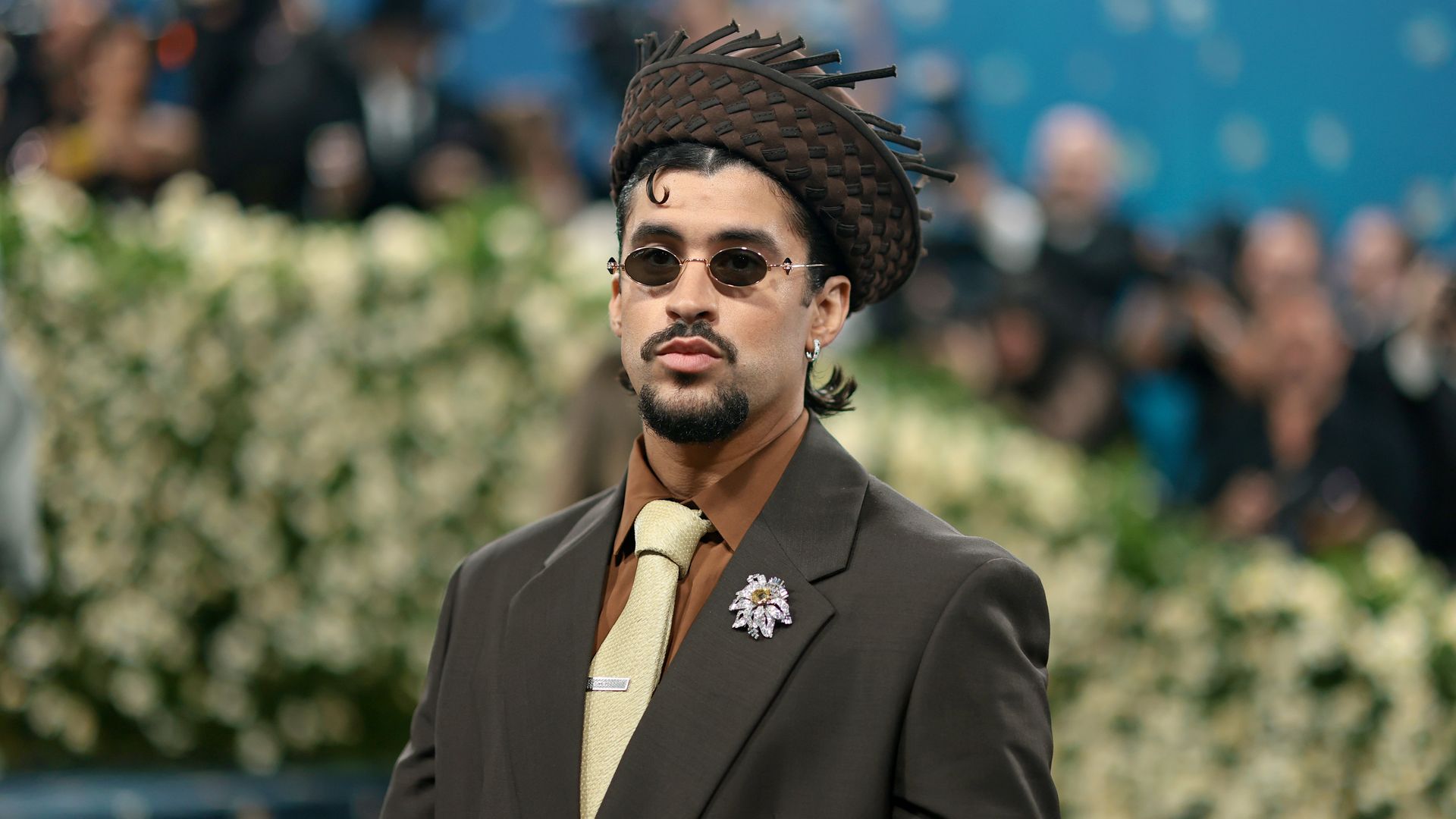
3. NFL fields MAGA fury over Bad Bunny halftime show

Conservative commentators are lashing out online over the choice of Bad Bunny to headline the 2026 Super Bowl.
Why it matters: The Puerto Rican musical artist is increasingly becoming a political talking point after he decided to skip the continental U.S. over concerns that ICE would raid his concerts.
Driving the news: MAGA influencers and conservative social media accounts widely denounced the NFL's decision.
- "The NFL chose Bad Bunny to perform the Super Bowl halftime show despite the fact that he recently said he wouldn't perform in the continental United States again because ICE is deporting illegal aliens," conservative commentator Greg Price wrote on X.
- Robby Starbuck, a conservative filmmaker, asked his followers on X: "Does this guy really scream American football to anyone? Be for real with me. No one thinks he does. This isn't about music, it's about putting a guy on stage who hates Trump and MAGA."
- "Massive Trump hater; Anti-ICE activist; No songs in English," podcaster Benny Johnson wrote on X.
Reality check: Bad Bunny has become one of the most popular musical stars in the world.
- He was the third-most-streamed artist globally last year on Spotify and the most-watched single artist performance on Amazon Prime.
The other side: The NFL did not comment on the complaints.
💭 Eleanor's thought bubble: Many of these culture war narratives are being amplified by bots across social media. This was also the case with the Cracker Barrel controversy, as reported by the Wall Street Journal.
- Comms teams must conduct an added layer of digital forensics before reacting. My guess is that's what the team at the NFL is currently monitoring.
Go deeper. ... Bots fuel "viral" posts on social media, distorting public sentiment
4. ICYMI: Trump demands Microsoft oust global affairs chief over Biden-era ties

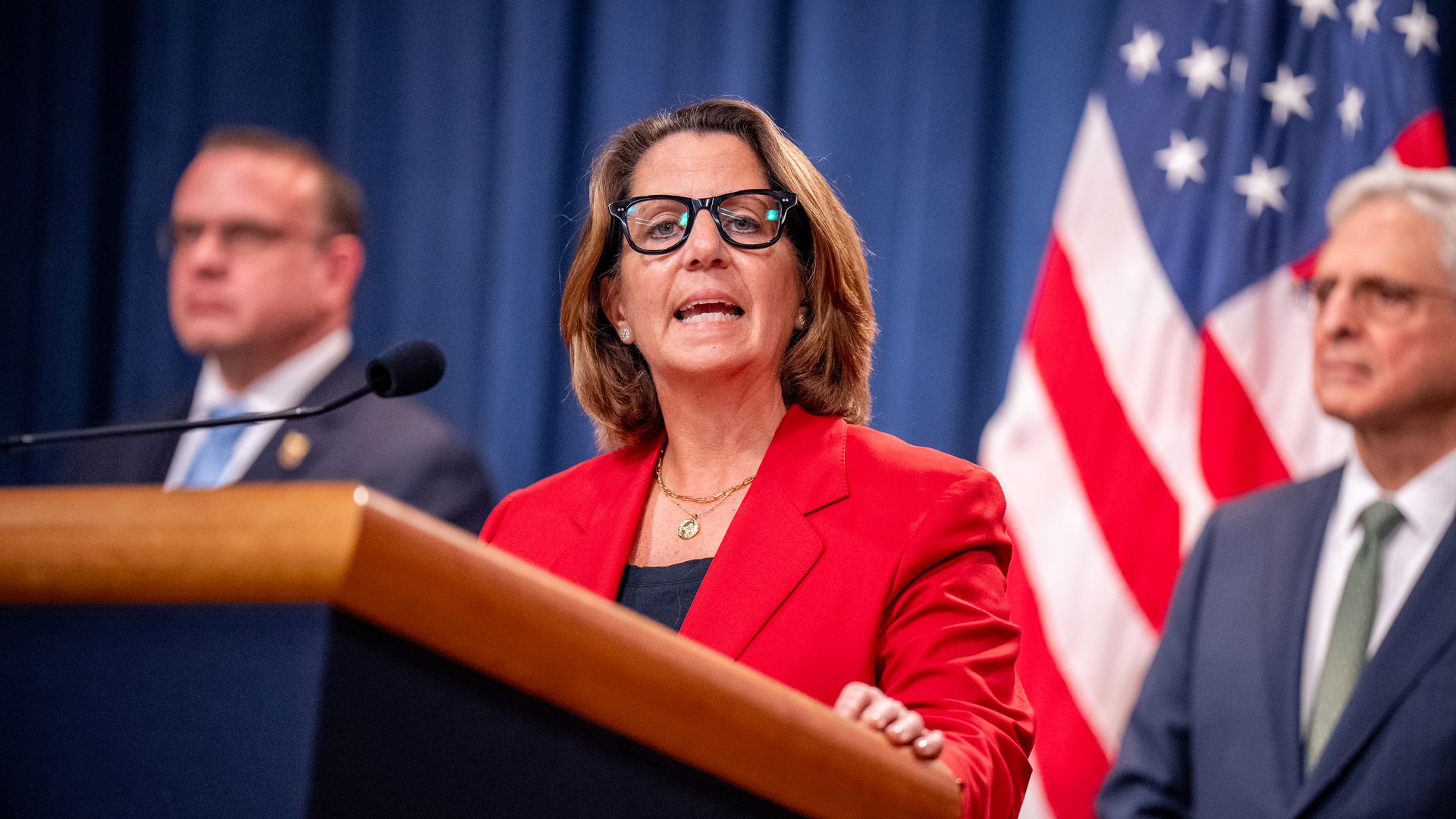
Late last week, President Trump demanded Microsoft fire its head of global affairs, Lisa Monaco, over her work in the Biden administration.
Why it matters: Trump's push for one of the world's largest companies to oust one of its top executives is the latest example of the administration's broad efforts to exert more active oversight of corporate America.
What they're saying: "It is my opinion that Microsoft should immediately terminate the employment of Lisa Monaco," Trump said in a Truth Social post, calling her "Corrupt and Totally Trump Deranged."
- Trump described her as a "menace to U.S. National Security," citing Microsoft's government contracts.
The intrigue: Conservative activist Laura Loomer claimed credit for the push to oust Monaco in a post on X, saying she alerted Trump to Monaco's role.
- Loomer tagged Microsoft CEO Satya Nadella in her post, asking "[A]re you going to comply? Or continue to be two faced?"
- Microsoft did not immediately respond to Axios' request for comment.
5. Communicator spotlight: Andy Pharoah of Mars Inc.

As vice president of corporate affairs and sustainability at Mars Inc., Andy Pharoah is responsible for communicating with employees, consumers, governments and local communities on behalf of the packaged food giant.
Why it matters: Several of the company's core shareholder objectives are directly tied to the work of comms and corporate affairs.
- "As a company, we have a set of shareholder objectives, and four of them are nontraditional shareholder objectives: external reputation, internal trust and two that relate to sustainability," Pharoah tells Axios.
📍How he got here: Early in his career, Pharoah worked in British politics and for a trade association before joining Hill & Knowlton.
- He spent more than a decade at the agency, where he served as head of its corporate practice in EMEA. In 2008, he joined Wrigley — which was acquired by Mars later that year.
- He was promoted to lead corporate affairs and strategic initiatives for Mars globally in 2016.
🗣️ What he's saying: "This is a family business that was founded over 100 years ago, so we have a very long-term approach. We think in generations, not quarters," he says.
- "We're fortunate in a way [because] we don't have a stock price. I don't have to look at the stock throughout the day to see how we're performing. ... So I think the biggest thing at the moment is not overreacting to the news of the day."
Yes, but: One current political movement that Mars is paying attention to is the Make America Healthy Again (MAHA) wave.
- Those in "the current U.S. administration have a particularly strong view on food dyes, and so we're [in] discussions with them," says Pharoah. "In fact, next year, we're launching a series under our main brands of products that will not have artificial dyes in them to give consumers choice. So, we look to constructively engage."
👀 What's next: "One of the issues that we're focused on is, how do we deploy a message that is relevant and can cut through all the noise," as corporate affairs teams navigate polarization, the fragmented media landscape and individual information bubbles, Pharoah says.
🧠 Best advice: Ignore imposter syndrome. "You need to promote yourself in your head," he says.
🎼 1 fun thing: Pharoah is a big fan of opera — he's the president of the Washington National Opera board of trustees — and supports the Crystal Palace Football Club.
Go deeper ... read his spotlight in its entirety.
6. 💭Eleanor's AI thought bubble
The No. 1 question I get from readers is "how are communicators thinking about AI?"
Based on my conversations and observations, here are the three areas in which comms teams can own the AI strategy:
- Threat taming. While AI is the future, it comes with reputational risk.
- A recent Muck Rack report found that only 21% of workplaces have AI policies in place.
- Meanwhile, confidentiality or security breaches, licensing issues and AI-produced hallucinations or inaccuracies are all real risks that communication teams can help manage and should prepare for.
- Meticulous messaging. Communicators are tasked with making sense of this technology, explaining how it makes their company better and then getting buy-in from employees, customers and shareholders.
- A Pew Research study found that 50% of Americans say they're more concerned than excited about the increased use of AI in daily life, up from 37% in 2021. 57% say they believe AI presents a high level of societal risk.
- How AI is messaged matters, especially given the potential job displacement, environmental impacts and rising geopolitical tensions.
- Explosive effectiveness. AI can help communicators work smarter, faster.
- Whether it's GEO, customized chatbots, message testing tools or reputation trackers, comms teams are experimenting with bespoke tools that are saving them time now, and potentially even more money in the long term.
🥊 Reality check: "The next five years, we're going to see more change than we have in the previous five decades, and there's going to be a massive reckoning in our profession," one agency executive recently told me.
What's next: AI metrics and goals are likely to become part of employee performance reviews, if they haven't already.
Go deeper ... become an Axios Communicators Pro member to read our AI case study and learn how communicators are measuring AI outputs.
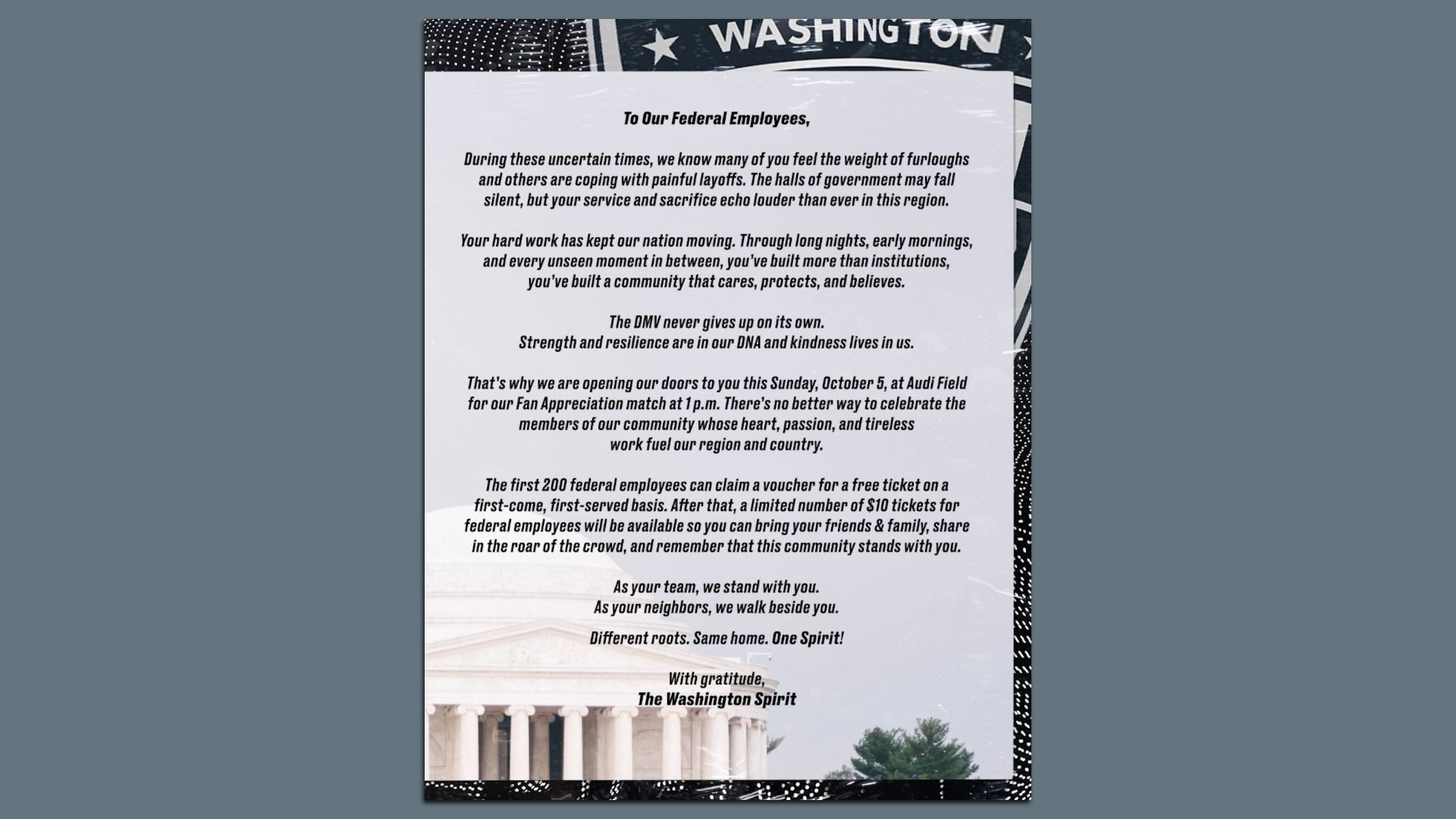
7. ⚽️ 1 message to go
The Washington Spirit, the national women's soccer team based in Washington, D.C., shared this message with fans amid the government shutdown.
💥 Thanks for reading! Was this forwarded to you? Become an Axios Communicators subscriber today.
Sign up for Axios Communicators