Axios Communicators

November 21, 2024

1 big thing: Taking a stance in 2025


The expected "burst of legislating and power-stretching" from the new administration and Congress could put corporate America's penchant for silence to the test.
Why it matters: There's a recalibration happening as executives navigate how and when to address socio-political issues in the era of Trump 2.0.
State of play: Instead of being caught flat-footed like they were the first time, teams are gaming out several approaches, according to the experts Axios spoke to.
- Proactively, most are anticipating how specific policy promises — like those related to immigration, health care and trade — might impact their business or affect employees, and how best to address it.
- Teams are also preparing for reactive scenarios — such as how to respond if they get roped into a culture war, used as a political football or singled out in an X post.
- Other considerations are whether peer companies are engaging, internal leaders can align on one message, and the company or executive has some authority on the issue and something meaningful to add.
Flashback: Trump's 2017 travel ban prompted nearly 100 tech CEOs to ask the courts to block it, and several issued public statements in opposition.
- "CEO criticisms of President Trump did not remain limited to differences over policy," says Matthew Kohut, managing partner at KNP Communications, pointing to Trump's comments following a white supremacist rally in Charlottesville, Virginia.
- "After Trump's remark that there was 'blame on both sides,' Merck CEO Kenneth Frazier announced he was leaving the administration's American Manufacturing Council. Others followed, and the council collapsed as a result," Kohut added.
What they're saying: The precedent set in the first Trump administration could make things more complex for leaders this time, says Selena Strandberg, founder of The Know, an enterprise software company that helps executives understand stakeholder sentiment on pressing global issues.
- "Some of the topics we're keeping an eye on going into January are discussion topics that were very hot with employees previously and have not been executives' immediate concerns, but I would suspect that they might come back to the top again," she told Axios.
- "Some companies are going to change their course, and I think it's more about having a very clear justification for why you came to that conclusion and making sure that justification is communicated across channels — particularly to employees."
Yes, but: Some experts think employees don't carry as much weight as they once did.
- "The conditions that existed in the 2016, Trump 45 era are important to remember," says Anne Marie Malecha, CEO of Dezenhall Resources.
- "Money was cheap, people were expanding their businesses at a rapid pace, and there was a really tight labor market, so companies were worried about losing their workforce and wanted to keep employees happy, so to speak. It gave vocal employee bases significant leverage. That's not where we're at now."
The bottom line: It's hard to predict what the exact policies of the new administration will look like and who they will impact, so time is best spent establishing the process for how and when to get involved.
What to watch: The White House could return to governance by tweet — or X post— which will require another level of scenario planning for those with government contracts or big brands that have recently been in the political crosshairs.
Case in point ... 👇🏻
2. Internal comms teams prepare for a new Washington
3. News influencers lean right
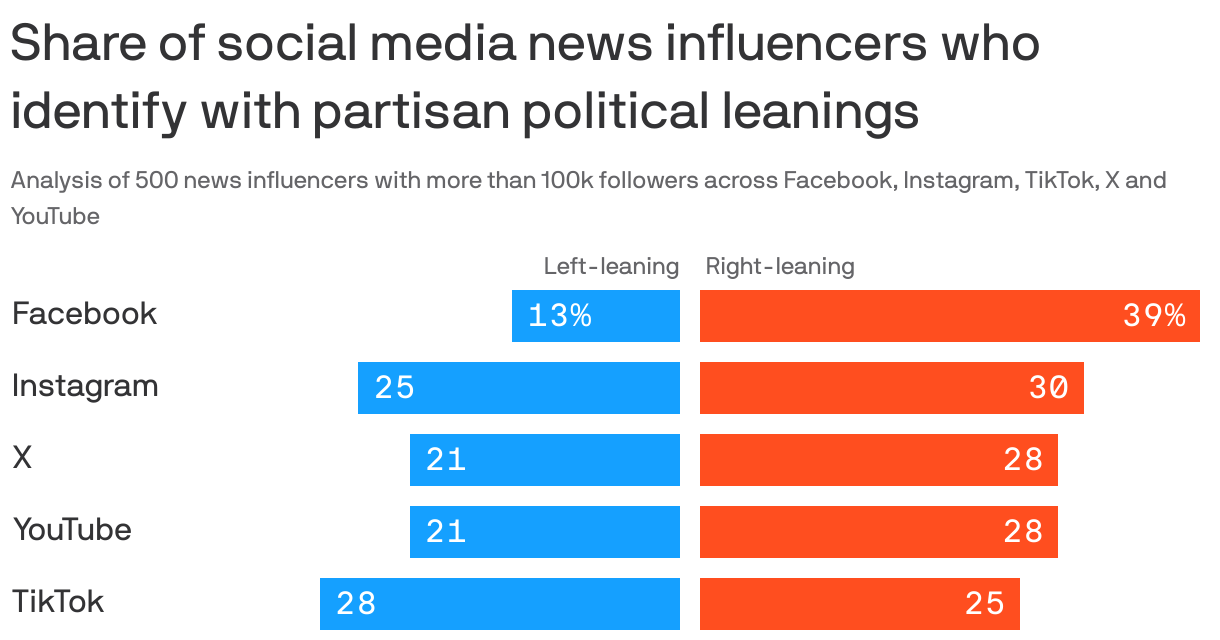
News influencers — people with at least 100,000 followers on Facebook, Instagram, TikTok, X or YouTube who regularly post about current events — are more likely to identify with the political right than the left, a new study from the Pew Knight Initiative found.
Why it matters: 1 in 5 Americans reports getting their news from influencers, and 65% of them say these news influencers have helped shape their opinions on political, societal or global news.
By the numbers: Male news influencers outnumber female news influencers 2 to 1, and those who express a political slant are more likely to lean right (27%) than left (21%).
- News influencers from both sides of the aisle are most likely to be found on X, where 85% have a presence, per the report.
- News influencers on Facebook are three times as likely to share conservative views (39%) than liberal ones (13%) across the platform.
TikTok, meanwhile, is the only site where left-leaning news influencers outnumber those on the right.
- TikTok also has the smallest gender gap, with 50% of news influencers identifying as men and 45% as women.
Reality check: While these influencers are creating content about politics and news, only 23% of them have a journalism background or are affiliated with a media organization.
- Those without journalism experience or affiliation are more likely to use video-based platforms and monetize their content through subscriptions, donations or merchandise.
- Of note, 84% of news influencers on TikTok do not have journalism experience or work for a media outlet.
What to watch: The report implies news influencers are looking for ways to expand their reach.
- Currently, about two-thirds of news influencers are on more than one social media site and 34% connect with their audiences through podcasts, while 22% write newsletters and 6% host a Discord channel or engage with other chat platforms.
4. Communicator Spotlight: Ashok Sinha of Dow Jones

5. 🥊 1 fun thing: Journalists in the hot seat
Axios Communicators