Axios Communicators

February 20, 2025

Welcome back!
- π€ Join me at the Axios House in Austin, Texas, during SXSW, March 7-9. Register here.
Today's newsletter is 1,503 words, a 5.5-minute read.
1 big thing: CCO roles see more turnover

Turnover among top communication jobs is up from last year, according to a new study by Patino Associates and the Corporate Affairs Search Alliance (CASA).
Why it matters: This is on par with the record number of departures happening across the C-suite.
State of play: Major U.S. companies like Netflix, Southwest Airlines, Boeing, UPS and Meta saw chief communications or corporate affairs leaders exit within the last year.
By the numbers: CASA examined the personnel and organizational changes across 883 global companies between Jan. 1 and Dec. 31, 2024. It found that chief communications officers (CCOs) are turning over at a rate of 10.5%, up from last year's historically low rate of 8%.
- CCOs in the technology industry continue to have the shortest average tenure, at three years, while those in the energy sector have the longest, at 5.4 years.
- Turnover rates in the U.S. are significantly lower than the European rate (17%) and slightly lower than the global rate (11.7%).
Zoom in: Of the 70 CCO changes in the U.S. this year, half saw the responsibility of the role expand.
- 55% took on a newly created role β mainly as chief corporate affairs officer.
- Expanded roles were seen most in the consumer, technology and health care industries, per the study.
Between the lines: The evolving nature of the role paired with the complex political and business climate make the roles more difficult to fill and sometimes harder to hold on to.
What they're saying: "When you look at [an average tenure of] 4.6 years, that means there's a bunch of CCOs that are turning over in less than two or three years. That is not a good thing," said Michael Patino, CEO of Patino Associates.
- "It's happening because people are being hired for the moment, and then that moment passes, and either the candidate isn't the right person for the next moment, or the next moment exposes a weakness in the candidate because they didn't have broader experience or capabilities," he added.
What to watch: A potential IPO revival could mean more opportunities for senior communicators, according to Patino.
- Companies looking to go public often prioritize communication in the months leading up to it, while newly public companies often need to expand their teams as part of the maturation process.
2. Bonus chart: Who's getting the job
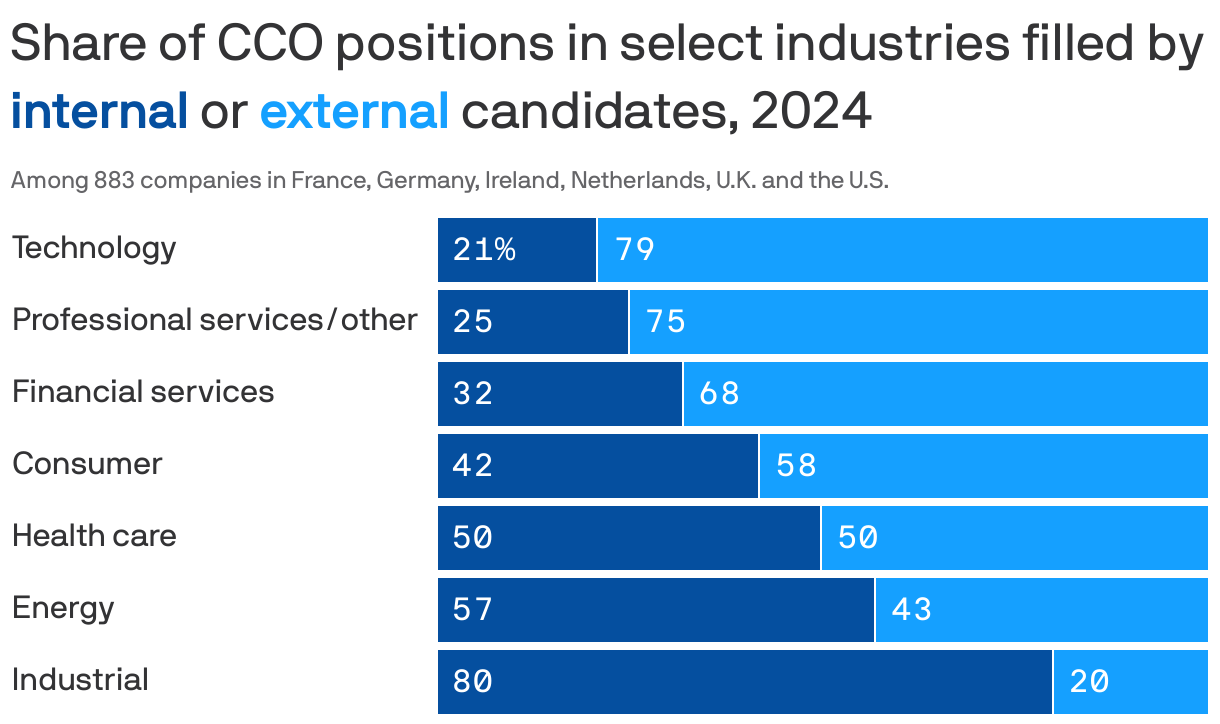
External candidates are most likely to fill open CCO roles, according to the Patino Associates study.
By the numbers: Roughly 7 in 10 CCO roles were filled with external hires in 2024, compared to 5 in 10 in 2023.
- This external hire rate significantly surpasses that of other C-suite positions in 2024.
- 1 in 4 of the CCO roles in the U.S. filled were by an external candidate with no previous CCO experience, while 9 in 10 of external candidates hired in the U.K. did not have previous industry experience.
- Yes, but: Regulated sectors like industrial, financial services and energy are more likely to bring in CCOs with industry experience.
Between the lines: The relatively small and flat organizational structures of communication teams can make it difficult for internal candidates to climb the ladder, Patino said.
- "If your CCO leaves and you look at the three or four people who are sitting at the next level β maybe it's a head of external [comms], maybe it's a head of internal [comms], maybe it's ahead of analyst relations β but more often than not they have grown up specifically within that one vertical and not necessarily played across the others," he added. "This makes them look singular relative to looking at an outside candidate who may have had the full complement already."
Of note: 68% of all filled CCO positions in the Fortune 500 and S&P 500 were held by women, slightly up from 2023.
- Women make up a majority of comms leadership roles in France and the U.S. However, Germany has the least representation among women CCOs, with men making up two-thirds of top company CCOs, per the report.
3. Brand boycotts pick back up

Democrats, Black and Gen Z shoppers are carving a new path of resistance by refusing to shop at certain stores over their political stances in the new Trump era.
- This comes after major U.S. companies like Target, Disney and Google rolled back their DEI policies and programs.
Why it matters: Consumers on both sides of the political spectrum have used their wallets to protest individual companies, especially in recent years β with varying results.
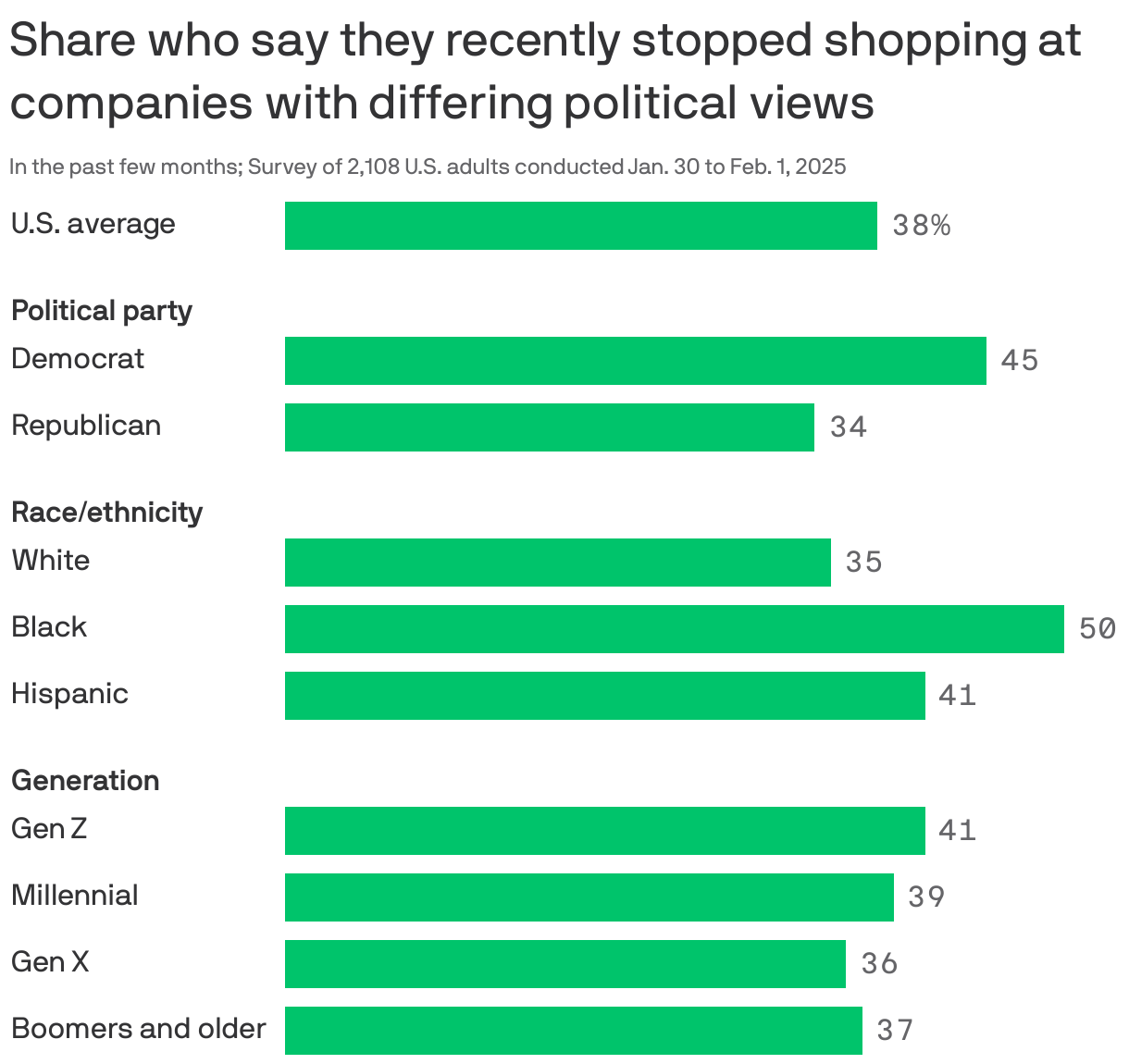
By the numbers: Democrats were more likely (45%) than Republicans (34%) to say they'd stop shopping at companies that have political views they disagree with, according to The Harris Poll findings shared with Axios on Tuesday.
- Close to 40% of Americans have changed their spending habits over the past few months to align with their moral views, the poll found.
- Roughly 1 in 4 say they had stopped shopping at their favorite stores because of their politics, a sentiment 35% of Black respondents and 32% of Gen Z respondents shared.
- Half of Democrats indicated they had recently shifted their spending entirely to better align with their morals.
State of play: Calls to boycott Target since it changed its DEI policies have gained broad traction online.
- Twin Cities Pride announced in late January that the Minnesota-based company would not "have a presence at the festival or parade" despite a long-standing partnership with the LGBTQ+ group.
What's next: Some entrepreneurs and business owners have pushed back against corporate DEI rollbacks. They contend policy changes have left some minority-owned brands that work with larger retailers in limbo over how to market their products.
- Activists have encouraged "intentional spending" to support minority-owned or small businesses. The NAACP's recently released Black Consumer Advisory urges Black buyers to make "informed spending decisions" and demand accountability amid attacks on DEI.
4. ICYMI: Whit Clay departs Sloane & Company for Longacre Square Partners

Sloane & Company co-CEO Whit Clay is departing the strategic communications firm after more than 25 years, Axios scooped.
- He will join Longacre Square Partners as partner and head of its New York office, according to a source familiar with the hiring.
Why it matters: Clay's departure speaks to a broader shift in the agency landscape as talent flocks to specialized, independently owned firms.
The big picture: Recent layoffs and consolidations have reshaped the mega-firms, while specialized firms have seen a flow of cash from private equity, which will continue to shake up the landscape.
- Challenger firms have grown in prominence as business leaders seek out more strategic communications counsel on corporate governance and engagement, crisis and stakeholder management, geopolitics, heightened regulatory scrutiny and the rise of artificial intelligence.
Zoom in: Longacre Square Partners was founded by Sloane alums Greg Marose and Dan Zacchei in 2022.
- The firm supports corporate clients like CVS Health, GameStop and Bausch + Lomb and advised on 129 shareholder activism disputes in 2024, placing them first in the communications advisory rankings, according to Bloomberg.
- Of note, Longacre recently advised Elliott Management in its dispute with Southwest Airlines and Ancora in its dispute with Norfolk Southern.
- Following Clay's departure, Darren Brandt will take on the role of sole CEO at Sloane. The firm has also added Melissa Green as chief growth officer.
5. 1 fun thing: Duolingo's marketing team is at it again

Language learning app Duolingo killed off its plucky mascot, Duo the owl β creating a social media marketing moment that may have more sticking power than recent Super Bowl ads.
- Why it matters: Duolingo has mastered not only helping people cultivate polyglot skills but also the art of storytelling marketing and pushing the envelope in a brand's online presence.
State of play: Firms ranging from entertainment and media to intergovernmental organizations joined the social media moment on X and TikTok throughout the week.
- Netflix, pop singer Dua Lipa and the World Health Organization were just some of the accounts to get involved in the conversation.
- Duolingo's ad "hijacked" about 84% of the conversations that all Super Bowl ads were generating, impacting culture unlike any of Sunday's commercials, per Nathan Jun Poekert, an adviser to chief marketing officers.
π Thought bubble, from Axios' media reporter Kerry Flynn: Sometimes marketing stunts actually work. But this campaign's virality is a testament to Duolingo's long commitment to brand building by leaning into unhinged content and relatable conversation on social media and its own platform.
6. βSome X questions to go
Is it an antiquated strategy to post corporate statements directly on X? I realize this was the norm on Twitter circa 2015, but is it still?
- How are your teams distributing one-off statements? Are you shifting to other platforms, like LinkedIn, or back to owned channels, like company newsroom pages?
- And if you're still posting corporate statements on X, who are you trying to reach there? If it's journalists, why are you posting there as opposed to sending the statement directly to inquiring reporters?
- π§ Let me know
Thanks to editors Nicholas Johnston and Kathie Bozanich.
β‘οΈ Want more Axios Communicators? Join Axios Communicators Pro.
Sign up for Axios Communicators