Consumers across the globe are boycotting foreign brands

Add Axios as your preferred source to
see more of our stories on Google.
Try as they might, big brands cannot escape global politics.
Why it matters: Consumers are increasingly linking corporate decisions and geopolitical matters with brand reputation.
Driving the news: Edelman surveyed 15,000 people across 15 countries between April 13 and 24, and found that nearly 80% of consumers will boycott a brand based on its country of origin.
- Those in South Korea, Japan, China and France are most likely to boycott, however consumers in Saudi Arabia saw the biggest increase in favoritism toward local brands — jumping 20% in the past year, according to the Edelman study.
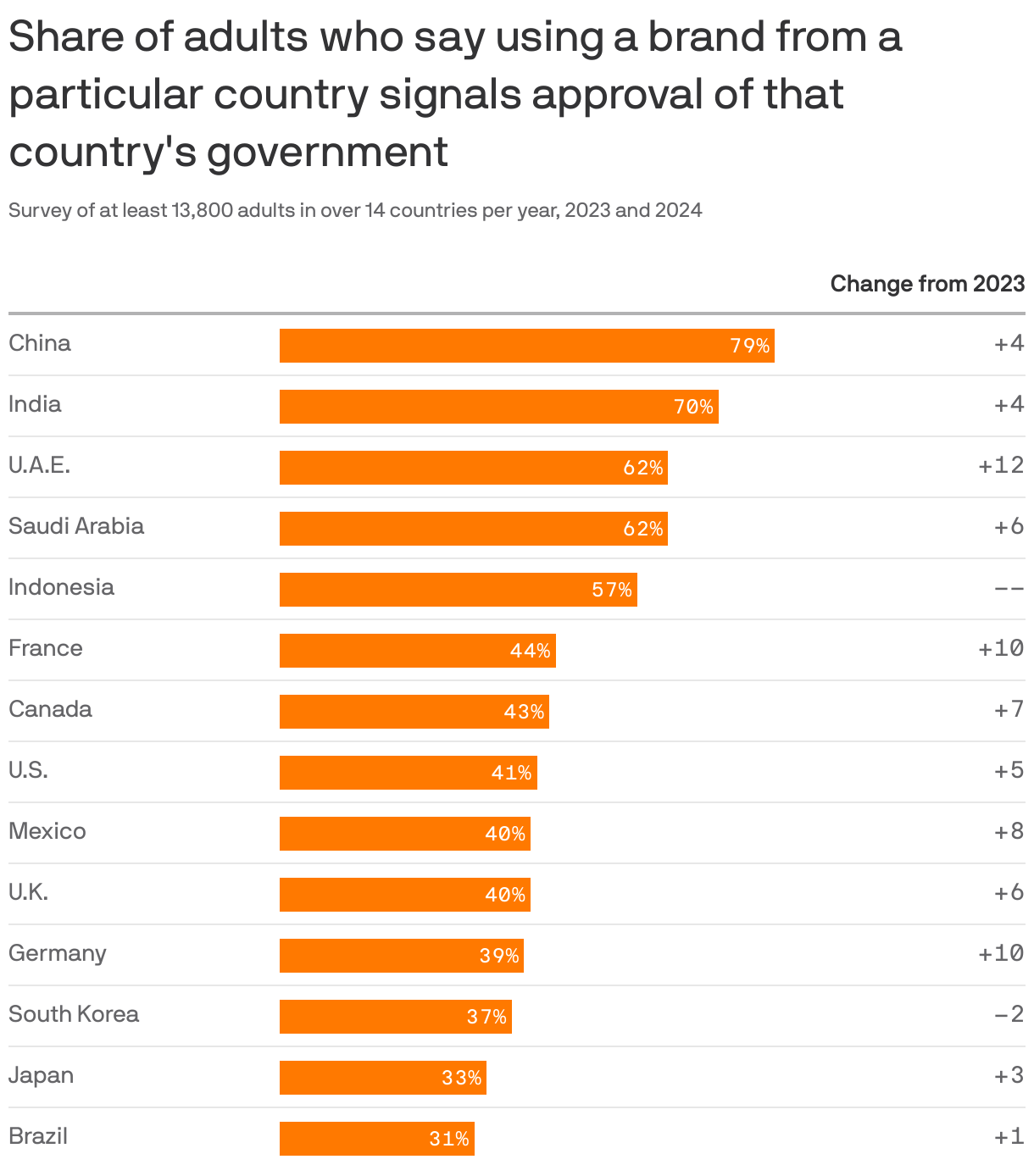
Roughly half of those surveyed believe that supporting a foreign brand signals approval of that country's government.
Of note for American brands: According to a new Pew Research Center survey, global audiences have more confidence in President Biden over former President Trump.
- Biden averaged a 15-point advantage across the 34 nations polled by Pew, with huge differences in European countries.
Zoom out: Globally, 60% of consumers buy, choose or avoid brands based on personal politics.
- A majority of consumers in France, Germany, Japan, Mexico and South Korea are are more likely to buy brands that committed to combatting climate change, while those in Brazil, Indonesia and Saudi Arabia prioritize brands that are focused on ending racial inequality.
- Consumers in Canada, India, South Africa, the UAE, the U.S. and the U.K. are more likely to support brands that are committed to improving access to health care.
What they're saying: Political affiliation is a key driver for brand loyalty, which means "all of a sudden, politics is a very important part of the brand marketing consideration set," Edelman CEO Richard Edelman told Axios.
- "Your supply chain is political. The people you have in your ads is political. The way in which you price your products is political. Everything is now seen through the political lens — and you don't have to rush out to be political, but you have to have a political sense," he added.
Between the lines: Common brand actions — like partnering with influencers, engaging in fads or wading into cultural flashpoints — can be seen as political statements.
- Bud Light's 2023 social media campaign featuring transgender influencer Dylan Mulvaney was quickly politicized, while Bumble recently found itself in hot water after displaying billboards that positioned celibacy as a bad alternative to online dating.
- "Politics is part of marketing now — and that's a big statement," Edelman said.
The big picture: High-stakes elections are taking place in more than 50 countries this year, meaning most consumers and employees across the globe are entrenched in politics.
- The biggest mistake a brand can make is "assume that the brand is so clearly understood that it will be immune to all of the political currents," Edelman said.
What to watch: Companies are grappling with how to communicate around business related issues that are also linked to politics, like inflation in the U.S.
Go deeper: More companies viewed as liberal as public sentiment shifts
