Axios Communicators

September 24, 2026

🎤 Hey, y'all!
- While I couldn't make it up to New York for the UNGA and Climate Week this year, I've been following from afar.
This edition of Axios Communicators, edited by Christine Wang and copy edited by Jay Bennett, is 1,982 words, a 7.5-minute read.
1 big thing: Power takes over the climate conversation

The climate conversation inside companies has shifted toward a more immediate business challenge: how to power growth.
Why it matters: AI and data centers have turned electricity into a boardroom issue — pulling climate change into conversations about grid costs, infrastructure and reliability.
- For corporate affairs leaders overseeing sustainability, this means climate has newfound relevance in the business conversation — and more ways to get lost inside it.
State of play: Throughout this week's Axios House conversations, one thing was clear: Energy has become a constraint on how fast companies can grow.
- "Energy is the most fundamental foundational layer," Nvidia sustainability chief Josh Parker told Axios' Amy Harder. "If you don't have enough energy, you're not going to be able to deploy AI at scale [or] build the next big thing."
- But infrastructure isn't moving at the same speed. Redwood Materials CEO JB Straubel said the timeline for adding grid and transmission capacity is "out of sync" with what hyperscalers and neoclouds want.
- "These two worlds are diverging. The timelines are just different by years, not by months," he told Axios' Mike Allen.
The big picture: "The rapid growth of data centers and scale up of electrification has fused climate and energy together in new ways, and it changes how we talk about both," said Zara Ahmed, COO of climate advisory firm Relae, formerly Carbon Direct.
- Her advice for communicators: Use the new attention on power to make climate more relevant, not less.
Zoom in: Rather than boasting about ambitious decarbonization goals, show where sustainability cuts costs, reduces risk or unlocks growth.
- For example, Hilton uses its scale to offer franchise owners sustainability programs — from energy and water audits to waste reduction, sustainability chief Jean Garris Hand told Axios' Nicholas Johnston, noting utility bills are hotels' second-largest operating expense, after labor.
- Delta is on track to use 75 million fewer gallons of jet fuel this year through operational efficiencies, saving more than $200 million, sustainability chief Amelia DeLuca told Axios' Alan Neuhauser.
- "I've actually put a P&L value behind every single piece of our work," she said, from cutting costs today to future-proofing the business and offering sustainability products customers are willing to buy.
Between the lines: Even longtime clean-energy advocate Rep. Mike Levin (D-Calif.) acknowledged the need for a messaging change.
- Asked why Democrats' latest economic agenda puts less emphasis on the word "climate" than previous efforts, he said leaders need to "meet the American people where they are." "Right now, where they are is: Everything is too expensive," he told Harder.
- The affordability focus isn't necessarily a retreat from climate issues, argued Sen. Brian Schatz (D-Hawaii). "As a person who prioritizes climate first, when I go home to talk to folks, that doesn't mean the first thing I say is climate," he said in an interview with Axios' Ben Geman.
- "I think we should talk about climate in the context of people not being able to afford their lives."
Reality check: Shifting climate into the language of affordability and grid reliability risks minimizing the challenges.
- Despite personally caring deeply about sustainability, Straubel said "climate is certainly a footnote" in many of his conversations with customers, partners and policymakers. "It keeps me up at night," he said.
Some organizations are being more thoughtful when and where climate comes up.
- "We lead with health and the taste of the food," said Maggie Baird, founder of Support + Feed, an NGO tackling food insecurity through plant-based meals. "We do not find it effective to start in the deep end," she told Geman.
- But its educational campaigns — including activations at music festivals and work tied to Baird's children, Billie Eilish and Finneas — connect more explicitly to climate change.
The bottom line: Climate change used to motivate conversations about future energy systems, but that's flipped. The huge AI-fueled demand for energy is now forcing companies to rethink how they talk about climate.
2. 🧨 Preventing the next crisis

Communicators are getting unusually close to operations, helping spot and resolve smaller issues before they snowball into a crisis.
Why it matters: This kind of intervention can save companies from financial and reputational damage.
Context: The insight came out of conversations at MB (LIVE) last week in Chicago, where senior comms leaders discussed how to make the function more essential.
Zoom in: Josh Earnest, United Airlines EVP for communications and advertising, said one of the biggest "unlocks" has been strengthening the link between communications and operations teams.
- If United's social intelligence team sees a passenger complaining about a bad experience while they're still in the air, comms can flag it to operations and have someone waiting at the gate to acknowledge the problem and try to fix it.
- "The issue is: In many cases it's not just the bad experience, it's how we react to it," Earnest said. Most customers, he added, "just want to feel seen."
Between the lines: This level of work requires strong communication and collaboration across multiple teams — comms can lead but can't do it all.
- Adam Collins, Reddit's CCO, stressed that when criticism starts piling up on Reddit, the first question shouldn't be how to manage the Reddit problem.
- "The first question shouldn't be 'what's happening in this platform?' It's 'what's happening that's making our consumers frustrated?'"
Case in point: Collins pointed to the Sonos subreddit, where company reps — and most recently, even the CEO — actively engage with the community to rebuild trust after a messy app update in 2024.
- The value wasn't just in showing up and offering bland "we're listening" statements.
- Instead, Sonos reps could answer with real operational information, explain what was being fixed and relay what they were hearing from customers back into the company.
What's next: On Monday, Mixing Board members will receive a deep dive with more takeaways and insights from MB (LIVE). Apply to join to receive exclusive insights and analysis!
Go deeper
3. 📚 Reading list

Amid a First Amendment fight with CNN, MS NOW and Politico, the White House launched a new YouTube stream, Trump TV. (USA Today)
- The stream, so far, is just a feed of past speeches and remarks.
- "If you build it, they will come" isn't immediately true for direct-to-consumer comms channels. Social-native news shows including TBPN and MTS News first had to find and build their audiences with new original content.
Paramount reached a settlement with state attorneys general who sued to block its acquisition of Warner Bros. Discovery, clearing a major hurdle for the massive media merger. (Axios)
- As part of the deal, an editorial independence board will be created for both CBS News and CNN.
- The board presents its own comms challenge for the news orgs: Every controversial coverage decision will be seen as a test of the board's influence.
Federal Reserve chairman Kevin Warsh appears to be shaking up his press conference format. Last week's conference was his shortest so far, clocking in at just 30 minutes. (Axios)
- While Warsh took questions from more outlets, his answers were noticeably shorter and reporters couldn't ask follow-ups.
- Question for readers: How are you thinking about press conferences in this environment? Relic of the past or still part of the toolbox? Let me know.
4. AI's women's sports play

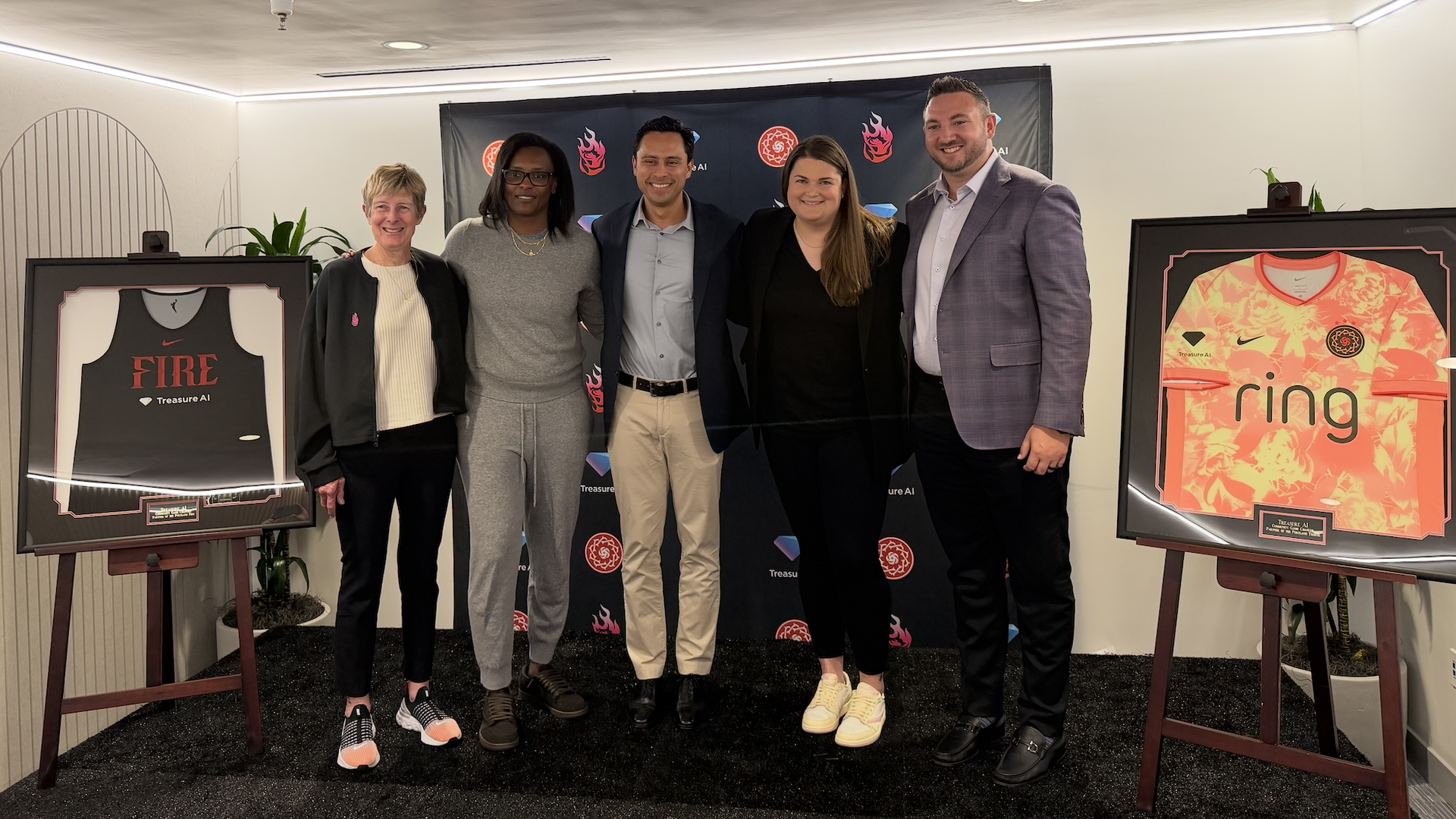
Treasure AI is betting that the rising popularity of women's sports can help build its brand — while the National Women's Soccer League's Portland Thorns and WNBA's Portland Fire see the AI company as a way to deepen their relationships with fans.
Why it matters: An expanded partnership announced last week deepens the bonds between the recently rebranded AI marketing company and two teams in the booming women's sports industry.
Driving the news: Treasure AI, formerly known as Treasure Data, will serve as the official "agentic experience platform" for both teams. The expanded deal includes a patch on the Thorns' uniforms, branding on the Fire's practice jerseys and court, sponsorship of the Fire's postgame show and several content and community initiatives.
The big picture: The partnership reflects a broader convergence between AI companies looking for visibility and sports franchises trying to turn fan data into more meaningful engagement.
- "Women's sports [fans] are extremely loyal," Rafa Flores, Treasure AI's chief product and growth officer, said at a launch event last week at the company's offices in Mountain View, California. "They're passionate about a sense of community. They're passionate about the players."
By the numbers: RAJ Sports told Sports Business Journal that there is only about 10% overlap between Thorns and Fire fans, suggesting room to use customer data to understand and reach the two audiences differently.
- The teams and Treasure AI are still figuring out how to work together beyond the sponsorship. They are discussing a range of potential uses for Treasure AI in their operations, including allowing the teams to better segment their loyal fan base to deliver more relevant ticket, content and merchandise offers.
Simon's thought bubble: Partnerships like this exemplify the old "show, don't tell" comms adage.
- If your product is too complex or unfamiliar for a jersey patch to mean much on its own, showing how the technology actually improves the fan experience can make the sponsorship much more meaningful to all parties.
5. 📖 Simplify your story

Below is an excerpt from "Simplify," the latest book from Jim VandeHei, Mike Allen and Roy Schwartz.
Most of us aren't Steve Jobs. Most companies aren't Apple.
We're mere mortals, struggling to tell a compelling story with duct-taped solutions of a bygone era: intranets no one visits, meandering notes no one reads, boring all-hands meetings few follow and a splattering of social media posts few know exists.
- The consequences of a story poorly told are so profound that most don't even bother to measure the startling cost. The cost of systems and people producing so many messages across so many platforms. And the cost of time wasted trying to decipher the ones people actually take the time to read.
We need to be the best short storytellers around. That requires a simple storytelling philosophy. It needs to be in one voice, one platform, vital to hear, easy to understand.
- What we tell ourselves should match what we tell others, without squinting, spinning or outright BS-ing.
- The big idea of our first book, "Smart Brevity," was: Do the work for the audience. Don't make your boss or employees do your work by sending them a long memo. What do you want them to remember, understand, buy, do? Then just say it, like you were talking in a bar.
Companies and other organizations need a simplicity revolution to tell better, more enthralling stories to staff and customers. Show us a bloated team, or bad product rollout, or sagging profits, or rotten culture, and we'll show you complexity's fingerprints. It's a slow, silent killer. It haunts every founder, CEO, and manager. Every time they reverse-engineer why a project or company goes off the rails, they find simple orders or ideas grew unintentionally complicated — and then suffocated progress.
—
What's next: If you'd like to bring Simplify to your team, we have a special bulk-order offer for friends and fans of Axios:
- 25+ books: Get a discount on every copy.
- 50+ books: Jim, Mike or Roy will join your team for a virtual briefing to help apply the "Simplify" framework to the things slowing you down.
- 250+ books: All three authors will join your team for a virtual deep-dive workshop tailored to your organization.
- 500+ books: One or more of the authors will come to you for an in-person session with your leadership team.
Reach out with questions!
Thanks for reading!
- Spot an interesting trend or story? Email me or connect with me on LinkedIn.
- For exclusive reporting, deep dives and events, apply to join Mixing Board, powered by Axios.
Sign up for Axios Communicators

Unpacking the topics and trends driving Communications.