Axios Columbus

July 08, 2026

What's up, Wednesday?
βοΈ Today's weather: Mostly sunny and almost 90.
π¦ Situational awareness: An intestinal illness that causes "explosive diarrhea" is being reported in Central Ohio, per WBNS-TV.
Today's newsletter is 1,063 words β a 4-minute read.
1 big thing: Ohio tops nation's ACA enrollment drop
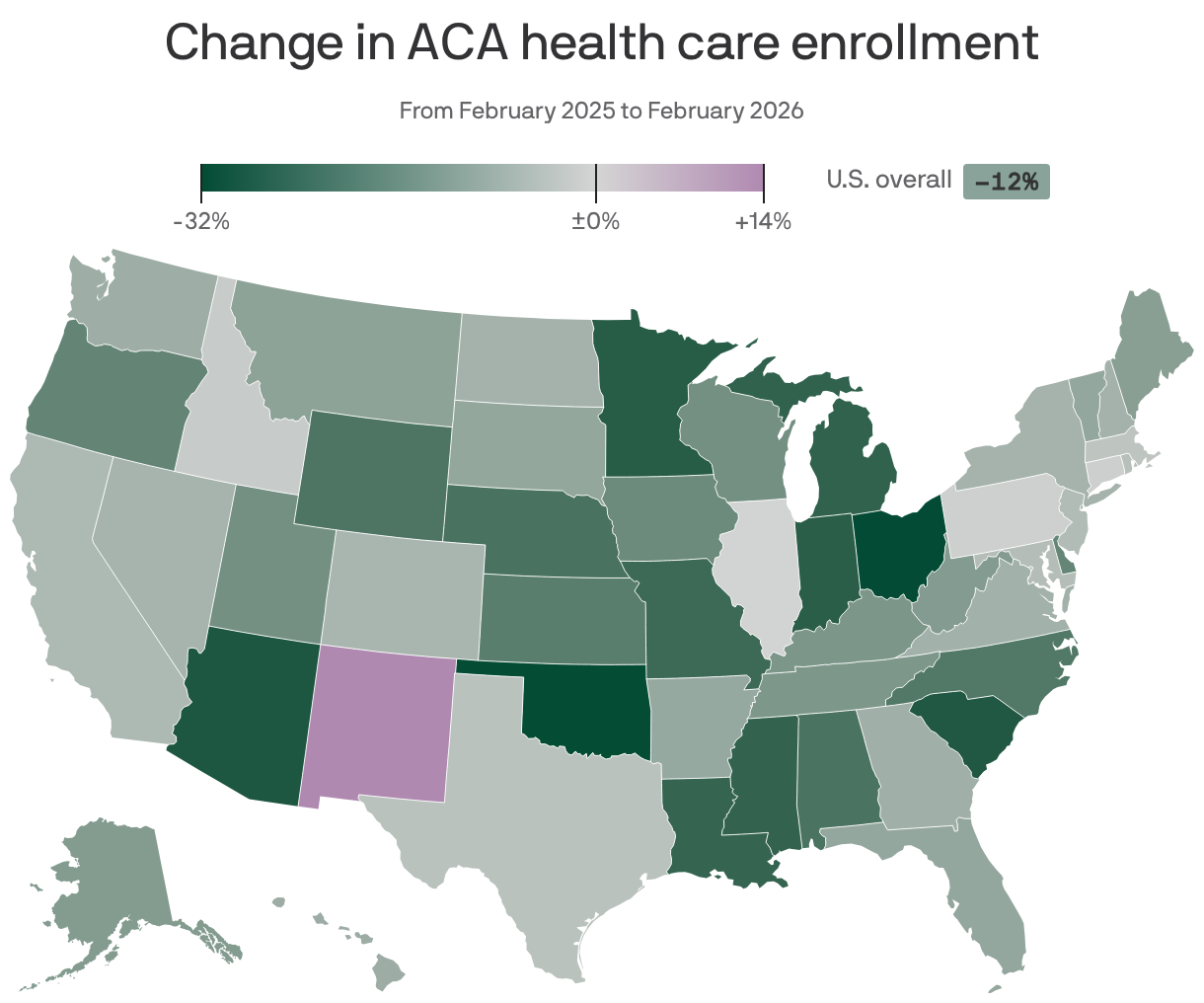
Open embedded content from datawrapper.dwcdn.netOhio has seen the nation's largest percentage decline in residents covered by Affordable Care Act plans as a result of federal subsidies allowed to expire this year, per federal data.
Why it matters: Expiration of the subsidies has resulted in tens of thousands of Ohioans losing health care access in a state that already struggles with health.
Zoom in: Ohio lost 32.4% of its enrollment between February 2025 and 2026, representing over 160,000 residents, according to the state breakdown first reported by the Associated Press.
- That number is even higher than the 114,000 projected in February by health care advocacy group Protect Our Care.
State of play: The coverage losses are hitting deep-red states as well as blue ones after the Republican-led Congress let the subsidies expire.
- The topic was a main point of contention in the longest government shutdown in history.
- Six months later, a federal report from the Department of Health and Human Services shows that nationwide ACA enrollment fell 13% β about 3 million people β since last year.
The latest: The state-by-state breakdown shows enrollment decreased in every state but New Mexico.
- Enrollment dropped by at least 20% in 14 states.
The big picture: The pandemic-era enhanced subsidies that Democrats passed in 2021 have overwhelmingly benefited red states, especially those that haven't expanded Medicaid, according to analysts.
What we're watching: More could lose coverage over the next few years.
- A March report from the Urban Institute suggests the "big, beautiful bill" could result in more than 350,000 Ohioans losing Medicaid coverage.
2. βοΈ Our melanoma rates
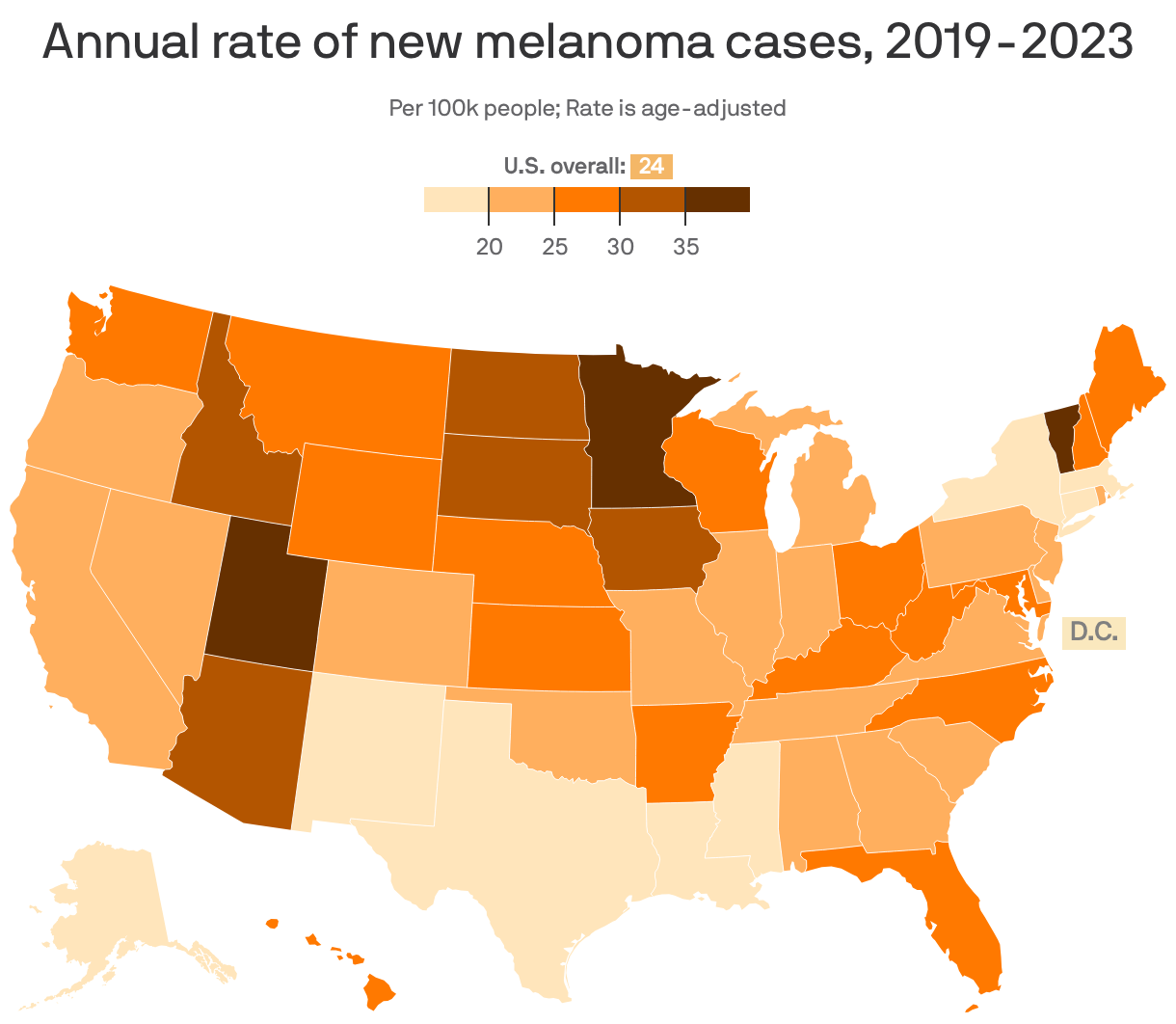
Open embedded content from datawrapper.dwcdn.netNew invasive melanoma cases have risen about 47% over the past decade, per the Skin Cancer Foundation.
State of play: The states with the highest numbers aren't necessarily the sunniest. Differences in screening, demographics and behaviors like indoor tanning all help explain the rates.
By the numbers: For every 100,000 people, 24 new cases of this cancer were reported in the U.S. β up from previous years β according to the most recent data compiled by the National Cancer Institute and Centers for Disease Control and Prevention.
π Zoom in: Ohioans reported melanoma at an even higher rate of nearly 29 per 100,000 residents.
- That's nearly 21,000 cases.
The big picture: It's not just that there's more disease.
- More aggressive screening is catching skin cancers that might have gone undiagnosed years ago, says Anthony Rossi, a dermatologist at Memorial Sloan Kettering Cancer Center.
The intrigue: Differences in state melanoma rates are driven in large part by population demographics.
- Melanoma is far more common in non-Hispanic White people, who make up about 80% of the population in North Dakota and Minnesota, compared with under 40% in California, American Cancer Society epidemiologist Ahmedin Jemal tells Axios.
- And rural workers are more likely to have outdoor jobs β and more sun exposure, ACS researcher Rebecca Siegel says.
Between the lines: Melanoma is the deadliest, but not only, type of skin cancer. Basal and squamous cell cancers are most common.
3. π§΄ Sunscreen improves while Americans tan
The FDA just approved its first new active sunscreen ingredient in 20 years. Instead of using it, many Americans are tanmaxxing.
Why it matters: Even as SPF products now promise better coverage than ever, people are deliberately chasing tans. That's not only unsafe but also at odds with the culture's anti-aging skin care obsession.
What they're saying: "There's no 'healthy tan,'" Philadelphia-based dermatologist Nazanin Saedi tells Axios. "A tan is a sign of sun damage," she says.
- "You can use all the retinol you want," says Rossi, the Memorial Sloan Kettering dermatologist. "No amount of retinol is going to counteract your lack of sunscreen."
Threat level: Too much UV doesn't just age your skin β it can cause cancer, as Rossi knows firsthand.
- A '90s tanning bed user, he tells Axios he developed skin cancer himself. And he's watching a new generation make the same mistake and use tanning beds again.
- Now, he says, "I'm cutting off more and more skin cancers" from patients in their teens, 20s and 30s.
- Tanning bed use is tied to nearly triple the risk of melanoma, according to new research.
State of play: There's been "a resurgence of tanning culture and sunscreen phobia," largely due to sunscreen misinformation shared on social media, Rossi says.
Case in point: One-third of Gen Z respondents flunked a new American Academy of Dermatology sun safety quiz β even as most rated their own habits "good" or "excellent."
The latest: Active sunscreen ingredient bemotrizinol β popular in Europe and Asia β was just approved for use in the U.S.
- The ingredient has been celebrated by dermatologists because it offers strong UV protection and is easy to wear.
- It comes after other recent sunscreen innovations: New mineral sunscreens now come in a range of shades and could blend better.
Yes, but: Sunscreen is only effective if people use it.
Reality check: A "natural" skin care movement is pushing people to make their own sunscreens with ingredients like beef tallow βΒ or skip applying altogether.
- Dermatologists don't approve.
The bottom line: "Sunscreen is safe. We have more options now. And just get into the habit of wearing it every day," Saedi says.
Go deeper: Sunscreen has never been better. But Americans are paying to tan.
4. π° Nutshells: Your local news roundup
π Columbus Metropolitan Library employees voted to officially unionize. (WOSU)
π³ The Ohio Casino Control Commission is finalizing a rule that would ban sports gambling with a credit card. (Statehouse News Bureau)
Ohio will provide $1 million to aid the 16 kids rescued from horrifying conditions in a Vinton County home last week. (Dispatch)
5. π Travel the world of film this summer
Want an international adventure this summer without getting on a plane? The Wexner Center for the Arts is taking film lovers around the world.
πΏ The intrigue: Starting this week, A Summer Abroad: International Film Classics showcases 14 beloved foreign films, most screening newly restored versions.
- Each film screens just once, starting Thursday, July 9.
- Check out the full schedule.
ποΈ If you go: Tickets are $8 for members and $12 for the public.
- A pass to all showings is $52 for members and $65 for the public.
Thanks to Tyler Buchanan for editing today's newsletter.
Our picks:
π· Alissa found more germs despite the season.
β½οΈ Andrew is still bummed about the garbage USMNT performance.
π€·ββοΈ Tyler is firmly back in baseball mode with USMNT out.
Sign up for Axios Columbus