Axios Closer

April 14, 2023
🍾 You've made it to the weekend!
Today's newsletter is 680 words, a 2½-minute read.
🔔 The dashboard: The S&P 500 closed down 0.2%.
- Biggest gainer? JPMorgan Chase (+7.6%), delivered Q1 results that topped expectations. (More below.)
- Biggest decliner? Catalent (-26.9%), the biotech company, warned that productivity issues and higher-than-expected costs will materially impact its fiscal Q3 results and full-year outlook.
1 big thing: Free returns could be history
Illustration: Sarah Grillo/Axios
The era of free online returns is starting to show cracks.
Why it matters: The pandemic-induced online shopping bonanza forced retailers to adopt lenient return policies that cost them dearly. Now free returns are something consumers may have to learn to live without, Axios' Kelly Tyko and Nathan write.
Driving the news: Amazon, once the king of free returns, is testing the waters of charging for them.
- It's not universal — not yet anyway — but if you choose to drop off an Amazon-purchased item at a UPS store, you could be charged a $1 fee.
Threat level: Consumers should expect more retailers to give up on free online returns because of how much stores lose on those products, Babson College professor and retail expert Lauren Beitelspacher tells Axios.
- Returns accounted for $816 billion in lost sales, or 17% of total sales in 2022, up from 11% in 2020, according to the National Retail Federation.
🔎 Zoom in: It's not just Amazon. Other retailers have also started deducting online return fees from refunds for items shipped back to stores, including JCPenney, Foot Locker and Dillard's.
- Some, like Kohl's, have stopped covering return shipping costs.
Yes, but: The temptation to maintain a free returns policy is powerful because of its allure as a marketing tool.
- Many stores, including Amazon, still offer free returns for online purchases brought to a brick-and-mortar store.
The bottom line: Retailers are trying to balance their desire to keep customers happy with the need to preserve profits.
2. Charted: Why not go out?

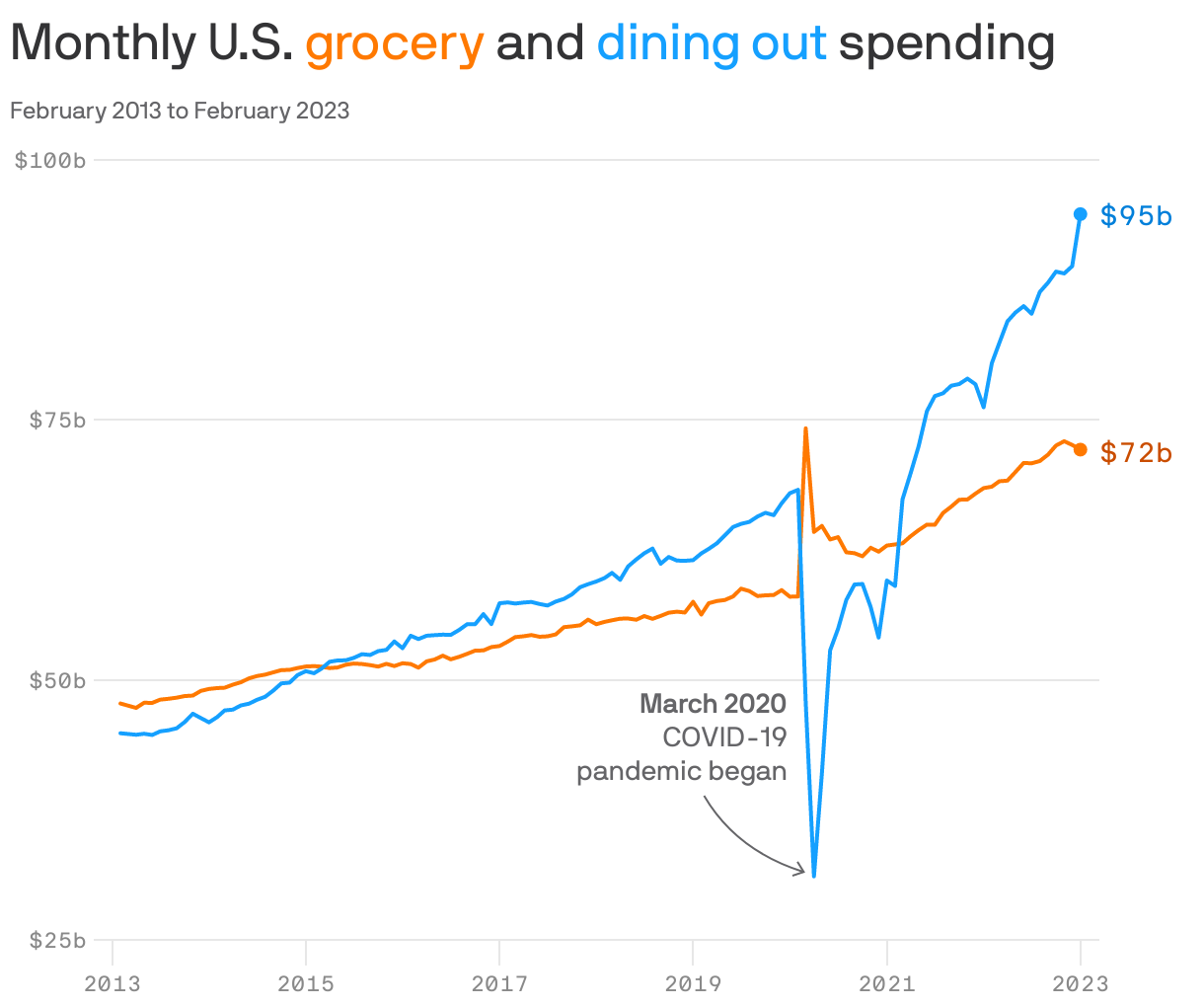
Americans are spending more money at restaurants than on groceries — and the gap has been widening, Nathan writes.
By the numbers: People spent 20.7% more at restaurants than they spent on groceries in 2022 — and that figure rose to 29.5% in the first two months of the year, according to Commerce Department data compiled by JLL.
- Put another way, consumers spent about $130 on dining out for every $100 they spent on groceries to start the year.
💭 Nathan's thought bubble: Inflation has been battering consumers on both fronts — restaurants and groceries — so people probably figure they won't save much money by eating at home.
- So why not go out.
3. What's happening
💍 David's Bridal is planning to file for bankruptcy protection for the second time in less than five years. (Axios Pro: Retail Deals) (Subscription)
👕 Walmart is selling Bonobos at a fraction of what it paid for the menswear brand. (Quartz)
✈️ Boeing's delay of 737 Max deliveries is bad news for carriers heading into the busy travel season. (CNBC)
4. Big banks turn in big quarters
Illustration: Aïda Amer/Axios
A trio of banking giants held their first checkups since the crisis — and the prognosis is a picture of health, Axios' Pete Gannon writes.
The big picture: JPMorgan, Citigroup and Wells Fargo all benefitted from rising interest rates, the very same factor that plagued certain regional banks in March.
- Higher rates allowed all three to profit more from lending, resulting in significant quarterly gains in net interest income.
- And deposit flight — the match that lit the flame at smaller lenders — was not a concern for these Wall Street giants. As suspected, many of the depositors that fled regional banks ran to bigger counterparts.
🧮 By the numbers: JPMorgan increased deposits 2% over the past quarter, attributing it to "significant" new account openings. It estimated that it picked up $50 billion in deposits as a result of the March crisis.
- Citi estimated it picked up a little bit under $30 billion.
Yes, but: All three — JPMorgan, Citi and Wells Fargo — increased reserves, guarding against loan losses in future quarters. JPMorgan cited a deteriorating economic outlook, while Wells Fargo pointed specifically to commercial real estate, credit card and auto loans.
The bottom line: Today's results were more than enough to cheer investors, who sent up JPMorgan shares 6.1%, and Citi 4.8%.
5. What they're saying
Brandon Crawford at bat against the New York Yankees earlier this month. Photo: Daniel Shirey/MLB Photos via Getty Images
"You have to figure out a different time to get your conversations in."— Brandon Crawford, shortstop for the San Francisco Giants, to AP on the impact of MLB's pitch clock on the social interactions between batters, catchers and umpires.
Today's newsletter was edited by Pete Gannon and copy edited by Sheryl Miller.
✏️ Was this email forwarded to you? Sign up here to get Axios Closer in your inbox.
Sign up for Axios Closer

Catch up on the day's biggest business stories and look ahead to important trends. Led by Nathan Bomey.