Axios China

March 14, 2023
Welcome back to Axios China. Today we're looking at China's major diplomatic victory in the Middle East, the deal to send nuclear-powered subs to Australia, global arms sales, and lots more.
- I'll be on vacation next week. Axios China will return to your inbox on March 28.
Today's newsletter is 1,611 words, a 6-minute read.
1 big thing: With Iran-Saudi deal, Beijing aims to bring its friends closer together
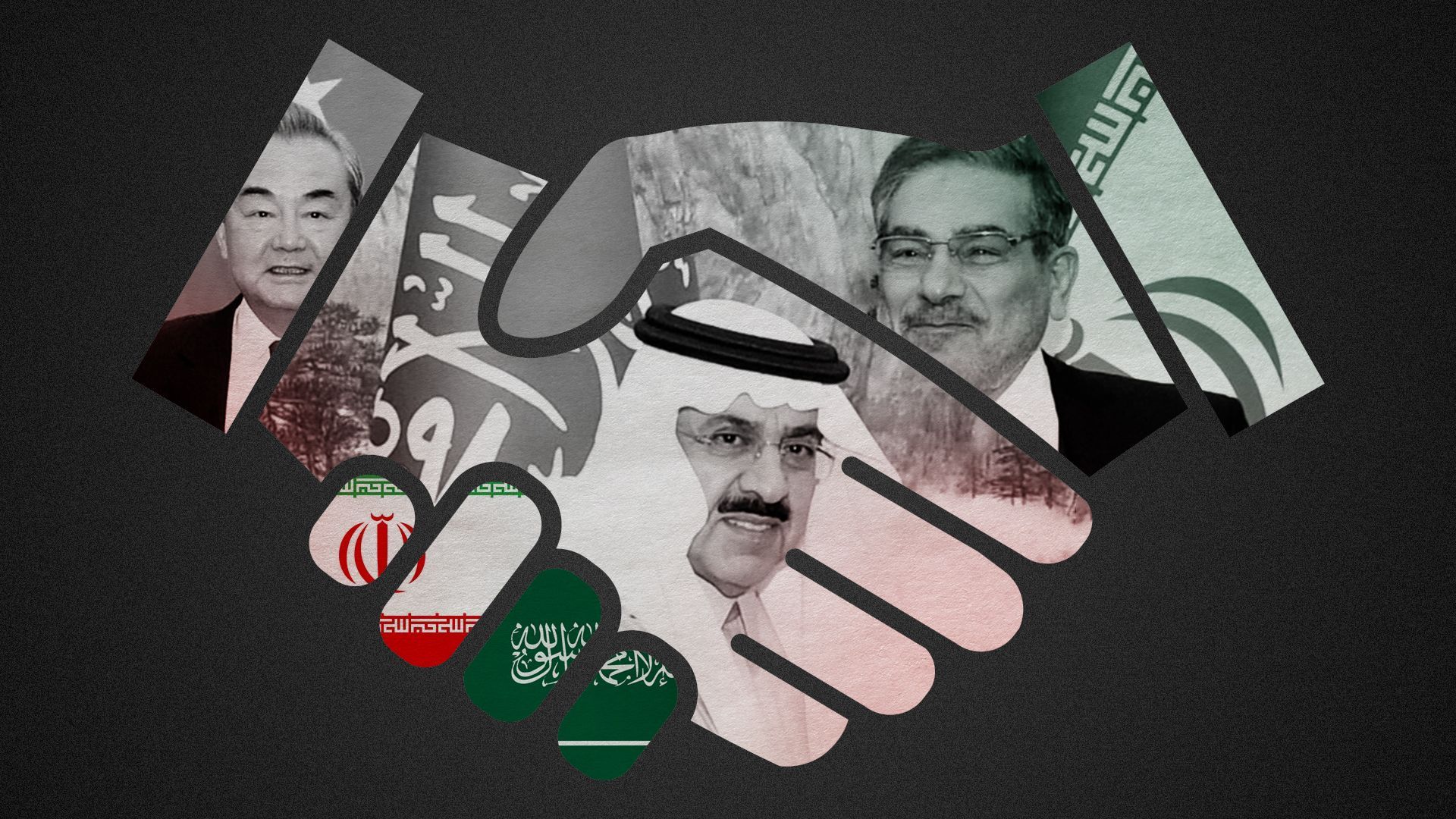
Photo Illustration: Natalie Peeples/Axios. Photo: Xinhua News Agency/Getty
By brokering a deal between Iran and Saudi Arabia, China is trying to ensure two of its most important partners in the Middle East get along so Beijing can achieve its economic and political goals, Axios from Tel Aviv author Barak Ravid reports.
Why it matters: The Middle East has become a major battleground for influence as Washington and Beijing both seek to strengthen their ties and mend relations between their friends in the region.
- A lasting detente between Saudi Arabia and Iran could reduce violence and instability, as both countries have long engaged in proxy wars in countries across the region. By getting involved, China is investing its diplomatic and reputational capital in trying to bring together two of the region's most bitter rivals — something other nations haven't been able to do.
- But “this is about bloc-building rather than peace-building," Andrew Small, a senior fellow at the German Marshall Fund of the United States' Indo-Pacific program, told Axios.
The big picture: Beijing's ambitions for its role in the Middle East are growing, just as the West is seeking to restrict China's access to Western technology and markets.
- China is "placing increasing emphasis on building a more resilient framework for trade, finance, technology and energy flows, in which Iran and Saudi both play important roles," Small said.
- But the conflict between Tehran and Riyadh has been a "headache" for China's leaders for years, Small added. "Every time they want to deepen economic and security ties with either one, it rubs up against the other."
What happened: Beijing has been setting the groundwork for months for negotiations between Iran and Saudi Arabia, in what analysts and key figures in the region see as a sign of China's growing challenge to U.S. dominance there.
- Chinese President Xi Jinping visited Saudi Arabia in December in a state visit that was hailed by both sides, and Iranian President Ebrahim Raisi visited Beijing in February.
- Maj. Gen. Yahya Rahim Safavi, the military adviser to Iran's supreme leader, said on Sunday that the agreement was "an earthquake" when it comes to U.S. influence in the Middle East.
China's efforts came as Saudi Arabia signaled it was trying to rebalance its relations with the U.S. and China, despite efforts by Washington to increase its engagement with Riyadh.
- Tensions between Riyadh and Washington over the killing of Washington Post columnist Jamal Khashoggi and Saudi Arabia's continued participation in a pandemic-era oil pact with Russia have brought new uncertainty to the bilateral relationship.
- There were stark differences between the way they welcomed President Biden and the way they greeted Xi.
- Biden was welcomed in July at the airport by the governor of Jeddah without any ceremony. Xi was welcomed with Saudi air force fighter jets, honorary cannon fire and the Saudi foreign minister, who waited for him on the tarmac.
Yes, but: There's no indication the Saudis will fully commit to a China-led bloc anytime soon, Small said.
- Riyadh has long been one of Washington's closest security partners in the region. In 2022, the U.S. approved $5 billion in weapons sales to the kingdom, per NPR.
- At the same time, the White House has tried to play down the Chinese role in last week's deal between Saudi Arabia and Iran and stressed this agreement was two years in the making. "This deal is not about China," a White House official told Axios.
- White House national security adviser Jake Sullivan told reporters aboard Air Force 1 yesterday that the Chinese mediation between Iran and Saudi Arabia was "not fundamentally averse to U.S. interests. Frankly, it's, in a way, rowing in the same direction as the U.S.," he said.
What to watch: China is planning a summit of Iranian and Gulf Arab leaders to be held in Beijing later this year, the Wall Street Journal reports.
2. Submarine deal shows new resolve to counter China
A nuclear-powered U.S. Navy submarine cruises into the Navy Port at Port Canaveral, Fla. Photo: Paul Hennessy/SOPA Images/LightRocket via Getty Images
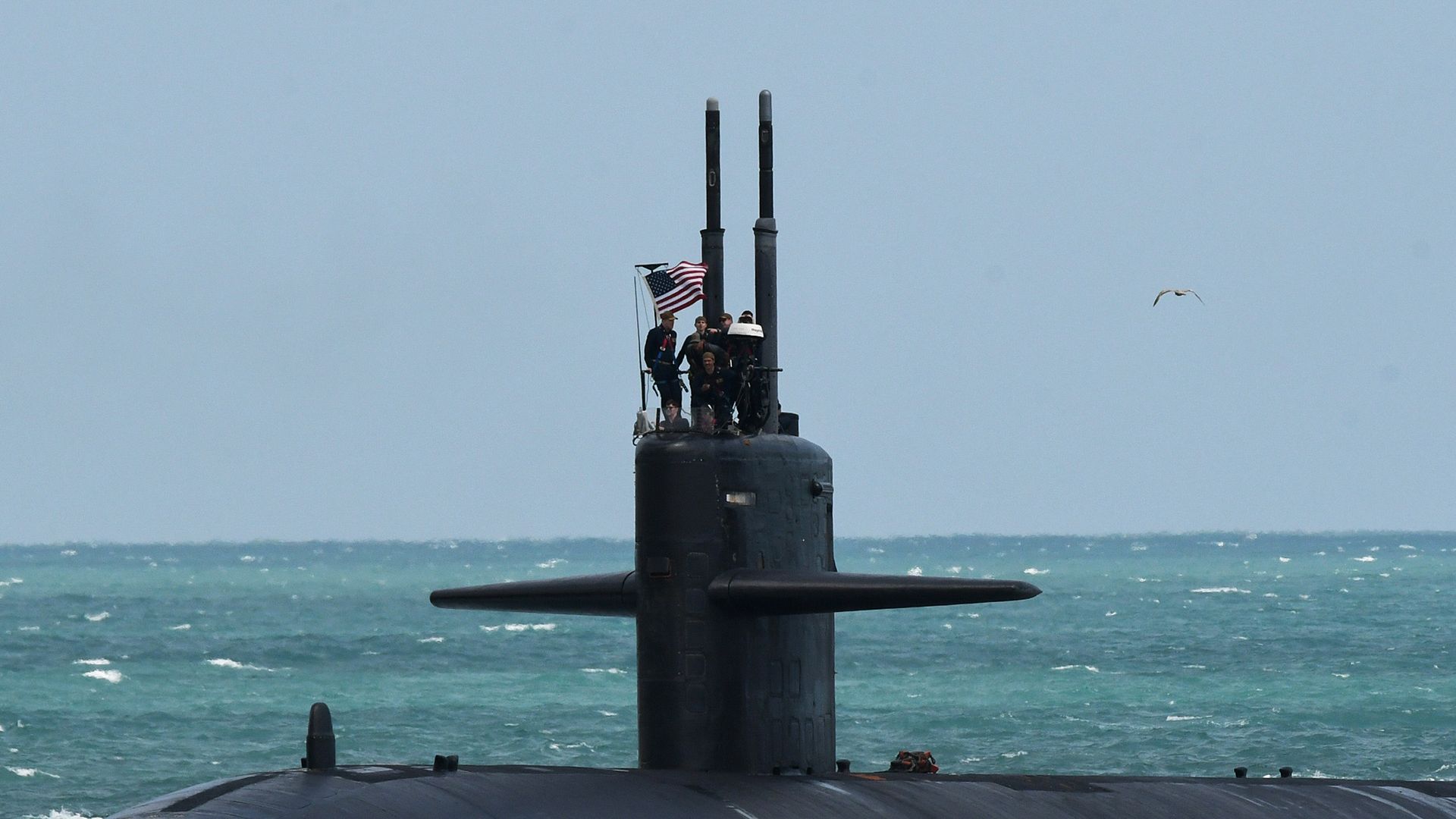
The plan revealed on Monday by the U.S. and the U.K. to transfer nuclear-powered submarine technology to Australia shows how seriously the three countries are taking the military threat from China in the Indo-Pacific, analysts say.
The big picture: It's the first time in 65 years that the U.S. has shared the technology — and only the second time ever.
- The broader significance of the AUKUS pact is the "intentionality to drive technological integration, grow the industrial capacity, and deepen strategic coordination between all three countries," said Charles Edel, Australia chair at the D.C.-based Center for Strategic and International Studies, in a press briefing on Friday.
- "All of this is being undertaken to help make our closest allies more powerful and more capable of convincing Beijing that it’s no longer operating in a permissive security environment."
What they're saying: By implementing the deal, the U.S., U.K. and Australia "completely disregard the concerns of the international communities and are walking further and further down the path of error and danger," Chinese Foreign Ministry spokesperson Wang Wenbin said at a press briefing on Tuesday.
Between the lines: For China, AUKUS is a signal that the U.S. is committed to helping Australia acquire capacity for "integrated deterrence," Jingdong Yuan, a professor at the University of Sydney who researches Asia-Pacific security, told Axios.
- That means the Australian fleet "can be part of coordinated allied operations, such as regular patrols in the South China Sea or around the key choke points or sea lanes."
- Nuclear-powered submarines are quieter and more difficult to detect than conventional submarines, and they can stay beneath the surface for longer periods of time, Yuan said. That strengthens deterrence and "adds complication" for China's territorial claims in the South China Sea and elsewhere, Yuan said.
3. Catch up quick
1. Xi will visit Moscow as early as next week and meet with Russian President Vladimir Putin, Reuters reports.
2. Xi is also expected to speak with Ukrainian President Zelensky for the first time since Russia invaded Ukraine, possibly after Xi's visit to Moscow, the Wall Street Journal reports.
3. The U.S. will lift COVID testing restrictions for travelers from China, which began on Jan. 5 after a wave of coronavirus infections there. Go deeper.
- Meanwhile, China announced it will resume issuing visas to foreign tourists again after three years of travel restrictions, CNN reports.
4. Xi has begun a third term after he was sworn in on Friday. Go deeper.
- The outcome was expected after he was named as China's unchallenged leader during a meeting of the ruling Chinese Communist Party elites last October.
5. Li Qiang, a close Xi ally, was formally selected as China's new premier on Saturday. Go deeper.
- The 63-year-old Li is perceived by many as a pro-business pragmatist who supports the continued growth of the private sector.
4. U.S. dominates global arms sales, with China a distant 4th
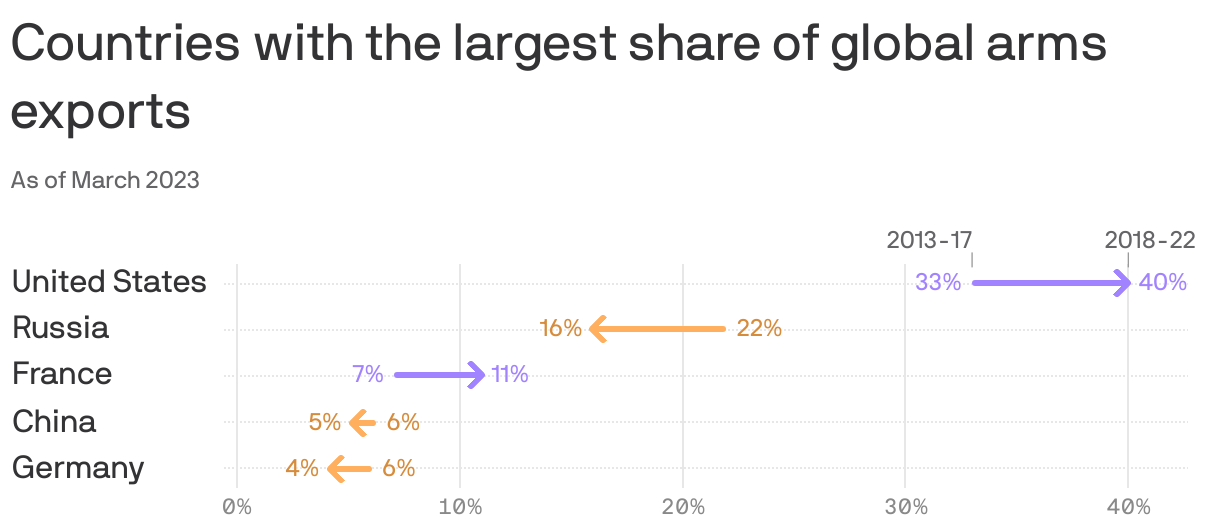
U.S. dominance in the global weapons trade increased dramatically over the past five years, according to new data from the Stockholm International Peace Research Institute, Axios World author Dave Lawler writes.
The big picture: Russia slipped to an increasingly distant second place, while China’s share of global exports stayed relatively flat.
By the numbers: The U.S. accounted for 40% of total exports from 2018 to 2022, up from 33% in the previous five years, while Russia declined from 22% to 16%.
- France was the No. 3 exporter over the last five years, thanks largely to contracts to sell combat aircraft, followed by China and Germany.
- China's arms sales are heavily concentrated in sub-Saharan African nations, where its weapons sales are triple that of the U.S., the data shows.
What to watch: Ukraine accounted for less than one-tenth of 1% of global arms imports until recently, but the flow of arms to Ukraine is now starting to reshape the global defense industry.
- Both the U.S. and EU are contemplating how to build up their defense industrial bases to keep up with the demands of the war, replenish their stockpiles and prepare for future conflicts.
- Russia, meanwhile, will likely play a smaller role in the global arms trade in the coming years both because its weapons are needed for the war and due to sanctions aimed at reducing its capacity to produce more.
5. What I'm reading
Freedom at any cost: Growing numbers of Chinese citizens set their sights on the U.S. — via the deadly Darién Gap (The Guardian)
- "Panamanian government data shows about 400 Chinese citizens made the journey during the first half of 2022. In November last year, the figure rose to 377, then to 695 in December. In January 2023, a record-breaking 913 Chinese nationals crossed, making them the fourth-largest group of migrants to do so this year."
- "A combination of draconian Covid lockdowns and Xi Jinping’s increasingly repressive rule has pushed thousands to flee China. They term it 'runology', or runxue in Chinese. The relaxation of China’s zero-Covid policy and border controls in December and January has led to higher numbers of Chinese nationals taking the perilous journey."
Offline warfare: Internet outage has Taiwan worried about threat from Chinese sabotage (Washington Post)
- "The undersea internet cables that serve the Matsu island chain — part of Taiwan but at points only a few miles from China — were severed just over a month ago. ... The first cable was damaged Feb. 2 by a Chinese fishing boat and the second Feb. 8 by a Chinese cargo ship, according to Taiwanese authorities."
- "This plunged residents back in time and forced them to confront what life would be like if increasing tensions with China made Taiwan’s internet infrastructure an intentional target."
6. 🤍 1 fun thing: White Valentine's Day

A lingerie shop employee at a Tokyo department store displays "White Day" gifts on March 8, 2000. Photo: Yoshikazu Tsuno/AFP via Getty Images
Today people in Taiwan are celebrating "White Valentine's Day," also known as "White Day," which is held each year on March 14, one month after Valentine's.
- For this holiday, which originated in Japan, people give gifts to whoever gave them a gift on Valentine's the month before.
- Happy White Valentine's Day!
A big thank you to Alison Snyder for edits, Sheryl Miller for copy edits, the Axios visuals team, and Barak Ravid and Dave Lawler for contributing.
Sign up for Axios China

Analysis and intel from Bethany Allen-Ebrahimian, authority on Beijing intrigue and intentions.


