Axios China

January 10, 2024

Welcome back to Axios China. Taiwan's presidential election is just days away, so today we're looking at what's at stake, how evolving Taiwanese identity comes into play, Beijing's mood, and more.
- Send tips and feedback to [email protected], or just hit reply.
Today's newsletter is 1,899 words, a 7-minute read.
1 big thing: Ahead of key election, Taiwan's identity politics shapes views on China
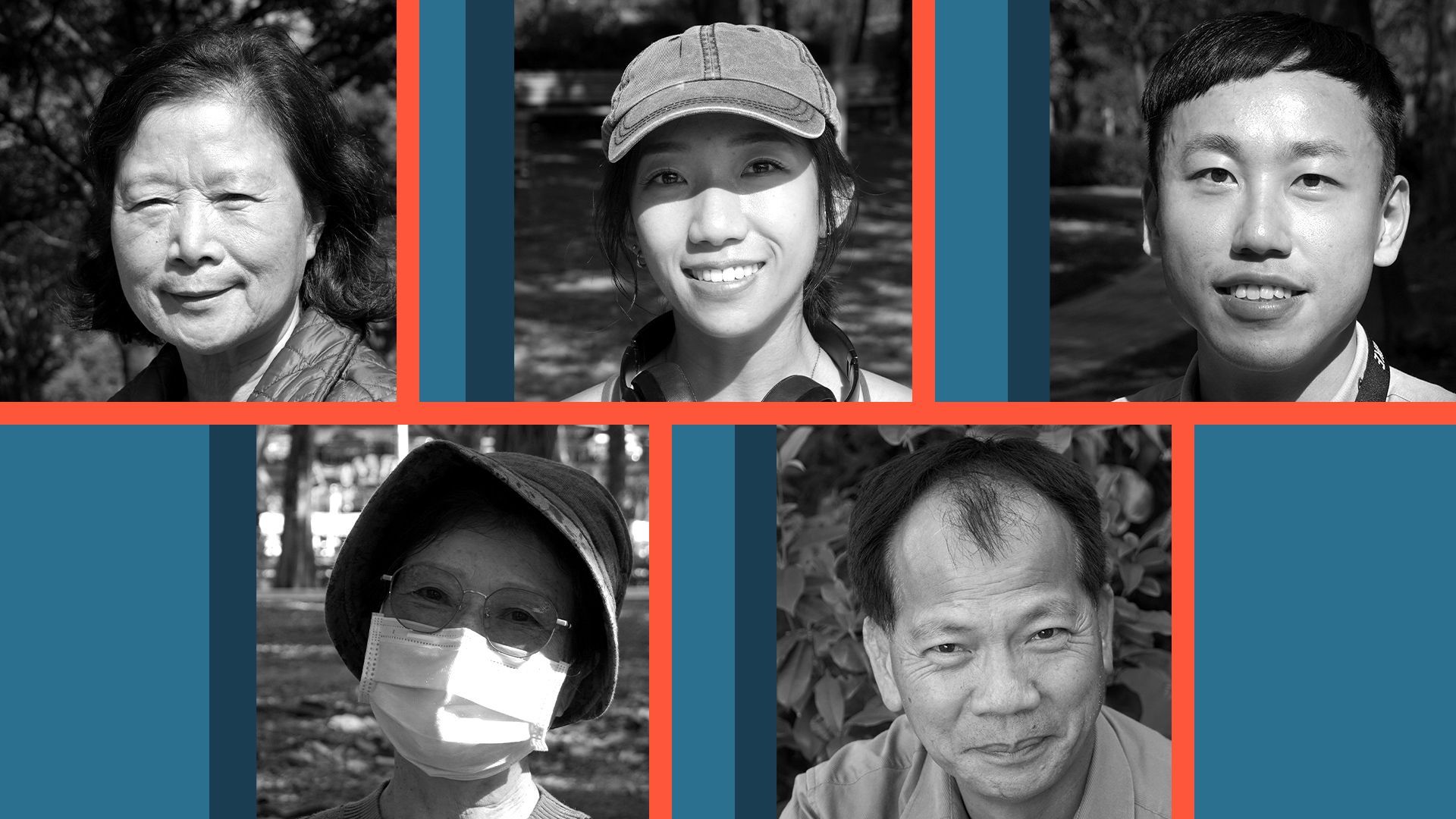
Photo illustration: Axios Visuals. Photo: Bethany Allen-Ebrahimian/Axios
Voters in Taiwan say cross-strait relations is a top consideration as they cast their votes in Taiwan's presidential election this Saturday.
Why it matters: Taiwan's residents increasingly identify as "Taiwanese" rather than "Chinese," and surveys have also found a rise in the number of people who support moving the country closer to independence.
- The three candidates are the ruling Democratic Progressive Party's (DPP) William Lai, the more Beijing-friendly Kuomintang's (KMT) Hou You-yi, and the recently founded Taiwan People's Party's (TPP) Ko Wen-je, whose cross-strait views lie somewhere in between.
By the numbers: In 1992, the proportion of Taiwan residents who identified as "Taiwanese only" was just under 18%, according to survey data by National Chengchi University (NCCU). By 2023, that had risen to 63%.
- In 1992, the proportion of Taiwan residents identifying as "Chinese only" (中國人) was just over 25%. By 2023, that had fallen to less than 3%.
- Those identifying as both Taiwanese and Chinese was 46% in 1992 and just over 30% in 2023.
- Meanwhile, between 1994 and 2023, the percentage of people wanting to "maintain the status quo, move toward independence" trended upward, while the percentage of people wanting to "maintain the status quo, move toward unification" trended downward, according to different survey data from NCCU.
Zoom in: Axios spent a day interviewing voters in Taipei about who they plan to vote for, why and if they identify as Taiwanese, Chinese or both.
Zhou, who only gave his surname and said he is in his 70s, said he preferred Ko Wen-je but was probably going to vote for the KMT because Ko had little chance of winning. "If Lai Ching-de wins, China might attack," said Zhou, who said he identifies as Taiwanese only.
Another voter, He, who said he is in his 50s and also only gave his surname, said he is voting for the KMT because the DPP has "made a huge mess of everything."
- Cross-strait relations is the most important issue to him, and he thinks the KMT does a better job managing relations with Beijing. "The world should have peace," he said. He said he is "deep blue," meaning a strong KMT supporter.
- When asked if he identifies as Taiwanese or Chinese or both, he said he identifies as "ethnic Chinese"(華人) and said that only Taiwan's Indigenous peoples are truly Taiwanese.
Zhen Yujie, who is 30 years old and works in finance, said he is voting DPP because "I am gay, and the DPP's LGBT policies are better."
- This year, concern about China isn't affecting his vote, he says. He isn't worried about the risk of an invasion because "other East Asian countries like Japan and South Korea would oppose it if China invaded Taiwan."
- Zhen identifies as Taiwanese only.
One 77-year-old voter, who declined to give her name, said she is voting for William Lai because he is "honest."
- She voted for the DPP in the election four years ago and said Tsai Ing-wen has been a very "trustworthy" president.
- Cross-strait relations is the most important issue for her in this election. "Lai Ching-de can protect Taiwan," she told Axios. The other candidates are "closer to China" and she doesn't trust them, she said.
- She identifies as Taiwanese only — "Taiwan born and raised," she said.
Sheila Liou, who works in marketing, told Axios she will vote for the DPP because "in the past four years, they have managed things really well," including LGBT issues and international politics.
- The 34-year-old voter said the relationship between Taiwan and China is the most important issue to her and she worries the KMT might give up too much to China.
- She identifies as Taiwanese only.
What to watch: The DPP's Lai is the front-runner for the presidential race, but legislative elections are also slated for this weekend, and the KMT and TPP together may hold a majority in the legislature — meaning a divided government could make it harder for Lai to make progress on his agenda.
Go deeper: China looms large in Taiwan's presidential election
2. China says it will "never compromise" on Taiwan
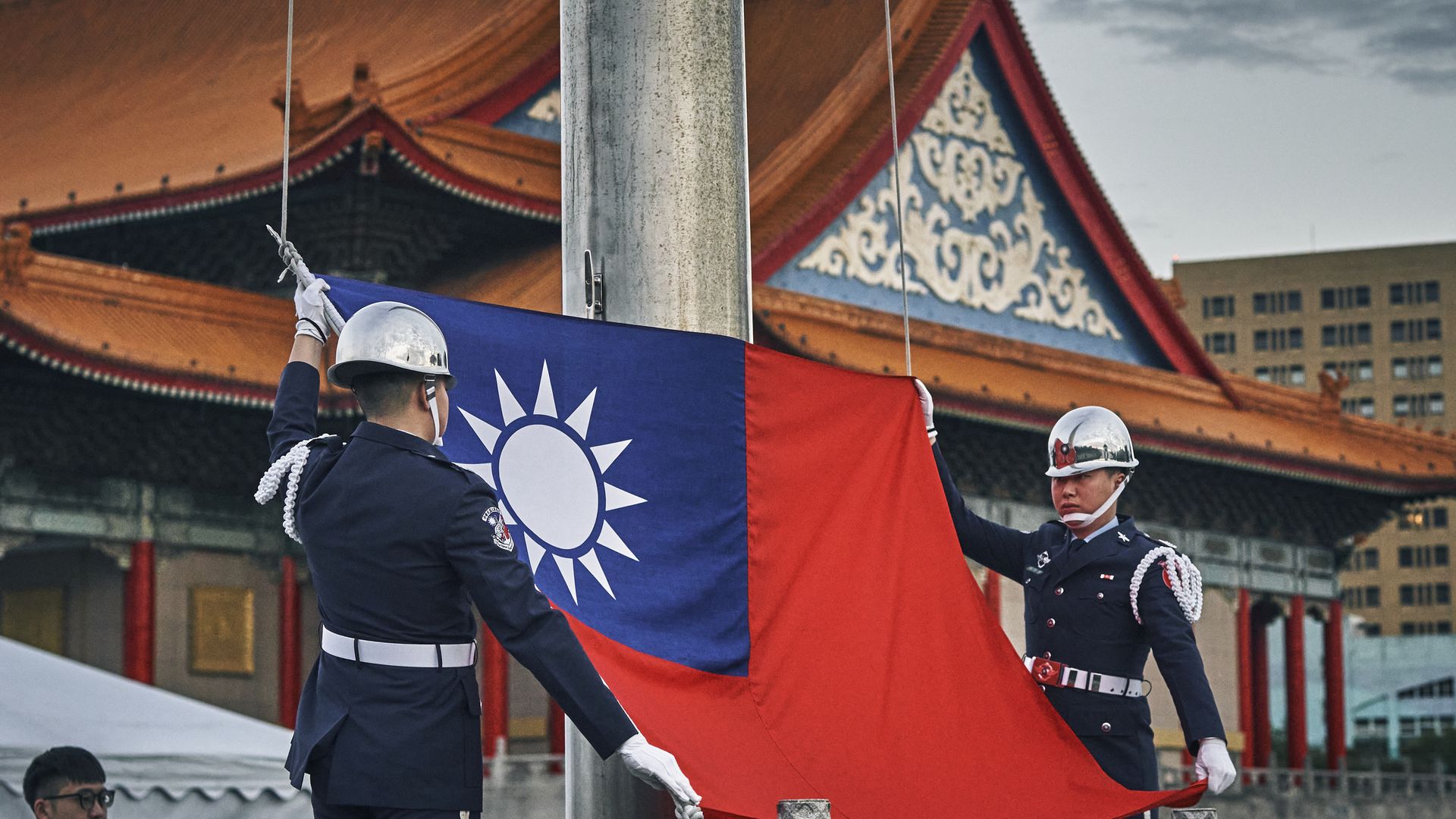
An honor guard during a flag-raising ceremony at Chiang Kai Shek Memorial Hall in Taipei, Taiwan, on Dec. 27, 2023. Photo: An Rong Xu/Bloomberg via Getty Images
China will "never compromise or yield on the Taiwan issue," China's Ministry of Defense said in a statement Wednesday after the conclusion of a U.S.-China military dialogue held in Washington, D.C.
Why it matters: The stark language is standard for China but also underscores that the Chinese government is firmly committed to its core interests ahead of improved ties with the U.S. The statement also comes ahead of a key election in Taiwan, in which cross-strait relations are a top issue for voters.
What they're saying: The statement also demanded the U.S. "stop arming Taiwan" and "not support Taiwan independence."
- But the statement also contained some affirmations of the progress made in the bilateral relationship after China agreed to resume military communications with the U.S. in November, including that China is "willing to develop a sound and stable military-to-military relationship with the U.S. side on the basis of equality and respect."
- It also said the U.S. "needs to take seriously China's concerns and do more things that contribute to the growth of the mil-mil relationship."
The other side: The U.S. Department of Defense readout, posted on Jan. 9, said the U.S. "reiterated that the United States remains committed to our longstanding one China policy" and "reaffirmed the importance of peace and stability across the Strait."
Background: This week marks the first time the U.S.-China Defense Policy Coordination Talks were held since 2021.
- China suspended some military-to-military communications with the U.S. after Nancy Pelosi visited Taiwan in 2022, the first House speaker to do so in 25 years.
- China agreed to resume military communications after Chinese leader Xi Jinping met with President Biden at APEC in San Francisco in November, following extensive diplomacy and lobbying from the U.S.
3. Catch up quick
1. China has become the world's biggest car exporter, with a surge in demand for gas-powered vehicles, especially from Russia, the Wall Street Journal reports.
- "The rise of China as the center of the world's automaking industry represents a hard-won victory for Beijing's industrial policies, following similar achievements in solar panels and batteries," the Journal's Selina Cheng writes.
2. China said one of its tech companies has cracked the encryption around Apple's wireless file-sharing service AirDrop, making it possible for authorities to identify users sharing "inappropriate remarks and potential bad influence," CNN reports.
- AirDrop has been used in China to spread spam messages but also to share information regarding rare protests.
3. Tesla will recall more than 1.6 million of its vehicles that were exported to China to fix glitches with their automatic assisted steering and door lock controls. Go deeper.
- The recall in China over the glitches, which will be fixed with remote software updates, follows two other recalls in the U.S. last month involving millions of the company's EVs that were experiencing similar issues.
4. KMT can only bring "fake peace," DPP's Lai says
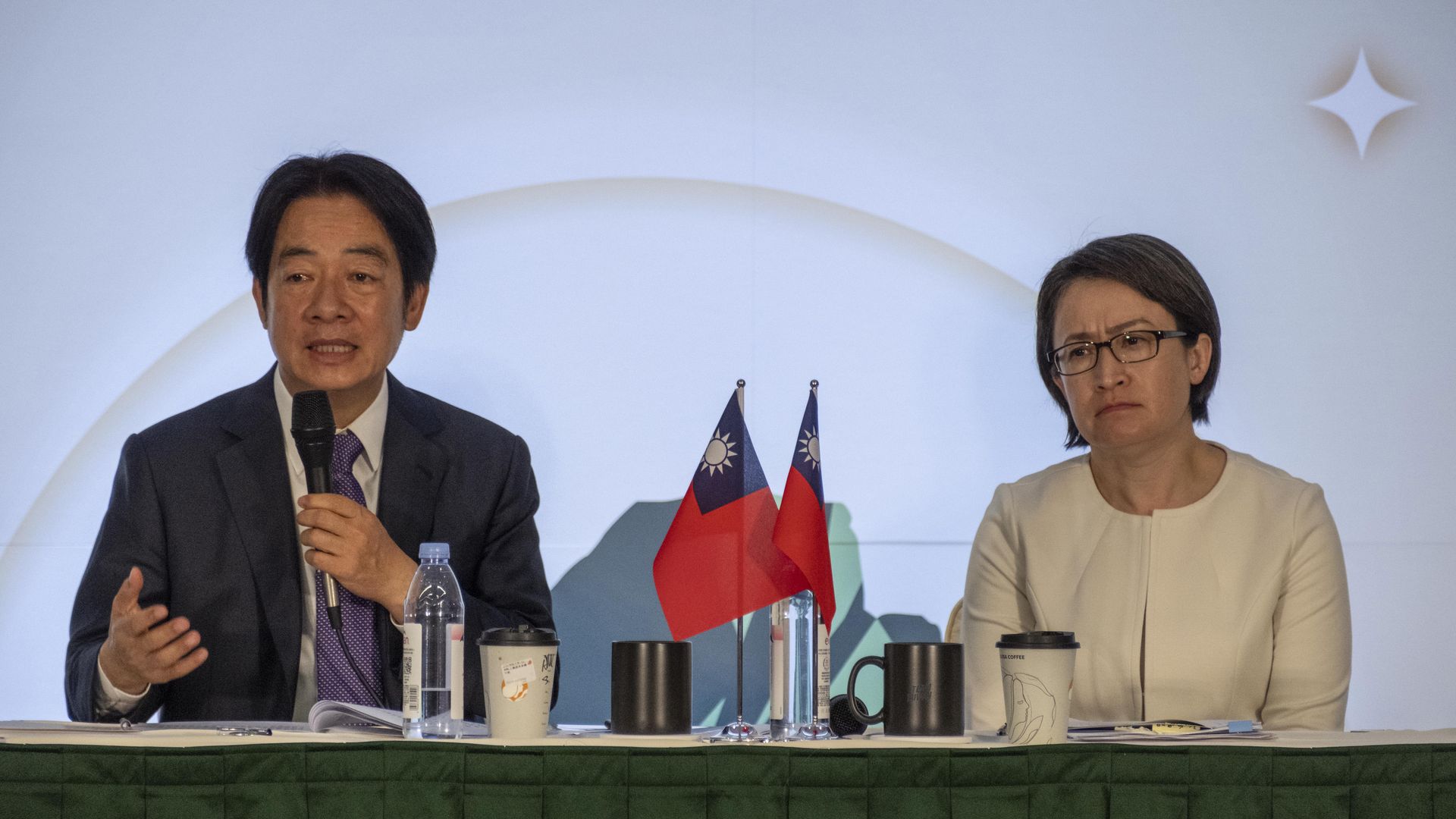
William Lai, left, and his running mate Hsiao Bi-khim, Taiwan's former representative to the U.S., during a news conference in Taipei, Taiwan, on Jan. 9. Photo: Lam Yik Fei/Bloomberg via Getty Images
The Taiwanese opposition party's support for the One China principle can't bring true peace and could lead to Taiwan becoming like Hong Kong, rival Democratic Progressive Party presidential candidate William Lai told reporters on Tuesday ahead of this weekend's election.
The big picture: Taiwan's relationship with China is a key issue this year as Beijing has increased its pressure on the island.
- The opposition party Kuomintang (KMT) is presenting the election as a choice between war and peace. Beijing has also cast the election in these terms. KMT presidential candidate Hou You-yi has promised better relations with China.
- The DPP, which has ruled for the past eight years, is presenting this year's race as a choice between democracy and authoritarianism.
What he's saying: "Accepting the One China principle isn't true peace. Peace without sovereignty is like Hong Kong; it's fake peace," Lai said at a press conference on Tuesday.
- Many Taiwanese see Hong Kong's fate as a cautionary tale. Hong Kong returned to mainland Chinese sovereignty in 1997 and Beijing promised to grant it a high degree of autonomy until 2047.
- But in 2020, the Chinese government imposed a tough national security law on the city that has resulted in the elimination of Hong Kong's once-robust political freedoms.
- Since then, Hong Kong hasn't seen the mass protests that at times brought the city to a standstill in 2019 — because such protests are no longer legal and dozens of protesters now stand trial under the new law.
Between the lines: The KMT and the Chinese Communist Party aren't aligned on how they describe the One China principle.
- The CCP says the People's Republic of China under the CCP's governance has rightful sovereignty over Taiwan and has the right to take action in support of that claim.
- The KMT says the Republic of China is still the legal and legitimate government of all of China, which includes Taiwan — a position that is enshrined in the Republic of China's constitution. But the KMT recognizes the reality that for now, the People's Republic of China administers the mainland, and the KMT does not actively seek to change that.
The DPP says adopting policies in line with the One China principle will eventually result in Taiwan's loss of sovereignty and political freedoms.
- Lai recently referred to the Republic of China constitution as a "disaster."
- The DPP's position is Taiwan is already an independent country known as the "Republic of China, Taiwan" and thus has no need to declare independence from China.
The other side: The KMT says the DPP's position brings Taiwan into dangerous conflict with China, and the DPP isn't being true to Taiwan's history.
- "The DPP clearly lacks the determination to defend the ROC," the KMT wrote on its Facebook page in April 2023. "It is unwilling to face the constitutional facts, and yet does not dare to amend the Constitution, nor declare Taiwanese independence."
5. What I'm reading
The "walking route": How an underground industry is helping migrants flee China for the U.S. (CNN)
- "In the first 11 months of 2023, more than 31,000 Chinese citizens were picked up by law enforcement crossing illegally into the US from Mexico, government data shows — compared with an average of roughly 1,500 per year over the preceding decade."
- "Many who left point to a struggle to survive. Three years of Covid-19 lockdowns and restrictions left people across China out of work — and disillusioned with the ruling Communist Party's increasingly tight grip on all aspects of life under Xi. ... Others nod to restrictions on personal life in China."
6. 💃 1 fun thing: The KMT drags Taylor Swift into election debate
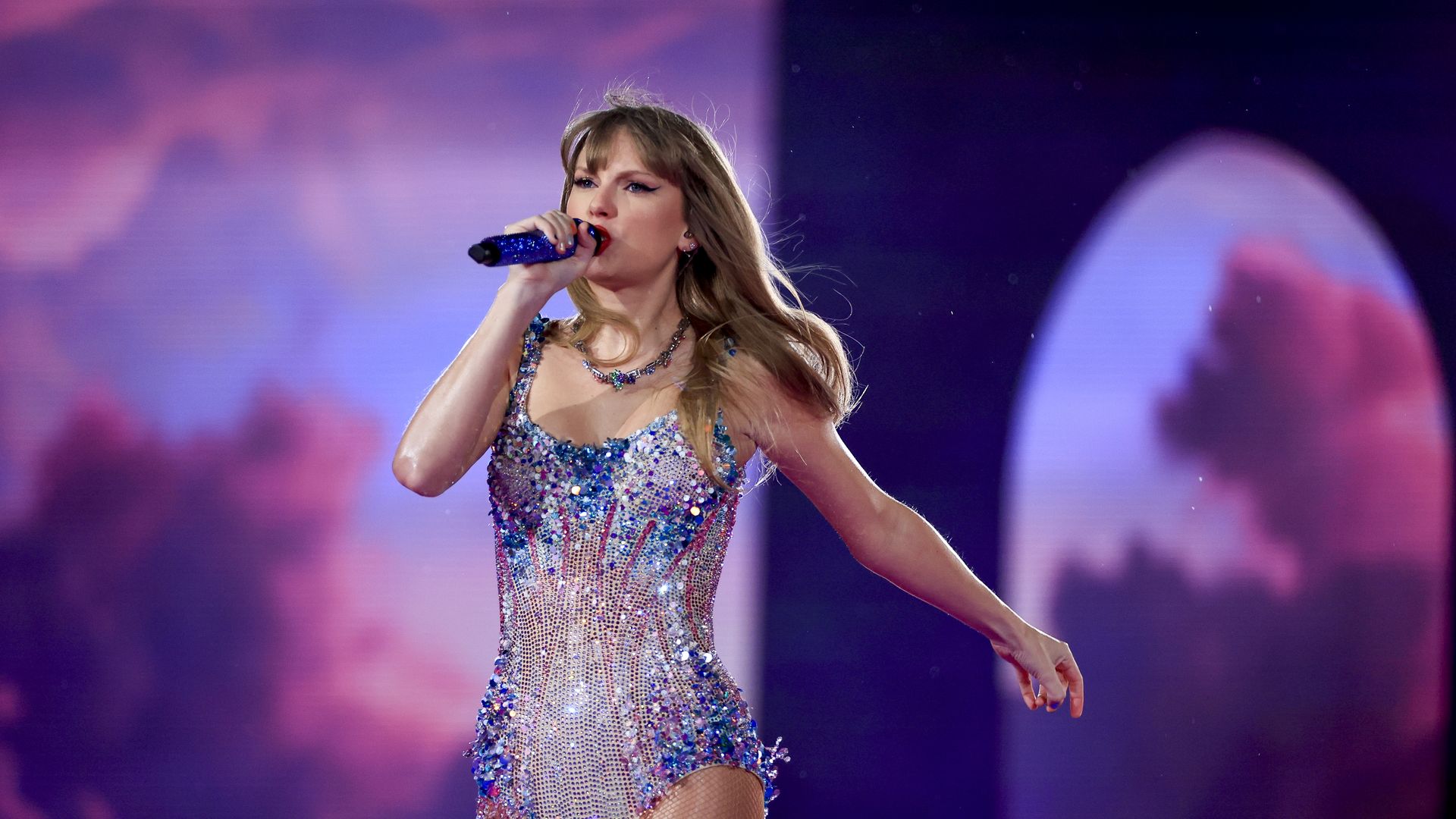
Taylor Swift in November 2023 in Sao Paulo, Brazil. Photo: Buda Mendes/TAS23/Getty Images for TAS Rights Management
Don't vote for the DPP, the KMT vice presidential candidate said recently — because they're making it impossible for Taylor Swift to perform in Taiwan without risking China's ire.
- Jaw Shau-kong said during a debate earlier this month that when he previously served as chair of the Broadcasting Corporation of China, he had invited Swift to Taiwan, but that she had declined, citing geopolitical reasons.
- Jaw cited this as a consequence of DPP's policies that have alienated Beijing and as an example of why the party's China stance is bad for Taiwan.
- Jaw did not provide evidence for his claim. Taiwan's Ministry of Culture said that many major bands have performed in Taiwan and that "what the KMT vice presidential candidate said was not true."
Between the lines: The Chinese government uses access to its enormous population of music fans to try to ensure that performing artists and movie stars don't cross CCP red lines.
- Lady Gaga was banned from China in 2016 after meeting with exiled Tibetan spiritual leader the Dalai Lama.