Axios China

February 01, 2022

Welcome back to Axios China. Today's newsletter is a special edition dedicated to the 2022 Beijing Olympic Games, which begin on Friday.
- Several of my Axios colleagues contribute this week: sports editor Kendall Baker, sports reporter Jeff Tracy, media reporter Sara Fischer, and health care editor Tina Reed.
- You can forward this newsletter to friends or colleagues who are interested in this year's Olympics, or they can subscribe here.
Today's newsletter is 1,759 words, a 6½-minute read.
1 big thing: The IOC stays silent on China human rights
Illustration: Sarah Grillo/Axios
The International Olympic Committee (IOC) has long stated it is committed to human rights, but ahead of the Beijing Olympics, it is declining to take a stand on genocide in Xinjiang — and insisting its only mission is to run the Games successfully, Axios' Sports editor Kendall Baker and I write.
Why it matters: By remaining silent and continuing to back Beijing, the IOC is deflecting pressure from the international community onto Olympic sponsors and athletes themselves.
- In an era of athlete empowerment, the Beijing Games are just the opposite. Athletes have been thrust into a geopolitical affair, been given burner phones and warned they may face punishment for speaking out against the Chinese Communist Party.
Driving the news: Numerous governments have announced a diplomatic boycott of the 2022 Winter Olympics in Beijing, due to the campaign of repression and genocide that Chinese authorities are currently waging against ethnic Uyghurs in the country's northwest region.
What's happening: Despite growing criticism, the IOC has not denounced the Chinese government's policies in Xinjiang or raised the topic publicly. It has cut off talks with human rights groups asking for answers about the possibility of forced Uyghur labor in Olympic uniform supply chains.
- IOC president Thomas Bach publicly met with Chinese President Xi Jinping, a key architect of the Xinjiang genocide, in Beijing last week.
- The IOC said in a statement that the "two leaders discussed the strong support of the international community for the Olympic Winter Games Beijing 2022."
The IOC's mission is to build a "peaceful and better world," and the organization preaches political neutrality. But it plays politics when it wants to, banning South Africa in 1964 due to apartheid and, more recently, cracking down on athletes' social justice protests.
- The Olympic Host City Contracts for Paris 2024 and Milan 2026 include a human rights assessment, but the Olympic Host City Contract for Beijing 2022 does not mention human rights at all.
- The IOC has seen its sponsorship revenue jump from $500 million in 2000 to roughly $3 billion today, which has fostered a cynical view of the Olympics as a money-making machine, rather than a unifying global event.
What they're saying: "Our responsibility is to run the Games in accordance with the Olympic Charter ... and to bring together the athletes from 206 teams and the IOC refugee team under one roof," Bach said in December when asked about China's human rights violations in Xinjiang.
- "The sporting sanctions against South Africa came in the wake of broad agreement within the international community on taking a wide range of political measures against the South African government, backed by the United Nations," an IOC spokesperson told Axios, in response to questions about China and the Uyghur genocide.
- "The IOC cannot take such a position unilaterally when most actors of the international community continue to have diplomatic, political, cultural or economic exchanges with a particular country."
The refusal of the IOC and its top executives to publicly denounce or acknowledge the existence of genocide in China is due in part to the Olympics' growing reliance on the pocketbooks of authoritarian governments in particular.
- Hosting the Games has become prohibitively expensive over the years, including building (and then maintaining) Olympic-sized facilities.
- "Keeping good working relations with authoritarian governments helps the IOC to secure the future of its main revenue driver, the Olympic Games, thus providing for its own future," sociologist Thomas Könecke and economist Michiel de Nooij wrote in a 2017 study published in the journal Current Issues in Sports Science.
Between the lines: The calls for boycotts, for sponsors to cut ties, and for NBC to include human rights coverage, have put Olympians in a difficult spot, leaving some athletes unnerved and upset.
- "I understand people want us and our backers to speak out about the host city decision," Elana Meyers Taylor, an American bobsledder, wrote in USA Today.
- "But sponsors and athletes didn't choose Beijing."
2. China embraces winter sports

Illustration: Annelise Capossela/Axios
The Olympics are about more than medals. They’re about leaving a lasting legacy for the host nation, and China’s goal for Beijing 2022 is an ambitious one: transform into a winter sports nation, Axios’ Jeff Tracy writes.
By the numbers: When China won its bid to host these Games, its goal was to attract 300 million new winter sports participants by 2022. It has exceeded expectations, attracting 346 million, per the organizing committee.
- Facilities have boomed in lockstep with demand, aided by tax incentives intended to spur growth. More than 450 ice rinks and 300 snow resorts have been built since 2015.
- 67% more people visited a Chinese ski resort in 2019 than in 2015, per China Daily, and all those customers — in the world’s most populous country — means a lot of money.
- The industry generated $94 billion in 2020, and reports suggest that number could reach $157 billion by 2025. The U.S., by comparison, generates approximately $20 billion.
The backdrop: To say this happened overnight wouldn’t be that much of an exaggeration. To wit, in 1996, China had just 11 ski resorts, which makes sense given its relatively modest annual snowfall. In fact, these Olympics will be the first ever to use 100% fake snow.
- Yes, but: While China’s winter sports industry is booming, the culture is still in its nascent stage. “Most of us are still [beginners],” said one local skier.
The other side: Growing anything too fast has inherent risks. The Chongli District — a resort-filled hub three hours north of Beijing — is mired in debt as revenue lags far behind Olympic-based spending, with pandemic restrictions further amplifying losses, per the Financial Times (subscription).
Zoom out: China won’t be the first host to use the Games to improve a local sporting culture: Albertville 1992 helped turn the Mont Blanc region into France’s leading winter sports destination, and since Salt Lake City hosted in 2002, Utah has become a year-round hub for sporting events.
3. Catch up quick
1. Chinese authorities are detaining activists and shutting down social media accounts in advance of the Olympics, the New York Times reports.
2. Beijing officials sealed off residential areas after two COVID cases were detected. Go deeper.
3. Foreign journalists and news outlets are "facing unprecedented hurdles covering China," a new report states. Go deeper.
4. The EU sued China at the WTO over its economic pressure campaign against Lithuania. Go deeper.
4. Team China athletes to watch

Eileen (Ailing) Gu, an 18-year-old American skiing sensation (and model) made waves when she decided to compete for Team China. Watch her in the halfpipe, slopestyle and big air.
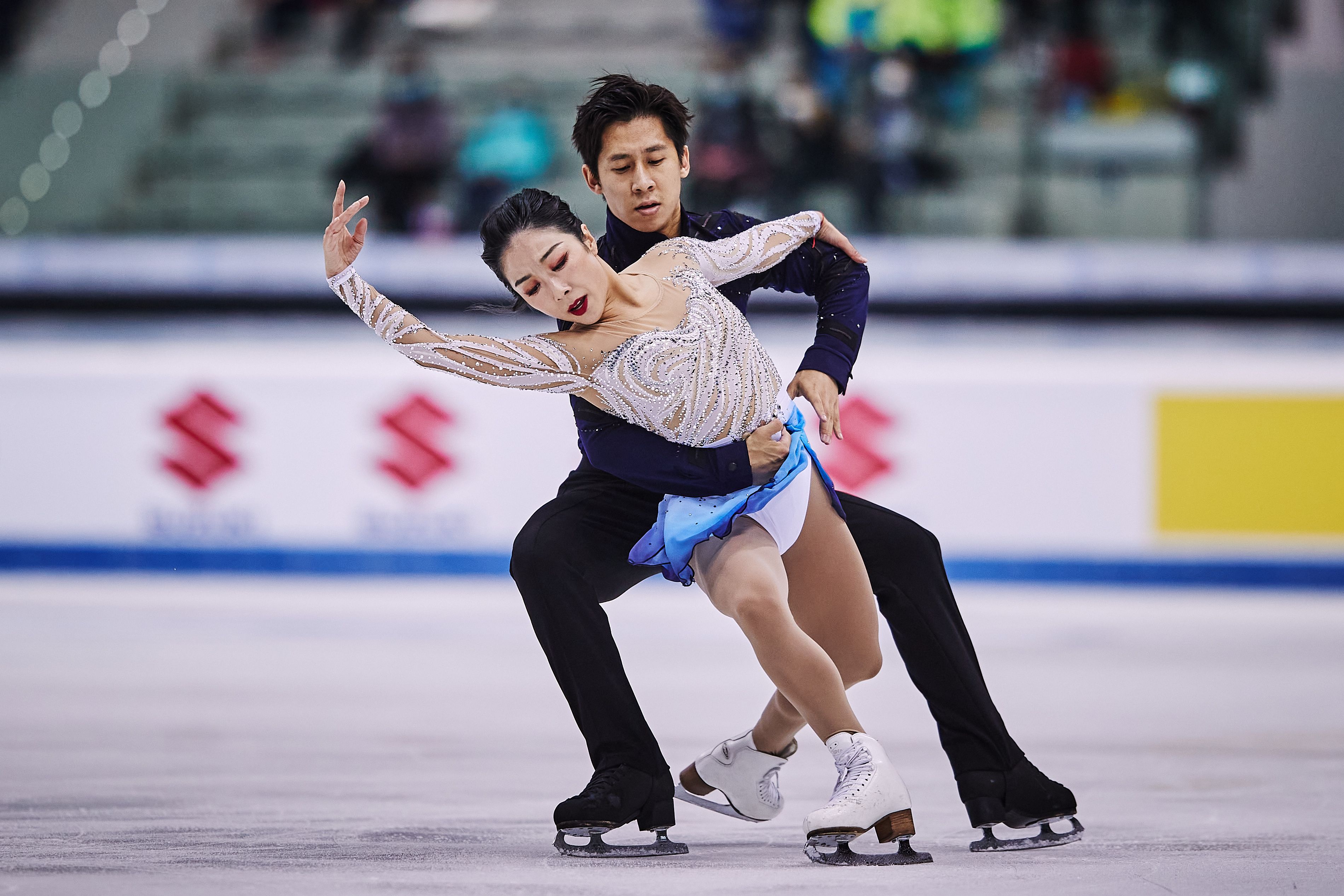
Figure skating pair Sui Wenjing and Han Cong won a silver medal in Pyeongchang in 2018 (you can watch that performance here), and this year they're hoping for gold.
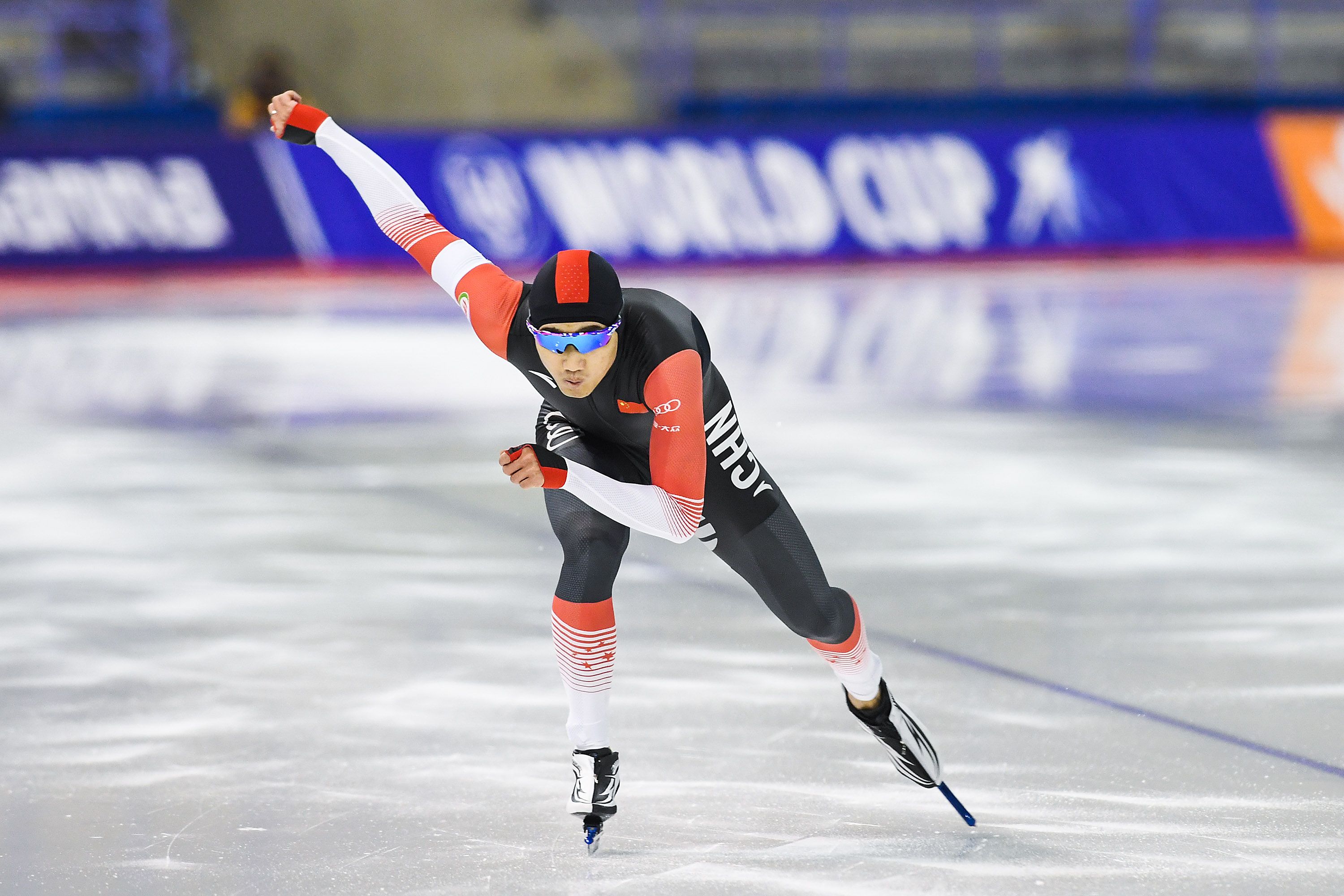
Gao Tingyu won both a gold and silver in speed skating at the 2021 World Cup, and in 2018, he became the first male Chinese speed skater to win an Olympic medal, claiming the bronze in the men's 500 meters.
5. The Omicron Olympics face the ultimate test

Photo illustration: Brendan Lynch. Photo: Jean Catuffe/Getty Images
Health experts are worried the Beijing Olympics face the perfect conditions for a COVID outbreak, due to the lightning-fast spread of Omicron, vaccines' weakened protection against the variant, and a mentality that the Games must go on in spite of the risks, Axios' Tina Reed reports.
The big picture: These Games boast a "closed-loop system" that has been called the strictest ever created for a global sporting event.
State of play: Omicron is still spreading fast, and now there are new warnings of an even more contagious version of the variant.
Details: As with the Summer Olympics in Tokyo, a playbook released by the IOC lays out a COVID safety strategy that stretches from well before an athlete's departure to the Games to their trip back home.
- Similar to Tokyo, individuals must test negative to enter China, must wear masks in public areas, and are told to socially distance, practice hand hygiene and get tested for COVID daily.
- But at these Games, China is also requiring vaccinations or quarantine for 21 days after arrival. Delegations have been told to use higher quality respirator masks, such as N95s or KN95s.
- Locals working within the closed-loop system won't be able to return to their homes until they've been quarantined. Even trash will be held in isolation.
6. COVID may reduce China's Olympic prestige

Photo Illustration: Shoshana Gordon/Axios. Photo: Carl Court/Getty Images
COVID is likely to cause a decline in the viewership, fanfare and prestige usually associated with hosting the Olympics.
The big picture: Empty stadiums, a ban on foreign visitors and a COVID-powered migration among global viewers away from TV to streaming is likely to reduce the attention Beijing was hoping to garner from the Games.
Details: China's strict zero-COVID policy has led the country's officials to prohibit foreign spectators, as well as most Chinese fans.
- The closed-loop system will isolate all Olympic participants and personnel from local residents.
- Some governments have said they won't be sending delegations of officials due to COVID.
The Chinese government planned to use the Olympics for the global debut of its new state-backed digital currency, and it pressured McDonald's, Nike and other big-name brands to accept payments in the new currency during the Games.
- But the lack of foreign visitors and the isolation of Olympic participants will put a dent in the high-profile rollout Beijing had intended.
- The digital yuan will still be one of just three payment methods that foreign athletes can use at Olympic venues.
Background: U.S. TV viewership of the Tokyo Olympics last year suffered as many U.S. viewers switched to streaming platforms like Netflix and Hulu during the pandemic. NBC, which has U.S. rights to broadcast the Olympics, still primarily relied on TV for its Olympic broadcast, and its new platform Peacock, the only streaming platform to show the Olympics, did not attract many viewers.
- The lack of fans in the stands and the accompanying cheering and sense of shared experience also reduced excitement among viewers.
- It also eliminated what is usually one of the most important and viral shots from the Olympics, the video of family members of athletes sitting in the stands and then reacting to their athlete's victory.
To address these issues at the Beijing Olympics, NBC will simulcast athletes' family members watching from home in hopes of catching moments of joy and excitement.
- The company has also made it easier to watch the Games on Peacock.
What to watch: Tokyo was the first TikTok Olympics. In Beijing, viral TikTok videos from athletes may help bring back some of the viewership and excitement.
7. 1 fun thing: Happy Lunar New Year from space!
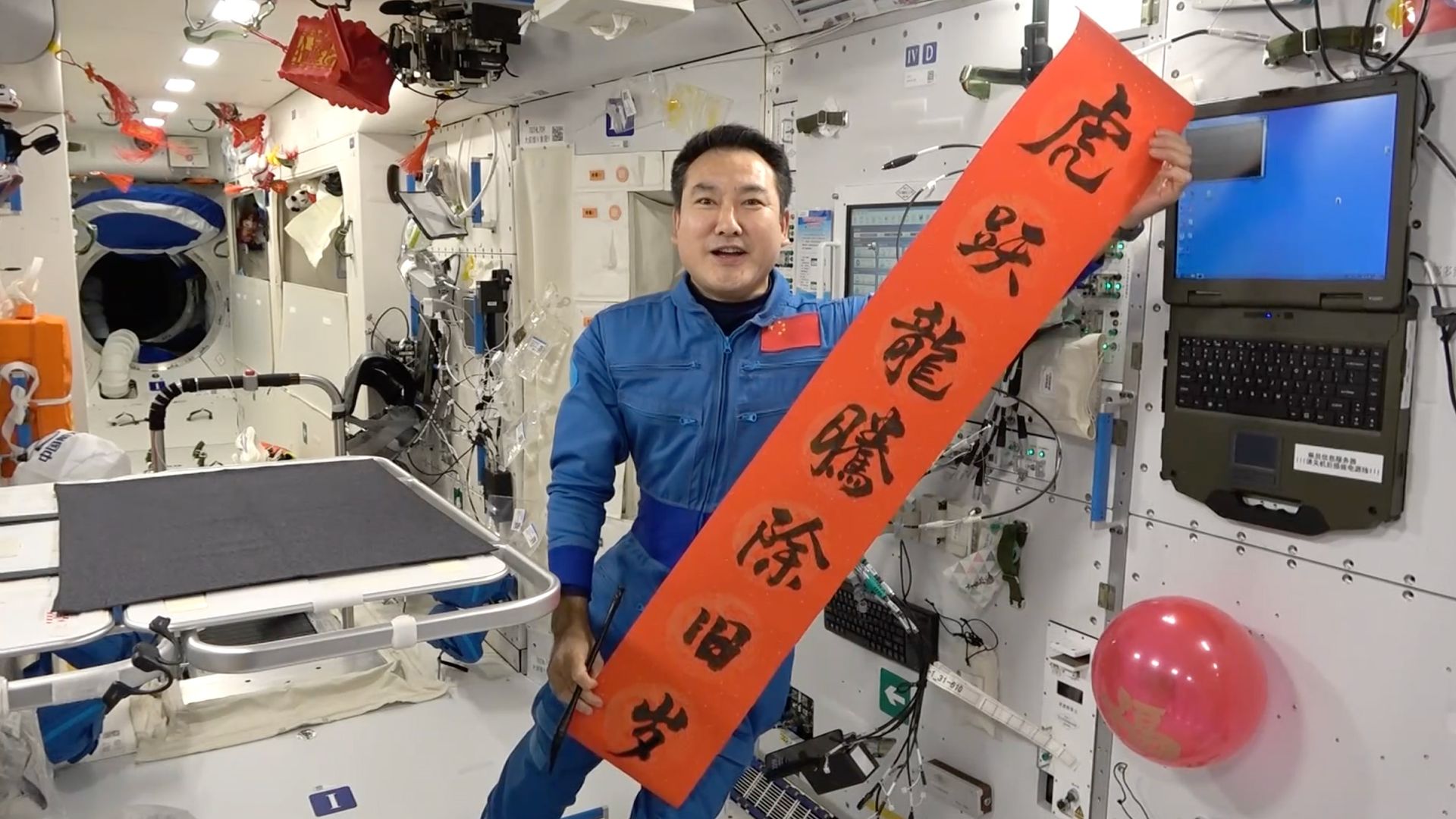
Taikonaut Zhai Zhigang, commander of the Shenzhou-13 mission, offers good wishes for Spring Festival. Photo: Xinhua via Getty Images.
The crew of China's space station, the Shenzhou-13, became the first Chinese taikonauts to celebrate the lunar new year in space.
Happy Year of the Tiger!