Axios China

March 15, 2022

Welcome back to Axios China. Today we're looking at Europe's changing view of China, fears of a superpower proxy war, and a walkout at Cornell University after a Uyghur student spoke about the genocide in Xinjiang.
- 🎧 This morning I spoke with "Axios Today" podcast host Niala Boodhoo about Beijing's stance on Ukraine. Listen.
- Send tips and feedback my way. Email me at [email protected], or just hit reply.
Today's newsletter is 1,787 words, a 7-minute read.
1 big thing: Europe's skepticism toward China grows
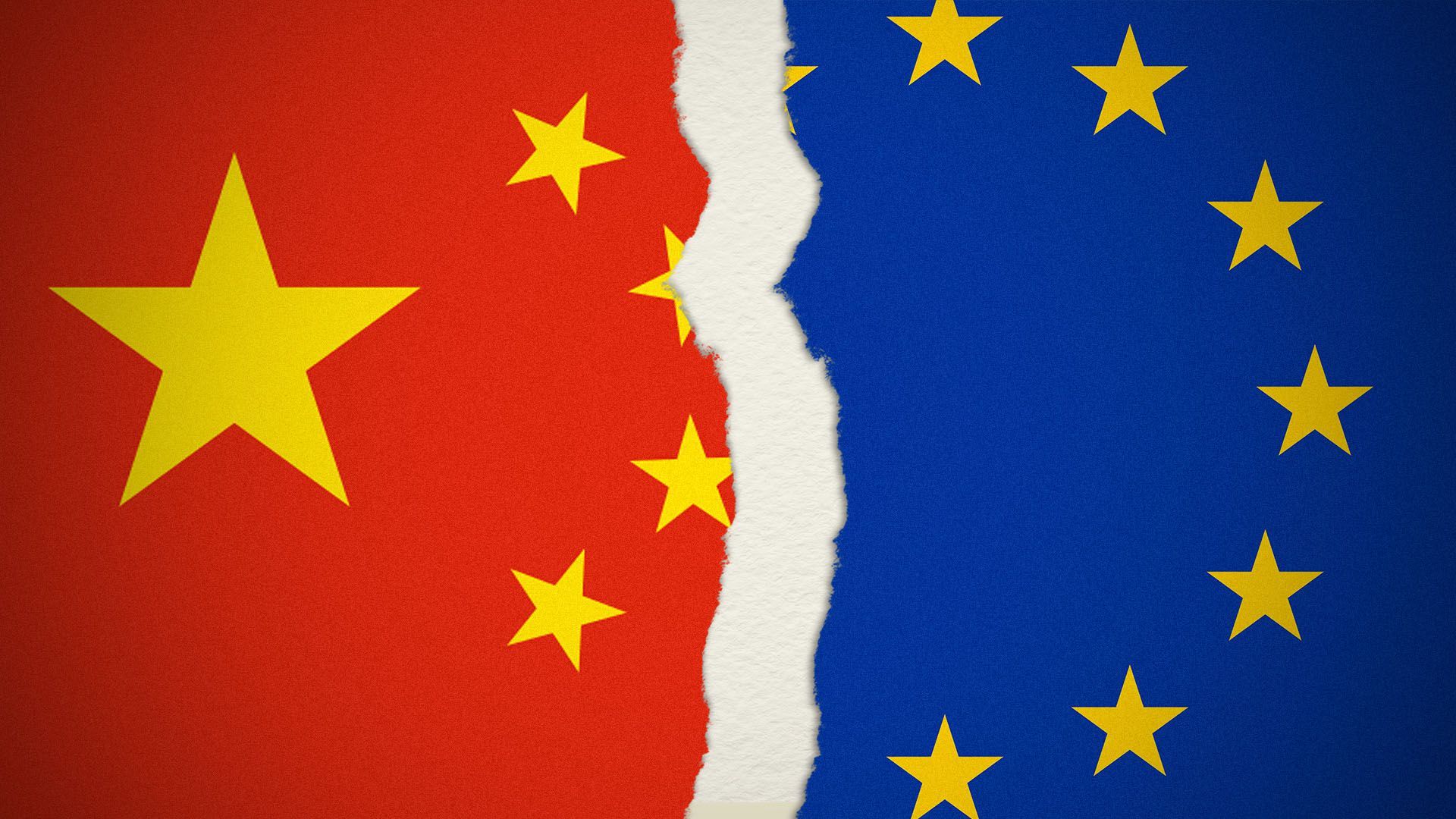
Illustration: Shoshana Gordon/Axios
Beijing's tacit support for Putin during Russia's invasion of Ukraine hasn't been lost on Europeans, who are viewing the Chinese government with growing skepticism.
Why it matters: "What we are witnessing now is a major shift when it comes to China’s relations with central Europe, and with the EU in general," said Jakub Jakóbowski, senior fellow at the China program at the Center for Eastern Studies in Warsaw.
State of play: The Chinese government has presented itself as neutral in the conflict, but Chinese officials and state media have widely disseminated pro-Russia disinformation and government censors have scrubbed the Chinese internet of pro-Ukraine views.
- Russian banks and companies are turning to China for an economic lifeline amid tough Western sanctions.
- China's abstention from the UN Security Council resolution denouncing Russia's invasion also irked Europeans, who have rallied around Ukraine.
This pro-Russia stance has accelerated a shift in Europe toward viewing Beijing not just as a trade partner but also a security concern.
- The European Commission labeled China a "systemic rival" in 2019, but the bloc has also emphasized its own strategic autonomy to distance itself from tougher U.S. policies on China.
- "For years, China was trying to present itself as a geopolitically transparent actor that has nothing to do with regional security in Europe and is only aiming at cooperation," Jakóbowski said. Now "China is certainly becoming a part of the European security landscape, though not directly, but as a Russian enabler."
- European officials and the European public now "see quite clearly that there are similarities between Russia and China," Didi Tatlow, senior fellow at the German Council on Foreign Relations, told Axios.
Yes, but: Some top European officials still believe China can play a constructive role in the conflict.
- Josep Borrell, the EU's top foreign policy official, said last week that Beijing should be the one to mediate between Russia and Ukraine, a role the Chinese government has also proposed.
Between the lines: China must balance opposing risks in its dealings with Europe and Russia, Patrik Oksanen, senior fellow at the Stockholm Free World Forum, told Axios.
- "If they support Russia too much, they will risk having a united West against them," Oksanen said."
- But "if they don’t support Russia, and Russia collapses and leaves the international arena, then the U.S. could focus its attention on China instead."
What to watch: How EU leaders translate their newfound skepticism of Beijing into policy.
2. Chinese students at Cornell "taunt" Uyghur classmate during event
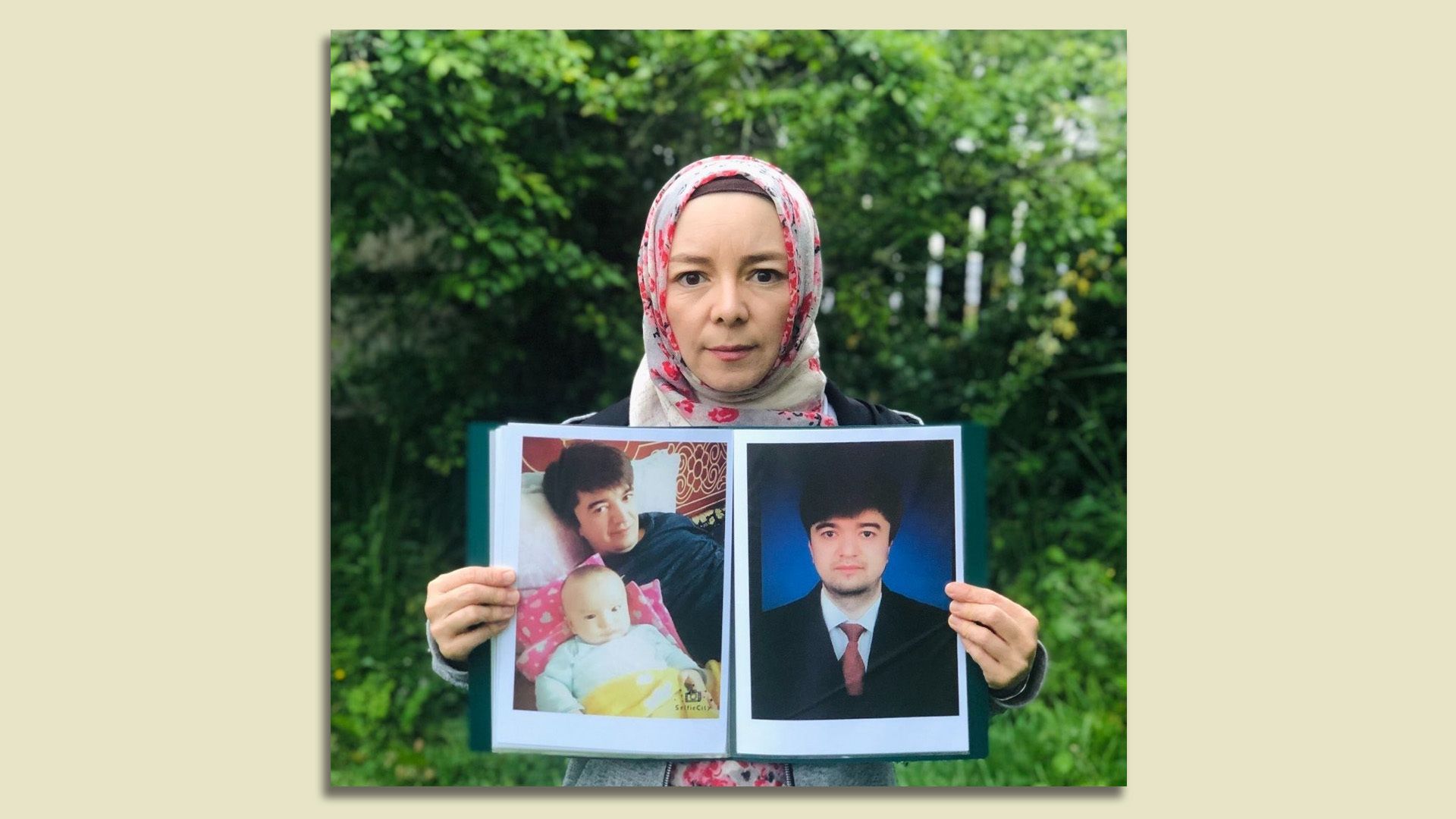
Cornell University student Rizwangul NurMuhammad holds up photos of her brother Mewlan, who has been detained in China since 2017. Photo: Rizwangul NurMuhammad
A group of Chinese international students at Cornell University booed and left an event last week in protest after a Uyghur student spoke about her brother's detention amid the Chinese government's genocide in Xinjiang.
The big picture: Uyghurs and other marginalized groups with ties to China can face intimidation, state surveillance and threats to their family members in China when they speak out on U.S. campuses about oppression by the Chinese government.
- Some Chinese international students at universities in the U.S. and Canada have reported anti-Beijing speech to university authorities as a form of anti-Chinese racism, or they reported Uyghurs and Chinese dissidents on campus to Chinese diplomatic officials.
Details: On Thursday, Rep. Elissa Slotkin (D-Mich.) spoke about her career in public service at a weekly speaker series held for students in Cornell University's Master of Public Administration program.
- During the question and answer portion of the talk, Cornell student Rizwangul NurMuhammad asked Slotkin why the U.S. and international community had reacted with great speed and resolve to punish Russia for invading Ukraine but had yet to levy a similar sanctions regime on the Chinese government for its genocide in Xinjiang.
- NurMuhammad explained that her brother Mewlan was arrested in 2017, as Chinese authorities began mass detentions of Uyghurs in Xinjiang, and that she has not been able to speak with him since then.
- Slotkin replied that while Americans have a long Cold War history with Russia and can understand the implications of Russian military aggression, Americans don't know much about China, and may not know much about the human rights violations in Xinjiang.
What happened next: "There was audible booing and jeering going on from the Chinese students partway through her question, and during the answer, they started to get up and just walked out of the room," said Pedro Fernandez, a Cornell student in the same program who was at the event.
- Multiple people present at the event described the Chinese students' reaction to NurMuhammad as "jeering," "taunts," "snickering" and "booing."
- About 40 Chinese students then walked out of the lecture hall, according to a video of the event viewed by Axios and interviews with people present.
What she's saying: "I don’t feel safe," NurMuhammad told Axios. "The walkout made me feel numb."
- The message Chinese students conveyed was, "I have to stay silent because my speech and my personal experience are not welcome to be shared in that space," NurMuhammad said, adding she will continue to advocate publicly for Uyghurs.
The response by university leadership also left her feeling "unsupported," NurMuhammad said.
- A program administrator addressed remaining students immediately after the event ended and urged them to reach out to Chinese students for reconciliation, but the university administration did not reach out to NurMuhammad to hear her perspective or inquire about her welfare.
- On Friday, the administration told students in an emailed statement "we have an expectation and responsibility to engage with viewpoints that we disagree with," but that "we must also respect that walkouts are a legitimate form of protest and an appropriate expression of disapproval."
- Cornell University declined further comment and directed Axios to the statements already sent to students.
The statement set off a chain of emails from program students who expressed outrage that the administration hadn't come out more forcefully in NurMuhammad's defense.
- "As an international student, I have been in classes where my country is used as an example of corruption and dysfunction, yet I don't take offense to reality," wrote one student in an email viewed by Axios.
- "Genocide isn’t up for debate. There is no both sides to the story," Guled Mire, a student from New Zealand and former refugee, told Axios. "I am absolutely ashamed to be a student at Cornell right now."
3. Catch up quick
1. China has ordered 51 million people into lockdown amid worst COVID surge since early 2020, ABC News reports.
2. Chinese stocks plunge as panic selling hits Tencent, Alibaba and other internet companies, Bloomberg reports.
3. Saudi Arabia invited Xi Jinping for a state visit as the two countries deepen ties, the Wall Street Journal reports.
4. UN human rights chief Michelle Bachelet will visit China, including Xinjiang, in May. Go deeper.
4. U.S. warns China against a superpower proxy war in Ukraine

Illustration: Aïda Amer/Axios
In an "intense" seven-hour meeting with China's top diplomat Yang Jiechi on Monday, national security adviser Jake Sullivan warned of "consequences" if Beijing materially supports Russia's war in Ukraine, a senior U.S. official briefed reporters.
The big picture: China is already providing its most powerful partner with tacit support, but U.S. officials are now trying to draw red lines to prevent a full-on superpower proxy war, Axios' Dave Lawler and I write.
Driving the news: The FT's Demetri Sevastopulo reports that the U.S. has warned allies in a diplomatic cable that China has "signaled its willingness" to provide Russia with weapons. Those include surface-to-air missiles, per the report.
- While China's next moves remain uncertain, fears are growing that Washington and Beijing could end up arming either side in a brutal land war — potentially escalating and prolonging it.
- Far beyond the battlefield, such a move would herald an even more adversarial era in U.S.-China relations, says Hal Brands of the Johns Hopkins School of Advanced International Studies. Sanctions and economic decoupling would "find a new gear," and the remaining hopes of a constructive relationship would evaporate.
- Beijing has denied receiving any request for weapons from Moscow, and it has not armed parties to other recent inter-state conflicts.
Between the lines: Chinese President Xi Jinping made relations with Russia a pillar of his foreign policy, and he appeared with Russian counterpart Vladimir Putin before the invasion in a show of solidarity.
- But the war is going badly for Russia on the battlefield and, in particular, in terms of global public opinion. It has united the West and placed additional focus on Taiwan. All of that is costly for Beijing.
- The costs will increase if China helps Russia evade sanctions or offers more overt diplomatic support. They will rise higher still if Xi sends weapons.
- However, Xi may calculate that he needs a strong Russia to occupy U.S. attention and that a catastrophic outcome in Ukraine could destabilize the Putin regime, Brands notes.
The bottom line: Xi's big bet on relations with Putin had been relatively low risk before now. The U.S. wants to convince him that if he doubles down over Ukraine, he'll come to regret it.
5. What I'm reading
Citizen journalist: A voice from the other China, but in Odessa (ChinaFile)
- Wang Jixian is a Chinese citizen who decided to stay in Ukraine and document for Chinese people the atrocities that Russia is committing there. It hasn't made him popular back home. His WeChat account has been suspended, and Chinese nationalists online have called for him to be deported back to China and put on trial for treason.
- "There I was going to work every day, enjoying a normal life when, out of nowhere, damn it, missiles started raining down on us. ... Why should they be bombed? It’s just that simple; it’s got nothing to do with NATO. People just want to be able to live their lives."
Dissenting opinion: Possible outcomes of the Russo-Ukrainian war and China’s choice (U.S.-China Perception Monitor)
- Hu Wei, a top research adviser at China's State Council, published this striking criticism of Beijing's current policy on Ukraine. The website has now been blocked in China.
- "China should avoid playing both sides in the same boat, give up being neutral, and choose the mainstream position in the world. ... [T]his position does not meet Russia’s needs, and it has infuriated Ukraine and its supporters as well as sympathizers, putting China on the wrong side of much of the world."
- What to watch: If Hu faces retaliation inside China for his (likely unapproved) public criticism of Xi's foreign policy choices.
Douban rectified: The decline of the last online sanctuary for China’s liberals (Quartz)
- This article from 2019 is good background for the crackdown on culture commentary platform Douban that Chinese regulators just announced.
- "[F]or years alternative thinkers found a refuge on a platform dedicated to film and book reviews that appeared to pass under the radar because of its relatively small size. Now its users fear its days are numbered."
6. 1 solidarity thing
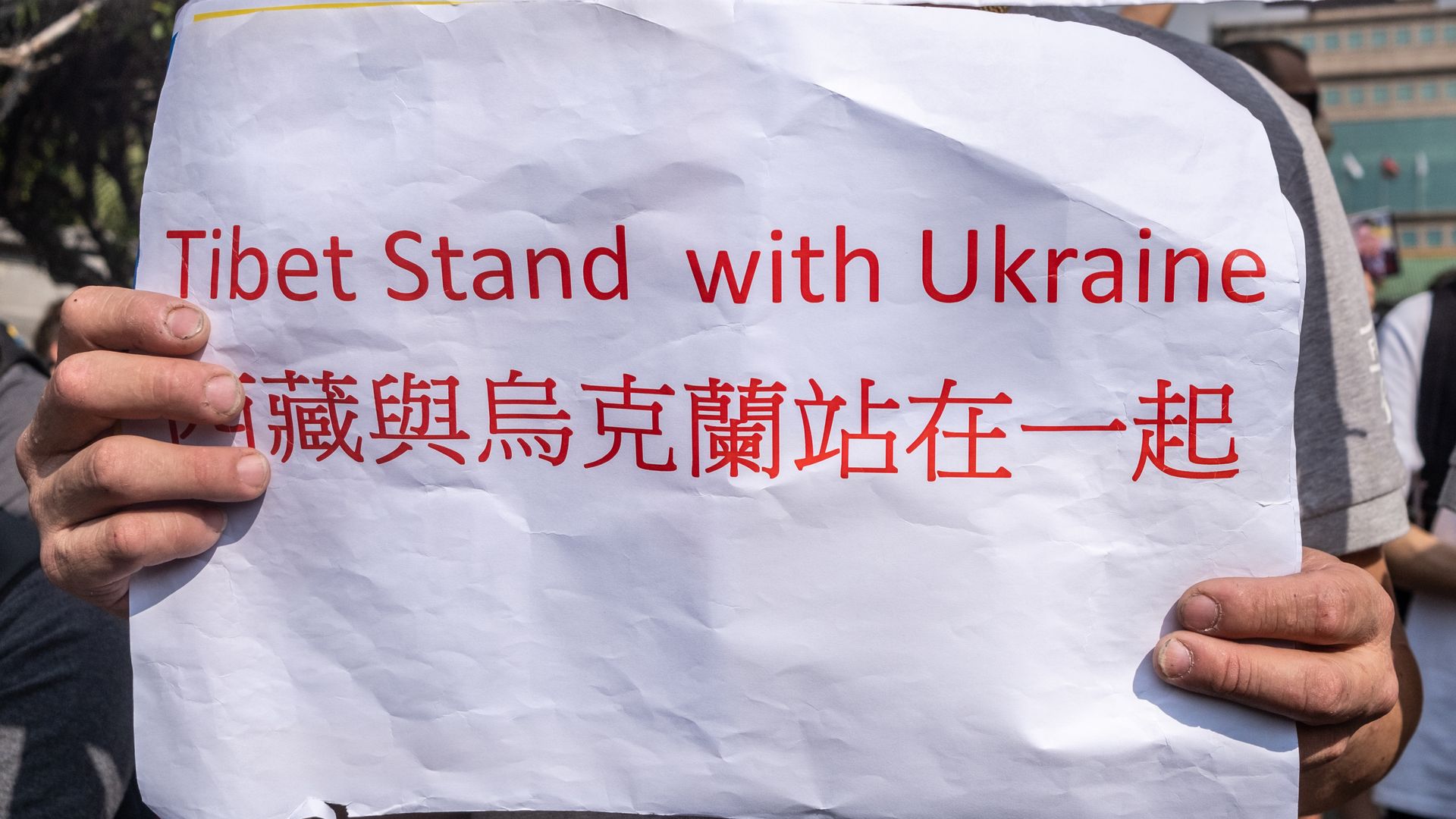
Photo: Jose Lopes Amaral/NurPhoto via Getty Images
A protester in Taipei, Taiwan, holds a sign expressing Tibetan support for Ukrainians.