Axios Chicago

June 19, 2024

Happy Wednesday! Today marks a special edition of our newsletter, dedicated entirely to the history, significance and celebration of Juneteenth.
Situational awareness: Your local reporters are off today for Juneteenth. They'll be back in your inbox tomorrow.
Today's newsletter is 972 words — a 3½-minute read.
1 big thing: Juneteenth gaining as a state holiday
Juneteenth, a once-obscure day commemorating the emancipation of enslaved people in Texas, has slowly gained official recognition across more states following the murder of George Floyd.
The big picture: Its growth comes even as some states try to limit the discussion of enslavement in public schools and resist official recognition of Juneteenth.
- The federal holiday is officially recognized in 29 states and Washington, D.C.
- All 50 states acknowledge the holiday and many receive a paid day off or can use it as a floating holiday.
Driving the news: Last month, Kentucky Governor Andy Beshear designated Juneteenth as a holiday for state executive branch workers, becoming the latest to recognize Juneteenth officially.
Flashback: President Biden signed legislation in 2021 establishing Juneteenth as a federal holiday, the first declared since Martin Luther King Jr. Day was created in 1983.
Context: Juneteenth commemorates June 19, 1865, the day Union Maj. Gen. Gordon Granger rode into Galveston, Texas, with word that President Abraham Lincoln had signed the Emancipation Proclamation more than two years before.
The New York Times' 1619 Project sparked controversy in 2019 surrounding discussions about race, particularly regarding enslavement. Efforts to recognize Juneteenth intensified following Floyd's killing during the 2020 summer of unrest.
- Recent book bans in the U.S. have disproportionately focused on titles about race and the experiences of people of color.
What they're saying: Jesse Holland, associate director at The George Washington University's School of Media and Public Affairs, tells Axios that celebrating Juneteenth recognizes the positive fact that slavery ended while also acknowledging the negative reality that slavery once existed.
- "The more we know about history, the more we can avoid these situations in the future. Those who know their history are least likely to repeat it," he said.
2. Mapped: From the Emancipation Proclamation to Juneteenth


Juneteenth commemorates the day when enslaved Black people in Galveston, Texas, learned they were free 2½ years after the passing of the Emancipation Proclamation.
Why it matters: At the end of the Civil War, Texas' enslaved Black people had yet to obtain freedom.
Zoom out: By the start of the Civil War in 1861, most of the Union had abolished slavery.
- Vermont became the first colony to emancipate its Black slaves in 1777.
- Pennsylvania, Connecticut, Rhode Island, New York, and New Jersey introduced gradual abolition from 1780 to 1804, leading to full emancipation by 1865.
- Slavery was abolished in the federal territories in 1862.
- President Abraham Lincoln issued the Emancipation Proclamation on Jan. 1, 1863.
Between the lines: Enforcement of the Proclamation was neither instantaneous nor easy in the Confederacy.
- The Proclamation wasn't enforced in slaveholding border states such as Missouri and Maryland or in Union-occupied Tennessee.
- Union victories, recruitment of contraband Black men and women, and direct intervention by soldiers were some of the many ways the Proclamation was enforced.
Zoom in: By the end of the war, Texas' estimated 250,000 enslaved people remained out of the Proclamation's reach.
- On June 19, 1865, Union Maj. Gen. Gordon Granger ordered the final enforcement of the Emancipation Proclamation in Galveston, Texas.
- Soon after, his General Order No. 3 circulated in newspapers and through word of mouth to freed slaves across Texas.
3. Juneteenth's growing popularity spurs commercial boom

Juneteenth is now a federal holiday, and like all other holidays, it can be a chance to make a few dollars — a trend that worries advocates.
The big picture: From Juneteenth sales of makeup products to department store specials, some fear the holiday's message could be lost like Memorial Day in a sea of mattress discounts.
State of play: The rapid commercialization of Juneteenth comes as some states pass laws limiting the discussion about enslavement in public schools and as some GOP lawmakers press for the return of Confederate monuments.
Zoom in: Long before it became a trendy day elsewhere, Juneteenth was celebrated in Houston and Galveston to commemorate General Order No. 3.
Context: The popularity of Juneteenth and the racial reckoning after George Floyd's murder in 2020 led several cities and states to rethink how they commemorate difficult chapters of American history, including slavery.
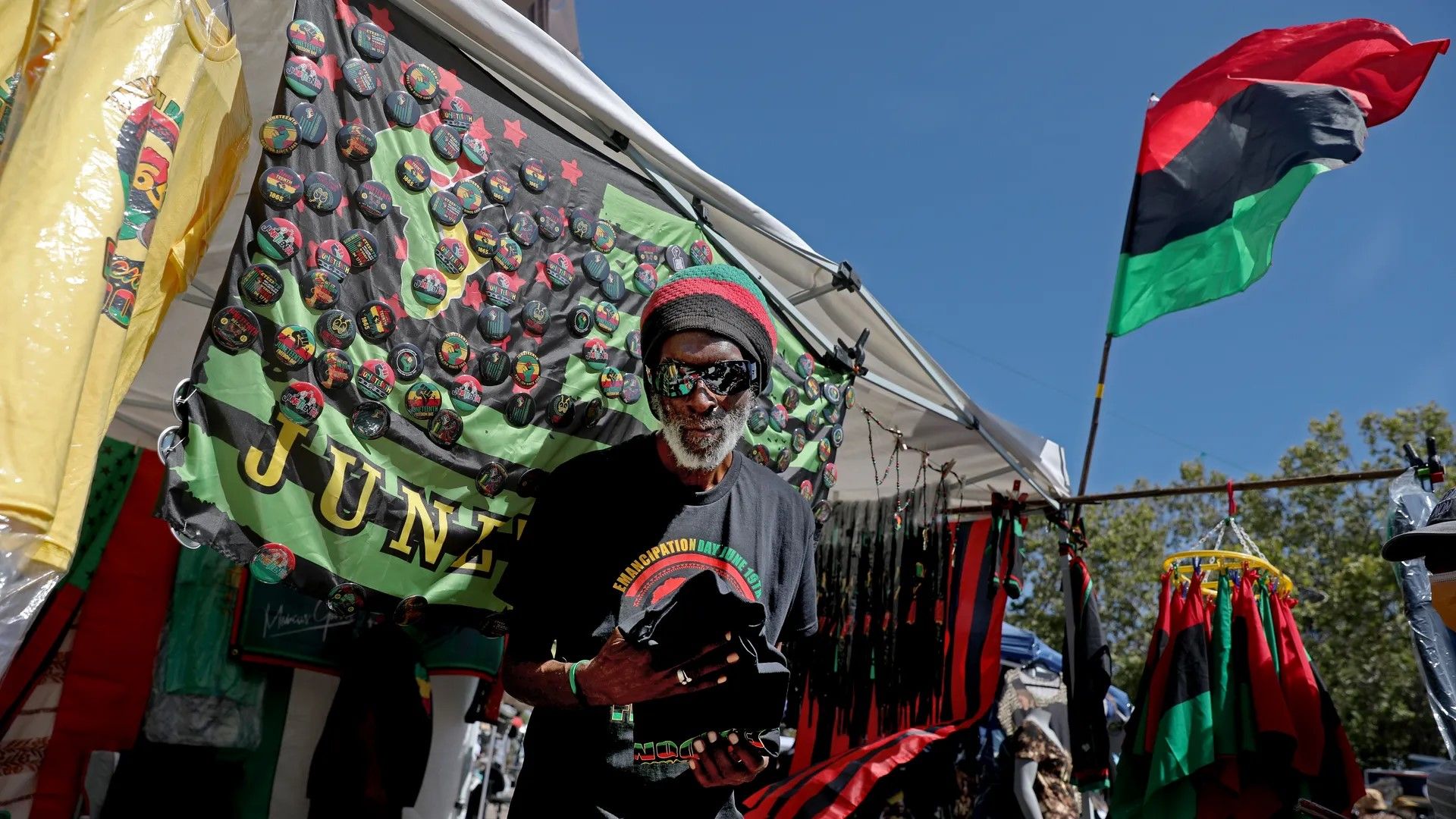
Yes, but: The celebrations saw vendors coming out to hawk Juneteenth-themed shirts, earrings, flags, bandanas, jewelry and toys.
- "The language of the United States is money and capitalism," Augusta, Georgia-based criminal defense attorney Keith B. Johnson tells Axios.
The intrigue: Commercialization goes beyond Juneteenth and even seeks to make money off the story of enslavement.
Case in point: CNBC Business News senior editor Lori Ann LaRocco recently wrote a book with her daughter, Abby Wallace, on four Black families and their links to enslavement. She says proceeds will fund a college book stipend for descendants of enslaved people.
The bottom line: By becoming a federal holiday and moving away from its epicenter, it risks transforming into another day off with passing references to enslavement while searching for a deal on a new dishwasher.
4. Celebrate through food
Juneteenth's food traditions are a way to bind generations in remembrance of trauma and celebration of emancipation.
Zoom in: Red has become a key color for Juneteenth meals, to celebrate resilience — watermelon salad, red velvet cake and strawberry soda or hibiscus tea are common items at Juneteenth gatherings.
What they're saying: "The practice of eating red foods … may owe its existence to the enslaved Yoruba and Kongo brought to Texas in the 19th century," culinary historian Michael Twitty once observed in his Afroculinaria blog.
- "For both of these cultures the color red is the embodiment of spiritual power and transformation. Enslavement narratives from Texas recall an African ancestor being lured using red flannel cloth, and many of the charms and power objects used to manipulate invisible forces required a red handkerchief."
Go deeper: Texas-based Joi Chevalier, the executive director of The Cook's Nook, thinks of family reunions in local parks and memories of "shoebox meals" on Juneteenth.
- Read our full interview with Chevalier here.
Thanks for reading this special edition today. Please share with a friend!
And thanks to our editor Emma Way and copy editor Bill Kole.
Sign up for Axios Chicago


/2024/06/17/1718647990270.gif?w=3840)