Axios AM

July 01, 2025

🎆 Happy Tuesday, and welcome to July!
- Smart Brevity™ count: 1,925 words ... 7½ mins. Thanks to Noah Bressner for orchestrating. Copy edited by Bryan McBournie.
⏰ Overnight Senate marathon: At 6 a.m. ET, the Senate is beginning Hour 21 of its vote-a-rama on President Trump's budget bill — with the outcome very much in doubt, report Axios' Hans Nichols and Stephen Neukam, who took turns staying up all night.
- It may come down to Sen. Lisa Murkowski (R-Alaska), who strolled out of Senate Majority Leader John Thune's office shortly before 4 a.m., without giving any indication she'd gotten to aye.
🦾 In the 4 a.m. hour, an amendment to remove the 10-year moratorium on state regulation of AI passed 99-1, with only Sen. Thom Tillis (R-N.C.) opposed.
- Stripping the 10-year ban, which is in the House version, is a defeat for big AI companies, which want to avoid a patchwork of state laws.
1 big thing: Trump's clean-energy grenade
Republicans in Congress are on the verge of knee-capping America's renewable energy boom, prompting urgent 11th-hour warnings from climate analysts, China hawks and industry titans like Elon Musk, Axios' Ben Geman and Zachary Basu write.
- Why it matters: Critics say President Trump's megabill amounts to an abject surrender in the battle for the future of energy. The consequences for U.S. jobs, electricity prices and the AI arms race could reverberate for decades.
The "big, beautiful bill," which would gut key Biden-era clean energy subsidies and potentially impose new taxes on solar and wind projects, could reach Trump's desk as soon as this week.
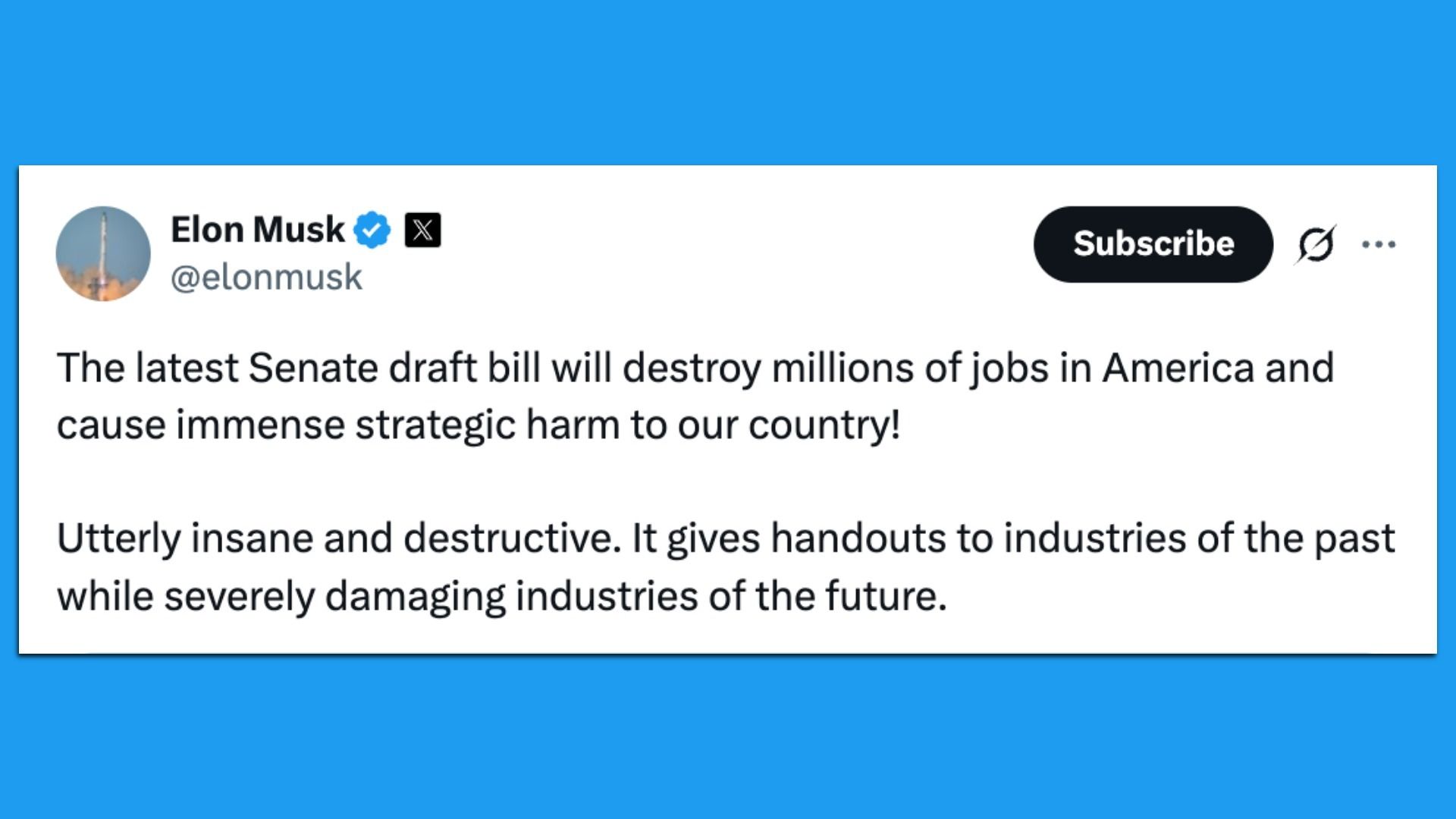
- "A massive strategic error is being made right now to damage solar/battery that will leave America extremely vulnerable in the future," Musk tweeted Sunday, after the Senate unveiled new changes to the bill.
🚨 Threat level: Jason Bordoff, who leads Columbia University's energy think tank, said the bill could hinder the U.S. in the AI race with China.
- "Winning that race is going to require that we increase electricity generation capacity in the U.S. really fast — and by a lot," he told Axios.
- That soaring demand is creating tailwinds for natural gas and nuclear, but even those "great" sources can't ramp up fast enough to meet the urgent near-term needs of data centers and AI infrastructure, Bordoff said.
The big picture: Trump has made "unleashing American energy" a pillar of his second-term agenda, casting it as central to both fighting inflation and powering the AI revolution's insatiable power demands.
- But his signature bill threatens to undercut that mission by targeting renewable energy sectors capable of delivering fast, scalable and affordable power.
Friction point: Several GOP senators led by Sen. Joni Ernst and Lisa Murkowski are negotiating to soften the bill slightly, especially by stripping out new taxes on wind and solar projects. But their amendment has not yet received a vote.
👀 What to watch: Critics and clean-energy analysts warn the policies in the GOP bill could ripple across industries, supply chains and geopolitical fault lines.
- Growth in solar, wind, electric vehicle sales, and clean tech manufacturing will likely decelerate, as investment stalls and incentives disappear.
- Tech companies will face fresh challenges meeting AI's voracious energy needs, especially as supply chains for gas-fired turbines remain backlogged into the 2030s.
Power prices may rise, with new projects delayed just as U.S. electricity demand climbs for the first time in 15 years. Wind, solar and batteries make up roughly 95% of the projects proposed to connect to the grid.
- China could widen its lead in low-carbon energy sectors that are becoming increasingly central to global power and competitiveness, even as the U.S. retreats on climate change.
Share this story ... Daniel Moore and Katie Fehrenbacher contributed reporting.
2. 🚨 New overnight: Trump threatens Musk
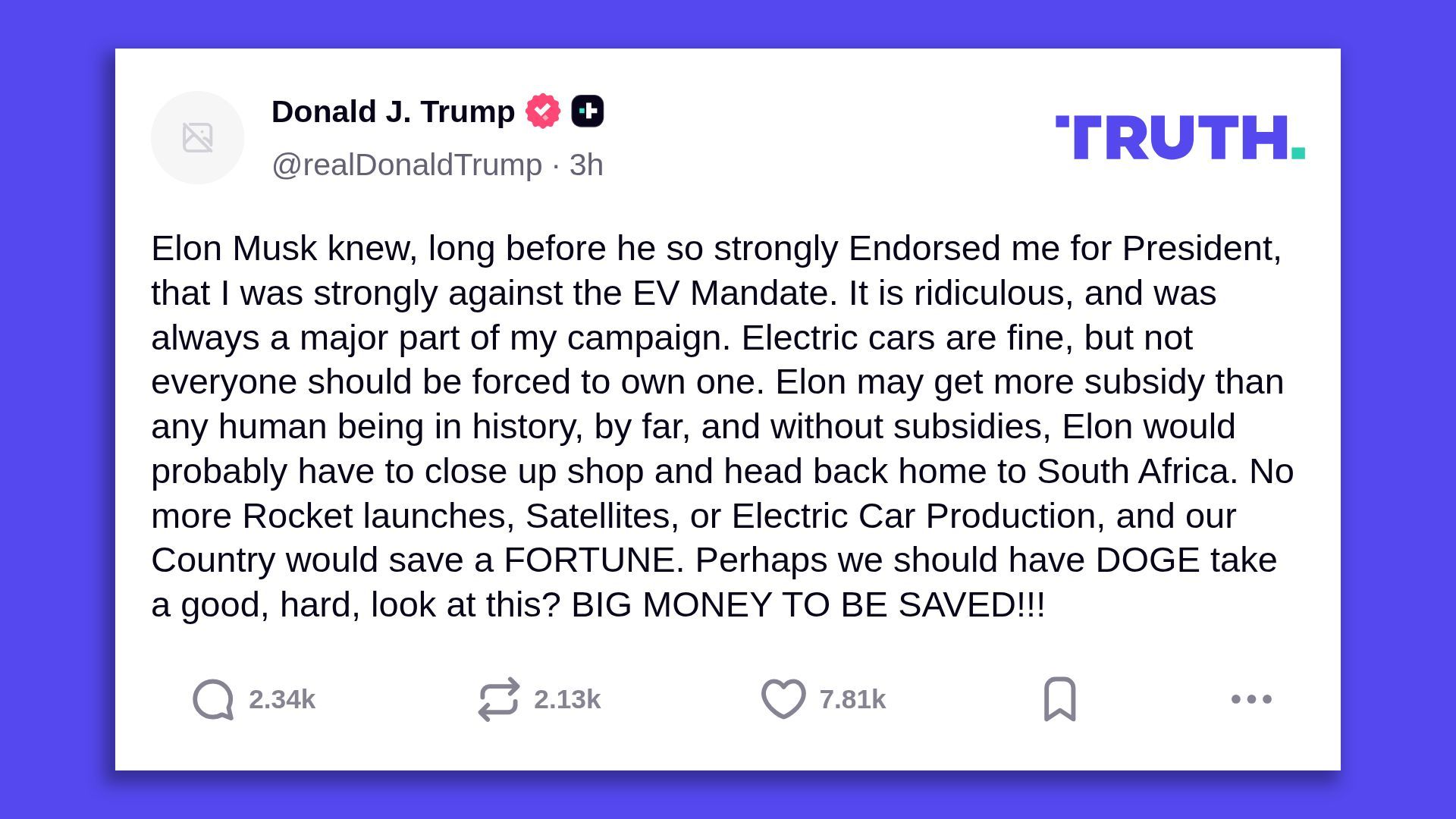
At 12:44 a.m. ET, President Trump said on Truth Social, his social media platform, that Elon Musk "may get more subsidy than any human being in history, by far, and without subsidies, Elon would probably have to close up shop and head back home to South Africa."
- Why it matters: It's a dramatic reignition of the powerful men's feud, which had gone quiet for a few weeks until Musk poked the bear Saturday by attacking Trump's megabill, as you saw in the item above.
Trump threatened to sic DOGE, the savings-hunting Department of Government Efficiency that Musk led before leaving the administration at the end of May, on Musk's businesses, including Tesla and SpaceX.
- On his own platform, Musk retweeted several posts with screenshots of Trump's threat, and replied: "I am literally saying CUT IT ALL. Now."
💡 Context: Musk's businesses include rocket company and government contractor SpaceX, which has about $22 billion in federal contracts, and its satellite unit Starlink, Reuters notes.
- Musk's rift with Trump also caused volatility for Tesla, with shares of the electric car company losing about $150 billion in market value on June 5, the largest single-day decline in the company's history, though it has since recovered.
💣 Musk is amping up his threat to form a new political party to take on Republicans and Democrats.
- Half an hour before Trump's early-morning attack, Musk tweeted to his 222 million followers that 80% of 6 million respondents to his unscientific online poll had voted in favor of "a new political party in America that actually represents the 80% in the middle."
3. 🏛️ Moderates flee Congress
Congress has gotten so miserable that the traditional "I'm sad to leave" has now become "not a hard choice" to retire, Axios' Justin Green writes.
- Why it matters: Exhausted lawmakers are choosing retirement over bipartisan dealmaking that their own parties clearly don't want.
Sen. Thom Tillis (R-N.C.) announced his retirement on Sunday by saying: "I haven't exactly been excited about running for another term. It's not a hard choice, and I will not be seeking re-election."
- Tillis capped off his retirement day by savaging the "big, beautiful bill" for its cuts to Medicaid and renewable energy tax credits.
- Rep. Don Bacon (R-Neb.) said yesterday he won't run again. Bacon is one of just three House Republicans who won in congressional districts won by Vice President Harris in 2024.
🔭 Zoom out: Sens. Mitt Romney, Joe Manchin and Kyrsten Sinema chose to retire in 2024, citing the difficulty of getting bipartisan deals done. Keep reading.
🗳️ '26 scoop: Former North Carolina Gov. Roy Cooper (D) is leaning toward a Senate run, Axios' Hans Nichols and Stephen Neukam report.
- Why it matters: The field is essentially frozen until Cooper and Lara Trump, the president's daughter-in-law, decide if they want to be their party's nominees. Keep reading.
4. ✂️ Massive safety net cuts
The megabill slashes food and health benefits for the poorest Americans, while giving tax cuts to higher earners — blowing a hole in the nation's safety net, Axios' Emily Peck writes.
- Why it matters: Experts say the cuts could unleash a tidal wave of pain — overcrowded emergency rooms, an increase in chronic health care issues, more medical debt, and more folks going hungry.
If the massive bill is signed into law, it'd be the biggest cut to the social safety net in decades, as The Washington Post noted.
🔎 Zoom in: The bill is on track to cut 20% of spending on food stamps — also known as SNAP — with more than 2 million losing benefits, according to an estimate from the Congressional Budget Office provided to Senate Democrats.
- Cuts to Medicaid could lead to nearly 12 million people losing health insurance, according to the CBO.
- Changes to the Affordable Care Act could lead to losses for millions more. Others would face higher healthcare costs.
Between the lines: Many of the losses in Medicaid and SNAP coverage are the result of new work requirements.
- Opponents of the bill say they're actually red tape mazes that typically lead to people losing benefits, even those who are working.
- The White House and Congressional Republicans say work requirements are a common-sense way to reduce waste, fraud and abuse.
Keep reading ... What's in the bill (updated with Senate changes + latest Congressional Budget Office analysis).
5. 🐂 Charted: Bizarre bull market


The companies that drove the market higher in the first half of 2025 are not typical of bull markets, Axios' Madison Mills writes.
- Why it matters: The best-performing sectors year-to-date were industrials, communication services and financials. These are not the growth names that tend to rally in exuberant environments.
State of play: Tech was the fifth-best performing sector year-to-date, up just over 6.5%.
- Utilities — a sector that can be seen as defensive since consumers are more likely to pay their utility bills even amid economic slowdowns —outperformed Big Tech.
- Investor excitement about AI "faded during the midst of the tariff selloff in March and April," according to a note from Clark Bellin, chief investment officer at Bellwether Wealth.
6. 🤖 Tech giants play AI musical chairs
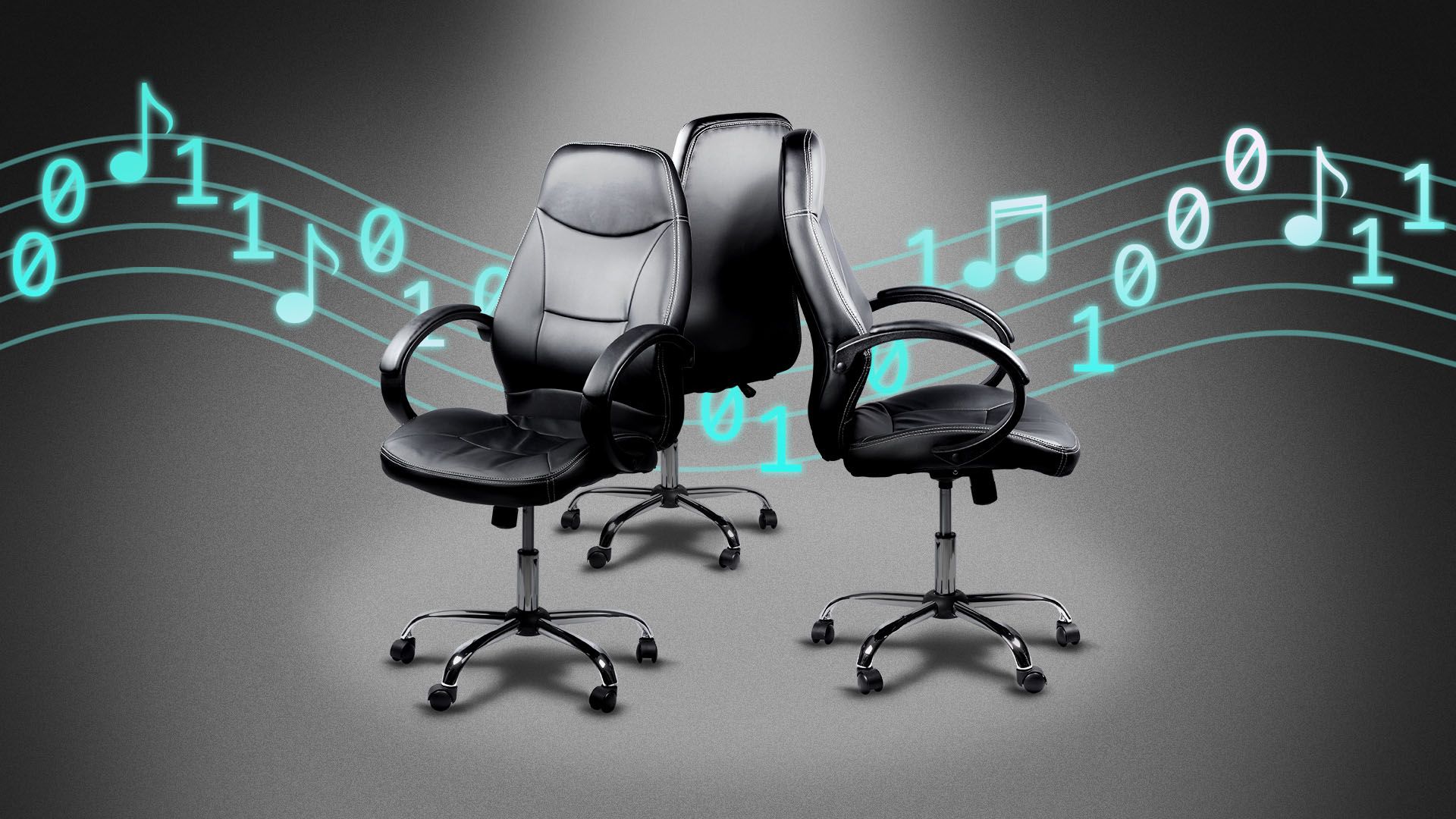
There are five consumer-tech giants — but only three leading AI foundation models, Axios' Scott Rosenberg writes.
- Why it matters: When the dealmaking music stops, someone's going to be left out.
Apple is talking with both Anthropic and OpenAI about using their foundation models to power Siri, after in-house efforts to upgrade Apple's voice assistant have faltered, Bloomberg reports.
- Once cutting edge, Siri is now a glaring anachronism in a world enthralled by the verbal and vocal agility of LLMs — and an irritating reminder to everyone at Apple of how far they've lagged behind in the voice-assistant competition.
The big picture: Every big player in tech is working on their own foundation models — the biggest and most ambitious large language models that fuel ChatGPT and all the other services at the heart of the generative AI revolution.
- OpenAI, Anthropic and Google seized the high ground early and have stayed ahead of the pack, both in scale, innovative advances and subtle refinements.
🔬 Zoom in: Most of tech's five trillion-dollar giants — Google, Microsoft, Meta and Amazon — already have a match in the foundation-model game, but there's constant movement, and the music is still playing.
- But that means Apple's choices are limited. The primary options are OpenAI and Anthropic — both of which Apple has explored partnering with, according to Bloomberg.
Apple could still decide to redouble its internal efforts instead. The company has a long history of avoiding shipping half-baked products and letting projects take as long as they need.
7. 🐊 Scoop: Byron Donalds' $22 million haul
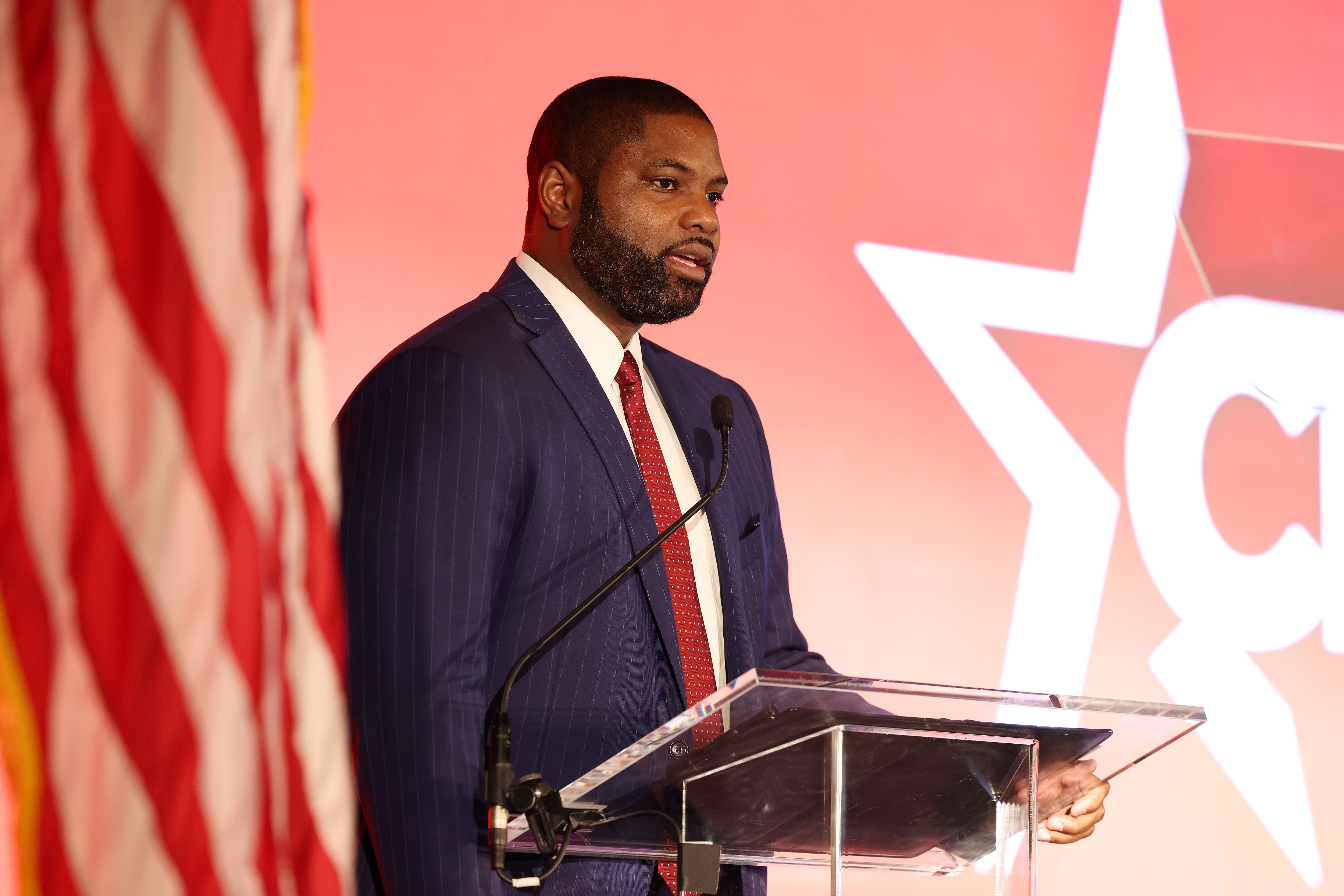
Rep. Byron Donalds (R-Fla.) has raised $22 million for his gubernatorial bid since entering the race, a sum that dwarfs any of the two dozen rivals in the race, Axios' Marc Caputo writes.
- Why it matters: The fundraising helps cement Donalds' status as the odds-on favorite to win the GOP primary in which he has a priceless asset — President Trump's endorsement.
The intrigue: Donalds will stand side-by-side at a Florida press conference today with Trump and termed-out Gov. Ron DeSantis, who has wanted his wife, Florida First Lady Casey DeSantis, to run for his office.
- DeSantis became embittered with Donalds in 2023 when the congressman didn't endorse him in his failed bid for president and instead backed Trump in his successful reelection campaign.
8. ⚽ 1 fun thing: Robot soccer

Humanoid robot soccer teams have won over fans in Beijing based more on the AI technology involved than any athletic prowess shown.
- Four teams of humanoid robots faced off in fully autonomous 3-on-3 soccer matches powered entirely by AI.

Equipped with advanced visual sensors, the robots were able to identify the ball and navigate the field with agility.
- They were also designed to stand up on their own after falling. But during the match, several had to be carried off the field on stretchers by staff.
Video footage ... Go deeper.
📬 Thanks for reading! Please invite your friends to join AM.
Sign up for Axios AM


/2025/06/30/1751323955901.gif?w=3840)