Why work requirements for Medicaid "don't work"

Add Axios as your preferred source to
see more of our stories on Google.
Work requirements for Medicaid will reduce the number of eligible Americans covered under the health insurance program, according to experts and evidence from states that imposed them.
Why it matters: Work requirements are part of a budget bill from House Republicans that would impose big cuts to the health insurance program for the poor that covers 21% of Americans.
Where it stands: The bill would require Medicaid recipients who are under 65 years old, without dependents, to confirm they are working at least 80 hours a month. Another provision requires some to certify twice a year that they qualify for insurance.
- This provision, and other changes would increase the number of people without health insurance by more than 8 million, according to the Congressional Budget Office's tally, cited by Democrats, Sunday night.
Friction point: Typically the idea behind work requirements is to make sure people aren't free-riding off of cash benefits — choosing not to work, and living off food stamps or welfare checks.
- The thing is: You can't live off health insurance — it doesn't pay the bills or provide food.
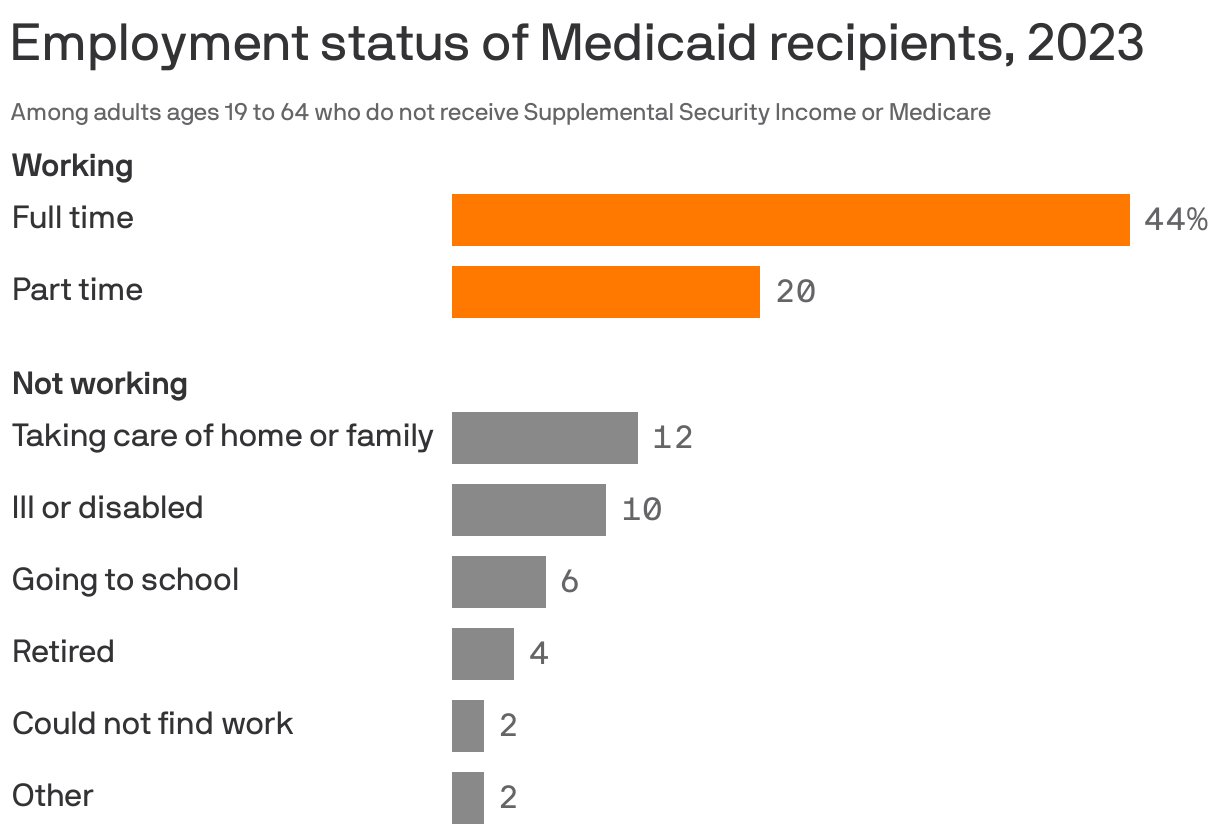
By the numbers: There's little evidence that people are somehow free-riding on Medicaid.
- 64% of adults with Medicaid work full time or part time, according to an analysis of census data by the Center on Budget and Policy Priorities.
- Another 32% are taking care of home or family, are ill or disabled, attend school, or are retired.
- 2% could not find work. And there's another 2% in an "other" category.
Zoom in: Two states have imposed work requirements on Medicaid.
- In Georgia, they were tacked on to a Medicaid expansion effort; an estimated 240,000 were expected to enroll. Instead only about 5,500 gained coverage in the first year, per a report from the Georgia Budget and Policy Institute.
- Meanwhile the state spent $13,000 per enrollee just to sign them up.
- There were similar negative results in Arkansas, where a work requirement reportedly pushed 18,000 people off of benefits in less than a year's time.
The other side: The idea is to avoid subsidizing those who choose not to work, Rep. Brett Guthrie, (R-Ky.) said in a WSJ op-ed.
- "[O]ur bill would implement sensible work requirements," he writes. "Every other capable adult works to afford healthcare."
- The legislation would include carve-outs for those who can't work, but such exemptions are often onerous to qualify for, experts say.
Between the lines: Work requirements are the big Medicaid change that people so far find most politically palatable, with a majority of adults supporting them, writes Axios' Maya Goldman.
- While President Trump has said he won't cut Medicaid, he's also said to support work requirements.
For the record: "President Trump is protecting Medicaid for every eligible American who relies on it by eliminating waste, fraud, and abuse within this program," the White House said in a statement.
- "By taking commonsense measures to strengthen Medicaid, we will ultimately improve care for those who this program is intended to serve: pregnant women, the disabled, seniors, and low-income families.
- "The President has repeatedly said that he will save Medicaid to ensure it remains a reliable and sustainable lifeline for generations to come."
Reality check: Not all Republicans are on board for this. Some want more cuts, others want less.
- Sen. Josh Hawley (R-Mo.) published a full-throated defense of the program as critical for the working poor in the New York Times on Monday.
The bottom line: Safety net programs like Medicaid are supposed to catch vulnerable Americans and keep them from falling further into poverty.
- "Work requirements don't work," says Jennifer Wagner, director of Medicaid eligibility at the Center for Budget and Policy Priorities.
