Axios AM

September 04, 2020
🍔 Happy Friday! Labor Day getaway day certainly isn't what it usually is. But wherever summer's finale finds you, wishing you and your family safety ... and smiles.
1 big thing ... Exclusive: Zuckerberg warns of "civil unrest" after election
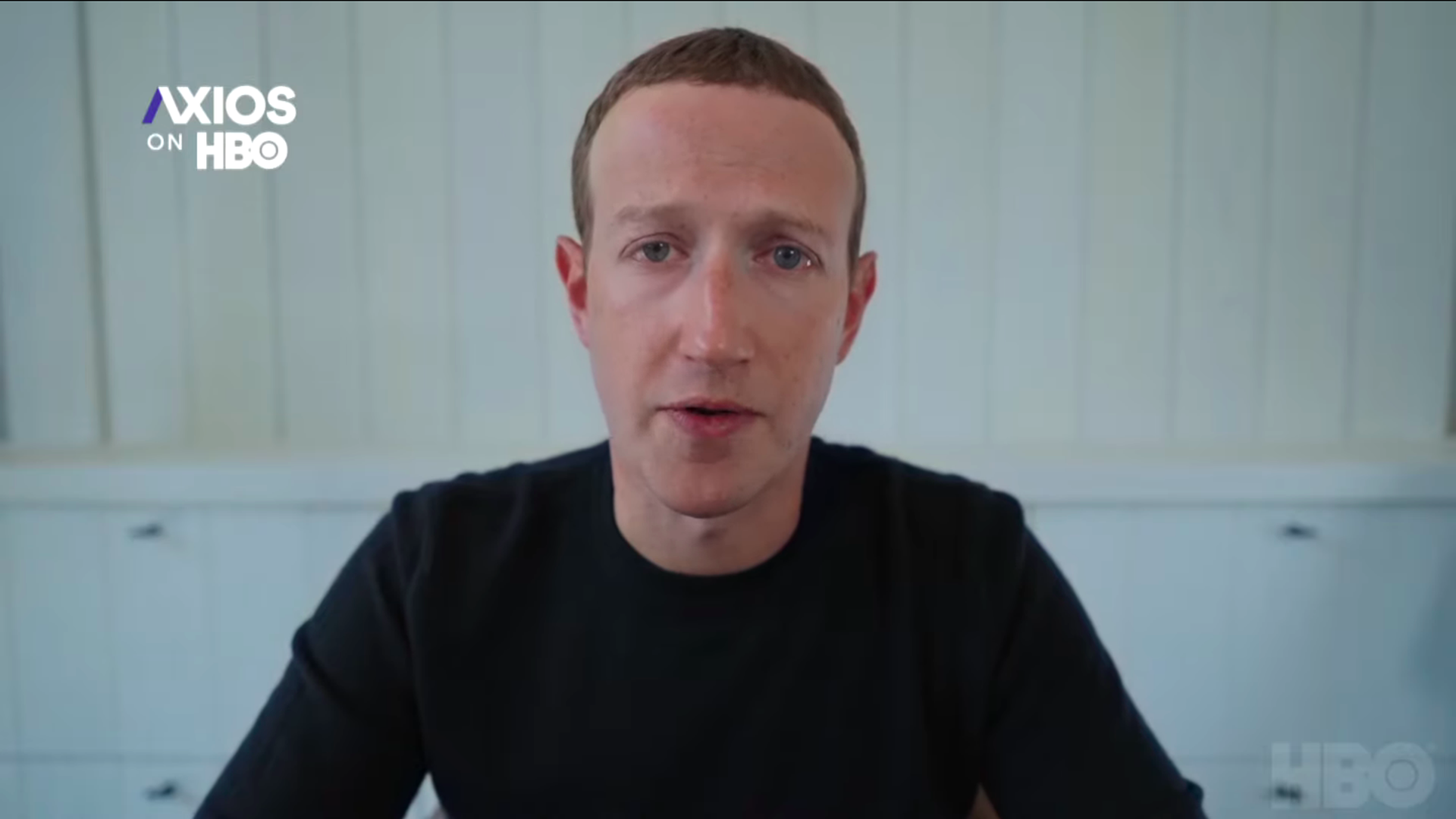
Photo: "Axios on HBO"
Mark Zuckerberg tells me for "Axios on HBO" that Facebook is imposing new election rules to deter use of the platform to spread misinformation and even violence, and to help voters see the results as "legitimate and fair."
- "There is, unfortunately, I think, a heightened risk of civil unrest in the period between voting and a result being called," Zuckerberg said in an hourlong interview Wednesday.
- "We're trying to make sure that we do our part to make sure that none of this is organized on Facebook."
🎬 Watch a clip.
- The interview airs this Tuesday, Sept. 8, at 11 p.m. ET/PT on all HBO platforms.
Zuckerberg said that since the outcome may not be known on election night, Facebook and news organizations need to start "preparing the American people that there's nothing illegitimate about this election," even if it takes "additional days or even weeks to make sure that all of the votes are counted."
- "So we're going to do a bunch of different messaging around that just to make sure that people know that that's normal."
- "I think we need to be doing everything that we can to reduce the chances of violence or civil unrest in the wake of this election."
Facebook's new measures, announced yesterday, include forbidding new ads within a week of Election Day (so the other side has time to reply), and throwing a flag on posts by candidates who claim premature victory:
- "We will attach an informational label to content that seeks to delegitimize the outcome of the election or discuss the legitimacy of voting methods, for example, by claiming that lawful methods of voting will lead to fraud," Facebook said in its "New Steps to Protect the U.S. Elections."
- "If any candidate or campaign tries to declare victory before the final results are in, we’ll add a label to their posts directing people to the official results."
2. Biden's centrist mirage
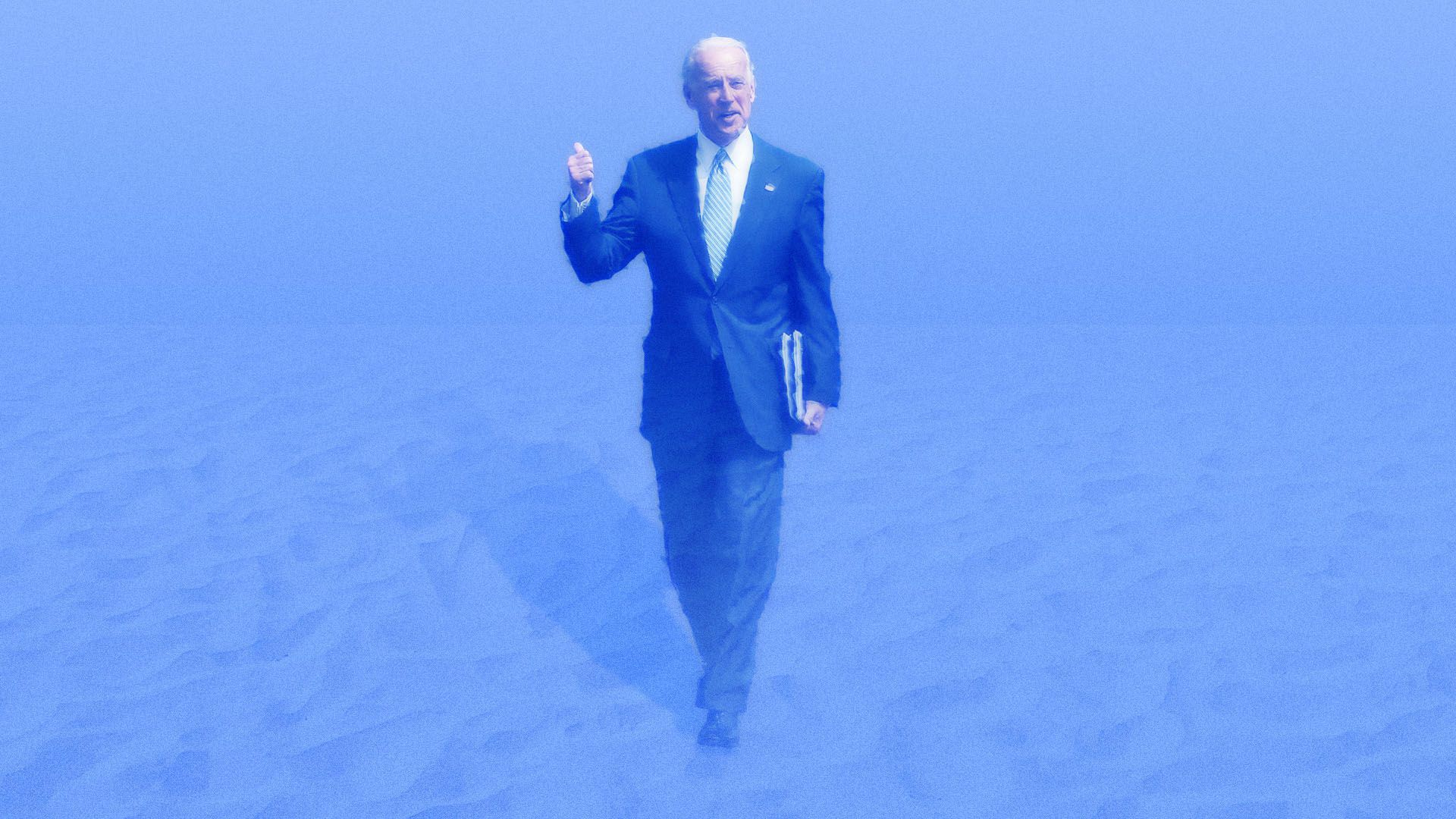
Photo illustration: Sarah Grillo/Axios. Photo: Alex Wong/Getty Images
Joe Biden spent a career cultivating the image of a deal-making centrist — and is making that a key selling point for swing voters in 2020. But the modern Biden has been pushed left by his party's insurgent progressives, Axios' Hans Nichols reports.
- Why it matters: Biden has moved to the left to accommodate party activists on crime, climate, education, immigration and health care. His central challenge with many swing voters: Prove he didn't move too far, too fast.
Biden wants many suburban voters to associate him with his persona as a white, firehouse Democrat — over a more woke 2020 primary candidate who navigated through his rivals to win his party’s nomination.
- Biden has to confront the nation's new dynamics by addressing police violence head on. At the same time, he subtly courted western Pennsylvania by saying his call in March for "no new fracking" only applied to public lands.
The bottom line: Voters are choosing between a composite of Biden that spans 48 years — or the undiluted Trump of the past four.
3. Portland suspect killed by police

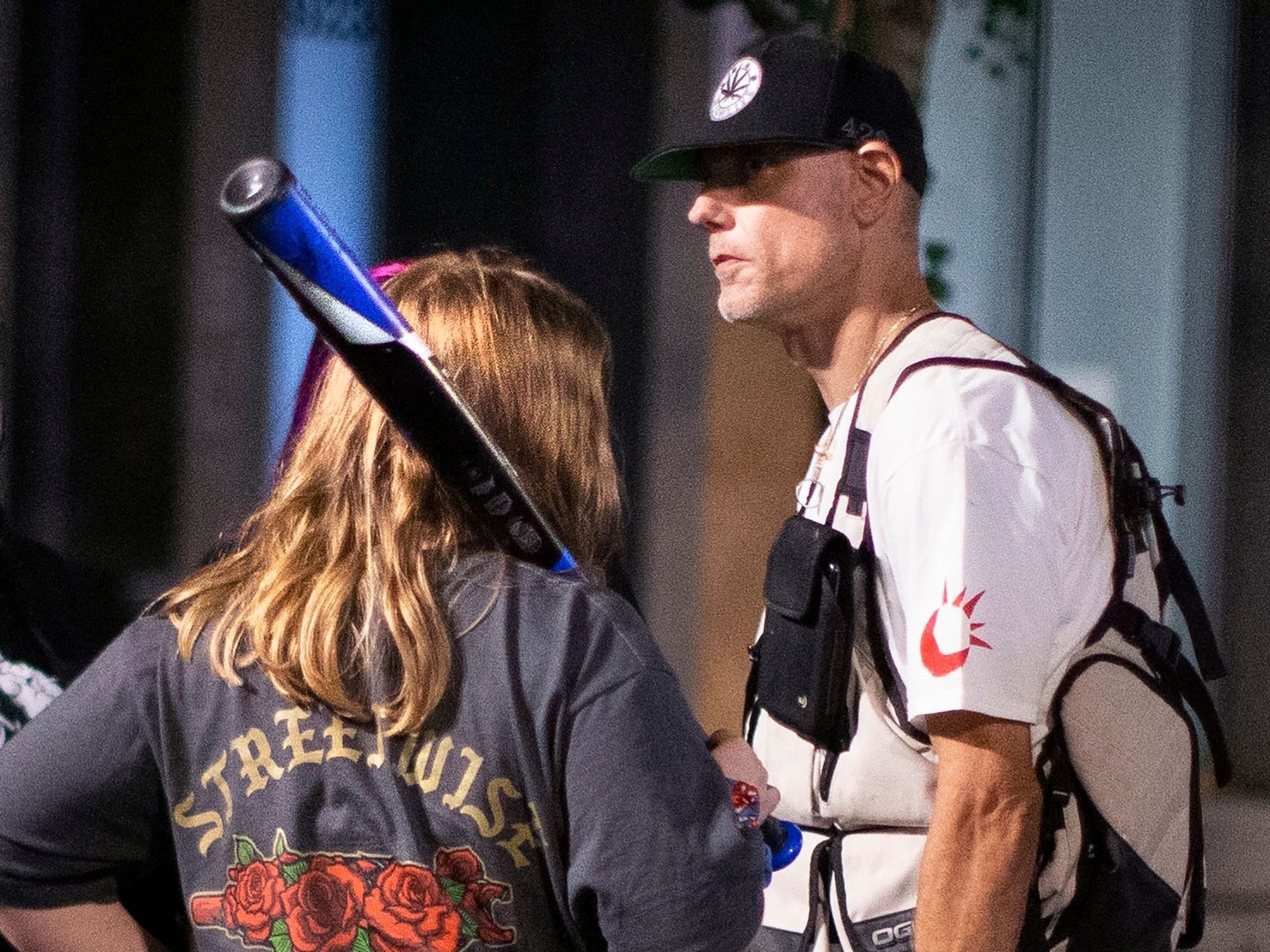
Michael Forest Reinoehl, the man wanted for killing a right-wing activist during a pro-Trump rally in Portland last weekend, was shot dead as federal law enforcement attempted to take him into custody overnight, The Oregonian's Maxine Bernstein reports.
- A U.S. Marshals Service spokesperson said that Reinoehl produced a gun during the encounter, leading federal agents to fire back.
- Reinoehl had described himself in a social media posts as "100% ANTIFA" and suggested the tactics of counter-protesters amounted to "warfare," per the AP.
4. Great battery race

Illustration: Sarah Grillo/Axios
The promise of a new generation of low-cost, long-lasting batteries is catalyzing a long-awaited shift to electric vehicles, Axios' Joann Muller reports from Detroit.
- Two big obstacles have long stood in the way: cost and driving range.
- The ultimate goal: the "million-mile battery" — one that can last 30 years and enjoy second, or even third, lives powering the electric grid.
What's next: Steady advancements in battery innovation — rather than a single breakthrough — have brought the electric vehicle industry to the cusp of widespread adoption, and it's set to kick off a whole new war among auto giants.
5. Trump goes on camera to deny Atlantic story
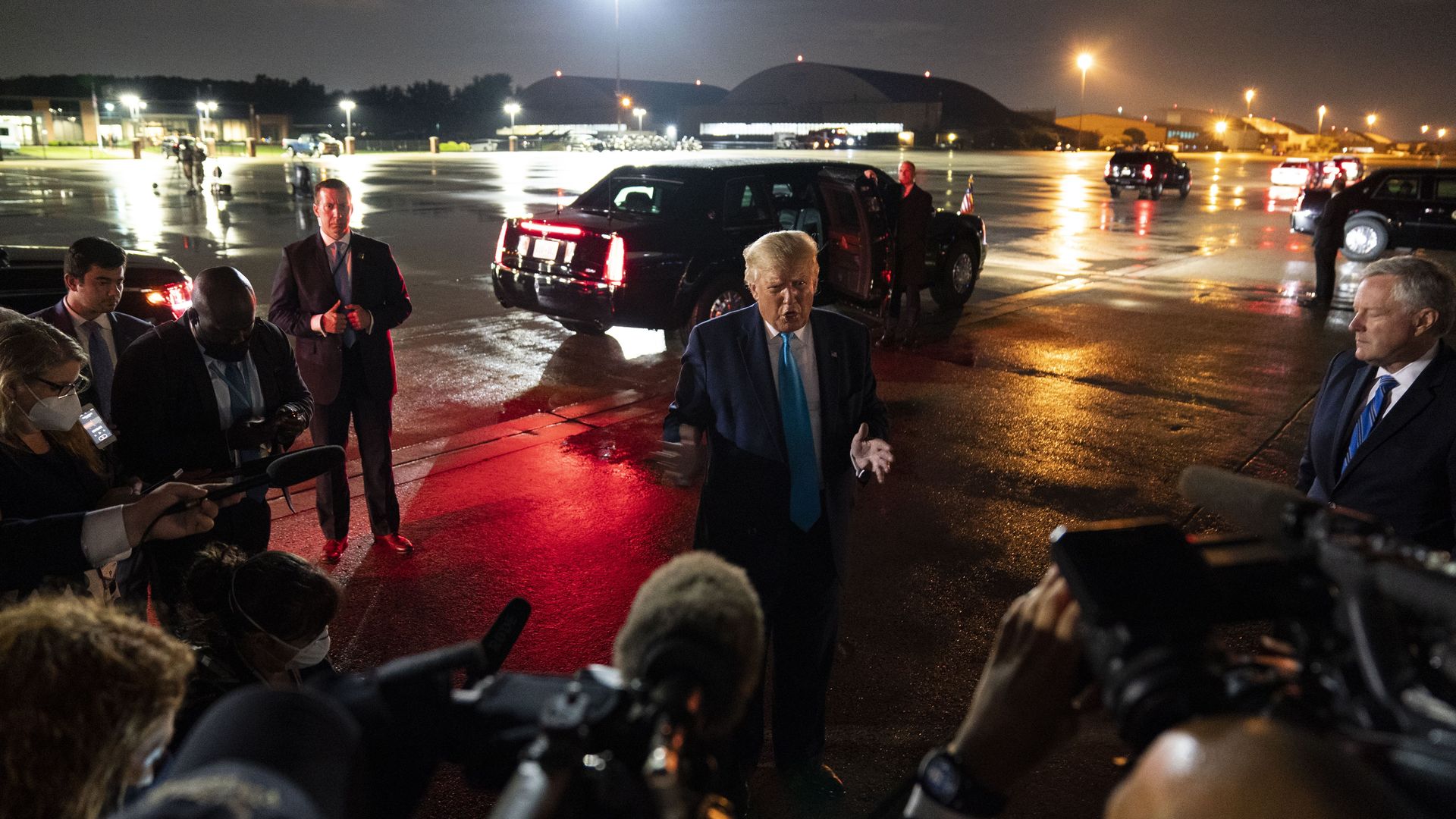
President Trump talks to reporters at Andrews Air Force Base after returning from Latrobe, Pa., last night. Photo: Evan Vucci/AP
President Trump, the White House and the Trump campaign all mobilized last night to push back on a damaging article from The Atlantic, by editor-in-chief Jeffrey Goldberg, reporting that the president "has repeatedly disparaged the intelligence of service members."
- When Trump landed at Andrews Air Force Base last night after a rally in Pennsylvania, Trump told reporters: "To think that I would make statements negative to our military and our fallen heroes, when nobody's done what I've done ... It is a disgraceful situation by a magazine that's a terrible magazine — I don't read it."
Here's a passage from Goldberg's article:
On Memorial Day 2017, Trump visited Arlington National Cemetery ... He was accompanied on this visit by John Kelly, who was then the secretary of homeland security, and who would, a short time later, be named the White House chief of staff. The two men were set to visit Section 60, the 14-acre area of the cemetery that is the burial ground for those killed in America’s most recent wars.
Kelly’s son Robert is buried in Section 60. A first lieutenant in the Marine Corps, Robert Kelly was killed in 2010 in Afghanistan. He was 29. ...
[A]ccording to sources with knowledge of this visit, Trump, while standing by Robert Kelly’s grave, turned directly to his father and said, "I don’t get it. What was in it for them?"
General Kelly declined to comment to The Atlantic.
6. Officers suspended as Rochester erupts
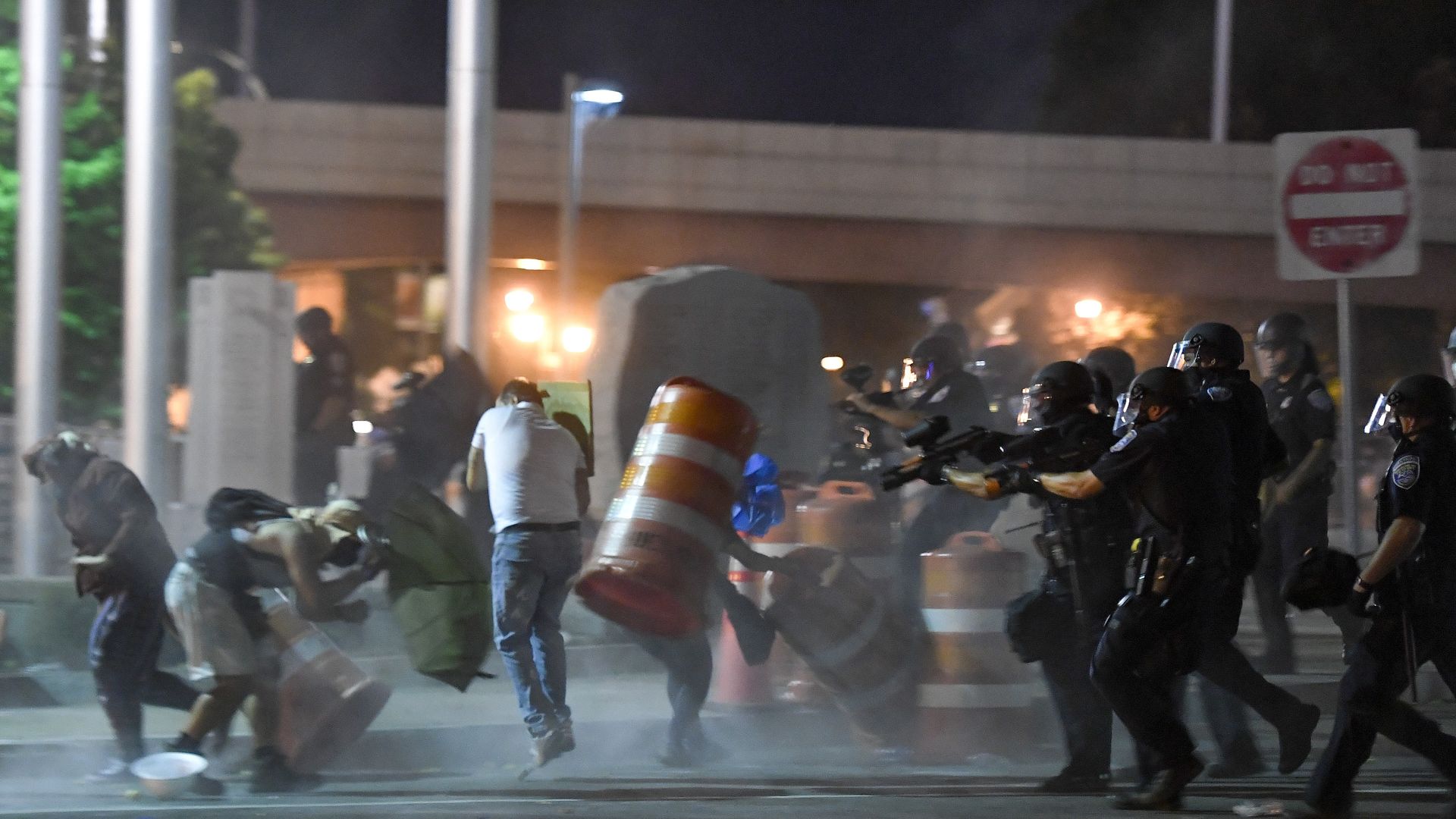
Police officers force a line of demonstrators away from the front of the Public Safety Building in Rochester yesterday. Photo: Adrian Kraus/AP
Rochester, N.Y., faced its most intense night of unrest yet over the death of Daniel Prude, a Black man, with one city council member calling the law enforcement response "unnecessarily aggressive," reports the Democrat and Chronicle's Mary Chao.
- "A mix of Rochester and New York state police fired volleys of pepper balls, and officers in helmets and face shields, carrying batons, pushed back demonstrators … some lobbing water bottles and shielding themselves with umbrellas."
Prude's March 23 death only received public attention this week after his family released body cam footage showing police officers putting a hood over his head and holding his face to the pavement for two minutes.
- Rochester Mayor Lovely Warren announced yesterday that seven police officers involved had been suspended, saying the city would "change how we deal with these situations going forward."
7. How the world sees us

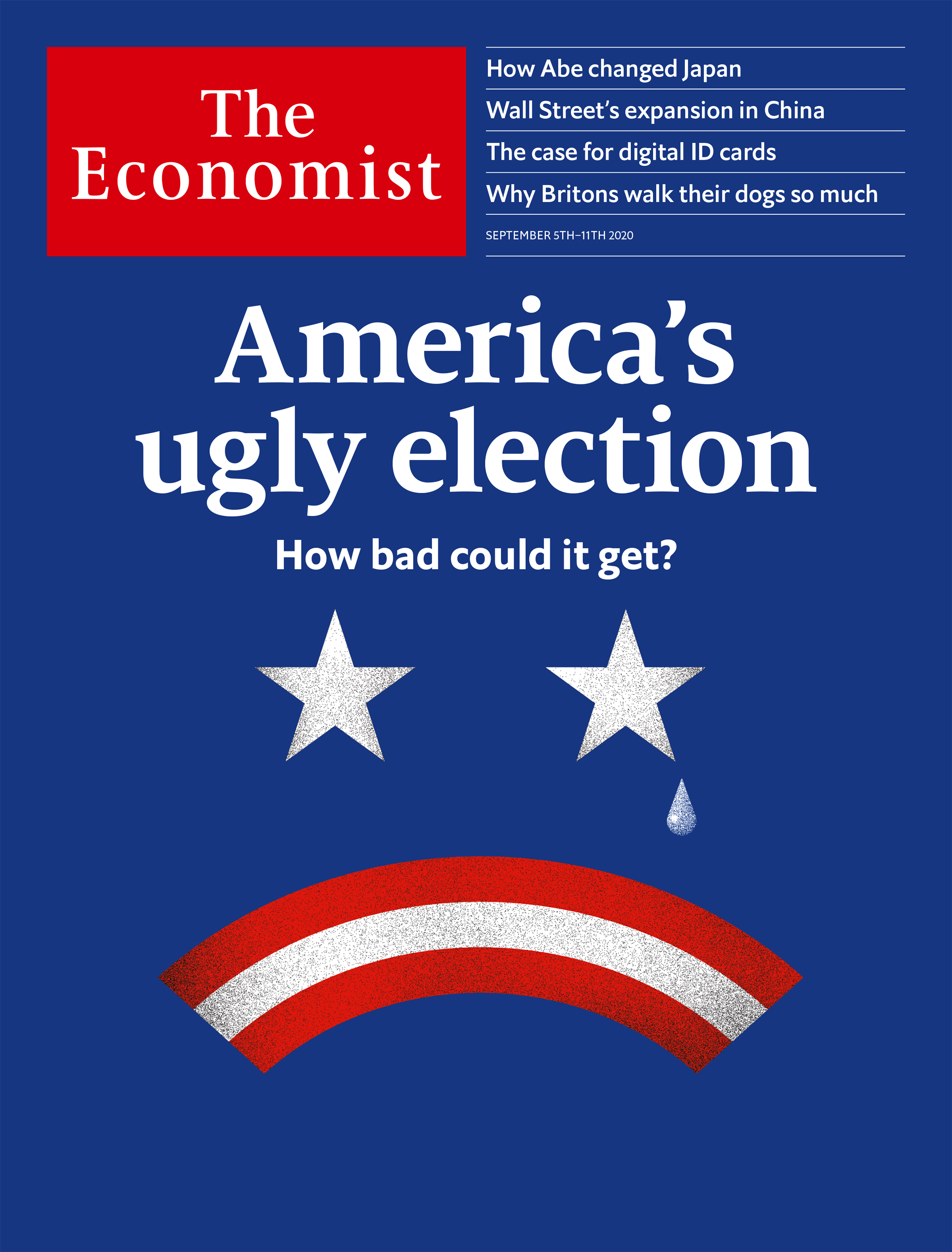
From London, The Economist writes that a "disputed result in November could be dangerous":
To ensure the peaceful handover of power, democracies need the losing candidates and most of their followers to admit defeat. ...
In the case of a landslide win for Mr. Trump or Joe Biden, about half of America will be miserable. ... In the event of a narrow one, America might not be able to generate losers’ consent. And without that, democracies are in big trouble.
8. Two-thirds of New York state restaurants say they could close
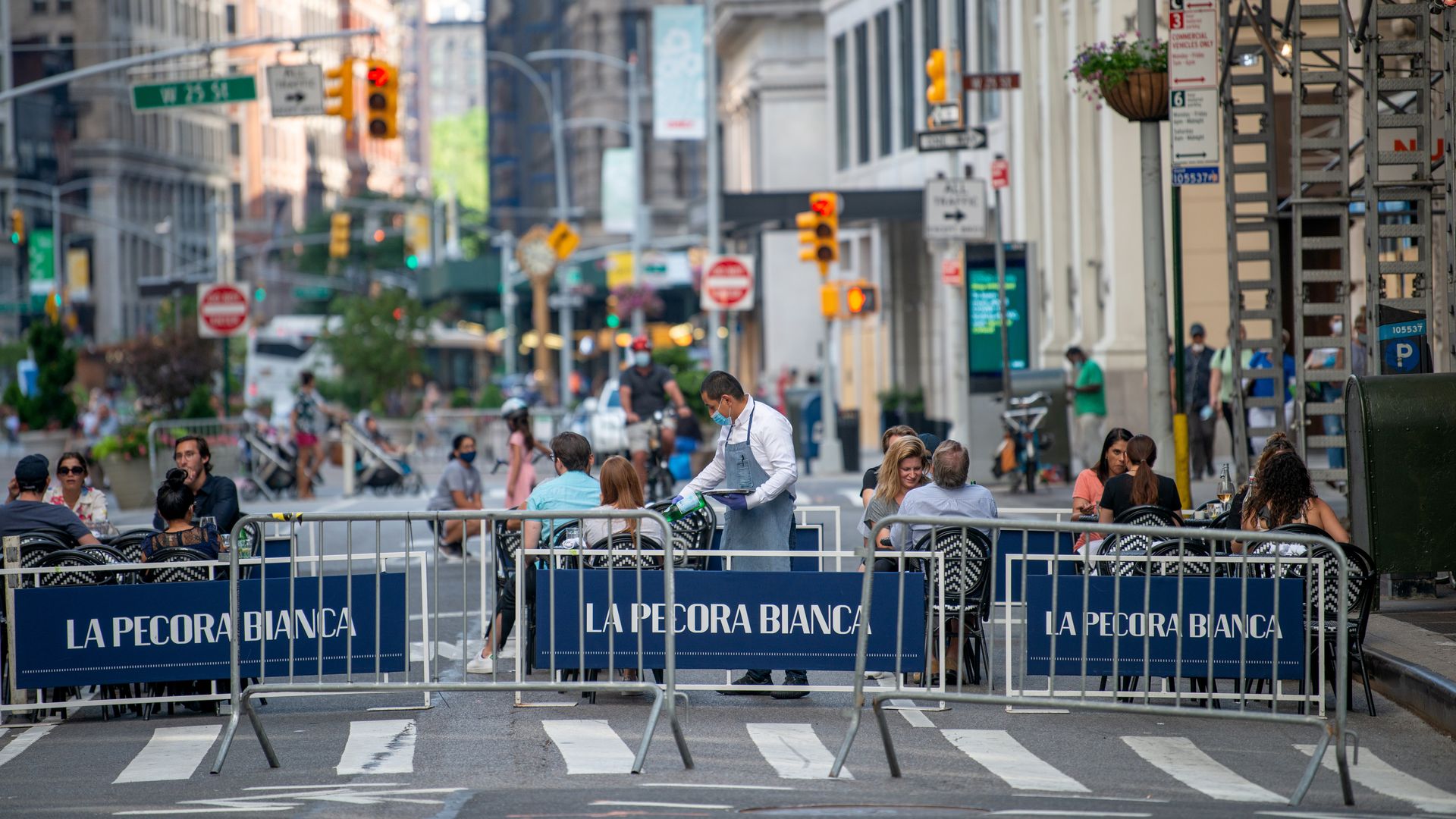
This summer's Manhattan dining reality. Photo: Alexi Rosenfeld/Getty Images
Without more state and federal relief specifically for restaurants, "63.6% of New York restaurants said they are likely to close by the end of the year," the New York State Restaurant Association reports from a survey of 1,042 restaurateurs.
- "Of those who are likely to close, 54.8% will be forced to shut their doors before November."
9. Lingo: "Coronasomnia"
"As if the novel coronavirus has not already wrought devastation aplenty on the world, physicians and researchers are seeing signs it is doing deep damage to people's sleep," the WashPost reports.
- "'Coronasomnia,' as some experts now call it, could prove to have profound public-health ramifications — creating a massive new population of chronic insomniacs grappling with declines in productivity, shorter fuses and increased risks of hypertension, depression and other health problems."
10. U.S. cinemas awaken for Labor Day

Labor Day weekend, usually sleepy in theaters, is a pivotal Hollywood showdown as two high-priced experiments test the new reality, AP film writer Jake Coyle reports.
The $200 million "Tenet" is the first must-see main event of the pandemic, a mega-movie litmus test for how ready moviegoers are to return to cinemas:
- After debuting in Europe, Canada and Korea last weekend, "Tenet" yesterday landed in the 75% of U.S. theaters currently open.
- At one Boston AMC, "Tenet" is playing 86 times from today through Sunday.
Another $200 million movie, Disney's live-action "Mulan" remake, is debuting not in theaters, as originally intended back in March, but on streamer Disney+, for $30 beginning today.
🎥 What's next: "Wonder Woman 1984" (Oct. 2) ... Marvel's "Black Widow" (Nov. 6) ... Pixar's "Soul" (Nov. 20).
📱 Thanks for reading Axios AM. Please invite your friends to sign up here.
Sign up for Axios AM

Catch up with the most important news of the day