Axios AM

September 09, 2024

☀️ Hello, Monday! Smart Brevity™ count: 1,945 words ... 7½ mins. Thanks to Noah Bressner for orchestrating. Copy edited by Bryan McBournie.
🎙️ If you're in D.C. tomorrow: Join us at 8 a.m. for our in-person event on AI and the workforce. Speakers include Rep. Ted Lieu (D-Calif.), White House special adviser for AI Ben Buchanan and IBM Consulting global managing partner Jill Goldstein. RSVP here.
🔎 Situational awareness: Vice President Harris added an issues section, A New Way Forward, to her website after weeks of criticism for being light on policy. ... Trump's "Agenda 47" is here.
1 big thing: Toss-up America
In an election year, everyone acts like they're Nate Silver — a prognosticator with complex theories on who'll win the White House.
- Why it matters: They all have something in common — they're full of it when expressing any confidence in any predictive outcomes, Jim VandeHei and Mike Allen write in a "Behind the Curtain" column.
The reason: You live in a toss-up nation, where every election brings coin-toss-close fights to run American government.
- This has been true for nearly every election since 2000, and will likely remain true until a seismic shift alters our concrete 50-50 reality.
A big national poll of likely voters released yesterday by the N.Y. Times and Siena College showed a neck-and-neck race: Former President Trump leads Vice President Harris 48% to 47% — well within the margin of error (± 2.8 points).
- People are driving themselves up the wall: Democratic X melted down; Republicans celebrated. All over one poll ... showing a tie. "Voters Still Unsure About Harris, but Trump's Base Holds Firm," as The Times puts it.
- A Silver post yesterday has the race leaning slightly "toward Trump given the Electoral College bias against Democrats."
- And the chatter will all change after tomorrow's Harris-Trump debate in Philadelphia — until the next hot poll or eruption on the trail.
So when your friends ask who'll win in November, toss out these eight immutable laws of Toss-up America. Then admit it: You're clueless, too.
- The 50-50 rule. Only twice since 2000 has the White House, Senate or House not flipped. Hence, constant political volatility. Move a few hundred thousand votes in three states in 2016 or 2020, and the loser would have been president.
- The popularity mirage. Democrats have won the popular vote for president in seven of the last eight elections. But they still lost the electoral vote, which decides the winner — George W. Bush in 2000 and Donald Trump in 2016. The same dynamic is often true for House and Senate races. Democrats pack themselves so tightly into big cities in big states, which is why those red and blue maps look like red seas.
- Women rule — voting. More women than men have voted in every election since 1980 — and almost always a majority for Dems. The number of U.S. women registered to vote is typically 7 million to 10 million more than the number of men, according to the Center for American Women and Politics. Among young women (ages 18 to 29) in six swing states, N.Y. Times-Siena College polls in August found an astonishing 38-point advantage for Harris (67%-29%).
- Most states don't matter. Both parties see the same seven swing states for the White House. The states change a bit — but the number hardly budges. The ballgame in 2024 will be the Blue Wall states of Wisconsin, Michigan and Pennsylvania + the fast-growing Sun Belt swath of Arizona, Nevada, Georgia and North Carolina. You can boil it down to: Harris needs Pennsylvania, and Trump needs Georgia. In the past four elections, 40 states have voted for the same party.
- The Trump hump. Roughly 45% of voters are diehards who can be expected to be with him no matter what. But he also has a ceiling: He didn't break 47% in 2016 or 2020, and is unlikely to go much above that this year. That's why third parties and double-haters matter on the margins.
- The Senate is almost always in play. It all comes down to which 33 states have Senate races in a given two-year cycle. It's all about the map. And this year, Republicans have a formidable advantage: West Virginia is certain to go red after the retirement of Sen. Joe Manchin. Democrats have to win Trump-friendly Ohio and Montana — plus the White House — for a 50-50 Senate majority, with the vice president as the tie-breaker. Candidate quality plays an outsized role: Republican Senate candidates have consistently underperformed Trump in battleground polling, giving Democrats an edge in what otherwise would be toss-ups. But Dems also face tough maps in 2026 and 2028.
- Flipping the House is easier than ever. Redistricting — and self-sorting, where conservatives and liberals literally move next to like-minded neighbors — has rendered 400 of 435 races over before they begin. Rural areas and big cities are rarely, if ever, competitive. After several changes Friday, The Cook Political Report with Amy Walter rates only 24 House races as toss-ups, with 13 held by Republicans and 11 held by Dems — a nearly even split. Dave Wasserman, Cook's senior editor and election analyst, tells us Democrats need to win 15 of 24 toss-ups (60%) to win the majority. They won 75% of Cook's toss-ups (27/36) in 2022.
- There's no Election Day. Yes, Nov. 5 is technically Election Day. But most people voted long before. COVID "accelerated voting trends that had been building for the past decade," Doug Sosnik, a top adviser to President Clinton, wrote last year in his "10 New Rules of American Politics." Several key states — including the biggest prize of all, Pennsylvania — start early voting this month.
Stat for the road: Dave "I've Seen Enough" Wasserman turned us onto a fascinating metric. In a House where Republicans hold the narrowest majority, just 16 districts out of 435 (4%!) voted for a different party for president than for House — toss-up America.
- Share this column ... Zachary Basu contributed reporting.
2. 💰 Harris' biggest business booster
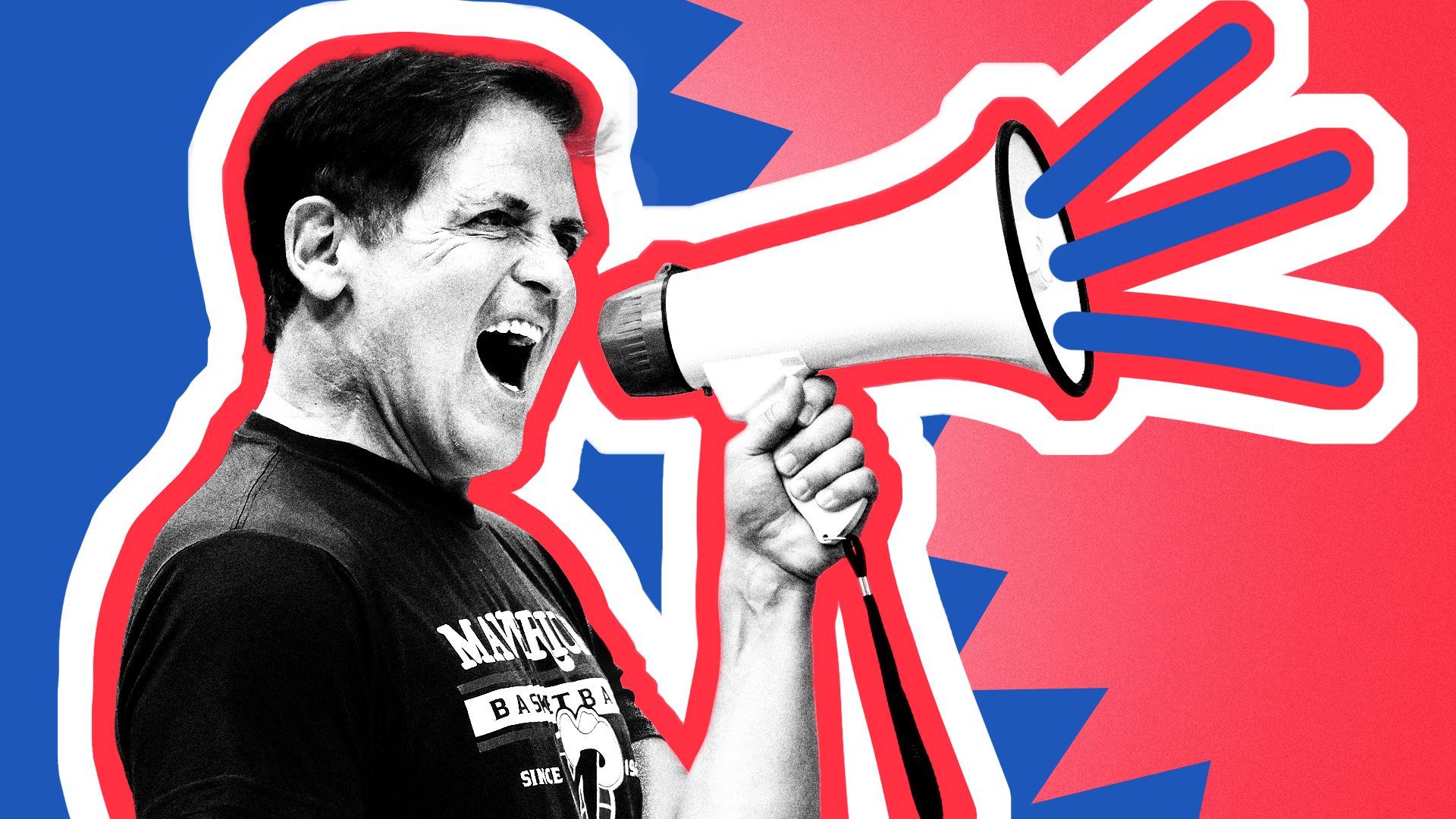
Mark Cuban has become a vociferous supporter of Kamala Harris, serving as a social media counterweight to fellow tech billionaires including Elon Musk, Axios Pro Rata author Dan Primack writes.
- Why it matters: Cuban has economic and health care bona fides in an election where inflation, taxes and abortion are taking center stage.
👀 Behind the scenes: Cuban isn't an official surrogate for Harris, but tells Axios that he's in regular dialogue with her campaign:
- "I talk to them. I tell them I'm going to say what's on my mind. They say: As long as you say you don't speak for us, go for it."
- He adds that while he got along with Biden staffers, he only had one or two calls with them.
🔢 By the numbers: Cuban has nearly 9 million followers on X, where he relishes keyboard combat. He's a constant TV presence via "Shark Tank" reruns.
- Cuban has posted more than two dozen times about the election in just the past week — including critiquing Trump's U.S. sovereign wealth fund proposal, and arguing that Harris is "more supportive of entrepreneurs than any candidate in a long time."
- He appeared on CNBC to call Harris "pro-business."
3. 🤖 AI's new bidding war
The latest billion-dollar bet on an AI startup is investors throwing cash at brainy researchers promising to kick AI into "super" gear, Axios managing editor for tech Scott Rosenberg writes.
- Why it matters: The money flowing into AI is enabling a handful of industry pioneers to write their own tickets.
Ilya Sutskever, an OpenAI co-founder who left the firm in May, has raised $1 billion to fund Safe Super Intelligence (SSI), the startup announced last week.
- SSI boasts that it has no product — or even a product plan. There'll be "no distraction by management overhead or product cycles," the post declares.
- Translation: These founders are saying, "Finally, we can do our research without being bothered by anyone else!" — including accountants, marketers or even customers.
🔬 Between the lines: Both OpenAI and Anthropic, spun up by OpenAI alumni, started out with manifestos like SSI's, aiming to make leaps in AI capability with a safety-first mindset.
- Today, both those companies are in the more mundane business of providing working generative AI tools to a broad consumer market.
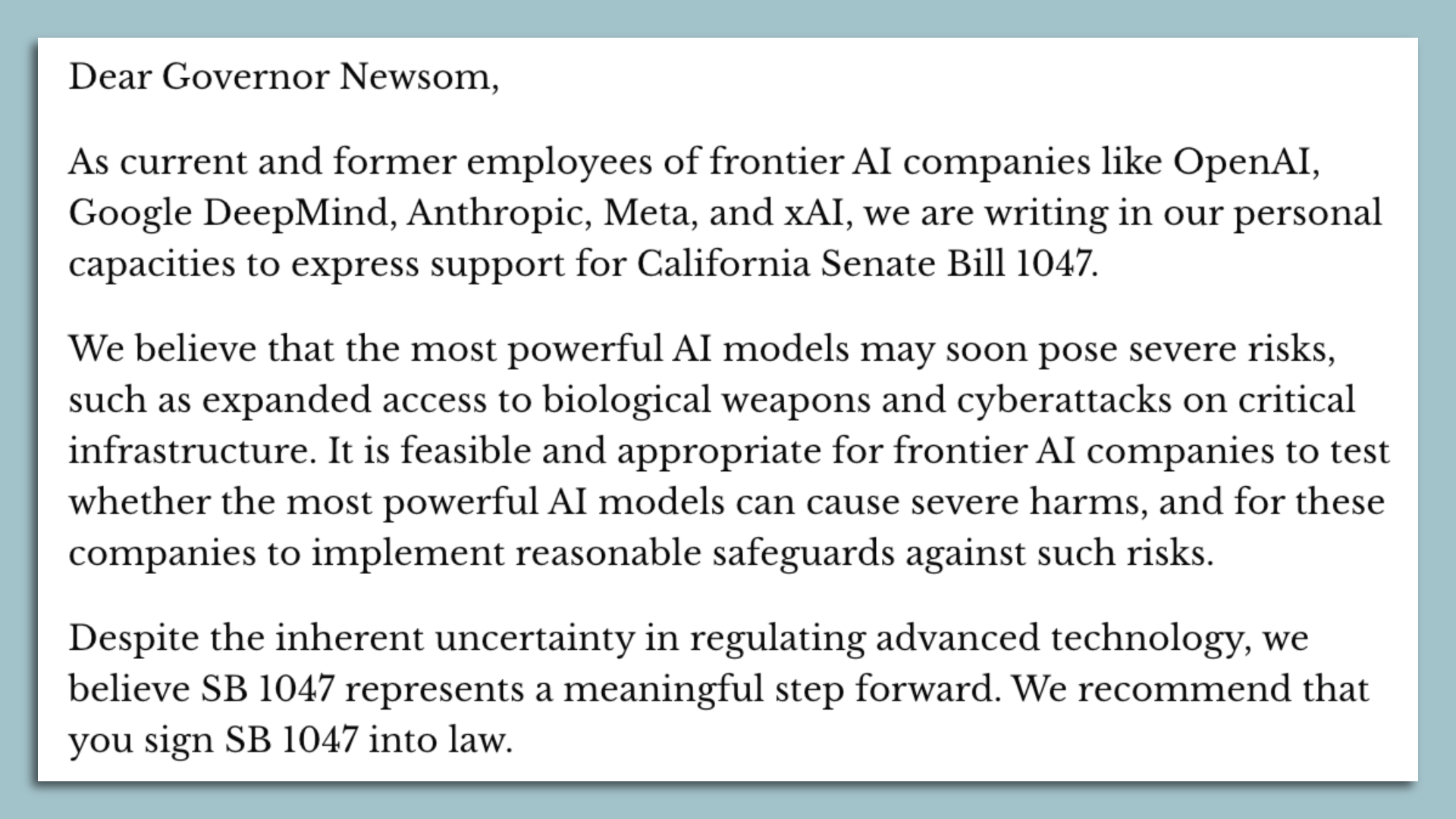
⚡ P.S. Nearly 120 current and former employees of OpenAI, Anthropic, Google's DeepMind and Meta issued a statement in support of California's new AI regulation bill, Axios' Megan Morrone scoops.
4. 📉 Charted: Fewer babies
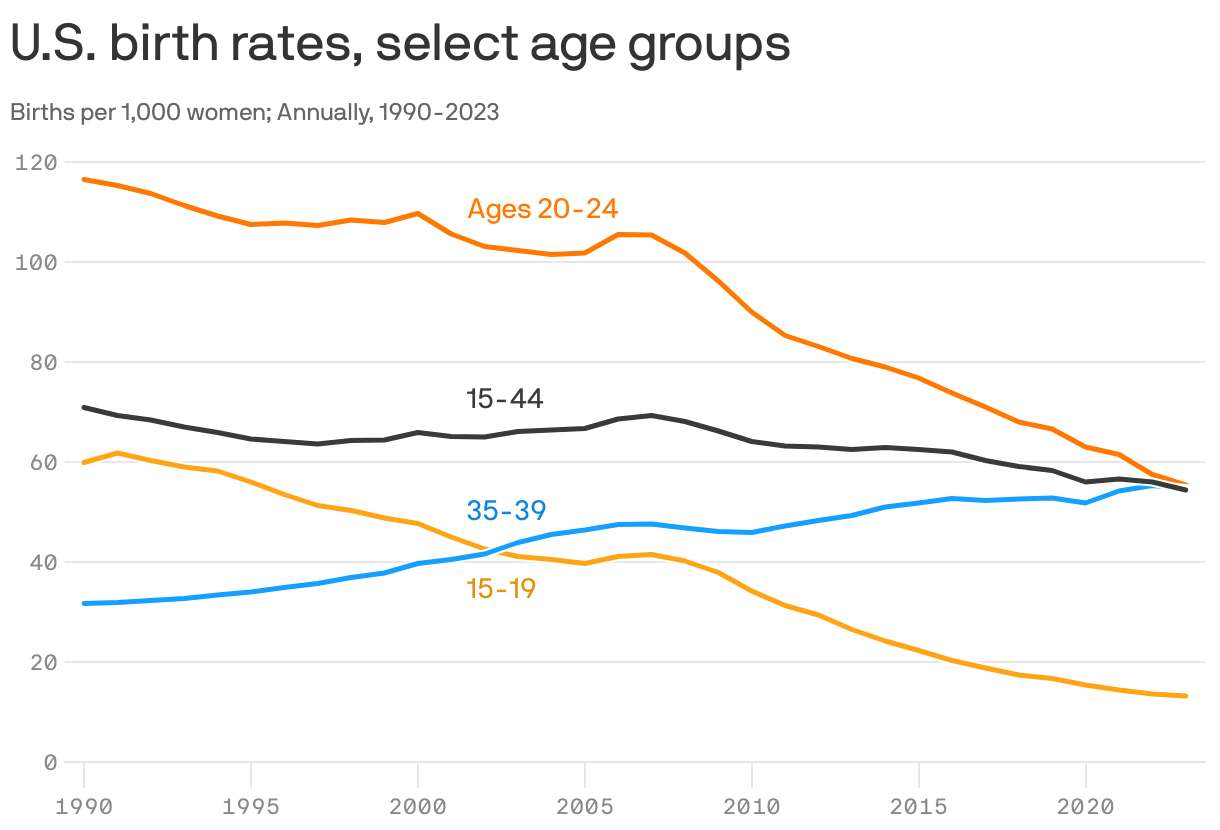
American women are having fewer babies — and that's become a political issue, Axios' Emily Peck writes.
Why it matters: Fewer babies mean fewer future workers. That translates into problems like labor shortages, less innovation and productivity.
- Elon Musk called the falling birth rate "the biggest danger civilization faces."
The intrigue: Some moves other countries have made — child-care supports and paid parental leave — increased birth rates a tiny bit.
- Funding for IVF, which Donald Trump has talked about, can help more older women have children.
5. 🔋 Biden's race to spend climate bucks
The Biden administration is in a race against the clock to get billions in "clean" energy funding out the door before the end of his term, Axios' Andrew Freedman writes.
- Why it matters: Former President Trump has vowed to claw back unspent funding from President Biden's signature climate law.
So Biden's legacy on climate and energy policy depends in part on the administration's ability to funnel billions of dollars out the door during the next four months.
6. 🏈 Bringing hip-hop to the Super Bowl
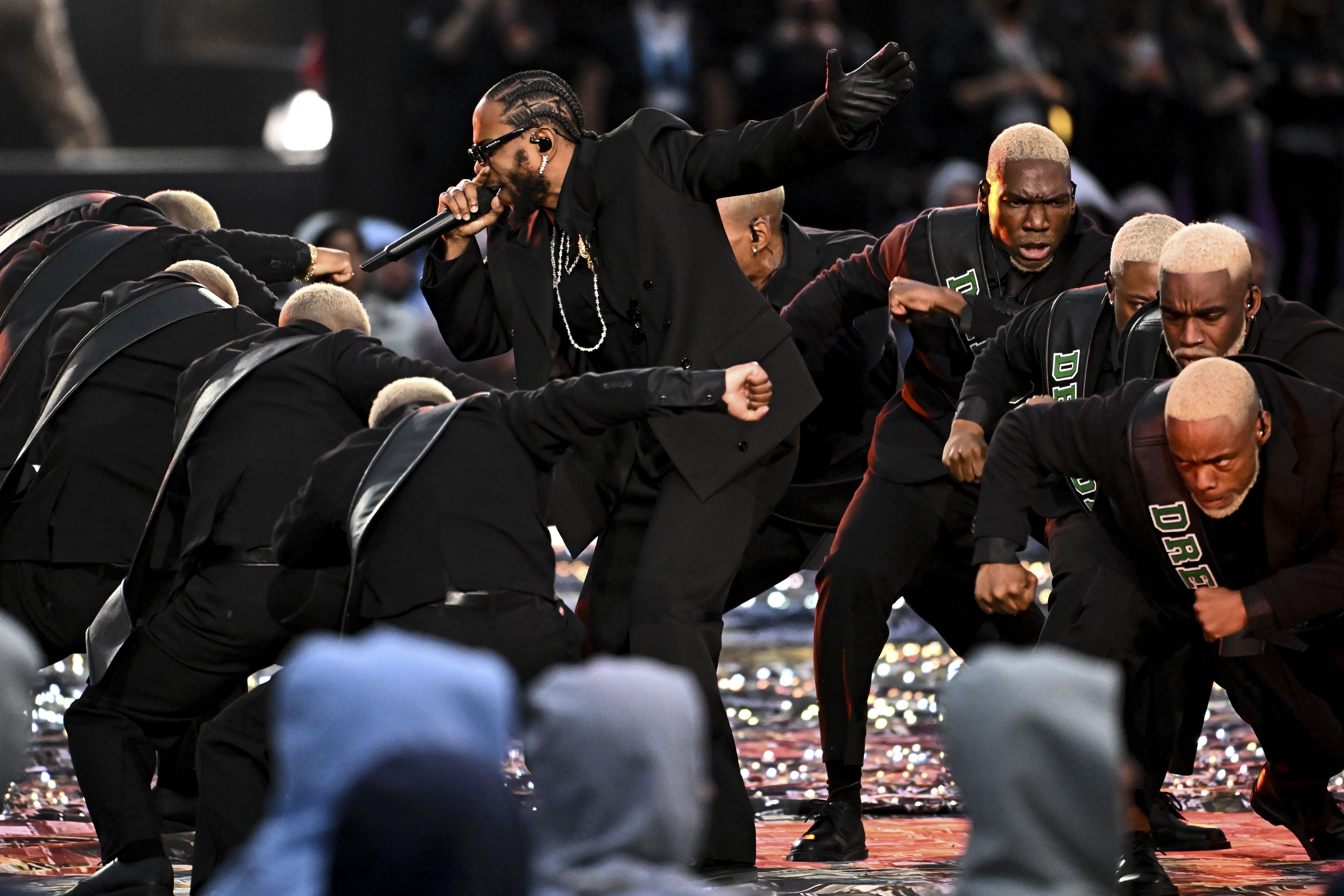
Rap megastar Kendrick Lamar will headline the Super Bowl halftime show in New Orleans this February.
- Why it matters: Nothing in America today gets more eyeballs than the Super Bowl, a quasi-national holiday. Usher's halftime show last season was the most watched on record — averaging 129 million viewers.
7. 📚 Kissinger's last book
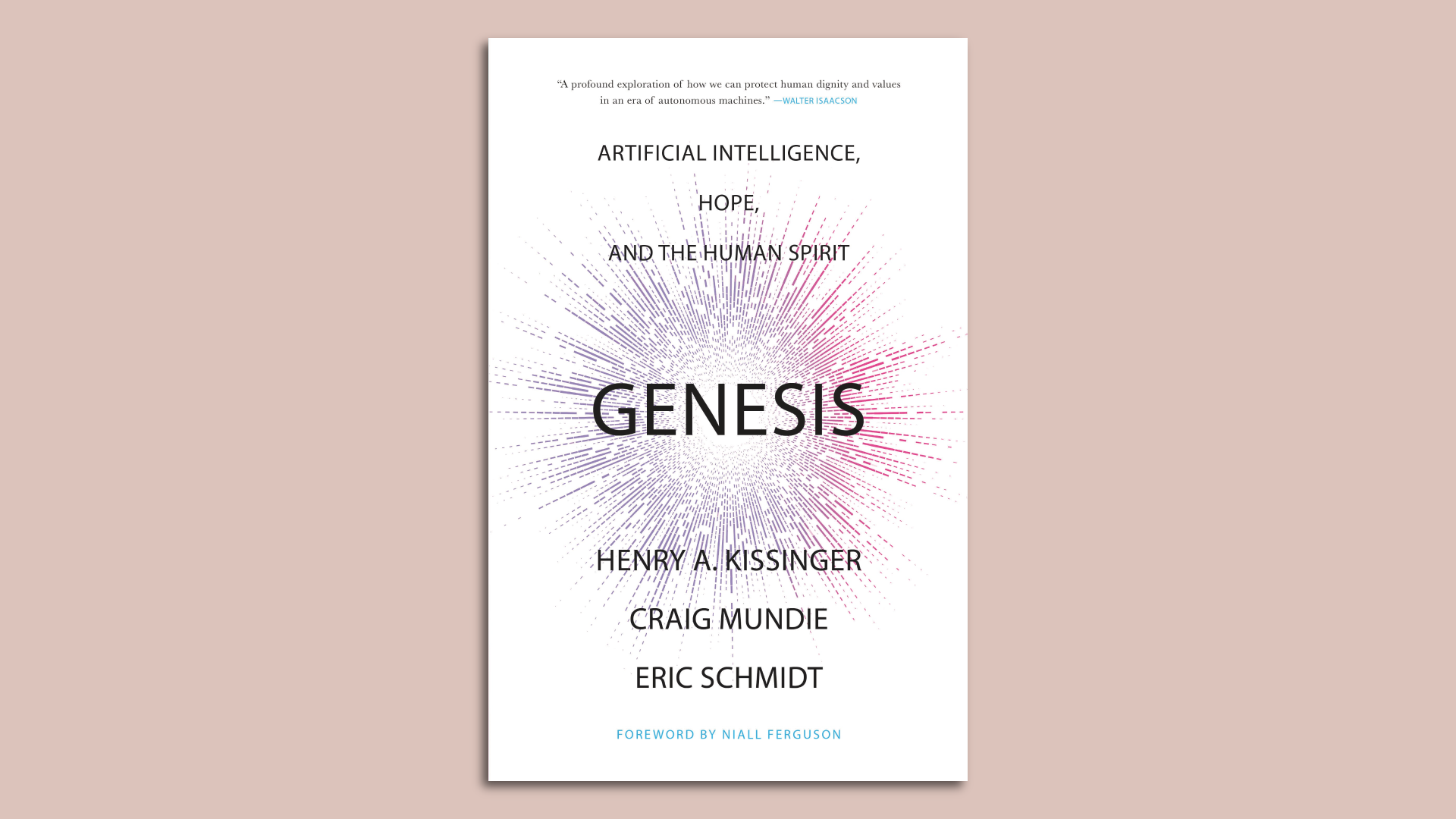
The last of 20 books written by the late Henry Kissinger — this one co-authored by former Google CEO Eric Schmidt and former Microsoft exec Craig Mundie — will explore "what it means to be human in the age of AI."
- Why it matters: "Genesis," out Nov. 19, wrestles with the massive implications of machines becoming our active collaborators, the publisher notes.
It's a sequel to Schmidt and Kissinger's prescient 2021 book, "The Age of AI."
- They also made an animated video with the help of AI that included a cartoon rendering of Kissinger, who died last year at 100.
Schmidt tells Axios: "We wanted readers to weigh the fact that for all the remarkable technological progress we are witnessing, we still need to make difficult decisions with partial knowledge, in ambiguous situations, and without the comfort of absolute moral certainty."
8. ⛲ 1 for the road: Trevi Fountain ponders fee
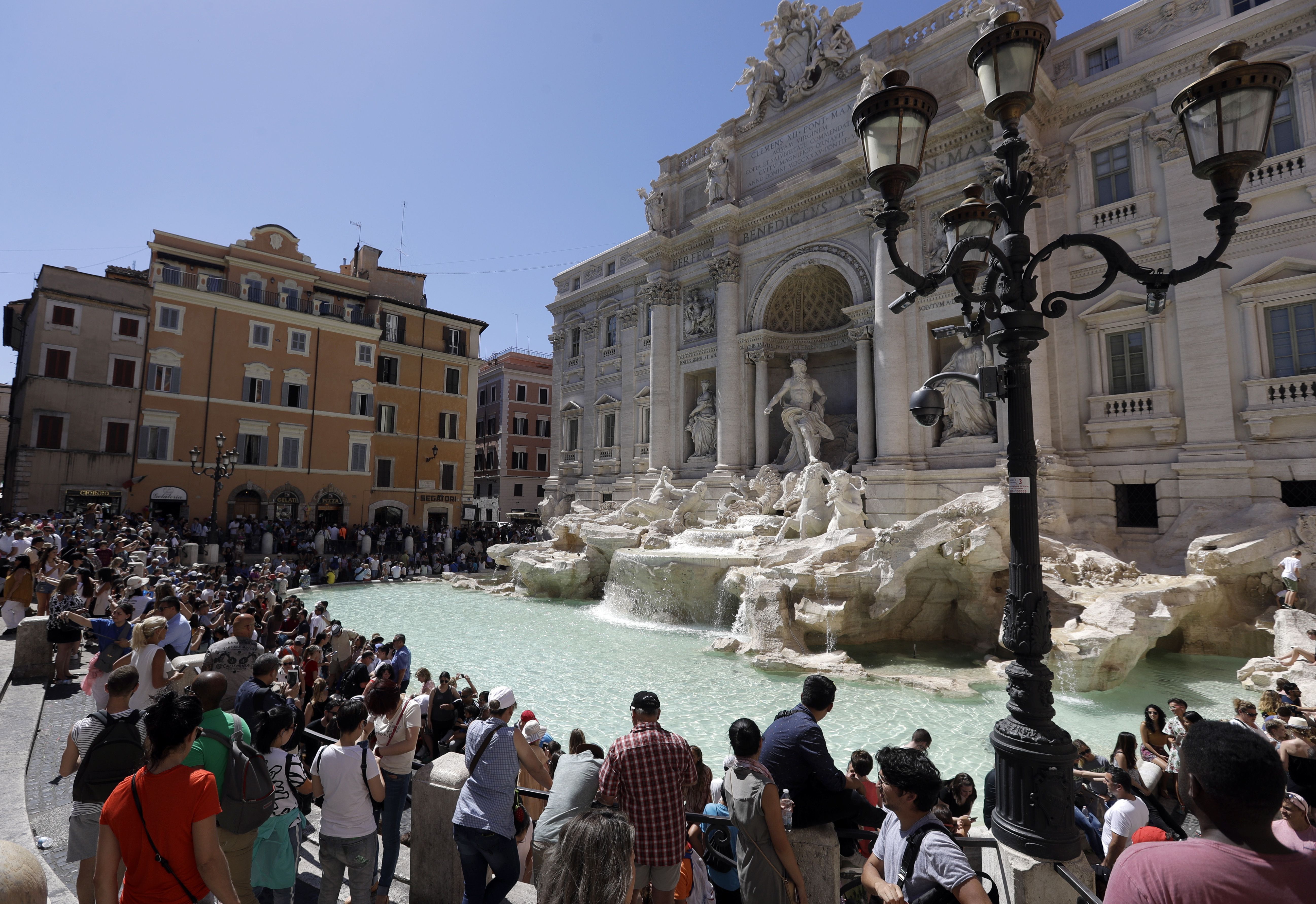
Seemingly every tourist in Rome knows the key to returning to the Eternal City is to toss a coin into the Trevi Fountain and make a wish.
- Officials are now considering a plan to manage tourism to one of Rome's most-visited sites: a €2 ($2.25) ticket to access the Baroque monument, AP reports.
🖼️ The big picture: Cities across the globe are grappling with an ever-growing number of tourists, who fuel the economy but inconvenience residents.
The proposal by Rome's top tourism official, Alessandro Onorato, comes after the Italian lagoon city of Venice tested a controversial €5 daytripper access fee to the city this summer.
- "Two euros is more or less the same amount that people toss into the fountain to make a wish,'' Onorato said.
Onorato said he hopes to test the entrance fee, managed through a reservation system and a QR code, in time for the Vatican's Jubilee 2025.
📬 Please invite your friends to join AM.
Sign up for Axios AM


/2024/09/08/1725823652188.gif?w=3840)