The dread election: Share of "double haters" hits historic high

Add Axios as your preferred source to
see more of our stories on Google.
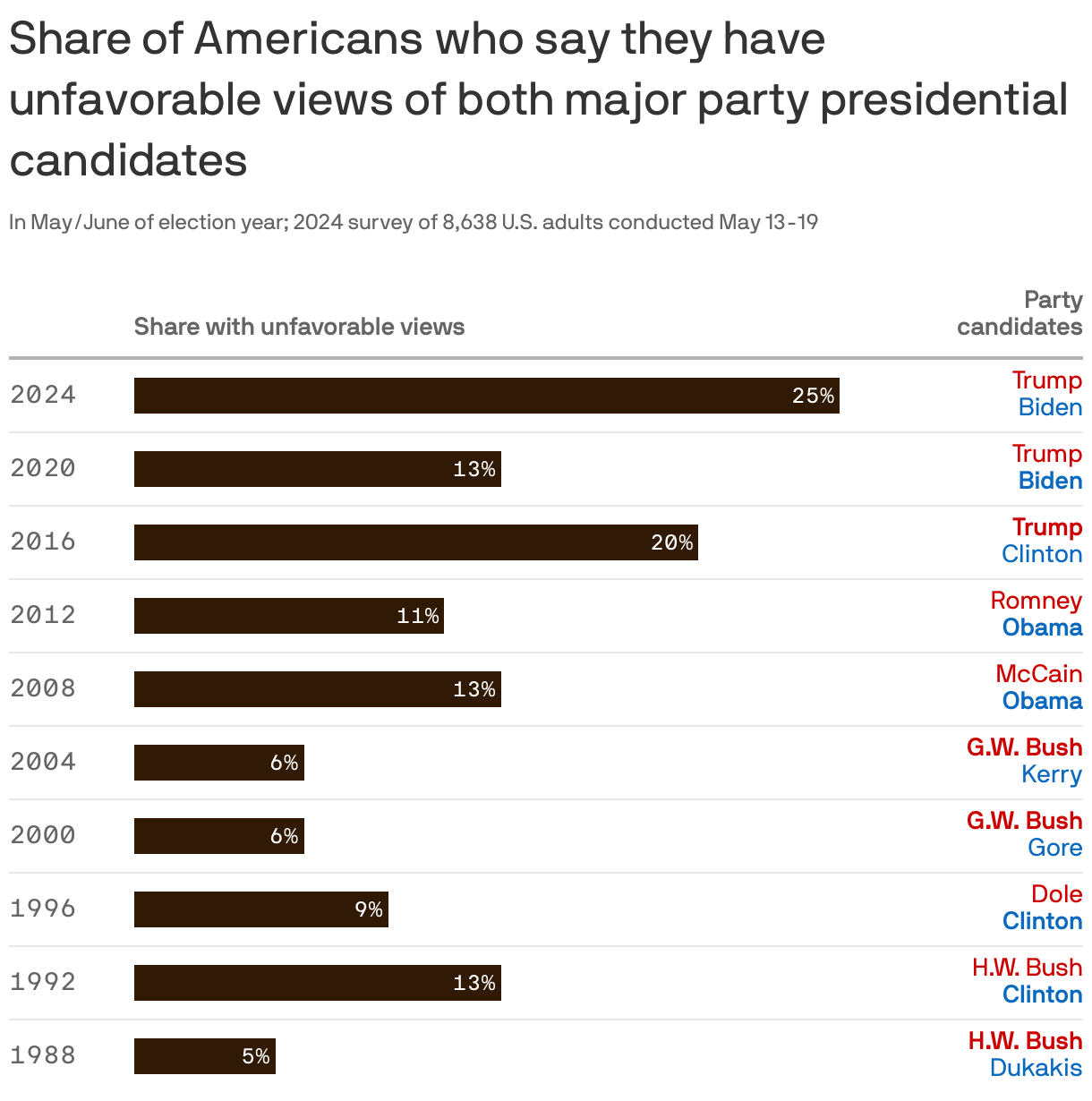
A quarter of Americans hold unfavorable views of both President Biden and former President Trump — the highest share of "double haters" at this stage in any of the last 10 elections, according to new Pew Research data.
Why it matters: The closely watched bloc has nearly doubled in size since 2020, making this fall's Trump vs. Biden rematch the most dreaded election in modern political history.
The big picture: Top strategists say the race is likely to be decided by 6% of voters in six swing states. Many of them will hold their nose and pick a candidate they dislike in November.
- Robert F. Kennedy Jr. claims to be on the ballot in several of those states, offering a third-party option that both the Biden and Trump campaigns are scrambling to neutralize.
- Whichever candidate can mobilize more "double haters" to back them in November could have a decisive advantage in the Electoral College, given the razor-thin margins.
Zoom in: Trump has made inroads with Republican critics in recent weeks, using a visit to Capitol Hill — and a handshake with Senate Minority Leader Mitch McConnell (R-Ky.) — to showcase the GOP's post-primary unity.
- Former UN Ambassador Nikki Haley, whose primary voters represent a huge cross-section of Trump-Biden skeptics, finally endorsed Trump last month.
- A steady drumbeat of wealthy GOP donors who condemned Trump after Jan. 6 are once again getting out their checkbooks, unable to stomach a second Biden term.
Between the lines: 67% of "double haters" believe Trump should end his campaign in the wake of his felony conviction, according to a recent ABC News/Ipsos poll.
- The Biden campaign sees that and other polling data as evidence that the president will win over this critical bloc of voters by the time Nov. 5 arrives.
- "They may dislike both candidates, but the intensity on Trump's negative is higher," Democratic pollster Jefrey Pollock told Axios. "A campaign that has the resources to persuade those individuals has some advantage."
The bottom line: Between 1988 and 2012, at least one of the major party nominees had a favorability rating over 50%. Both Trump and Biden will be lucky to draw much higher than 40% by the time they're nominated this summer.
