Axios AM

August 15, 2025

🏖️ Happy Friday! Smart Brevity™ count: 1,675 words ... 6½ mins. Thanks to Noah Bressner for orchestrating. Copy edited by Bryan McBournie.
1 big thing: Dems' "Abundance" rift
The trendy center-left "Abundance" movement is an early battlefield as Democrats brawl over the future of their brand, their party and their purpose, Axios' Alex Thompson writes.
- A growing number of left-wing politicians and thinkers are labeling it a clever rebrand by the party's corporate wing, which they blame for driving working-class voters from the party.
Why it matters: The escalating feud is a preview of the 2028 presidential primary, as the Democratic Party grapples with its identity — including whether to moderate to attract independent voters, or counter Trumpism by leaning into progressive economic populism.
🖼️ The big picture: "Abundance" was popularized by this year's bestselling book of the same name by New York Times columnist Ezra Klein and journalist Derek Thompson, who just launched a Substack.
- The idea: Democrats have lost voters' trust because of governing failures in blue cities and states, and need to respond by cutting excess regulations to build more housing, energy projects and more.
- "Liberals speak as if they believe in government — and then pass policy after policy hamstringing what it can actually do," the authors wrote.
As Democrats continue to reckon with how Donald Trump returned to the White House and the ongoing fallout from the 2024 elections, many in the party are enthusiastically embracing Abundance.
- California Gov. Gavin Newsom, a potential 2028 presidential candidate, signed legislation in June to change environmental rules to make it easier to build more housing. He posted on X that "we're urgently embracing an abundance agenda by tearing down the barriers that have delayed new affordable housing and infrastructure for decades."
- Tech billionaire and prolific Democratic donor Reid Hoffman said in late July that he's sending everyone he knows a copy of the book, and that he'll be backing pro-abundance candidates.
👓 Between the lines: The abundance buzz hasn't been universally accepted — and has drawn some backlash from the Democratic Party's left wing. Those Democrats argue:
- Getting rid of excessive regulations is good, but doesn't address — and in some ways could exacerbate — the more pressing issues of wealth inequality and corporate power.
- Voters are angry, and a deregulation agenda isn't a compelling political message.
2. ✍️ Scoop: White House loyalty ratings

The West Wing has created a scorecard that rates 553 companies and trade associations on how hard they worked to support and promote President Trump's "One Big Beautiful Bill," a senior White House official tells Mike.
Why it matters: Trump works transactionally, and companies have rushed to pay demonstrative homage. Now, senior aides will have data to consult when considering corporate requests.
- The unusual spreadsheet fits this administration's proclivity for micromanaging companies and administering loyalty tests.
Factors in the rating include social media posts, press releases, video testimonials, ads, attendance at White House events, and other engagement related to "OB3," as the megabill is known internally.
- The organizations' support is ranked as strong, moderate or low.
- Axios has learned that "examples of good partners" on the White House list include Uber, DoorDash, United, Delta, AT&T, Cisco, Airlines for America and the Steel Manufacturers Association.
💡 How it works: The data, which is being circulated to White House senior staff, will be used as a reality check when someone from K Street calls and says, for instance, that they'd "love to catch up — was so great working with you to pass the big, beautiful bill."
- The ranking "helps us see who really goes out and helps vs. those who just come in and pay lip service," the official said.
🔮 What's next: We're told this is an evolving document, with the organizations' engagement on other presidential initiatives to be added.
- "If groups/companies want to start advocating more now for the tax bill or additional administration priorities, we will take that into account in our grading," the official said.
3. 🍽️ Dinner with Sam Altman
OpenAI CEO Sam Altman is still talking like the future belongs to him, a week after the rollout of ChatGPT raised a storm of criticism and questions about his strategy, Axios' Ina Fried writes.
- "If you project our growth forward pretty soon, like billions of people a day will be talking to ChatGPT," Altman said during an on-the-record dinner with Ina and a few other reporters at the Mediterranean restaurant Dalida in San Francisco last night.
- "ChatGPT will say more words a day than all humans say, at some point, if we stay on our growth rate."
Altman has heard the concerns, integrated some lessons learned, and is charging forward with plans to spend trillions of dollars to build a slew of products and services, led by an even more ubiquitous ChatGPT.
- "You should expect OpenAI to spend trillions of dollars on data center construction in the not very distant future," Altman said.
- "And you should expect a bunch of economists to wring their hands and be like, 'Oh, this is so crazy. It's so reckless and whatever.' ... And we'll just be like: 'You know what? Let us, like, do our thing."
🤖 On last week's launch of GPT-5, Altman invoked Dickens' "the best of times, it was the worst of times."
- "You have people that are like, 'You took away my friend. You're horrible. I need it back,'" he said, referring to users who wanted to keep using OpenAI's older models. At the same time, Altman said the company is finding scientists saying they can finally do real research using GPT-5.
- OpenAI has also seen traffic to its API double within 48 hours, to the point that it's limited by compute capacity. "We have really got the full spread of the human experience with this one," he said.
Fielding questions for 90 minutes, Altman also said:
- If Google is forced to sell its Chrome browser as part of an antitrust settlement, Altman would like to buy it.
- A brain-computer interface company along the lines of Musk's Neuralink is something Altman said he's interested in setting up: "I would like to be able to think something and have ChatGPT respond to it."
- On his social media spat with Elon Musk: "There's no grand strategy ... It was probably a mistake."
4. 💰 Charted: New spending gap


Rich Americans are spending at a higher rate this year — while everyone else is slowing their roll, Axios' Emily Peck writes.
- Why it matters: New data show that while the good times continue for higher-income earners — strong wage growth, less debt — lower-income Americans are under increasing financial stress.
🧮 By the numbers: Spending increased nearly 2% in July from last year for higher-income households, and 1% for middle-earners, according to a Bank of America Institute analysis released earlier this week.
- For the lowest third of households, those earning roughly $50,000 a year or less, spending growth was zero.
Go deeper: More spending data.
5. 🏔️ Putin's summit long game

For President Trump, today's summit in Alaska is all about "the first couple of minutes" — that's how long it'll take to know whether Russian President Vladimir Putin is serious about peace, Axios' Dave Lawler and Barak Ravid write.
- Putin, by contrast, seems to be taking a longer view.
Why it matters: For the Russian leader, this summit (expected to start 3:30 p.m. ET) is about more than a ceasefire — more even than Ukraine.
- He'll visit the U.S. as a peer, not a pariah, with an opportunity to nudge superpower relations onto a more favorable course. But he'll also have to contend with Trump's desire for immediate results.
💥 Breaking it down: This is Putin's first meeting with a U.S. president since 2021 — before the full-scale invasion — and his first time on U.S. soil in a decade.
- He'll have a chance to repair his fraying relationship with Trump and try to influence his thinking on any number of key issues.
- "Putin will strongly promote the idea that the U.S. and Russia are two great nations that should maintain good relations regardless of local conflicts," predicts Russian political analyst Tatiana Stanovaya.

👀 Behind the scenes: Ukrainian officials are bracing for virtually any outcome from Anchorage — for Trump to call Zelensky over to Alaska, or freeze him out once again.
What to watch: Trump said he expects to hold a joint press conference if things go well. If they don't, he'll walk out alone.
6. 🚨 Mapped: Where homicide rates are highest
To hear President Trump tell it, the nation's murder problem is particularly bad in New York City, Chicago, Baltimore, Los Angeles and Washington, D.C. — all run by Democrats.
- New FBI crime figures from 2024 tell a different story, Axios' Russell Contreras.
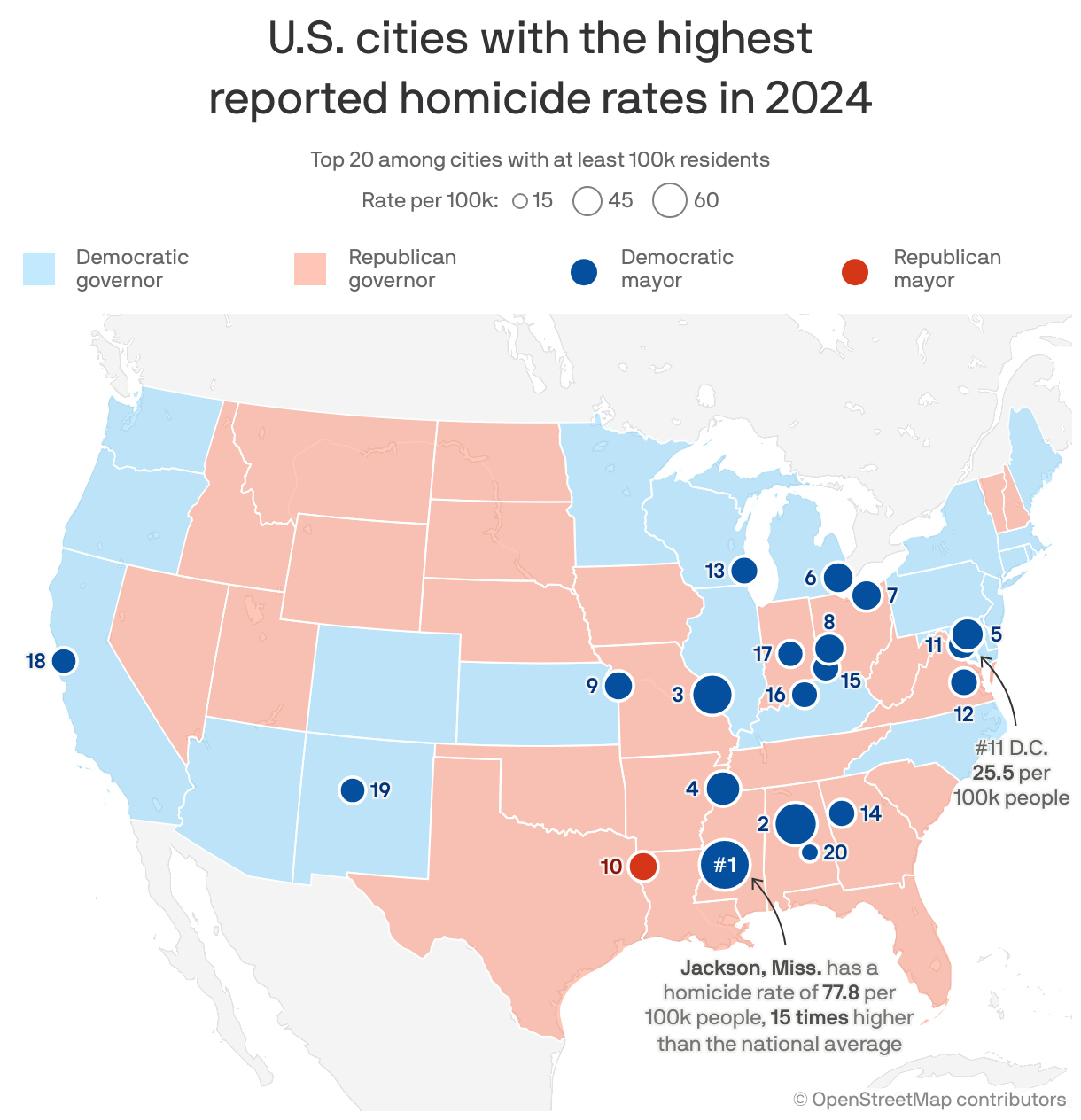
🔎 Zoom in: 13 of the 20 U.S. cities with the highest murder rates were in Republican-led states. Many of those cities were run by Democrats who often are at odds with state officials, an Axios analysis of FBI data finds.
- Eight of the top 10 cities with the highest murder rates and populations of at least 100,000 were in red states — Mississippi, Alabama, Missouri, Tennessee, Ohio and Louisiana, Axios found.
Jackson, Miss., had the nation's highest homicide rate— nearly 78 per 100,000 residents, more than 15 times the national average.
- Birmingham, Ala., was second with a homicide rate of almost 59 per 100,000 residents — more than 11 times the national average.
- St. Louis was third, followed by Memphis, Tenn.
7. 🎓 Record $2 billion donation
Nike founder Phil Knight and his wife, Penny, are giving $2 billion to a cancer institute named after them at Oregon Health & Science University.
- Why it matters: The megagift is believed to be the largest single donation in higher education history.
It surpasses Michael Bloomberg's $1.8 billion donation to Johns Hopkins in 2018.
8. 🥇 1 fun thing: First robo-Olympics

Competition for the first World Humanoid Robot Games — like the Olympics for robots — starts today in Beijing.
- More than 500 humanoid robots are competing in 280 teams from 16 countries, including the U.S., Germany and Japan.
The games last three days and will feature 26 competitions ranging from track and field to table tennis.
- Watch: 1-min. clip of the opening ceremony ... Keep reading.
📬 Thanks for reading! Please invite your friends to join AM.
Sign up for Axios AM