Axios AM

August 09, 2026

🌅 Happy Sunday! Smart Brevity™ count: 1,584 words … 6 mins. Thanks to Shane Savitsky for orchestrating. Edited by Andrew Pantazi.
1 big thing: The age of post-processable velocity

Something huge has shifted for all of us. Axios CEO Jim VandeHei writes that he realized it last month while preparing for our board meeting:
First, there was a discussion around six-month horizons. And I kept thinking: This is pure fantasy — it's impossible to envision our company and our world even a few months from now.
- Then, despite an amazing 2026, I felt compelled to offer the board a gut check unthinkable even a year ago: Yes, we're crushing it, but that could all change in a month.
- For the first time, my confident line of sight is six weeks, tops.
Why it matters: We have entered what I call post-processable velocity — a speed of change exceeding the ability of any individual, company, market or government to fully absorb, understand and respond to it in real time.
We've moved from the velocity of information outpacing human comprehension … to the velocity of capabilities outpacing strategic thinking.
- The consequences for how we think and operate in this environment seem profound — and, in this moment, unknowable.
The big picture: This is the end of one era and the start of something much bigger.
📱 I've long believed that something fundamental changed in early 2007.
- That was the year we started Politico. More importantly, that's when today's core information ecosystem — the iPhone, Android, Facebook, Twitter, the cloud, streaming — all began to take off.
- Life, business and information started moving faster than most people could keep up with. Most never did. We just got used to being behind or overwhelmed or confused.
🌀 For nearly two decades, that acceleration continued, then fused with AI to signal that something very different was ahead. We've now fully crossed that new line.
- The defining change of the past 20 years was the velocity of information: News broke instantly. Ideas spread quickly and globally. Public opinion shifted or clouded fast. Everyone could see more, say more and react more.
The defining change now is the velocity of capability: What a person can do, what AI can unleash, what a small team can build, what a competitor can launch, and what an entire industry can automate can change in mere weeks.
- The cycle seems set and accelerating. Intelligence gets better, faster, so AI capabilities rise. The cost eventually falls, as competition rises and businesses adjust. The use spreads — unevenly, messily, but undoubtedly.
😵💫 State of play: I read about and use AI voraciously, and implement it companywide. But just in the past few weeks, it suddenly feels almost incomprehensibly hard to keep up with the change.
- Capability velocity makes it hard to know what is possible — for everyone.
- When you can't reliably know what's possible six weeks from now, planning on timelines of months or years seems hard, if not silly.
Don't misunderstand me: I'm not suggesting that strategy is dead. But your old ways of thinking about how to build it are.
- Most strategic planning is built on a reasonably stable set of facts: known competitors, understandable technologies, predictable behavior and gradually improving capabilities. It's always been possible to plan and execute against those facts.
- Post-processable velocity destroys that stability. A decision can be logical when made and obsolete by the time it's implemented. A staffing plan can be based on tasks that software learns to perform weeks later. Government writes rules that feel antiquated once they're law.
💡 In moments like this, I return to Donald Rumsfeld's concept of "known knowns" and Silicon Valley's obsession with "first principles." I try to fuse both with our Axios philosophy of "simplify."
- It all comes down to three questions: What do we know to be true? What do we know matters most? What are the fewest things we can do with the fewest people in the shortest period of time?
- 📖 Preorder our book, "Simplify," coming Sept. 15. Special for AM readers: Send us a screenshot, and we'll invite you to a prepublication Simplify briefing.
2. Leading in this new age

Jim gave Axios C-Suite readers these four tips for navigating post-processable velocity:
- No-regret moves. Loosen reliance on plans that require you to be right about things far in the future. The way forward? Strong directions, with loosely held paths.
- Monthly mentality. Force yourself to rethink your focus and tools every month. That's how fast things are changing.
- Simplify. The fewer things you do, with fewer bureaucratic obstacles, the easier it will be to evolve and succeed.
- Amplify human intelligence. Keep evolving your information inputs so you can see the shifting field more clearly. This requires constantly updating how and where you get informed.
- 📈 If you're a CEO or on a CEO's team: Ask to join Jim's new weekly Axios C-Suite newsletter.
3. 🤷♂️ Dems' AI disconnect

Axios Pro Rata author Dan Primack surveys the AI policy landscape — or, as he sees it for one party, a lack thereof — as the midterms loom:
America is less than three months away from … say it with me … the most important election of our lifetimes.
- Yet the Democratic Party hasn't articulated its vision for artificial intelligence, a technology that promises to fundamentally transform our economy and society.
We tend to know what Republicans would do, based on the first 18 months of Trump 2.0.
- The macro ideology is laissez-faire, occasionally interrupted by micro squabbles. Bigger, better, faster — all in the service of "beating China."
- It's basically what Trump promised in 2024, which is why so many tech titans traded blue for red.
Democrats thus far have offered an assortment of one-off proposals — usually from the party's left flank — that haven't gained traction with the broader caucus.
- At a dinner in May, I asked Sen. Ed Markey (D-Mass.) what Dems would do differently on AI policy were they to take congressional gavels. "Even just something small," I added.
- Markey's reply was that they would hold hearings.
- This came shortly after an Axios event where Sen. Mark Warner (D-Va.) — a former venture capitalist and tech founder — said Congress "desperately needs the AI community to come in and help us figure it out."
Democrats are pretty unified on issues like taxes, health care, antitrust and Iran.
- But voters have no idea what most Democrats want to do about regulating AI models (foreign or domestic), using AI in schools, preparing for possible labor disruptions, taking government stakes in AI companies, addressing circular economy risks, etc.
4. 🚗 Car buyers trade down

More premium car buyers are trading down to mainstream brands, Axios' Joann Muller reports from Detroit.
- They've discovered they can get lots of the same technology, comfort and features at a substantially lower price, according to new J.D. Power research.
Why it matters: It's more bad news for luxury automakers that have been clobbered in recent years by Tesla and now Chinese competitors — and another reflection of how affordability is upending the U.S. car market.
🏁 A big reason: You can get many of the same tech and convenience features once associated only with luxury cars in a Chevy, Toyota or Hyundai.
5. 🤖 Mapped: Deepfakes and elections
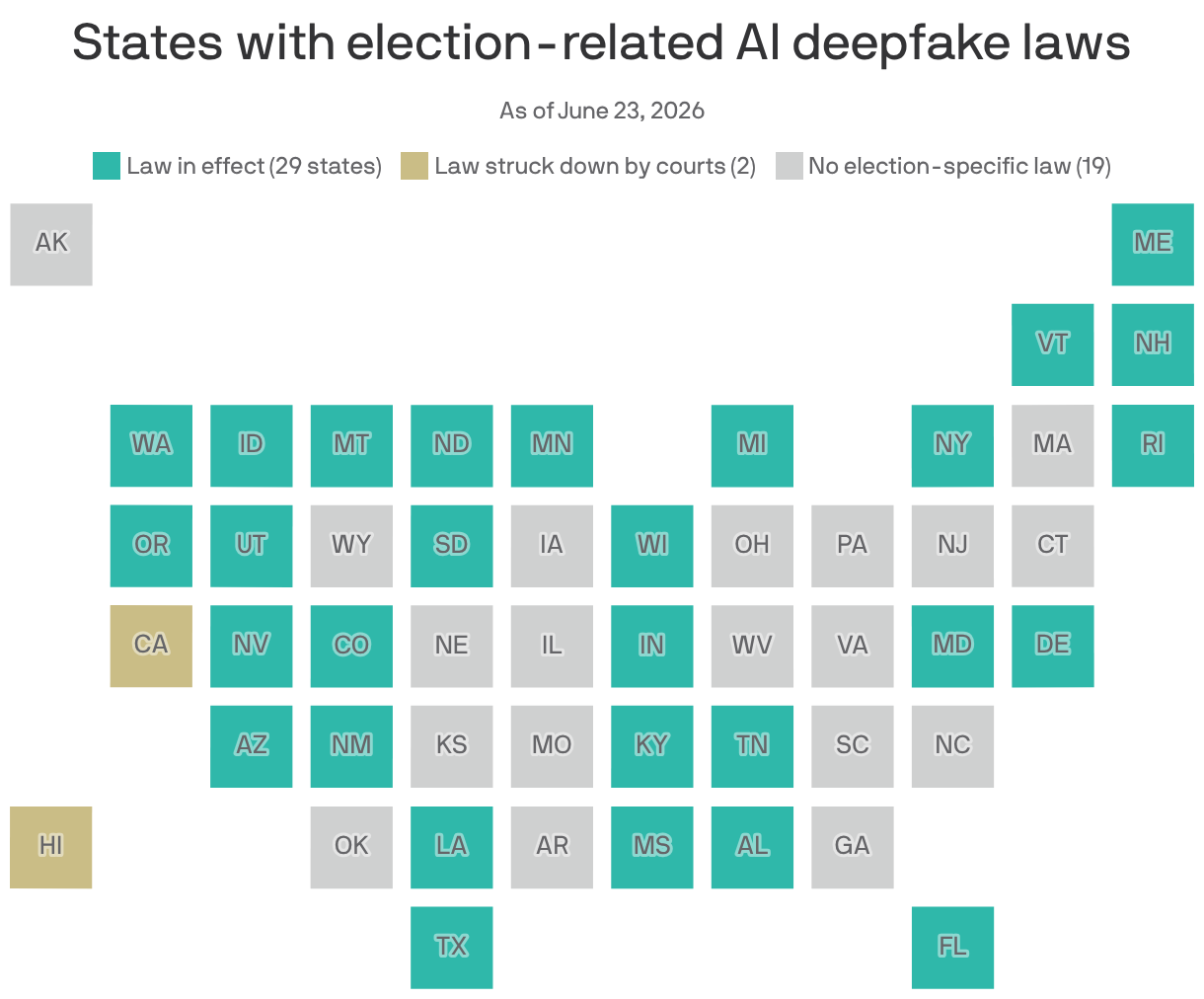
Americans across the country could have very different experiences with AI deepfakes leading up to Election Day, thanks to a patchwork of state rules, Axios' Maria Curi reports.
- Twenty-nine states have AI election deepfake laws in effect. Two others — California and Hawaii — had their laws enjoined, according to the National Conference of State Legislatures.
6. 👯♀️ We're having fewer twins
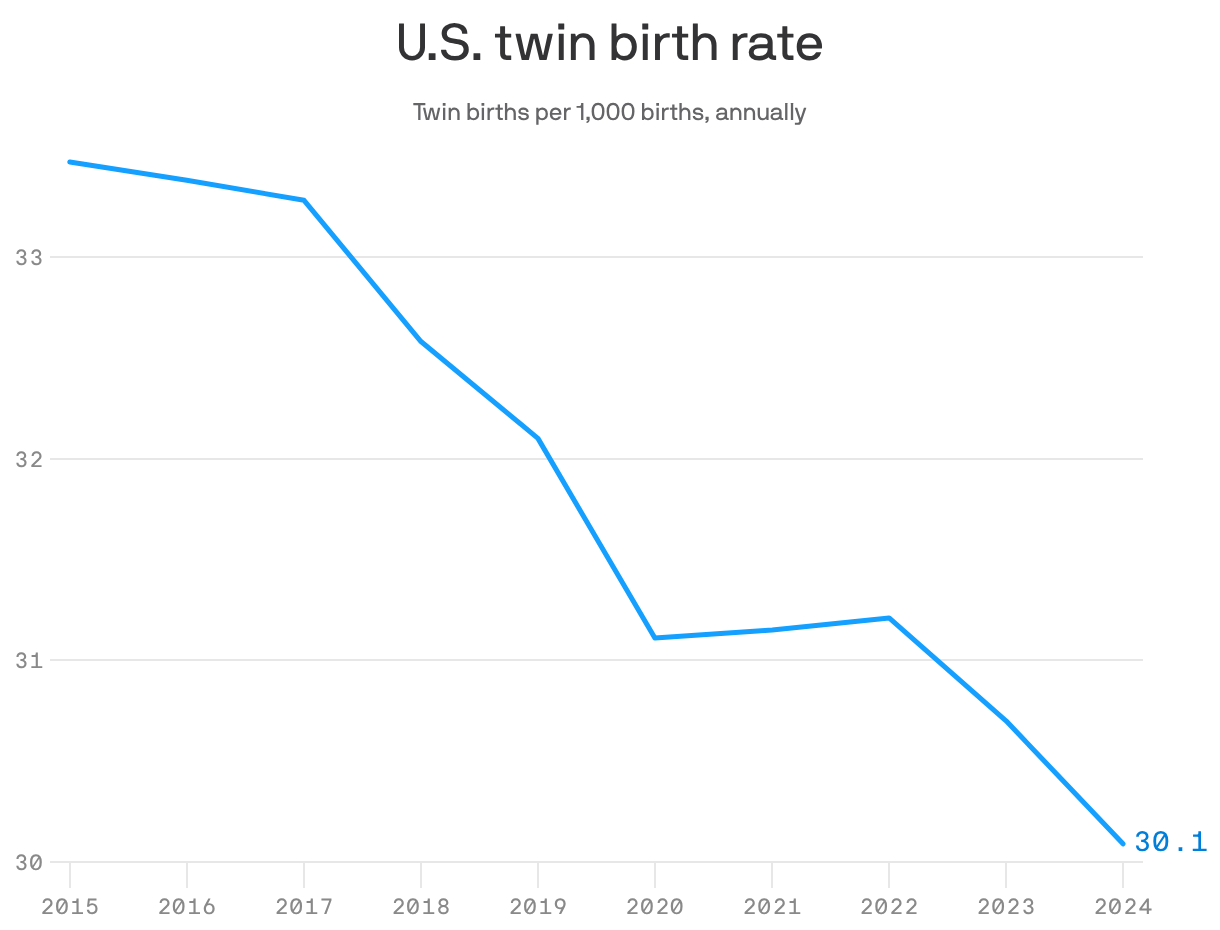
Over the past decade, the rate of twin births has declined in the U.S., Axios' Carly Mallenbaum (a twin!) writes.
- Early use of IVF contributed to a twin baby boom. But as fertility treatments advanced, doctors increasingly recommended transferring a single embryo to reduce pregnancy risks.
Fraternal twins can result when two embryos are transferred during IVF or when a woman releases two eggs in the same cycle, which becomes more common with age.
7. 🥤 Sip trend: Mood drinks

As Americans rethink alcohol, beverage startups are racing to fill the gap with drinks that promise social connection without the hangover, Axios sip expert Nicole Cobler writes.
- On the Brightside is among the latest entrants, launching canned drinks made with Zembrin, a patented extract of the succulent kanna that founder Adam Terry tells Axios is designed to promote a calming, "pro-social" effect without intoxication.
- The Massachusetts-based company joins brands like Recess, Hiyo and Trip — all of which market mood-support beverages as alternatives to alcohol or THC.
Zoom in: Younger consumers "are not necessarily abandoning alcohol — they are redefining what belongs in the adult beverage occasion," says Sally Lyons Wyatt, a global consumer packaged goods and food service industry adviser at Circana.
- She points to moderation, novelty and mood support as growing priorities.
8. 🦫 1 last bite: It's rabid beaver summer

We had hot girl summer. Then brat summer. And now we may have rabid beaver summer, Axios D.C.'s Mimi Montgomery warns.
Driving the news: Two people have been attacked by rabid beavers in just under two weeks at Cunningham Falls State Park, a sprawling site that sees more than 575,000 visitors a year in Frederick County, Md.
- And, yes, people are making beaver attack memes.
The last recorded beaver attack in Maryland before this year was in 2021.
- "There's no larger trend going on here," Joshua Tabora, a Maryland Department of Natural Resources biologist, tells Axios. "This is unfortunate, but a chance event."
Share this story … Get Axios Local, newsletters in 41 cities and counting.
📬 Thanks for making us part of your weekend! Please invite your friends to join AM.
Sign up for Axios AM