Axios AM

October 19, 2023

1 big thing: Record share of households own stocks


The share of U.S. households that own stock either in mutual funds, retirement accounts or as individual shares hit a new high in 2022.
- Why it matters: The large share of households with a stake in the stock market is a distinctive feature of American capitalism, setting it apart from other big advanced nations, Matt Phillips reports for Axios Markets
🧮 By the numbers: The Fed's just-published triennial Survey of Consumer Finances shows that in 2022, about 58% of American households owned stock, either directly or indirectly through mutual funds and other investment accounts.
- That's the highest on record — trouncing the previous high water mark of 53% seen during the dot-com boom and right before the Global Financial Crisis.
What's happening: The rise in those who own stock directly — that is, by buying individual shares rather than through mutual funds — was a big driver.
- Direct ownership of stocks increased "markedly" between 2019 and 2022, jumping from 15% to 21% — making it the largest change on record, the Fed said in its report.
💭 Matt's thought bubble: This reflects COVID-related changes in behavior among Americans, many of whom first turned to the stock market as a way of scratching a sports gambling itch during the early phase of the pandemic.
- Smartphone-based apps aimed at younger traders, notably Robinhood, helped build the habit.
Surging retail stock buying famously became a cultural phenomenon in January 2021, when coordinated retail investors helped drive the share price of GameStop into the stratosphere.
2. Biden claims trip wins
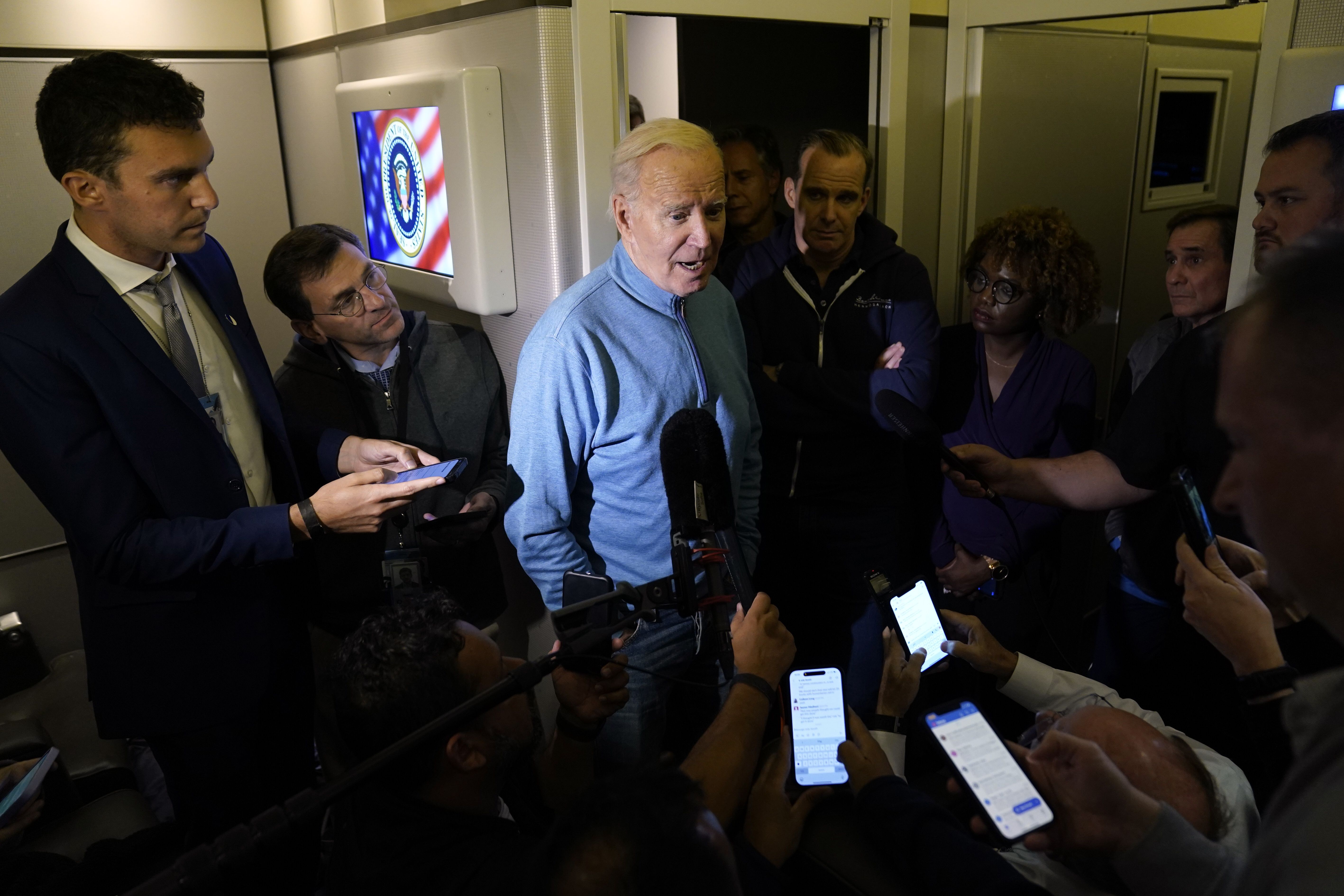
Aboard Air Force One as he returned from Israel, President Biden said he made progress when he spoke by phone with Egyptian President Abdel Fattah el-Sissi — who agreed to reopen his sealed border crossing with Gaza, and allow up to 20 trucks carrying humanitarian aid supplies to cross.
- "He stepped up. As did Bibi," Biden said after meeting with Israeli Prime Minister Benjamin Netanyahu, AP reports.
"I came to get something done. I got it done," Biden said. "Not many people thought I could get this done. ... And not many people wanted me to be associated with failure."
- Biden said officials discussed for "an hour or more ... whether to go": "Had we gone and this failed, then 'the United States failed. The Biden presidency failed,' et cetera, which would be a legitimate criticism."
At 8 p.m. ET, Biden will make the case for aid to Israel and Ukraine in an Oval Office address to the nation.
3. 🗳️ NEW: Swing-state voters reject Bidenomics
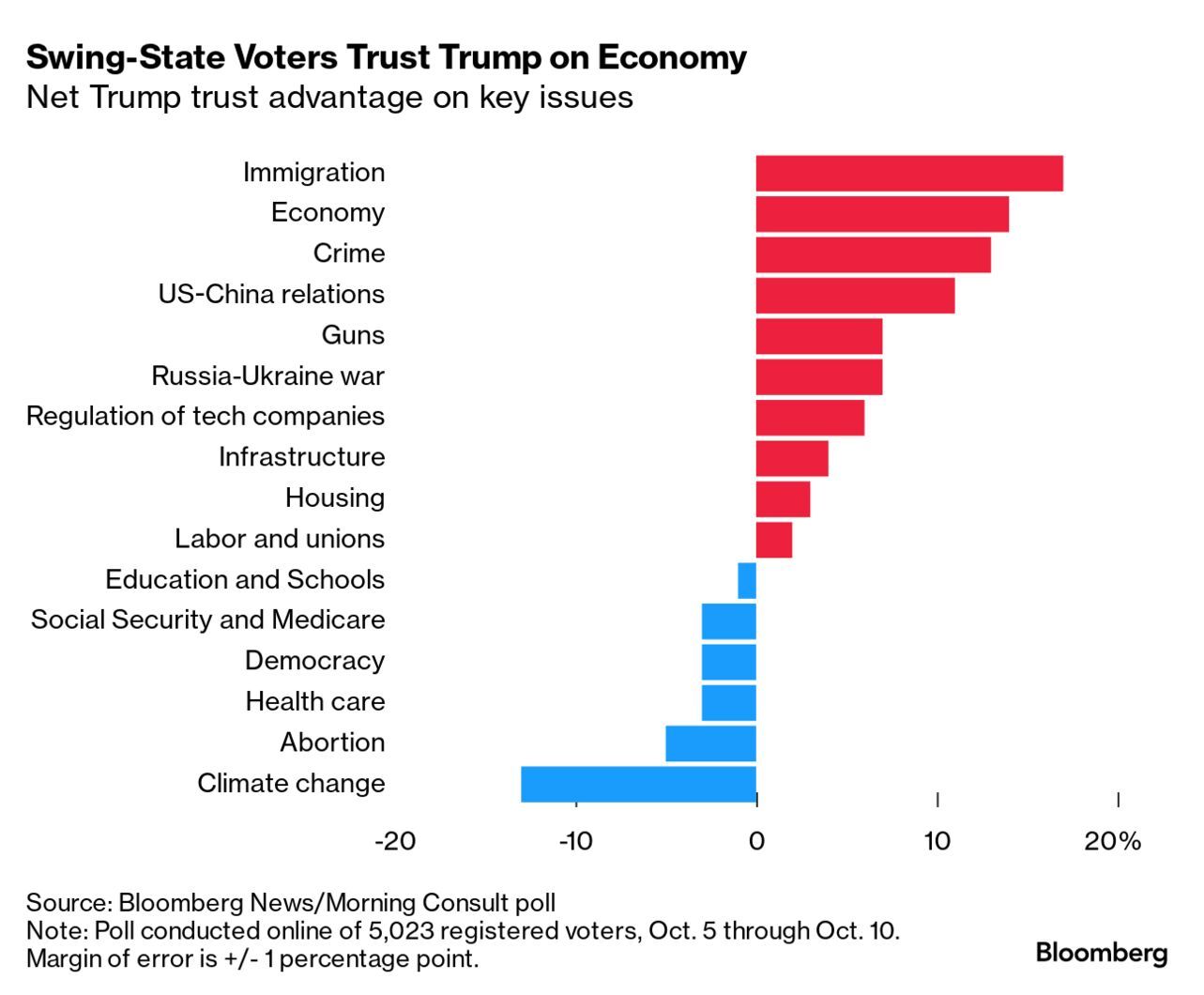
Voters in the top seven swing states are rejecting the Bidenomics message that's central to President Biden's reelection campaign, according to a poll out this morning from Bloomberg News and Morning Consult.
- Why it matters: What's important in a presidential election isn't national polling, but how the candidates are doing in the swing states that decide the winner. But there aren't many polls that wrap in multiple swing states.
🧮 By the numbers: Voters who said the economy was their most important issue disapproved of Biden's economic policies, 65% to 14%.
- The poll covers Arizona, Georgia, Michigan, Nevada, North Carolina, Pennsylvania and Wisconsin.
Former President Trump leads Biden 47% to 43% among 5,023 registered voters in the seven-state poll, with a margin of error of 1 percentage point.
- 51% of swing-state voters said the national economy was better off during the Trump administration.
Only 26% of voters in the poll said Bidenomics has been good for the economy. 49% said the policies have been bad.
4. 💨 Workers savor quicker commutes
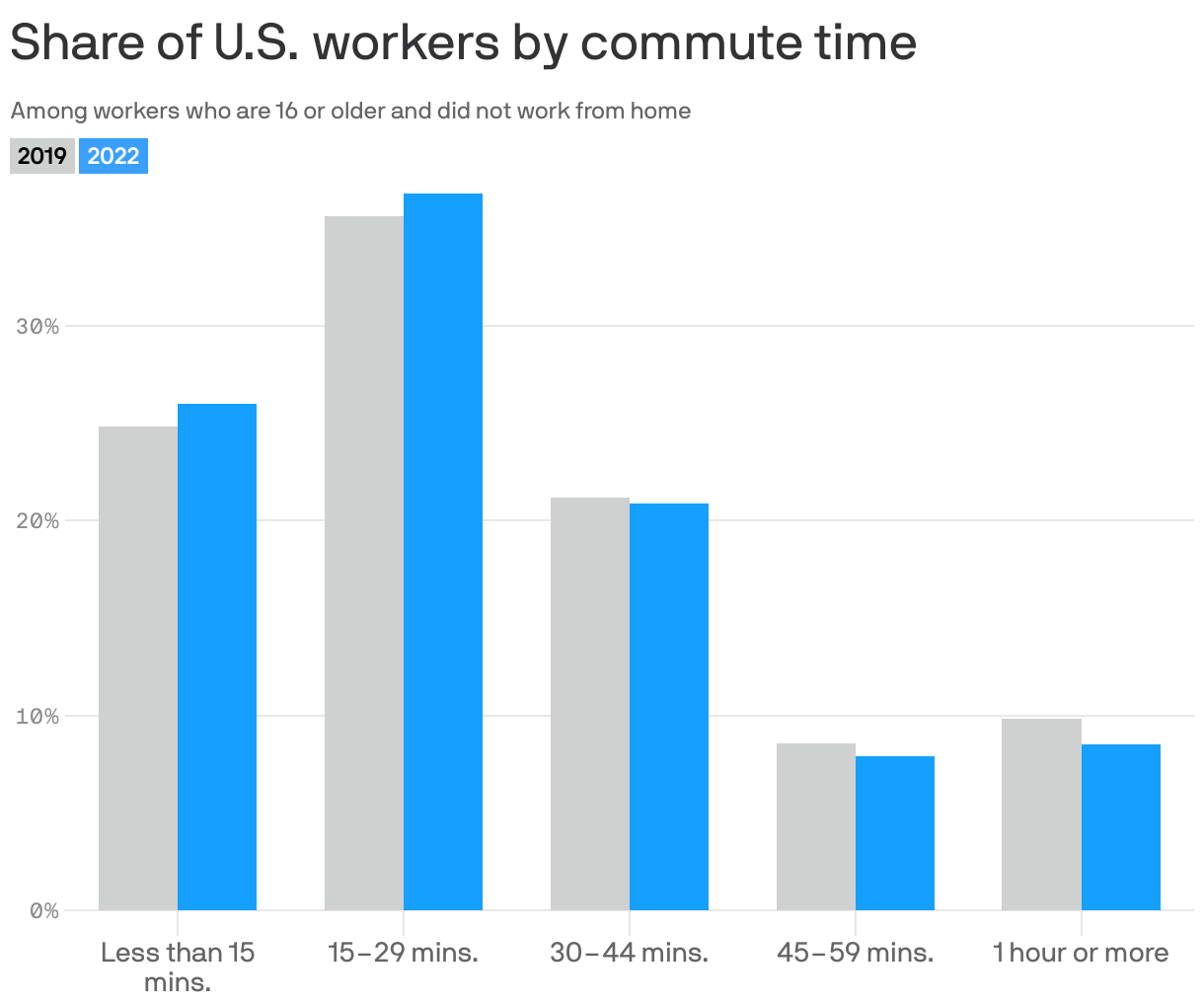
In this work-from-home era, workers are enjoying shorter commutes, Axios' Alex Fitzpatrick and Alice Feng found in analyzing census data.
- Why it matters: Quicker commutes are tied to better mental health and greater job satisfaction.
Between the lines: These findings don't include employees who work from home, and thus have a commute time of zero — or maybe a minute or two, if you stop to pour a cup of coffee on your way to your home office.
🖼️ The big picture: The "Great Reshuffling" led many Americans to move or find new jobs that let them prioritize family time.
💬 Alex's thought bubble: As a fully remote worker, there are times when I miss my NYC commute. It was often a good buffer between work and home, giving me time to throw on some music or a podcast and decompress.
- But I sure don't miss dealing with day-ruining subway delays or line changes.
5. 🦾 Investors ❤️ AI

Illustration: Maura Losch/Axios
6. Scoop: Border cities see homicide drop

Several communities along the U.S.-Mexico border saw homicide rates fall last year to levels that are well below the national average, Axios' Russell Contreras found in analyzing FBI crime data out this week.
- Why it matters: Many Republicans have focused on illegal immigration as the presidential election approaches, often portraying border communities as chaotic and lawless.
What we found: Eight U.S. border communities had lower homicide rates than the national average, per the FBI data, which was released Monday.
- On average, the eight cities — Brownsville, McAllen, Laredo, Eagle Pass and El Paso in Texas; Sunland Park, New Mexico; Yuma, Arizona; and San Diego — had a homicide rate of 4.2 per 100,000 residents, compared to 6.3 nationwide.
Reality check: The same cities also saw jumps in overall violent crime in 2022, after seeing years of declines.
- The eight communities had a violent crime rate of 382 per 100,000 residents in 2022 — a 10% increase from the year before.
- The border communities had violent crime rates slightly above the national average for the first time in years.
🔎 Between the lines: Experts point to research showing low crime in immigrant communities.
- They also point to the heavy presence of law enforcement in the region, from Border Patrol to federal drug enforcement agents.
Subscribe to Axios Latino for news about Latinos and Latin America, delivered to your inbox on Tuesdays and Thursdays ... Share this story.
7. 🏀 Vegas repeats as WNBA champs

WNBA Finals MVP A'ja Wilson said she relished silencing critics after her Las Vegas Aces won the championship for a second straight year, beating the New York Liberty 70-69 in Game 4 at the Barclays Center in Brooklyn.
- Wilson produced 24 points and 16 rebounds to help the Aces overcome a 12-point deficit against New York in a crowd-pleasing clash of "superteams," Reuters reports.
"To be up here — this one was special because so many people counted us out," Wilson told reporters.
- "A lot of people counted us out ... a lot of people in here said Liberty in five," she said. "We read it, we see it and it fueled us. So thank you! That says a lot about us. We came ready to play."
8. 📷 Parting shot: Capital makeover

The imposing former home of the Newseum — within sight of the U.S. Capitol at 555 Pennsylvania Avenue — reopens today with a dedication ceremony for the Johns Hopkins University Bloomberg Center.
- The school acquired the 435,000-square-foot building in 2019, when the Newseum went virtual. The building will house Johns Hopkins' newest academic division, a School of Government and Policy.
Mike Bloomberg and D.C. Mayor Muriel Bowser will speak. There'll be an AI showcase and a global interactive health data experience.
Axios AM

Catch up with the most important news of the day