Axios AM

August 10, 2026

😎 Good Monday morning! Smart Brevity™ count: 1,989 words ... 7½ mins. Thanks to Shane Savitsky for orchestrating. Edited by Andrew Pantazi and Carolyn DiPaolo.
⚡ Scoop: Sen. Bernie Sanders (I-Vt.) is urging AI CEOs to pause AI development, warning that lawmakers will step in if no action is taken, Axios' Maria Curi reports.
- Sanders writes in a letter to OpenAI's Sam Altman, Anthropic's Dario Amodei and Meta's Mark Zuckerberg: "Pause AI development. It is not too late to avoid disaster. Stop building machines that humans cannot control ... Let me be very clear: If you do not take appropriate action now, my colleagues and I in the U.S. Senate will." Keep reading.
1 big thing: Warsh rewires the Fed
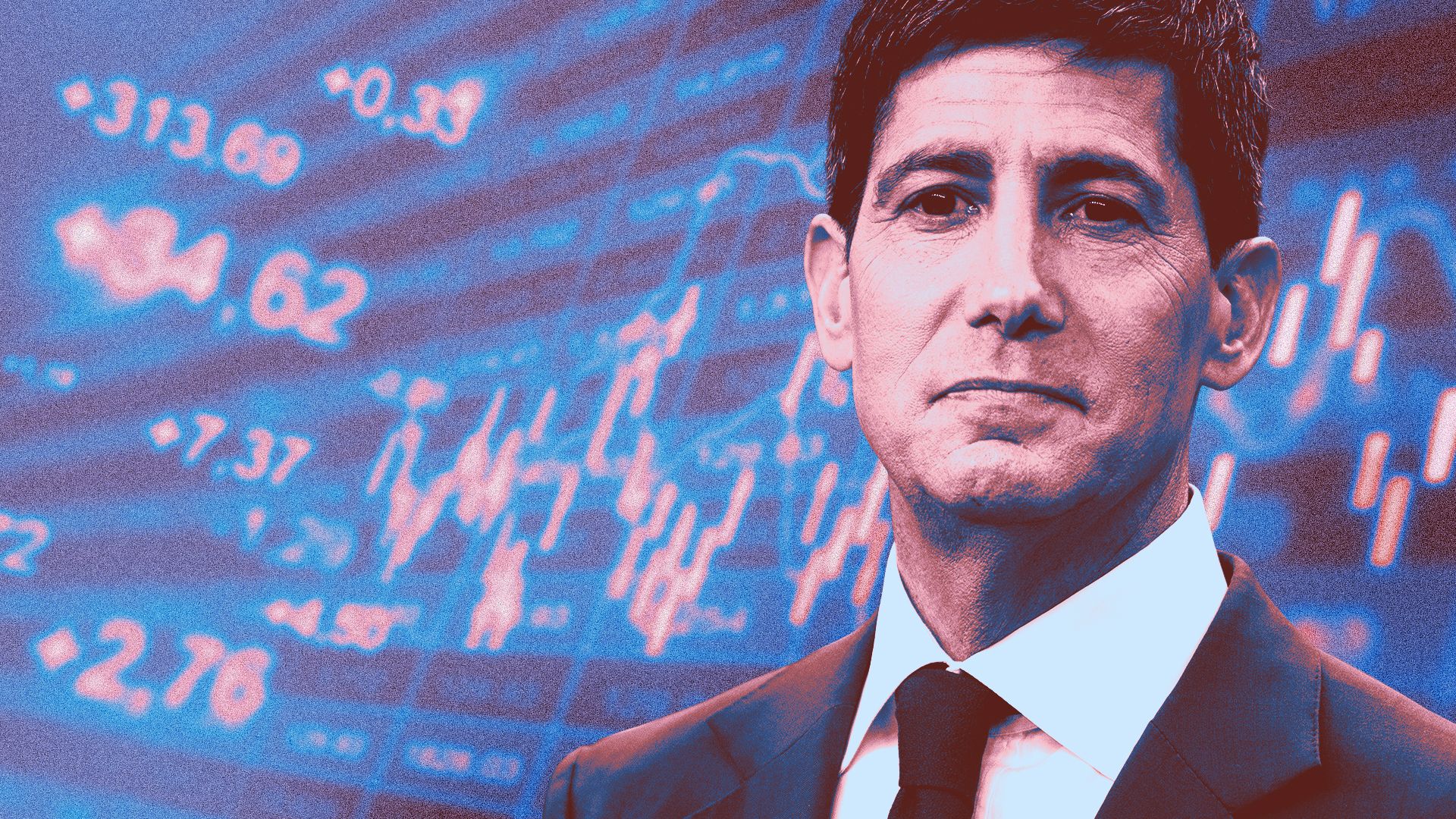
Federal Reserve Chair Kevin Warsh is attempting a high-wire act: rethinking the central bank's approach to guiding the economy, while also using its standard toolkit to bring down stubbornly persistent inflation, Axios chief economic correspondent Neil Irwin reports.
- A market blowup late last month showed the perils of doing both at the same time.
The big picture: Warsh is ultimately trying to rewire the central bank to take greater advantage of AI to understand the economy in real time, aiming for better decision-making in the next few years.
- Some saw his July 29 news conference as evidence of a lack of commitment to quashing inflation — but to allies, it was a short-lived bump in the road toward a more credible Fed.
🔭 Zoom out: Warsh's supporters frame a couple of volatile trading days as a small price to pay for a world where markets are less dependent on central bank handholding.
- He seeks a paradigm shift in how the Fed uses AI — but those tools will take time to develop and prove workable, and meanwhile inflation has been elevated for more than five years.
- In the near term, the Warsh Fed is prepared to use its standard tool of raising short-term interest rates to combat inflation, based on tried-and-true analysis of government economic statistics.
The intrigue: Warsh is a full-throated believer that AI is a transformative technology that stands to remake the economy.
- He has told associates that before taking office, he built AI bots that ingested the collected works of economists Milton Friedman and James Tobin. He then turned to them for their insights on contemporary economic questions.
- He also sees its use as an urgent need for the Fed itself to more fully embrace AI, both to understand what's happening in the economy at any given moment and to reason toward better policy decisions.
- His aspiration is that eventually, real-time information from retailers, banks and other companies can give a more reliable guide to what's happening to inflation and growth than government surveys.
Reality check: Warsh leads a 112-year-old central bank with a $6.7 trillion balance sheet, which sits at the core of global finance.
- There's a reason it is historically cautious and slow to change, even with an approach that co-workers describe as pragmatic and collegial.
The bottom line: Expect the Warsh Fed to keep pushing boundaries of how technology can shape economic data and policymaking — but with more reassurance that for now, the basic Fed toolkit remains intact.
2. A different Fed view
Axios CEO Jim VandeHei highlights what he sees as the most overlooked part of the Fed's Warsh era so far:
When Mike and I are curious about the "real economy," we talk to sources at big-box stores for a read on real-time sales trends or friends at super regional banks to gauge the mood and money movement.
- To us, that's the real world and real data, imperfect but less imperfect than dated Bureau of Labor Statistics surveys built for a different time and economy.
That's why we think the most interesting thing to watch long-term at the Fed is the seemingly boring data task force Warsh appointed last month to improve the "quality and timeliness of real economic signals that inform the Federal Reserve's policy judgments."
- The members: Harvard economics professor Raj Chetty, former Walmart CEO Doug McMillon and University of Chicago economics professor emeritus Kevin Murphy.
The big picture: AI should surely help aggregate and better analyze more real-time data feeds to help policymakers make better decisions. If not, AI will be a total flop.
- Imagine a parallel Fed that uses more fine-tuned, real-time data feeds, analyzed without economic worldview bias or personal interest of Fed governors.
The bottom line: We've known Warsh for years, and his interest in AI and rethinking data is real and intense. We'd be surprised if the ultimate manifestation of his "new chapter" isn't deeply infused with the work of McMillon & Co.
📈 If you're a CEO or on a CEO's team: Ask to join Jim's new weekly Axios C-Suite newsletter.
3. What Zuck's manifesto really means

Meta CEO Mark Zuckerberg, the latest tech mogul to unfurl a long AI manifesto, reveals — and defends — Meta's we're-behind-and-need-to-catch-up strategy.
- Every principle in his 6,500 words happens to be Meta's business plan: Distribute widely (the company has over 3 billion monthly active users), unleash open source AI (it's behind at the frontier), distillation is fine and legal (it does it) and don't delay releases (it's catching up).
Zuckerberg argues that the most common concerns are overblown and fail to account for all the positives it can achieve. In his vision of AI, the biggest risk instead is that one government or entity has too much power over the technology, Axios' Ina Fried writes.
- "One of the ways to achieve both individual empowerment and checks and balances is to make sure you put the technology in everybody's hands," Zuckerberg told me in an interview ahead of the manifesto's release.
- "It's definitely a different view than what you're hearing from a lot of other people in the tech industry right now."
- He wrote that he wants to ensure the U.S. and other democracies lead, and ultimately make sure "humanity maintains control over superintelligence so it serves rather than endangers us."
🛰️ The big picture: Even as the world confronts AI that is breaking out of sandboxes, comparing notes on message boards and creating new viruses, Zuckerberg portrays it instead as an analog to other disruptive technical innovations.
- "Humanity has witnessed many transformative advances," he writes in the manifesto, which he previewed in a Wall Street Journal op-ed last month. "Each time there is fear that people will be left behind. But each time humanity has come out with more people sharing greater prosperity, health, and freedom."
⚠️ Threat level: Zuckerberg contrasts this vision with one in which only some people, some businesses or some countries have access to the most powerful AI, suggesting that would represent a far more dangerous outcome.
- "I'm personally more worried about centralization than I am about any of the specific risks others are talking about," he told me.
👀 Playing politics: Without naming his rival, Zuckerberg joined the anti-Anthropic pile-on. "I do not understand why anyone who believes that AI will eliminate most jobs and much of humanity's relevance would rush to build that future," he writes.
- Zuckerberg's plan for Meta is that "everyone will have free or affordable access to these tools," with the paid versions using a "dynamic auction mechanism" to get the compute they need at the lowest possible price. "This will ensure the benefits of superintelligence are distributed widely."
🔎 Between the lines: Zuckerberg also said Meta will resume releasing some open-source AI models, now that Meta Superintelligence Labs is up and running, as Axios reported in April.
- Meta says it's opening the weights of a new model, Muse Glimmer, billed as "one of the highest-performing models of its size," and will open the weights for a version of the foundational model Muse Spark 1.2 in coming weeks.
- Preempting federal mandates, Zuckerberg added that Meta's independent board will have the power to approve model-release safety criteria and review whether releases meet those standards.
💰 Local spending: Hoping to tamp down data-center backlash, Zuckerberg also announced Meta is launching the Future is for Everyone Fund "to support each community we work in directly." The fund, seeded with $1 billion for U.S. communities where Meta owns and operates data centers, will benefit teachers, first responders, and energy and water infrastructure.
The bottom line: The manifesto represents Zuckerberg's clearest effort yet to weigh in on AI's future, both as a matter of policy and technology.
4. 📞 Trump on Iran: "We are low-keying it"

President Trump signaled yesterday that he's prepared to allow economic pressure on Iran to mount — as opposed to ordering a new military offensive — even as the country continues to defy the U.S.
- This is a massive strategic shift, after threatening Iran repeatedly and then watching them ignore, mock and even bully U.S. negotiators. Iran is now the one making bombastic and unrealistic demands.
Only a week ago, Trump was on the verge of ordering a return to major combat operations. But he didn't make any new military threats during a phone call with Axios' Barak Ravid.
- Trump also didn't express any anger or frustration about Iran holding up an announcement on a deal with Oman to reopen the Strait of Hormuz.
- "We are low-keying it," Trump told Barak. "We are only semi-negotiating with them. We are just watching Iran with its huge inflation and the fact they have no money."
Trump stressed that Iran "is in very bad shape" economically and has no money to pay its troops. The U.S. naval blockade has exacerbated the Iranian regime's economic crisis, Trump added.
- "It will work out," Trump said. "It always works out. It's like a chess game."
5. 🤷♂️ COVID's enduring mystery

More than six years after COVID swept the world, there's still no definitive answer about its true origins — and likely never will be, Axios' Caitlin Owens writes.
- Why it matters: For all of the political vitriol and intelligence disputes over the topic, missing evidence means the debate over whether it jumped from animals to humans or came from a lab may never be satisfyingly settled.
The big picture: There have been numerous assessments over the past six years of whether COVID jumped naturally from animals — potentially in a Chinese wet market — or was the product of a leak from a Chinese lab.
- But the conclusions use language like "suggests" or "likely" or "probable," building cases through the biology of the virus, declassified intelligence reports and other circumstantial evidence.
6. 🖊 New White House counsel

Longtime Trump aide Will Scharf, now the White House staff secretary, will take over as the next White House counsel on Sept. 1, the White House announced last night.
- Scharf replaces Dave Warrington, who'll leave the administration for the private sector.
Scharf represented Trump in his Supreme Court presidential-immunity case.
- Scharf chairs the National Capital Planning Commission, which has tried to clear the way for Trump's White House ballroom construction. An appellate court halted the project Friday.
7. Mullin's MAGA backlash

Just 4½ months after replacing Kristi Noem as Homeland Security secretary, Markwayne Mullin is feeling the heat from President Trump's MAGA enforcers, Axios' Brittany Gibson reports.
- Steve Bannon, a top MAGA podcaster, is among those who've joined the chorus of MAGA figures objecting to Lance Schroyer's nomination to lead ICE. "You can't pick a cop from Oklahoma and think he's going to walk in and be able to do that, right? You're asking too much of somebody," Bannon told Axios.
8. 🤖 1 for the road: GTA meets GPTs
The reality of building your own video game is here. And just like so many other AI-driven changes, it threatens to permanently disrupt a $300 billion industry, Axios' Herb Scribner reports.
- Gamers on X are posting videos of playable game demos built using LLMs, many of them resembling popular shooters like "Call of Duty" and "Counter-Strike."
- "If something is kind of possible today, in a year, it's going to be nailed," Matt Shumer, an AI investor and video game builder, told Axios.
📬 Thanks for starting your week with AM! Please invite your friends to join.
Sign up for Axios AM