Axios AI+

October 09, 2025

This week you can watch regular season NFL, NHL, college football and NWSL games, as well as WNBA and MLB playoffs — and preseason NBA games. I love this time of year; my sports widow AJ, not so much. Today's AI+ is 1,246 words, a 4.5-minute read.
1 big thing: OpenAI's Sora deepfakes the dead



Family members of the late actor Robin Williams and comedian George Carlin urged OpenAI to restrict deepfakes of their loved ones on video-generation platform Sora.
Why it matters: While living public figures can opt out of Sora's videos, the likenesses of the dead are fair game, a loophole their families say desecrates their legacies.
What they're saying: "Please, just stop sending me AI videos of Dad," Robin's daughter Zelda Williams posted on her Instagram stories Tuesday.
- "It's dumb, it's a waste of time and energy, and believe me, it's NOT what he'd want."
- "You're not making art, you're making disgusting, over-processed hotdogs out of the lives of human beings, out of the history of art and music, and then shoving them down someone else's throat hoping they'll give you a little thumbs up and like it. Gross."
The other side: An OpenAI spokesperson told Axios in an email there are "strong free speech interests" in allowing users to depict historical figures.
- "For public figures who are recently deceased, authorized representatives or owners of their estate can request that their likeness not be used in Sora cameos," they said.
- OpenAI did not clarify what counts as "recently deceased."
The big picture: Sora's release reignited Hollywood's critiques of AI in entertainment creation, which Zelda Williams previously criticized during the SAG-AFTRA strike in 2023.
Zoom in: Carlin's daughter, Kelly Carlin-McCall, said she gets daily emails about AI videos using her father's likeness.
- "We are doing our best to combat it, but it's overwhelming, and depressing," she wrote in a post on Bluesky.
- Other Sora-watermarked videos of the famous and deceased — such as Michael Jackson doing standup comedy, Stephen Hawking doing tricks in his wheelchair or the Rev. Martin Luther King Jr. stumbling through a speech — are also circulating on social media.
Between the lines: The ownership of our AI likenesses — and those of our dead loved ones — is shaping up to be another big legal battleground for Big Tech.
- These companies are taking the same "ask forgiveness, not permission" route they followed when training their text, video and image models on copyrighted work.
- Altman warned reporters at OpenAI's DevDay on Monday that soon other AI companies would make products similar to Sora with "none of our safeguards, and that's fine, that's the way the world works."
- "We can use this window to get society to really understand, 'Hey, the playing field changed, we can generate almost indistinguishable video in some cases now, and you've got to be ready for that,'" Altman said.
Green-lighting all dead celebrities for use in Sora also gives OpenAI a chance to show families they might someday be able to monetize the likeness of their dead loved ones (with OpenAI presumably taking a cut).
What we're watching: CEO Sam Altman acknowledged in a blog post last weekend that Sora's rapid rollout will continue to see rapid transformations.
- "Please expect a very high rate of change from us; it reminds me of the early days of ChatGPT," he wrote.
- "We will make some good decisions and some missteps, but we will take feedback and try to fix the missteps very quickly."
2. Exclusive: Salesforce lets AI agents speak
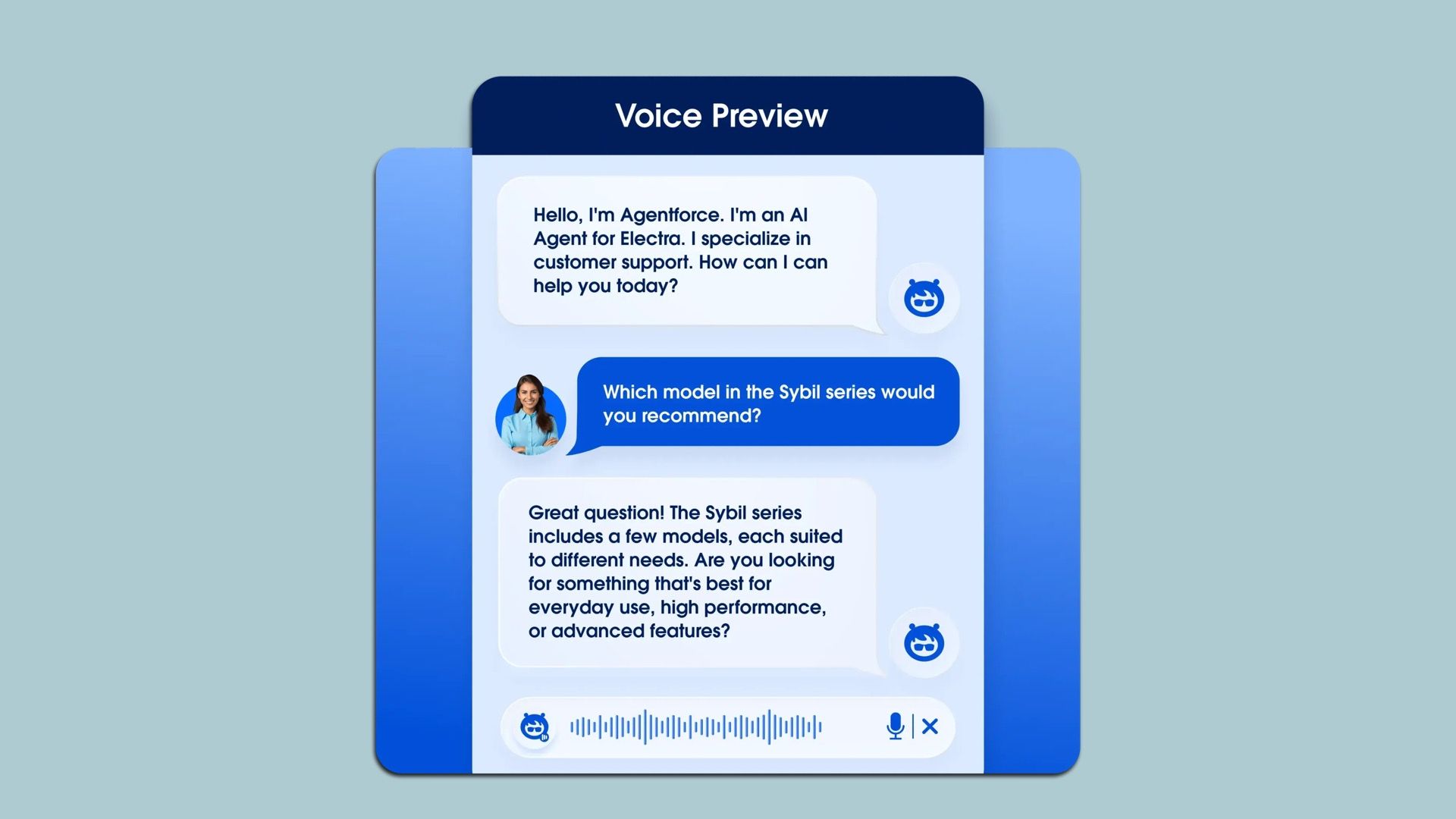
Salesforce will announce next week two new capabilities to make its AI agents more versatile and useful for businesses, Axios has learned.
Why it matters: Salesforce faces growing competition from tech giants with their own large language models and startups focused on AI customer service.
Zoom in: Salesforce agents will now have the power of speech and new hybrid reasoning skills.
- The upgrades aim to make them sound more human while following clear rules for key decisions, like giving refunds.
Driving the news: The features will be part of a flurry of announcements at Dreamforce next week.
- Agentforce Voice works across phone systems, websites and apps, and will be widely available on Oct. 21.
- Hybrid reasoning will debut as part of a feature called Agent Script, now in pilot, with a customer beta coming in November.
What they're saying: Both features reflect that there's no one-size-fits-all approach to AI agents, Salesforce Executive VP Adam Evans told Axios yesterday.
- "You can have the creativity and fluidity when you want it, or you can have the rigidity, consistency and scale when you don't," he said. "It's your choice on a job-by-job basis."
Salesforce said it's spent about a year developing the new voice features, focusing on understanding speech and detecting nuance and emotion to respond appropriately.
- The voice system can also pull data from various systems and hand off to a human worker when needed.
- "There's not very many companies that can do that," Evans said.
Enterprise agents for customer service is a saturated space with fierce competition from tech companies like ServiceNow and startups like Sierra, which was co-founded by Bret Taylor, a former top Salesforce executive.
- While Sierra prices its services based on interactions that its AI agents can address without human intervention, Salesforce has largely stuck with a model that charges based on the length of conversations or number of tasks its agents perform.
- Sierra requires customers to identify its voice agents as AI bots. Salesforce doesn't, saying disclosures may not be needed for some uses, like internal company agents.
3. Google unifies its AI for business efforts

Google announced today that it's combining its business AI tools into Gemini Enterprise, a subscription for building and using AI agents.
Why it matters: Google sees the breadth of its options — from core models to premade agents to industry-specific templates — as a key way it can stand out from its rivals.
Between the lines: Gemini Enterprise offers access to the latest Gemini models and no- and low-code tools to build custom agents.
- The subscription also includes pre-built agents for specific roles and tasks such as research, writing code, data science, and customer engagement, along with an "agent finder" to sort through thousands of other agents available from Google partners.
- Gemini Enterprise is designed to work not only inside its own Workspace productivity suite, but also within tools built by rivals, including Microsoft 365 and apps from Salesforce and SAP.
By the numbers: Gemini Enterprise costs $30 per person per month.
- Google is also offering a cheaper $21 per month plan — Gemini Business — aimed at smaller businesses as well as departments within larger firms.
- That version lacks some security and management capabilities and offers less cloud storage.
Zoom in: Among the new customers Google has landed with the approach is retail giant Gap, which is aiming to use AI to shorten the time it takes to spot trends and respond with new products.
- Gap CTO Sven Gerjets told Axios Google's approach was more comprehensive and better integrated than rivals'.
- "It allowed us to move faster and at a better price point, because we weren't having to go buy five or six tools to make it happen," he said.
4. Training data
- Nvidia and AMD have both announced deals with OpenAI in the last two weeks, heating up the chip designers' rivalry. (Axios)
- Goldman Sachs says we're not in an AI bubble — yet. (Axios)
5. + This
As a senior prank last year, a group of high school students convinced their entire town that a Trader Joe's was coming.
Thanks to Scott Rosenberg and Megan Morrone for editing this newsletter and Matt Piper for copy editing.
Sign up for Axios AI+
