Axios AI+
July 25, 2024

Ina here, still buzzing thanks to Uber's preview of the daylong Uber Bubbles tour to the Champagne region of France that the company is offering during the Olympics (see + This below).
Today's AI+ is 1,264 words, a 5-minute read.
1 big thing: Sam Altman's China plea


OpenAI CEO Sam Altman is calling for a "U.S.-led global coalition" to ensure democracies continue to dominate AI, and says both Washington and state governments must act with more urgency.
- "The future continues to come at us fast," Altman told Axios in a phone interview Wednesday. "I'm grateful that some stuff is happening [at the White House and on Capitol Hill]. But I don't think we're seeing the level of seriousness that this warrants."
Why it matters: In the face of China's determination to become a dominant AI player, Altman wants to goad U.S. governments at all levels into a more strategic AI approach — with more urgency.
- "We need the democratic — small 'd' democratic — world to win here, and we have the opportunity to do it," he told Axios.
Altman was previewing an op-ed posted Thursday morning by The Washington Post, in which he argues that "authoritarian regimes and movements will keep a close hold on the technology's scientific, health, educational and other societal benefits to cement their own power."
- "If they manage to take the lead on AI," Altman writes, "they will force U.S. companies and those of other nations to share user data, leveraging the technology to develop new ways of spying on their own citizens or creating next-generation cyberweapons to use against other countries."
Altman writes that U.S. "public and technology sectors need to get four big things right to ensure the creation of a world shaped by a democratic vision for AI":
- Basic security: "American AI firms and industry need to craft ... cyberdefense and data center security innovations to prevent hackers from stealing key intellectual property such as model weights and AI training data."
- Infrastructure "is destiny when it comes to AI. The early installation of fiber-optic cables, coaxial lines and other pieces of broadband infrastructure is what allowed the United States to spend decades at the center of the digital revolution and to build its current lead in artificial intelligence. U.S. policymakers must work with the private sector to build significantly larger quantities of the physical infrastructure — from data centers to power plants."
- Commercial diplomacy, "including clarity around how the United States intends to implement export controls and foreign investment rules for the global buildout of AI systems. That will also mean setting out rules of the road for what sorts of chips, AI training data and other code. ... can be housed in the data centers that countries around the world are racing to build to localize AI information."
- Global governance: "I've spoken in the past about creating something akin to the International Atomic Energy Agency for AI, but that is just one potential model. ... Another potential model is the Internet Corporation for Assigned Names and Numbers [ICANN], which was established by the U.S. government in 1998, less than a decade after the creation of the World Wide Web, to standardize how we navigate the digital world."
Altman told Axios that state governments must do more to ensure "physical infrastructure — data centers and power and water and manufacturing."
- "I realize how difficult that is, and that it takes a long time. But all the more reason to get going," he said.
Ina's thought bubble: The challenge for the U.S. and other like-minded countries is to balance two priorities: the pressure to harness AI faster than authoritarian rivals, and the need to do so with enough care and smart rules in place to keep the systems safe for users.
- This means keeping the systems accurate, protecting users from disinformation and misinformation, and mitigating bias and discrimination.
Altman told us that regardless of who wins in November, "the next president is going to be required to make some very substantial decisions about the rollout of AI into the world."
- Asked how much it matters who wins the White House, Altman said Open AI will "proudly work with whoever is the next president of the United States. ... This is an issue for the United States of America much more than an issue for either political party."
2. Nike is using AI to make dream shoes
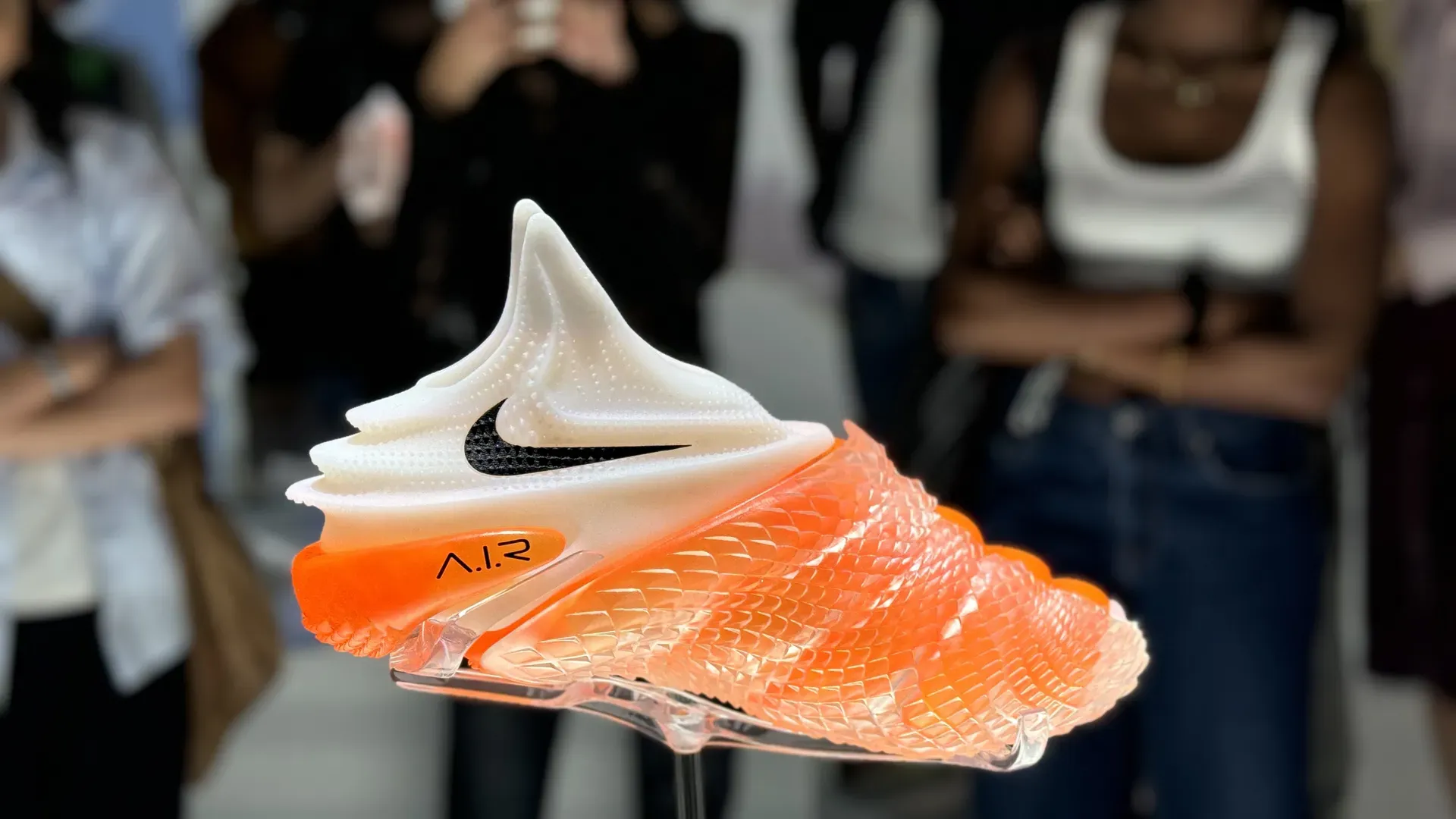
At a Paris building that helped inspire the first Air sneakers 37 years ago, Nike is using the Olympics here to show a future where generative AI is helping bring athletes the shoe of their dreams.
Why it matters: Much of the discussion around AI and design focuses on replacing human labor, while Nike's effort demonstrates that the technology can also be used to explore and expand creative possibilities.
Driving the news: Nike on Wednesday opened an exhibition titled "Art of Victory," allowing those here in Paris to see a range of shoe prototypes designed with and for individual star athletes, with AI playing a key supporting role.
- Among the shoes on display at the Centre Pompidou are models custom designed for basketball stars A'ja Wilson and Victor Wembanyama, sprinter Sha'Carri Richardson and soccer legends Sam Kerr and Kylian Mbappé.
- In all, Nike created prototypes with 13 of its athletes across four sports: track, soccer, basketball and tennis.
- Along with the final prototype for each athlete, Nike displayed smaller gray versions of other designs that were part of the exploration process for what it is calling A.I.R. (Athlete Imagined Revolution).
Zoom in: Nike used genAI to suggest new ideas, including using a variety of prompts to produce images with different textures, materials and color to kick off the design work.
- Nike, which also used 3D printing to churn out prototypes of the designs, isn't saying which generative AI tools it used in its process.
What they're saying: "It's a new way for us to work," Nike lead footwear designer Juliana Sagat told Axios during a media tour of the showcase on Tuesday.
- "We used to sketch a lot by hand ... but I think my world is changing," Sagat said.
- Interestingly, Nike executives have said they had to push the AI systems to be more creative after noticing they were initially generating designs that closely resembled one another.
- "We noticed that a lot of the AI images interpreting Air were bound by a similar fluid aesthetic," vice president Roger Chen said earlier this year, when Nike first announced the project. "We focused on the inspiration points that would push each concept in a specific, distinct direction."
Yes, but: Sagat says designing custom shoes for star athletes remains first and foremost a human proposition.
- "It's still a collaboration between athletes and the designer," she said.
3. Training data
- Microsoft will now prioritize generative AI responses to search queries in Bing. The search engine has been offering LLM-powered chat answers since February. (Windows Central)
- Go inside the factory that's building AI robots and drones to do the most dangerous jobs. (Axios Charlotte)
- Insurer Parametrix estimates that the recent CrowdStrike outages caused $5.4B in losses to Fortune 500 companies and $1.9B losses in the healthcare sector alone. (Axios)
- Sen. Ron Wyden (D-Ore.) says he'll vote "no" on the package containing the Kids Online Safety Act, meaning online civil liberties activists still believe the bill goes too far. (Axios Pro)
- Lawmakers asked Meta to keep its CrowdTangle research tool running for another six months instead of shutting it down as planned so researchers and journalists can use it to track election-related misinformation. (Axios)
4. 🍾 + This

While I enjoyed seeing the history of French champagne and tasting the present, perhaps my favorite part of the Uber Bubbles tour was seeing a custom bottle that Mumm has designed to be the first to take champagne into space.
- So far Mumm has only made two of the steel-over-glass bottles that are designed to be reused over multiple space missions.
Thanks to Megan Morrone for editing this newsletter and to Bryan McBournie for copy editing it.
Sign up for Axios AI+
